To increase organic traffic to website pages in 2026, fix your technical SEO first. Match every page to one search intent.
Structure content for AI answer engines. Publish on a steady schedule. Add expert quotes and original data.
Build backlinks through digital PR. These six moves, done together, drive the fastest and most stable growth this year.
Getting more visitors from Google feels harder today. AI Overviews sit on top of search results. Fewer people click through. Rankings alone don’t guarantee visitors anymore. But traffic growth is still possible.
Why Organic Traffic Feels Harder to Get in 2026
Search changed fast this year. AI answers questions directly on the results page. Users often skip clicking any link.
Here’s the current picture:
- Organic search still drives the largest share of all website traffic, at roughly 53% of trackable visits across industries
- 60% of Google searches now end with no click at all
- AI Overviews appear on about 13% of queries and cut click-through rates nearly in half when they show up
- The top organic result still gets 19 times more clicks than the top paid ad
So organic search isn’t dying. It’s splitting into layers. You now compete with AI answers, paid ads, and classic blue links at the same time.
One of my remote clients hired me a few months ago to handle their content site.
Right after Google rolled out AI Overviews for their main keyword cluster, their click-through rate dropped 18%.
Their total traffic still grew that same quarter. I added more pages. I targeted more specific questions.
We picked up clicks in spots the site never ranked before. One channel slowed. Others opened up. That’s the pattern most site owners miss this year.
Where Website Traffic Actually Comes From Right Now
| Traffic Source | Share of Total Traffic | Trend in 2026 |
| Organic search | 53% | Still dominant, but click-through rates are shrinking |
| Direct traffic | 43.3% | Growing as brand searches rise |
| Social media | 5-7% | Flat, low conversion for most niches |
| AI referral traffic | Under 2% | Small but growing fast, mostly from ChatGPT |
| Paid search | 15% | Stable, cost keeps rising |
Organic search is still the biggest opportunity on this list. That’s why you need a plan to increase organic traffic to website pages this year. Last year’s plan won’t work anymore.
The Real Reason Your Traffic Dropped
Most site owners blame a Google update. The cause is usually simpler than that.
Ask yourself these questions first:
- Does each page answer one clear question?
- Does your homepage load fast on mobile?
- Do you publish new content on a steady schedule?
- Does your content match what the searcher wants?
- Do other trusted sites link back to you?
If you answered no to two or more, you found your problem. Fix these before touching anything else.
Step-by-Step Ways to Increase Organic Traffic to Website Pages
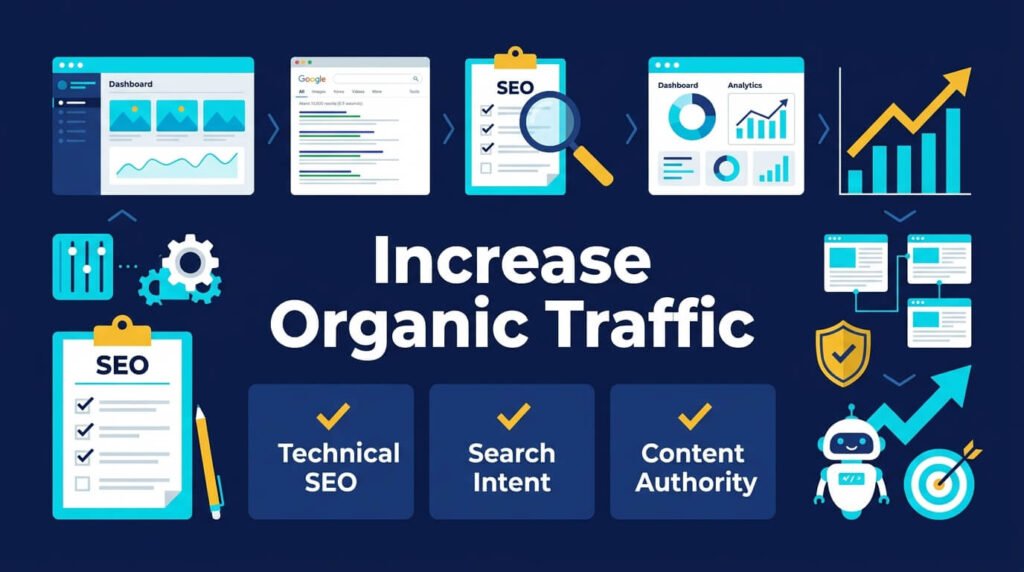
These steps build on each other. Fix the technical side first. Google can’t rank pages it struggles to crawl. Content and authority come next. Distribution and upkeep close things out.
Work through them one at a time. Small, steady fixes beat trying to do everything at once.
1. Fix Technical SEO First
Nothing else matters if Google can’t crawl your site properly. Check these basics:
- Page speed under 2.5 seconds on mobile
- No broken internal links
- Clean XML sitemap submitted in Search Console
- HTTPS active on every page
- No duplicate title tags
A slow site loses rankings quietly. You won’t see a warning. Traffic just fades.
2. Match Search Intent Exactly
Google groups pages by what the searcher wants, not just by keyword. Four intent types exist:
- Informational: the user wants an answer
- Navigational: the user wants a specific site
- Commercial: the user compares options
- Transactional: the user wants to buy now
Write content for one intent per page. Mixing intents confuses both readers and search engines. This single fix moves rankings faster than almost anything else on this list.
3. Write for Answer Engines, Not Just Google
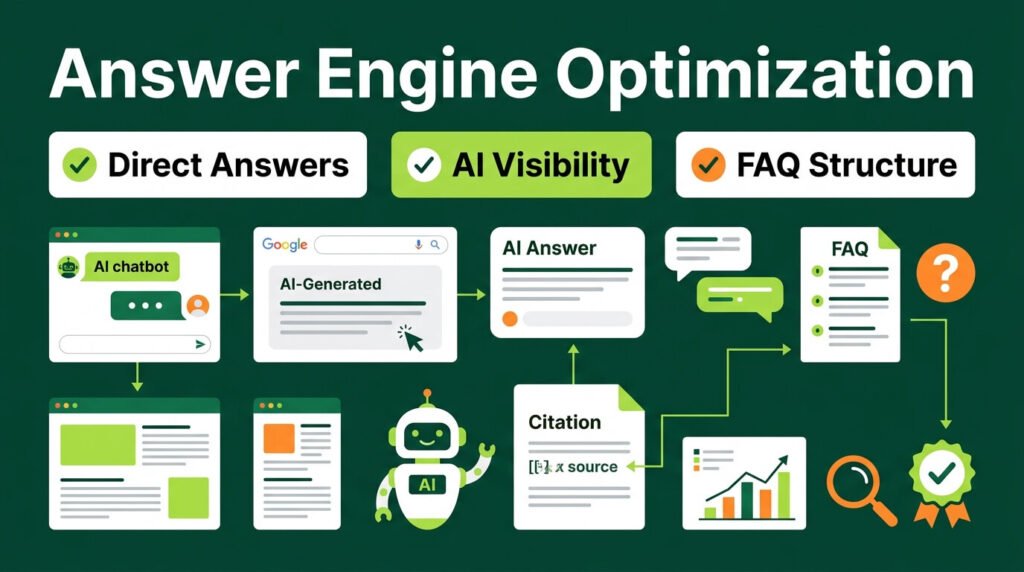
This is the biggest shift in 2026. AI tools like ChatGPT, Perplexity, and Google’s AI Mode now pull answers straight from web pages. This practice is called Answer Engine Optimization, or AEO.
Structure every page this way:
- Put the direct answer in the first two sentences
- Use a question as your subheading
- Follow with supporting detail and examples
- Add FAQ sections near the bottom
Melissa Popp, VP of Content Strategy at Ricketyroo, put it simply. As she told Sitebulb: “The future of organic visibility starts in the prompts, not the SERPs.”
That single line sums up 2026 search. Write for the question people type into AI tools, not just Google’s search box.
4. Add Schema Markup So AI Tools Can Read Your Page
This step gets skipped too often. Schema markup is code that tells search engines and AI tools what your content means. It’s the technical piece behind Answer Engine Optimization.
Three schema types matter most this year:
- FAQPage schema for your FAQ section
- HowTo schema for step-by-step guides like this one
- Article schema with author and publish date included
Add schema through your CMS plugin or a manual script. Test it in Google’s Rich Results Test tool before you publish.
Pages with clean schema get pulled into AI Overviews more often. This one technical fix supports every AEO step above it.
5. Build Topical Authority With Content Clusters
Random blog posts don’t rank well anymore. Google rewards sites that cover a topic fully.
Build a cluster like this:
- One main pillar page covering the broad topic
- Five to ten supporting posts, each covering one narrow angle
- Internal links connecting every post back to the pillar page
Use descriptive anchor text for every internal link. Don’t just link the word “here.” Link the exact phrase a reader would search for.
This helps Google understand your cluster and helps readers find related posts fast.
I built a cluster around home organization for a client last year. Traffic sat flat for two months. Once the tenth supporting post went live, organic sessions jumped 40% in six weeks. The pillar page alone barely moved. The full cluster is what worked.
6. Add Original Data and Expert Quotes
AI systems favor pages with real proof, not opinion. A Princeton study on generative search behavior found that adding expert quotes lifts content visibility by about 41%. Adding statistics lifts it by roughly 30%.
Practical ways to add proof:
- Quote a named expert with their title
- Cite a stat with the source linked
- Share your own results with real numbers
- Run a small survey among your own customers
Seth Besmertnik, CEO of Conductor, explained the shift this way. As he noted in Conductor’s report: “AI hasn’t replaced search, it’s replaced your website as the first touchpoint.”
Your site now needs to earn trust before the click happens, not just after.
7. Publish on a Steady Schedule
Consistency beats bursts of activity. Sites publishing nine or more posts monthly grow traffic at nearly double the rate of infrequent publishers.
A simple, sustainable schedule beats a rushed one. Pick a number you can hold for six months straight. Two solid posts a week beat ten posts one month and zero the next three months.
8. Build Backlinks Through Digital PR
Links still carry weight, but the tactics changed. Guest posts on low-quality blogs barely help anymore. Digital PR does.
Ways to earn backlinks in 2026:
- Pitch a data study to a niche journalist
- Get quoted as a source in industry roundups
- Publish original research other sites want to cite
- Answer reporter requests on platforms like Qwoted or Help a Reporter
Tina Reis, Senior SEO Strategist at brightonSEO, gave this advice for 2026 visibility: “Expand beyond your website, get featured in listicles, Reddit discussions, and reputable publications.”
Getting mentioned outside your own site now feeds both classic SEO and AI visibility at once.
9. Show Up on Reddit and Other Community Platforms
Google now shows Reddit threads and forum discussions high in search results. AI tools cite these threads often too. This is one of the fastest-growing pieces of search visibility in 2026.
Ways to build presence here:
- Answer questions in relevant subreddits without pitching your site first
- Join niche forums tied to your industry
- Build a small history of helpful comments before you ever link back
- Let your expertise show through answers, not through ads
Tina Reis’s point above applies directly here. Sites that show up in Reddit threads and forum answers earn trust signals that a blog post alone can’t match. This channel takes patience. It pays off in both AI citations and referral clicks.
10. Add Visual and Video Content
Text alone isn’t enough anymore. Google pulls images and video clips straight into AI Overviews and video carousels.
Simple steps to fix this:
- Write descriptive alt text for every image
- Add at least one short video per pillar page
- Upload videos to YouTube and embed them on your site
- Use clear, keyword-rich video titles and descriptions
A short video answering the same question as your page gives you two shots at ranking instead of one. It also keeps readers on your page longer, which sends a positive signal to Google.
11. Improve Core Web Vitals
Google still measures how a page feels to use. Three numbers matter most:
| Metric | Good Score | What It Measures |
| Largest Contentful Paint | Under 2.5s | How fast the main content loads |
| Interaction to Next Paint | Under 200ms | How fast the page responds to clicks |
| Cumulative Layout Shift | Under 0.1 | How much the page jumps while loading |
Check these free inside Google Search Console under the Core Web Vitals report.
12. Refresh Old Content Every Few Months
Old posts lose rankings quietly over time. Facts go stale. Competitors publish newer pages. Pick your top ten pages by traffic and update them every quarter.
Simple refresh checklist:
- Update any statistic older than twelve months
- Add a new section covering a recent development
- Fix any broken links
- Add one new internal link to a recent post
I refresh five old posts every quarter on my own site. Those refreshed posts bring back roughly 25% of the traffic they had lost within a month of the update. New content isn’t always the answer. Sometimes the fix sits in a post you wrote two years ago.
What to Do About the 60% Who Never Click
Most guides ignore this number. It’s too large to ignore. Six out of ten searches end without a single click.
This doesn’t mean that traffic is wasted. It means your goal shifts. When a reader sees your brand name inside an AI answer, that’s a brand impression, not a lost visitor.
Ways to win even without the click:
- Use your brand name naturally inside your content, not just in the footer
- Keep your answers accurate so AI tools quote you correctly
- Build recognition through repeated appearances across many queries, not just one
- Track brand search volume in Search Console, not just click volume
A reader who sees your name three times in AI answers is more likely to click through on the fourth. This is a slower path to increase organic traffic to website pages. It still works.
Expect Fewer Visitors, But Better Ones
Here’s something most guides skip. As AI tools filter out simple questions before a reader ever searches, the searches that remain come from people who need more depth.
This shifts what “success” looks like. Raw visitor counts may flatten or dip. Time on page, return visits, and conversion rates often rise instead.
Don’t panic if your total numbers look smaller than last year. Check your engaged traffic instead. A smaller, sharper audience often converts better than a large, distracted one.
GEO and AEO: The Layer Beyond Traditional SEO
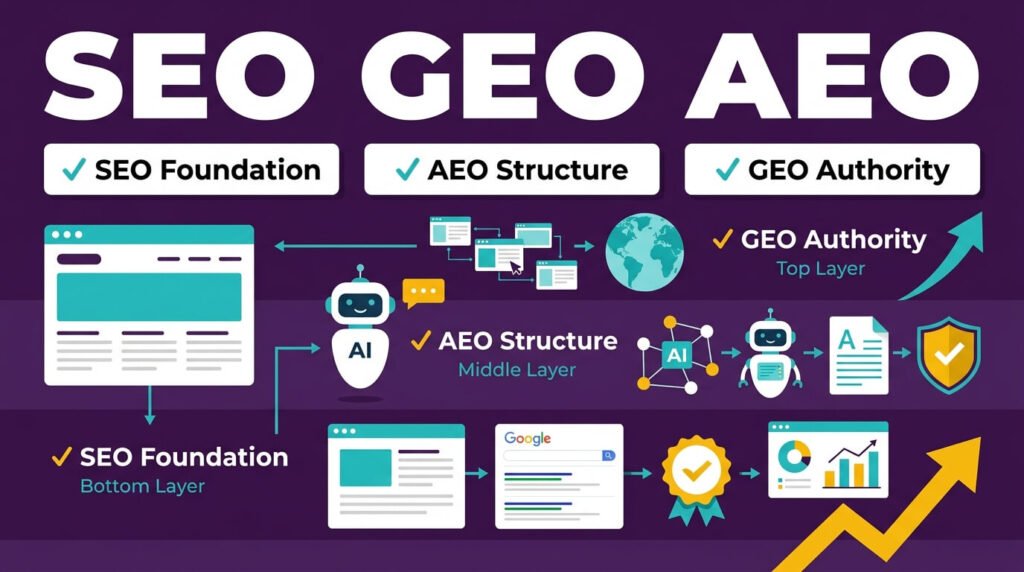
Three terms now sit side by side in every 2026 SEO conversation:
- SEO ranks your page in classic search results
- AEO structures your content to become the direct answer AI tools pick
- GEO shapes how AI models describe and cite your brand across many platforms
These three work together, not against each other. Strong technical SEO and clear writing form the base. AEO adds structure on top. GEO adds trust signals spread across the wider internet, not just your own site.
Gartner predicts traditional search volume will fall 25% by the end of 2026 as AI platforms absorb more queries. That number alone explains why GEO and AEO can’t wait until next year.
Quick 2026 Action Checklist
| Action | Priority | Time to Results |
| Fix page speed and Core Web Vitals | High | 2-4 weeks |
| Match content to search intent | High | 4-8 weeks |
| Structure pages for AI answers | High | 4-6 weeks |
| Add schema markup | High | 2-4 weeks |
| Build a content cluster | Medium | 6-10 weeks |
| Add original stats and quotes | Medium | Ongoing |
| Show up on Reddit and forums | Medium | 8-12 weeks |
| Add video and image content | Medium | 4-8 weeks |
| Pitch digital PR for backlinks | Medium | 8-12 weeks |
| Refresh old top pages quarterly | High | 2-4 weeks per refresh |
Final Thoughts
Search changed shape in 2026. It didn’t disappear. Zero-click results and AI Overviews shifted where clicks go. Organic search still sends more traffic than any other channel by far.
The sites that grow this year share three habits. They publish steady, focused content. They structure pages for both readers and AI systems. They keep earning mentions across the wider web.
Start with your slowest pages. Fix intent mismatches next. Add proof, quotes, and fresh data as you go. That’s the path to increase organic traffic to website pages in 2026, one page and one fix at a time.
FAQ
Is organic traffic better than paid traffic for long-term growth?
Yes. Paid traffic stops the moment you stop paying. Organic traffic keeps working after the initial effort, often for years.
Can AI-written content still rank well in 2026?
It can, but only with human editing, real data, and expert input added. Pages that read as fully automated tend to lose trust and rankings fast.
Do I need a large website to see real traffic growth?
No. A focused ten-page site built around one topic often outperforms a scattered hundred-page site with no clear focus.
How many keywords should one page target?
One primary keyword per page works best. You can naturally include two or three related terms, but don’t split a page across multiple main topics.
Does mobile-first design still matter for rankings?
Yes. Google ranks the mobile version of your site first, not the desktop version. A slow or broken mobile layout hurts rankings directly.
Is old domain age still an advantage in 2026?
It helps a little, but it’s not the deciding factor. Fresh, well-structured content on a newer domain can outrank an older, neglected site.
Do meta descriptions still affect click-through rate?
Yes. They don’t affect rankings directly, but a clear, specific meta description still pulls more clicks from the search results page.
Should local businesses follow the same organic traffic strategy?
Mostly, with one addition. Local businesses also need a complete Google Business Profile and consistent name, address, and phone details across the web.
What tools should I use to track organic traffic progress?
Google Search Console and Google Analytics cover the basics for free. Add a rank tracker if you want to monitor keyword position changes weekly.
Can one strong page carry an entire website’s traffic?
It can happen, but it’s risky. A single top-performing page can lose its ranking overnight. Spreading traffic across many pages protects you from that drop.

Aliza Khatun is a Digital Marketing Professional and the founder of DigiGenHub. She has helped various businesses grow their online presence through real-world experience in marketing, branding, traffic growth, and business strategy.
Through DigiGenHub, she shows how to build and grow a business from the ground up using Website Setup, SEO, Branding, Paid Promotion, and smart digital tools.
She also highlights how AI can be used to its full potential to make content creation, automation, marketing, and business growth faster and smarter.
She believes that the right knowledge, modern technology, and the right tools can help any individual or business build a stronger online presence.