Most people build communities on borrowed ground and wonder why nothing sticks.
You built something. You showed up. You posted. Nothing stuck.
That is not your fault. You were building on the wrong ground.
A real community building strategy has one non-negotiable. Own your space. Not a Facebook group. Not an Instagram following. Your space. Your rules. Your people.
Get your purpose sharp. So specific the wrong people leave. That is not a problem. That is the filter working.
When someone joins, you have seven days before they decide if this place is worth returning to. Give them something to do. Not something to scroll past.
Show up weekly. Recognize one person. Make somebody feel genuinely seen by you.
Stop counting followers. Count who came back this week.
The one thing no algorithm copies. This is you connecting with someone who needed exactly what you offer.
Why Most People Get This Wrong From Day One
You join a group, post a few times, get zero replies, and quietly give up. Sound familiar?
That happens because people confuse a platform with a community. A platform is just a tool.
A community is built on genuine relationships. Studies show 31% of online communities fail due to a lack of support and 24% collapse from poor engagement.
Most people never fix this because they chase follower counts instead of real connection.
What Is a Community Building Strategy in 2026?
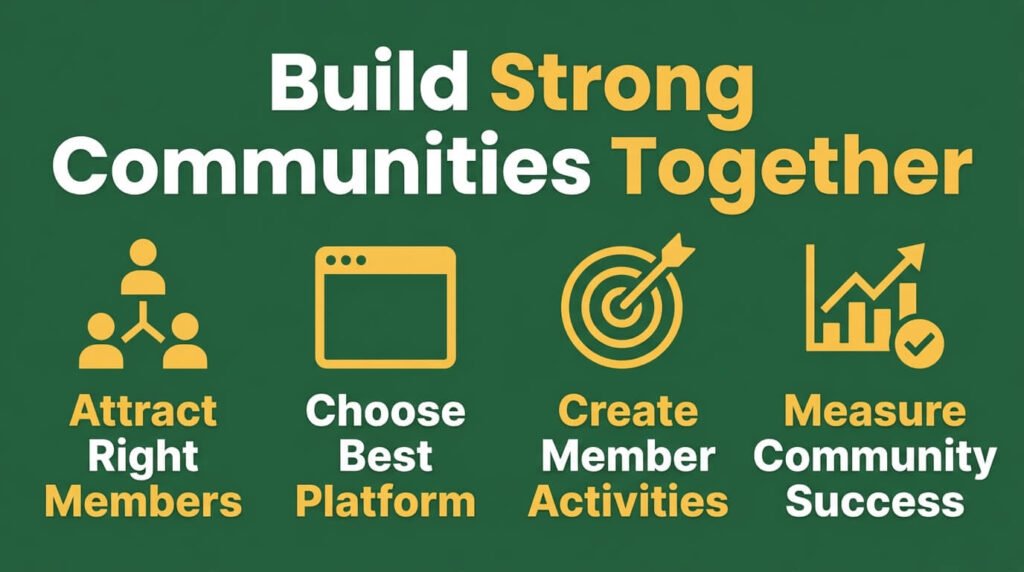
A community building strategy is a structured plan for bringing the right people together, keeping them engaged, and giving them ongoing reasons to stay.
It covers:
- Who you bring in
- Where you host them
- What you give them to do
- How you measure success
Strong community engagement strategies focus on two-way dialogue rather than one-way broadcasting.
They create psychological safety where members feel comfortable sharing ideas, asking questions, and supporting each other. This is the shift from broadcasting to belonging.
Step-by-Step Community Building Strategy for 2026
Most people jump straight into picking a platform. That is the wrong first move. Strategy comes before software.
These steps follow the exact sequence that works, from the first decision to long-term growth.
Step 1: Define Your Clear “Why”
Before anything else, write one sentence. What specific problem does your community solve for members?
This guiding purpose directs all decisions, from content to moderation and outreach.
Do not say “a place to connect.” Say “a space where freelance writers get editing feedback from peers within 24 hours.” Specific purpose attracts the right people and turns away the wrong ones.
Step 2: Know Exactly Who You Are Building For
You cannot build for everyone. The communities that grow fastest serve one type of person extremely well.
If you focus on a community that does not fit your offering, your campaign will flop. HubSpot
Run a simple three-question survey with your current audience:
- What is your biggest daily frustration around this topic?
- Where do you currently go for help with it?
- What would make you show up every week?
Those three answers become your entire foundation.
Step 3: Choose Owned Over Rented
This is where most people make their most expensive mistake. They build everything on a social platform and call it a community.
If your community lives entirely on social media, you are not building an asset. You are leasing attention.
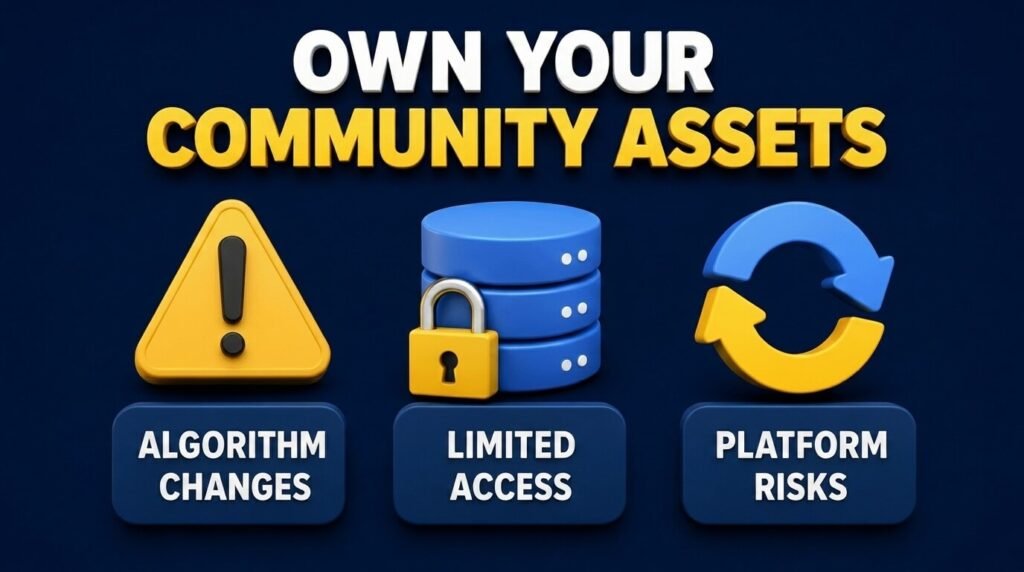
Algorithms decide who sees you, data access is limited, and platform policies can shift overnight.
Pick at least one owned channel as your home base. A private forum, email newsletter, paid membership, or branded app all work. Use social media for discovery. Use your owned space for everything that matters.
Step 4: Nail the First 7 Days for New Members
The first week is where communities lose most people. They sign up, look around, see nothing urgent, and disappear.
I watched this happen with a community I built. We went from 200 sign-ups to 40 active members in three weeks.
The problem was not the content. It was the silence new members felt when they arrived.
An automated welcome workflow guides new members through their critical first 7 days without requiring manual effort from your team.
Day 0 sends a welcome email with a quick-start guide. Day 1 highlights the most popular current discussion.
Day 3 features members with similar interests to encourage connection. Day 7 sends a digest of what happened that week with a prompt to share their own thoughts.
This sequence alone can triple your first-week retention.
Step 5: Create Consistent Engagement Loops
Inconsistency kills more communities than bad content ever will. Members do not need you to post daily. They need a rhythm they can predict and rely on.
Proven formats that hold attention:
- Weekly prompts: one focused question every Monday
- Monthly AMAs: invite a guest or spotlight a knowledgeable member
- Friday open threads: casual conversation that builds social bonds
- Member spotlights: featured profiles that make contributors feel valued
- Weekly challenges: small, actionable tasks tied to your community topic
It is better to run two recurring series reliably than five that fizzle out after a month. Start with one. Add a second only when the first runs without effort.
Step 6: Use Gamification the Right Way
Gamification gets misunderstood constantly. People think it means turning their community into a points game. It does not. It means recognizing the behaviors you actually want more of.
Give members points when they post helpful answers. Reward consistent participation with badges, and let them climb a leaderboard for their contributions. This builds a positive feedback loop that keeps people coming back.
Start simple. Give a badge for the first post. Give another for the tenth reply. Recognize the top contributor each month. These cost nothing and build long-term habits faster than any campaign.
Step 7: Make Members Feel Seen
Here is something I discovered by accident. My friend found this out by accident. She ran a small professional community for two years and tried every trick in the book.
She did weekly posts, challenges, resource drops, and live sessions. But only one thing truly moved the needle: a monthly member spotlight email.
The results were huge. Open rates were three times higher than her regular emails. Even better, the featured members posted four times more the following week.
It taught us a big lesson. People do not just want to belong. They want to be noticed.
A regular spotlight does three great things:
- It rewards the featured member. They feel valued and become much more loyal.
- It sets an example. It shows the rest of the community what great participation looks like.
- It finds your superfans. It helps you spot potential brand advocates among your most active members.
Step 8: Build a Moderation Plan Before You Need It
Nobody wants to think about conflict when they are excited about launching.
But the communities that survive long-term set the rules on day one, not after the first problem surfaces.
Write three things before you open the doors. What behavior is never allowed. What earns a warning.
What leads to removal. Post these publicly. A safe space is what keeps your best members from leaving quietly when things go sideways.
Step 9: Create a Feedback Loop Every 60 Days
Your members know what they need better than you do. The problem is most builders stop asking after the first month.
Send a simple three-question poll every 60 days. Ask what they love, what feels missing, and what would make them invite a friend.
Then act on at least one answer publicly. When members see their input turn into a real change, trust compounds fast. This single habit separates communities that grow from ones that plateau.
Step 10: Plan for the Plateau
Every community hits a flat stretch around month three to six. Posts slow down. Engagement dips.
Familiar faces go quiet. This is normal and almost every builder mistakes it for failure.
The fix is not a complete rebuild. Introduce one new format. A themed challenge week, a guest session, or a member takeover.
Novelty re-activates quiet members without forcing you to start over. The communities that survive this phase almost always come out stronger on the other side.
Step 11: Empower Micro-Leaders From Within
At some point, you will notice two or three members who show up more than everyone else. They reply first.
They help newcomers. They care. These people are your most valuable asset and most builders ignore them completely.
Give them a role. Make them a topic moderator, a weekly thread host, or a welcome committee member.
When people feel trusted and supported, you unlock more active participation and long-term sustainability. It also takes real pressure off you as the sole driver of everything.
Step 12: Connect Community Activity to Real Outcomes
Members stay when they can point to a result your community helped them get. A job lead. A skill they built.
A problem they finally solved. A decision they made with confidence after asking the group.
Ask members to share wins publicly inside the community every month. Keep it simple.
One sentence. One result. These stories do two things at once. They remind existing members why they joined and they give new members proof that showing up is worth it.
The Recent Numbers You Need to See
Before you build anything, look at what the data says.
88% of community professionals believe community is critical to their company’s mission.
Social media engagement rates average 0.05–5% of followers, while online community engagement can reach nearly 50% of members. Bettermode
That gap is why brands are moving fast toward owned communities.
| Metric | Social Media | Owned Community |
| Average engagement rate | 0.05% – 5% | Up to 50% |
| Data access | Limited | Full control |
| Reach control | Algorithm-dependent | Direct access |
| Member retention influence | Low | High |
| Revenue influence | Indirect | 18% of organizations say community influences 30%+ of revenue. Bettermode |
According to Forrester’s 2025 research, organizations with engaged communities see 37% higher customer retention rates and 56% faster growth in customer lifetime value.
The Biggest Mistake: Building on Rented Land
Here is a personal experience I kept repeating. I built a following on a social platform for months.
One algorithm change cut my reach by 60% overnight. I had no emails, no direct access, nothing I owned. Three months of work, gone.
If your community lives entirely on social media, you are not building an asset. You are leasing attention.
Algorithms decide who sees you, data access is limited, and platform policies can shift overnight. CX Today
When your community lives mainly in social feeds, you inherit four problems.
- Reach risk where your access can shrink even if your content quality stays steady.
- Measurement risk, where you might miss real intent in private sharing.
- Governance risk, where you cannot fully control moderation.
- Finally, strategy risk, where your community can turn into a content treadmill, not a relationship engine. CX Today
The fix is simple. Use social media to attract people. Then move them into a space you own, whether that is an email list, a private forum, or a paid membership platform.
Community Platform Comparison: Which One Fits Your Goal?
Choosing a platform is where most people overthink. Here is a practical breakdown based on what your community actually needs.
| Platform Type | Best For | Ownership | Data Access | Cost Range |
| Private forum (self-hosted) | Deep discussions, niche experts | Full | Full | $10–$100/mo |
| Email newsletter community | Thought leadership, trust building | Full | Full | $0–$50/mo |
| Paid membership platform | Creators, course sellers | Partial | Full | $39–$199/mo |
| Facebook/LinkedIn Group | Discovery, top-of-funnel | None | Very limited | Free |
| Discord server | Gen Z, gaming, tech, creatives | Partial | Limited | Free–$10/mo |
| Slack workspace | Professional, B2B teams | Partial | Limited | Free–$15/mo |
The key insight: use social platforms as funnels. Use owned platforms as the destination. Never make a social group your only community home.
What Kills Engagement (And How to Fix It Fast)
Here are the most common problems and their exact fixes.
Problem 1: Members join but never post
Fix: Ask one direct question in the welcome message. Give them a low-stakes action like introducing themselves with two sentences.
Problem 2: Posts get no replies
Fix: The first reply always has to come from you or a moderator. Never let a post sit for more than 2 hours with zero response in the first 30 days.
Problem 3: Content dries up after month one
Fix: Use short member polls every two weeks. Ask what they want next. Build content from their answers, not your guesses.
Problem 4: Members ghost after 90 days
Fix: Compare monthly joins to retention rate, the percentage still active after 90 days. Sudden churn often points to stale content or poor onboarding, both fixable with tighter feedback loops and clearer first-week wins.
Problem 5: No one engages with posts beyond likes
Fix: Stop posting statements. Post questions. End every single post with a direct prompt: “What is your take on this?” or “Which of these have you tried?”
How to Measure If Your Community Building Strategy Is Working
Do not track vanity metrics. Track these instead.
The metrics worth tracking depend on who your community serves. Retention means whether members are returning.
A community where participation peaks at launch and fades is a community that did not build a habit.
User-generated content volume and quality signal genuine ownership. Referral rates measure how often members recommend your community to others.
The three numbers that matter most in 2026:
- 90-day retention rate: What percentage of members who joined 90 days ago are still active?
- Weekly active members / Monthly active members ratio: Aim for 50% or above. A ratio of 50% weekly to monthly active members suggests members visit your community on average two to three weeks per month. Mighty Networks
- Post-to-reply ratio: Are people responding, or just lurking?
Once you track these three numbers for 60 days, you will know exactly where your strategy needs work.
Personal Experience: What I Would Do Differently
I built three communities over five years. Here is the truth from each one.
Community 1 (a niche blog reader group): I put it on Facebook. A year later, the group had 800 members and 3 active ones. Algorithm changes killed it. Lesson: never build your only home on a rented platform.
Community 2 (an email-based community for content writers): I started with 40 people. I sent one valuable answer per week based on questions readers asked me. Two years later, 6,200 subscribers, 38% open rate, zero ad spend. Lesson: email is still the highest-ownership, highest-trust channel.
The Community Building Checklist for 2026
Use this before you launch or relaunch any community.
- Written a one-sentence purpose statement that names a specific problem
- Chosen at least one owned platform as your primary home
- Built a 7-day onboarding sequence for new members
- Set up at least two weekly recurring engagement formats
- Decided on three metrics you will track monthly
- Created a simple recognition system (badges, spotlights, shoutouts)
- Set a 90-day review date to adjust your strategy based on real data
Brands in 2026 are prioritizing community cultivation over mass audiences because owned, engaged communities outperform every paid channel on long-term value. Pulse Advertising
Sum Up
You do not need a big budget. You do not need a big team. You need a clear purpose, a consistent rhythm, and the patience to serve your members before you ask anything from them.
Start with 50 of the right people. Give them a reason to talk to each other. Show up every week without fail. Everything else builds from there.
FAQ
Should a small business build a community or just focus on social media growth?
A small business gets more long-term value from an owned community than from social media growth. Social followers are borrowed.
Community members are yours. Even 200 highly engaged community members drive more referrals, repeat purchases, and word-of-mouth than 20,000 passive followers who never buy. Start small and owned. Grow social as a funnel into that owned space.
Can AI tools help manage and grow a community in 2026?
Yes, but only for the right tasks. AI works well for scheduling posts, summarizing long discussion threads, flagging toxic content early, and sending personalized onboarding messages at scale.
AI cannot replace human-led conversations, genuine recognition, or relationship-building. Use AI to handle repetitive operational tasks.
So you have more time for human moments that actually build loyalty. Members always know when they are talking to a bot versus a person.
Is a free community or a paid community better for long-term engagement?
Paid communities consistently show higher engagement than free ones. Members who pay show up more, contribute more, and stay longer because they have skin in the game.
Free communities work well at the top of your funnel for brand awareness. Paid communities work better for deep engagement and real transformation.
If you want both, run a free entry-level space and offer a paid inner circle with exclusive access and direct interaction with you.
What role does content play inside a community versus on a blog or social media?
Content inside a community serves a completely different purpose than blog posts or social content. Blog content attracts strangers. Social content builds awareness.
Community content deepens relationships and drives action. Inside your community, the best content is question-driven, member-generated, and discussion-starting.
Think less about publishing polished articles and more about sparking conversations. One well-placed question often generates more value than a 2,000-word post.
How is community building strategy shifting because of AI assistants and voice search in 2026?
AI assistants like ChatGPT, Perplexity, and Google AI Overviews now pull answers directly from community discussions more than ever before.
When your members ask and answer specific questions in natural conversational language, those threads become discoverable by AI tools.
Communities with deep, specific, experience-based discussions are gaining organic visibility they never had before. Structure your community discussions as clear questions with direct answers to capture this growing traffic source.
What is the right time to monetize a community?
Do not monetize before your community has genuine daily activity without your constant prompting. That is your green light. Premature monetization kills trust fast.
The safest sequence is: build value first for at least 90 days, identify your most active members, then introduce a paid tier that gives those members something meaningfully exclusive.
Charge for access to you, to advanced resources, or to a smaller high-trust inner group. Never charge simply for access to the community itself before proving its value.
How do niche communities outperform broad general communities in 2026?
Niche communities win because specificity creates belonging. A community for “women over 40 returning to freelance writing” will always outperform a general “writers community” on engagement, retention, and word-of-mouth growth.
Members in niche spaces feel immediately understood. They find their people faster. They stay longer because the conversations feel directly relevant to their exact situation. Going narrow feels risky at first. In practice it is the fastest path to a genuinely active community.
How do you build community trust with a brand new audience that does not know you yet?
Trust with a cold audience builds through three things: transparency, consistency, and giving before asking.
Share your own failures openly in the early days. Post without expecting anything back for the first 60 days. Let members see your decision-making process publicly.
Invite early members into decisions about the community direction itself. When people feel involved in building something, they develop ownership. That ownership converts into the kind of loyalty no marketing campaign can manufacture.
How do community building strategies differ for B2B versus B2C audiences?
B2B community members join for professional outcomes. They want peer learning, industry insights, career growth, and problem-solving relevant to their work.
They engage less frequently but with much higher intent. B2C community members join for belonging, identity, and shared passion.
They engage more casually but more often. B2B communities perform best with structured formats like expert sessions, case study discussions, and accountability groups.
B2C communities thrive on challenges, personal stories, and cultural moments. Knowing which audience you serve shapes every decision from platform choice to posting frequency.

Aliza Khatun is a Digital Marketing Professional and the founder of DigiGenHub. She has helped various businesses grow their online presence through real-world experience in marketing, branding, traffic growth, and business strategy.
Through DigiGenHub, she shows how to build and grow a business from the ground up using Website Setup, SEO, Branding, Paid Promotion, and smart digital tools.
She also highlights how AI can be used to its full potential to make content creation, automation, marketing, and business growth faster and smarter.
She believes that the right knowledge, modern technology, and the right tools can help any individual or business build a stronger online presence.