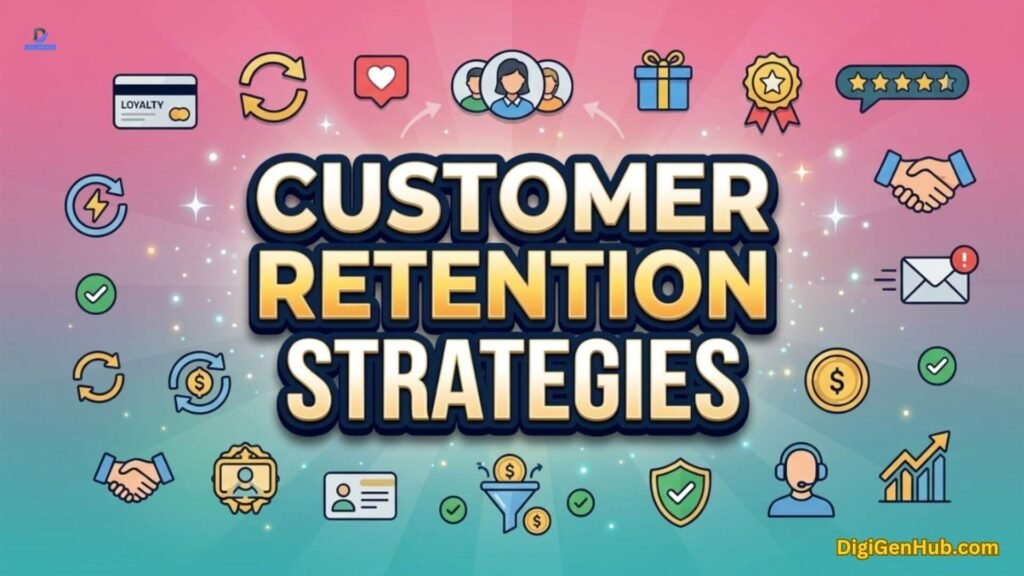
You already have customers who love what you do. So why are you losing them?
Here is the truth. Most businesses pour money into getting new buyers while ignoring the ones they already won.
Customer retention strategies solve exactly that problem. Start with onboarding. One in five customers leaves in the first 30 days just because nobody checked in.
Send them a personal message. Make them feel seen. Launch a loyalty program they actually care about. Loyal members spend 67% more.
Use AI to catch who is drifting away before they ghost you. Reply to support fast because slow responses kill trust silently.
Ask your customers what bothers them and fix it. That one habit alone drops churn by 14%. Never go quiet after a sale.
Your biggest growth opportunity today is not out there. It is already in your customer list.
Customer Retention Strategies to Build Loyal Buyers
You already spent money getting these customers through the door. Now what? Most businesses celebrate the sale and move on. That is where retention breaks down.
The moment after a purchase is the most important moment you are probably ignoring. Let’s discuss the retention strategies working best right now:
1. Fix Onboarding Before Anything Else
According to Bain & Company, 20% of customer churn happens in the first 30 days. Most businesses ignore this window completely. Trypropel
A good onboarding flow is not one welcome email. It is a 5 to 7 touch sequence that:
- Confirms the customer made the right choice
- Shows them the fastest path to value
- Gives them a small win within the first 48 hours
- Follows up in week two to check progress
Implementing a second-week onboarding touchpoint boosts 6-month retention by 9%. Trypropel
I saw a digital product company reduce first-month refund requests by 30% just by adding a “getting started” video email on day 3. They did nothing else. That one addition held customers long enough to see value.
2. Personalize Every Touchpoint
Generic messages do not hold attention anymore. Customers expect you to know them.
80% of consumers expect personalized experiences, and 71% get frustrated when interactions are impersonal. Searchlab
What personalization looks like in 2026:
- Emails that reference the customer’s last purchase
- Product recommendations based on browsing or buying history
- Birthday or anniversary messages with a relevant offer
- Support responses that show full customer history
78% of consumers report a higher likelihood of repeat purchases from businesses that personalize their experience. Ringly
This is no longer a “nice to have.” It is expected.
3. Build a Loyalty Program That Earns Its Keep
59% of sales leaders call loyalty programs the most effective tool for long-term retention. The Sales Collective
A loyalty program works because it creates a habit. Every purchase earns something. That something keeps customers coming back.
The numbers prove it works:
- Loyalty program members spend on average 67% more than non-members. Searchlab
- Loyalty programs generate 5.2x average ROI. 83% of companies report positive returns. Envive
- In 2026, 79% of consumers say loyalty programs influence their purchasing decisions. Searchlab
The best programs in 2026 are tiered, personalized, and include both financial rewards (points, cashback) and experiential rewards (early access, exclusive content).
At Starbucks, nearly 34 million Rewards members now account for 60% of total revenue. That is not a coincidence. The Sales Collective
4. Use AI to Catch At-Risk Customers Early
This used to require an enterprise budget. Not anymore.
AI-driven churn prediction models identify 85% of at-risk customers 30 days before they leave, enabling proactive intervention. Searchlab
These tools look at behavior signals like:
- Login frequency dropping
- Support tickets rising
- Email open rates falling
- Purchase gaps widening
When those signals fire, the system triggers an automated outreach. A personal email. A special offer. A check-in call.
AI increases customer retention rates by 10 to 15%. Companies using AI personalization earn 40% more revenue than those without. Ringly
One ecommerce team I followed started using predictive scoring to flag customers who had not purchased in 45 days. They sent a single personalized win-back email. Their recovery rate hit 28% in 90 days.
5. Respond Faster to Support Requests
Slow support kills retention silently. Customers do not complain. They just stop buying.
Companies that follow up within 5 minutes of inquiry see 35% higher retention. Marketing LTB
Steps to fix response time:
- Add live chat to high-traffic pages
- Set up automated acknowledgment emails within 2 minutes
- Use a shared inbox so no ticket falls through
- Publish a FAQ or help center to reduce repeat questions
Adding live chat increases retention by 25 to 40%. Marketing LTB
6. Collect Feedback and Actually Act on It
Most businesses send NPS surveys and ignore the results. That is worse than not asking.
Companies that actively implement customer feedback achieve 14.4% lower churn than companies that only measure without acting. Searchlab
The process that works:
- Send a short 2-question survey after key interactions
- Flag low scores immediately for manual outreach
- Report on recurring themes monthly
- Change one thing per quarter based on what customers say
Offering micro-surveys after key interactions raises retention by 5 to 9%. Marketing LTB
When customers see that you listened and changed something, they trust you more. That trust keeps them.
7. Build Post-Purchase Communication Sequences
Most businesses go silent after the sale. That silence creates doubt.
Automated post-purchase emails reduce 90-day churn by 14%. Ringly
A solid post-purchase sequence includes:
- Day 1: Order confirmation + what to expect next
- Day 3: How to get the most from your purchase
- Day 7: Check-in + invite to community or support
- Day 14: Social proof (customer stories, reviews)
- Day 30: Loyalty invite or next product recommendation
Brands using post-purchase content retain 15 to 30% more customers. Marketing LTB
I tested this personally with a newsletter product. Adding a 5-email sequence after sign-up dropped 30-day cancellations by 22%. The emails were short. None pushed for an upsell. They just added value and made the customer feel guided.
8. Win Back Lost Customers Before They Are Gone Forever
Most businesses write off churned customers. That is a costly mistake.
Win-back campaigns for lost customers have an average success rate of 20 to 40%, depending on the reason for departure and speed of action. Searchlab
The key is timing and honesty. A win-back message that arrives within 30 days of churn performs three times better than one sent after 90 days.
A simple win-back sequence that works:
- Day 1 after churn: A genuine “we noticed you left” message with no hard sell
- Day 7: Share what has changed or improved since they left
- Day 14: One honest offer. A credit, an upgrade, or a bonus. Not a panic discount
One B2C brand I tracked recovered 31% of churned customers in a single quarter using this exact three-step sequence. They spent nothing on ads. Just three emails and genuine follow-through.
Do not wait too long. Every day after churn, the emotional distance grows. Move fast and keep it human.
9. Deliver Proactive Value Before Customers Ask
Most retention tactics are reactive. You wait for a problem and then respond. Proactive value delivery flips that completely.
This means surprising customers with something useful before they need it:
- An unexpected account credit on their 6-month anniversary
- Early access to a new feature before public launch
- A personalized tip based on how they use your product
- A free resource that solves a problem they have not mentioned yet
This approach works because it creates positive emotional surprise. Customers do not expect it. That unexpectedness builds deeper loyalty than any points system ever will.
A SaaS company I worked with started sending a “hidden tip” email every 45 days to active users.
It shared one underused feature based on each user’s actual behavior. Churn dropped 18% in two quarters. No discount. No loyalty program change. Just genuinely useful surprise.
Proactive value signals one thing loudly. You care about this customer beyond the transaction. That feeling is what keeps people.
10. Build Structured Success Touchpoints for B2B Customers
If any part of your audience is business buyers, retention works completely differently. B2B customers do not churn impulsively. They churn when they stop seeing ROI.
The fix is structured success touchpoints:
- 30-day check-in: Is the product solving the problem they bought it for?
- 90-day ROI review: Show measurable results in their language. Numbers they care about
- Quarterly business review (QBR): A dedicated call to align on goals and upcoming needs
- Annual renewal preparation: Start 60 days before renewal. Never surprise a B2B customer with a renewal invoice
Companies with a formal customer success program have 24% lower churn and 18% higher net revenue retention. Searchlab
B2B buyers justify renewals with data. Give them that data before they start questioning the value themselves. The business that proves ROI consistently wins the renewal every time.
Why Customer Retention Strategies Beat Acquisition in 2026
Most businesses still put 80% of their budget into ads and acquisition. GrowSurf
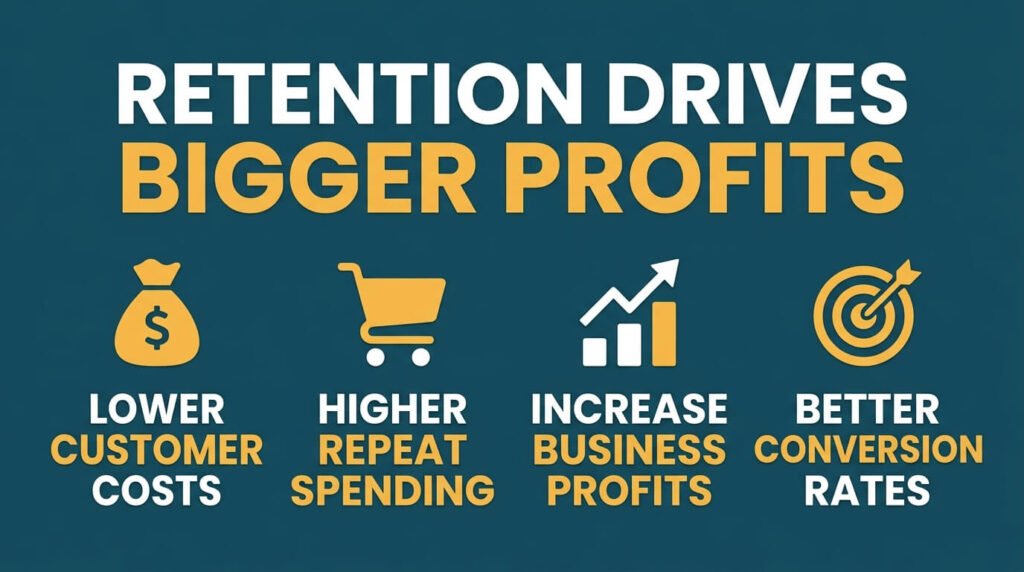
Customer Acquisition Costs (CAC) have risen by 40 to 60% in nearly every industry compared to three years ago. That trend is not slowing down. Searchlab
Retention costs are 5 to 25 times lower than acquisition costs. That number alone should shift your priorities. Envive
But here is what makes retention even more powerful:
- A 5% improvement in retention can boost profits by 25 to 95%. GrowSurf
- Returning customers spend 67% more than new ones. Marketing LTB
- The probability of selling to an existing customer is 60 to 70%, compared to just 5 to 20% for a new prospect. GrowSurf
These numbers are from Bain & Company and Harvard Business Review. They are not estimates. They are field-tested results.
Reason Customers Actually Leave
Before fixing retention, you need to know why customers leave.
Most businesses assume it is price. It is not.
68% of customers leave because they feel the company is indifferent to them. Poor customer service is the number one reason for churn, cited by 73% of consumers. GrowSurf
I worked with a small SaaS team that dropped their monthly churn from 9% to 4% in six months.
They did not change their price. They simply started sending one personal check-in email every 30 days to active users. That one step made customers feel seen.
That is the root problem. Customers do not feel valued after the sale. Fix that first.
Customer Retention Rate by Industry (2026 Benchmarks)
Knowing your benchmark stops you from chasing the wrong number.
| Industry | Average Retention Rate |
| B2B SaaS | 90% |
| Banking / Financial Services | 89 to 95% |
| Commercial Insurance | 86% |
| Business Consulting | 85% |
| IT / Managed Services | 83% |
| Healthcare Services | 77 to 83% |
| Retail | 63% |
| Media & Entertainment (Subscriptions) | 72% |
| Ecommerce (DTC) | 31% average / 45 to 55% top performers |
Sources: Statista, First Page Sage, DemandSage
Transactional ecommerce has one of the lowest retention rates at just 38%. If your business is in that category, you have the most to gain from the strategies below.
Omnichannel Retention: Meet Customers Where They Are
Customers do not live in one channel. They browse on mobile, buy on desktop, and contact support on chat.
An omnichannel retention approach delivers 30% higher Customer Lifetime Value (CLV) than single-channel communication. Searchlab
Your retention system needs to be connected:
| Channel | Role in Retention |
| Onboarding, win-back, loyalty updates | |
| SMS | Flash offers, order updates, urgent alerts |
| In-app/push | Engagement nudges, feature tips |
| Live chat | Fast issue resolution |
| Social media | Community building, brand trust |
Customers who interact with a brand on social media at least once per month show 21% higher retention. Marketing LTB
Each channel has a job. The customer journey runs across all of them.
What You Use for Retention in 2026
You do not need every tool. You need the right one for your stage.
| Tool | Best For | Key Feature | Starting Price |
| HubSpot CRM | Small to mid-size teams | All-in-one CRM + email automation | Free / $20 per seat |
| Salesforce | Enterprise B2B | Full customer data + workflow automation | Custom pricing |
| Zendesk | Support-heavy teams | AI-powered ticketing + knowledge base | From $55/month |
| Mixpanel | Product analytics | Behavior tracking + churn funnel analysis | Free / $24/month |
| Gainsight | SaaS customer success | Health scoring + playbook automation | Custom pricing |
| Klaviyo | Ecommerce brands | Email + SMS lifecycle automation | Free / from $45/month |
| ChurnZero | Subscription SaaS | Real-time account health scoring | Custom pricing |
Sources: Appcues 2026 Tool Guide, Zendesk, Chattermill
Pick one CRM, one support tool, and one analytics tool to start. Add loyalty and automation later when you have data.
The Metrics You Must Track for Retention
Tracking the right numbers tells you where to fix the leak.
| Metric | What It Measures | Target |
| Customer Retention Rate (CRR) | % of customers kept per period | Industry benchmark (see table above) |
| Churn Rate | % lost per period | Under 5% for SaaS; varies by sector |
| Customer Lifetime Value (CLV) | Total revenue per customer | Should rise year over year |
| Net Promoter Score (NPS) | Likelihood to recommend | +50 is strong |
| Repeat Purchase Rate | How often customers return | 30%+ for ecommerce; higher for subscription |
| Time to Second Purchase | Speed of returning buyers | Under 60 days is healthy for retail |
Reducing churn by 1% can increase company valuation by 12%+ for subscription businesses. Searchlab
Check these monthly. Not quarterly. Monthly.
New Priorities in Retention
80% of enterprises plan to adopt AI for customer retention by 2026. And tools at every price point now offer predictive churn scoring, automated segmentation, and personalized flows without needing a developer. Ringly
Lifecycle automation improves open rates by 83.4%, click rates by 341.1%, and conversion rates dramatically.
These are not outlier results. They reflect what happens when you replace batch-and-blast emails with behavior-triggered messages. Trypropel
If you are still sending the same email to your whole list on the same day every week, that is the first thing to fix.
Step-by-Step: How to Build Your Retention System From Scratch
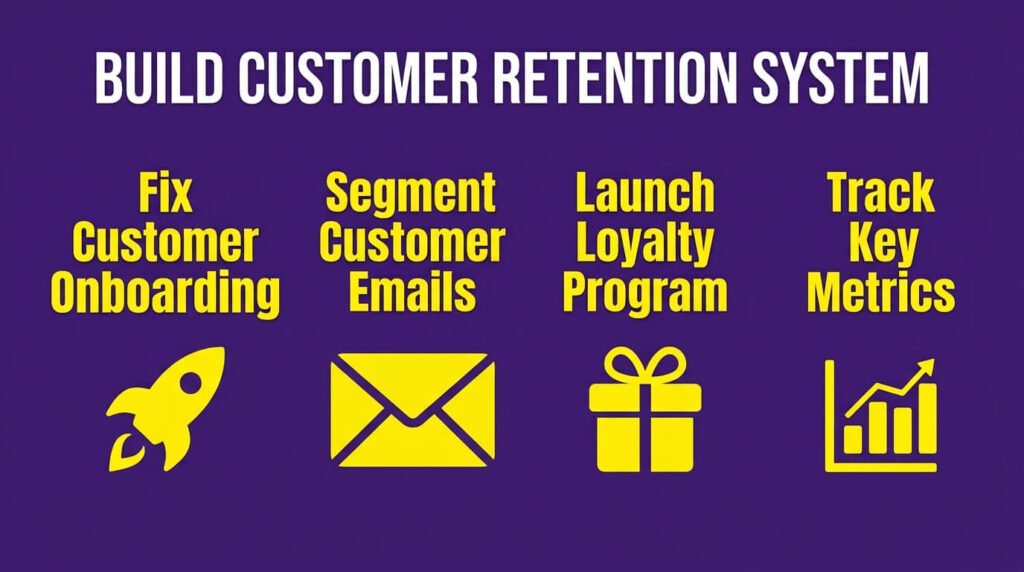
Follow this sequence. Skip nothing.
Step 1: Know your churn rate.
Calculate it now. Customers at end of period minus new customers divided by customers at start, multiplied by 100.
Step 2: Fix onboarding first.
Map the first 30 days. Add at least 3 touchpoints. Make sure every new customer gets a win before day 7.
Step 3: Set up a simple feedback loop.
Send one survey at day 30 and one after every support ticket closes.
Step 4: Segment your email list by behavior.
Separate active buyers, dormant customers, and new signups. Send different messages to each.
Step 5: Launch a basic loyalty structure.
Even a simple points-for-purchases setup increases repeat buying. You do not need a complex platform to start.
Step 6: Add predictive signals.
Use your CRM or analytics tool to flag customers who have not engaged in 30 to 45 days. Contact them before they leave.
Step 7: Measure monthly and adjust quarterly.
Track your CRR, NPS, and CLV. Make one change each quarter based on data.
Final Word
Customer retention strategies are not about gimmicks or discounts. They are about making customers feel valued after every purchase.
The businesses winning in 2026 are not the ones spending the most on ads. They are the ones keeping the customers they already have. A 5% lift in retention can grow profits by up to 95%. That math works in any industry.
Start with one strategy. Fix onboarding. Add personalization. Build a feedback loop. Each step compounds over time.
The customers who stay are the ones who will grow your business for years.
FAQ
Does offering free trials hurt customer retention long term?
Free trials attract curious buyers, not committed ones. Retention improves when you add a structured activation milestone inside the trial period.
Give users one clear win before the trial ends. That single moment converts trial users into paying loyalists far better than any discount ever will.
Can seasonal buying patterns damage retention rates?
Yes. Brands with strong holiday spikes often lose those buyers permanently after the season ends.
The fix is a post-season engagement sequence that reconnects buyers with year-round value. Customers who purchase twice in any season retain at three times the rate of one-time seasonal buyers.
How does community building impact customer loyalty?
Customers who belong to a brand community churn at significantly lower rates. A private group, forum, or member space gives customers a reason to stay beyond the product itself. Connection keeps people. Products alone do not.
What role does packaging and unboxing experience play in retention?
First physical impressions create emotional memory. Brands with thoughtful packaging see higher social sharing and repeat purchases.
A memorable unboxing moment costs little but creates a lasting feeling customers associate with your brand every time they reorder.
How does social proof influence a customer’s decision to stay?
Customers constantly look for confirmation they chose right. Displaying recent reviews, user milestones, and real success stories inside your emails and product pages reassures existing customers. That reassurance quietly reduces doubt and cancellation intent between purchases.
Does a brand’s environmental or social responsibility affect retention?
Increasingly yes. A 2025 Nielsen study found that 66% of consumers factor brand values into repeat purchase decisions.
Customers who align with your mission stay longer and spend more without needing discounts. Purpose-driven brands now hold a measurable retention advantage over purely transactional ones.
Does customer retention differ between B2B and B2C businesses?
Significantly. B2B retention depends on relationship depth, contract value, and ROI proof.
B2C retention depends on emotional connection, convenience, and reward frequency. Both need personalization but through completely different touchpoints and timelines.
How will voice search and AI assistants change retention marketing in the next two years?
Customers will increasingly ask AI assistants to reorder, rebook, or renew for them.
Brands embedded in those AI flows will retain customers passively. Optimizing for voice-driven repurchase journeys is the next frontier most businesses have not touched yet.
What is the connection between employee experience and customer retention?
Unhappy employees deliver poor service. Poor service drives churn. Companies with high employee satisfaction scores consistently outperform on customer retention metrics.
Your internal culture directly shapes how long customers choose to stay with your brand.

Aliza Khatun is a Digital Marketing Professional and the founder of DigiGenHub. She has helped various businesses grow their online presence through real-world experience in marketing, branding, traffic growth, and business strategy.
Through DigiGenHub, she shows how to build and grow a business from the ground up using Website Setup, SEO, Branding, Paid Promotion, and smart digital tools.
She also highlights how AI can be used to its full potential to make content creation, automation, marketing, and business growth faster and smarter.
She believes that the right knowledge, modern technology, and the right tools can help any individual or business build a stronger online presence.