
TL;DR
- Launching a social media management company in 2026 works best when you stay narrow, not broad.
- Choose one small group of businesses to serve. Depth beats spread every time.
- Set up your legal paperwork first. A contract and coverage keep you safe from costly surprises.
- Use only a handful of tools. Extra apps slow you down more than they help.
- Charge what your time is worth. Cheap pricing traps you in a cycle of overwork.
- Win your opening client through a free review, not a hard sell.
- Turn one client into many by asking for referrals right after strong results.
- Put your workflow on paper. Templates save you from repeat mistakes.
- Track your cash closely. Set money aside for taxes from day one.
- Keep learning fast. Trends shift often, and staying current keeps you ahead of rivals.
If you remember one thing about how to start a social media management company, remember this: small, sharp moves beat big, scattered ones.
How to Start a Social Media Management Company
You want more freedom. You want income you control. You want work that actually excites you.
Learning how to start a social media management company gives you all three, and this year is wide open for it.
Brands everywhere struggle to show up online, and they need someone who just gets it done. That someone can be you.
Stop waiting for perfect timing. You already hold the tools: a laptop, a phone, and the hunger to figure things out. Choose one niche.
Focus on two platforms. Win your first client this month, not someday. Every thriving agency began with one bold pitch and one happy customer who told a friend.
Your grit beats any certificate. Your follow-through beats pure talent. Leap today, pitch with confidence, and turn that first client into ten. This is your shot to build something yours, on your own terms, starting right now.
Why 2026 Is the Right Time to Start
The market backs this up with numbers. The social media management market hit $30 billion in 2025. It will reach $36.4 billion in 2026.
It will jump to $171.6 billion by 2033. That is a 24.8% growth rate each year, according to Grand View Research.
| Market Fact | 2026 Figure |
| Global market size | $36.4 billion |
| Projected size by 2033 | $171.6 billion |
| Annual growth rate | 24.8% |
| Demand driver | AI tools, video content, social commerce |
Small business owners cannot keep up with algorithm changes.
Right now, someone in your niche is searching for exactly what you offer. They just don’t know you exist yet. That gap is your opening.
Here’s the truth about how to start a social media management company: it isn’t complicated, but it does need order.
Skip a step and you pay for it later, through lost money, a shaky contract, or a client who walks.
Follow the right sequence and everything clicks into place faster than you’d expect. Below, you’ll walk through six clear moves. Each one builds on the last.
Step 1: Pick a Niche Before Anything Else

Do not try to serve every industry. Pick one lane. Own it. A dentist wants different content than a real estate agent. A niche makes your pitch sharp. It makes your work easier.
Ask yourself these questions first:
- Which industry do you already know well
- Which platforms fit that industry best
- Can you find 20 local businesses in that niche today
Pick a niche you understand fast. I picked local service businesses first. I knew how they talk to customers. That choice made my first three pitches land without much back-and-forth.
Popular niches right now include:
- Local restaurants and cafes
- Real estate agents and brokers
- Fitness studios and gyms
- E-commerce brands
- Medical and dental practices
- B2B software companies
A tight niche builds trust fast too. When you know how to start a social media management company around one industry, referrals come quicker. Your clients talk to each other.
Step 2: Register Your Business the Right Way
Skip this step and you risk fines. You risk lawsuits. You risk losing client trust. An LLC protects your personal assets if a dispute happens.
Here is what registration costs in 2026:
| Item | Typical Cost |
| LLC state filing fee | $35 to $500 |
| Registered agent (optional) | $50 to $300 per year |
| Business license | $50 to $400 per year |
| EIN from the IRS | Free |
| Total average first-year cost | $130 to $1,000 |
Get your EIN directly from IRS.gov. Do not pay a third party for this. It takes minutes. It costs nothing.
Check your local requirements too. The Small Business Administration lists exact steps by state. Some counties need a general business license on top of your LLC.
Open a separate business bank account right after you register. Mixing personal and business money creates tax headaches later.
I learned this the hard way in my first year. One shared account made tax season take three extra weeks to sort out.
Protect Yourself With Contracts and Insurance
Most new owners skip this part. Do not skip it. A written contract protects both sides before work starts.
Your contract should cover:
- Scope of work and deliverables
- Payment terms and due dates
- A kill fee if the client cancels early
- Who owns the content after the contract ends
- Notice period for termination
Add insurance too. General liability insurance covers accidents and property damage claims.
Professional liability insurance, also called errors and omissions insurance, covers mistakes in your work.
Many clients now ask for proof of insurance before they sign. The Hartford and Next Insurance both offer policies built for small agencies.
Skip this step and one bad client relationship can wipe out a year of profit. A contract and a policy cost far less than a lawsuit.
Step 3: Build a Lean Toolkit That Works
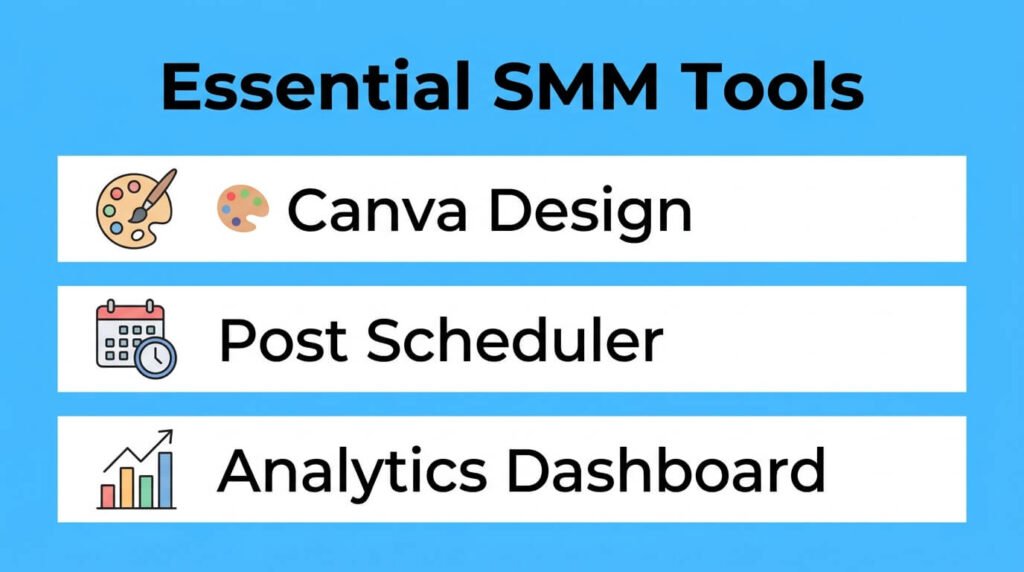
You do not need ten tools. You need five that cover the full workflow.
- Scheduling tool: Buffer, Later, or Metricool for planning posts across platforms
- Design tool: Canva for quick graphics without a designer
- AI writing assistant: Speeds up captions and content ideas
- Analytics dashboard: Tracks what content drives results
- Client communication hub: Slack or a shared project board
AI plays a central role in daily output now. Marketers report that content built with AI support performs better than content made without it, according to HubSpot’s 2026 research. Use AI to draft faster. Then edit with your own voice. Clients pay for judgment, not just speed.
Free training helps you sharpen skills before your first pitch. HubSpot Academy offers certification at no cost. Use it to fill gaps in strategy or analytics before you start selling.
Build Your 2026 Content Stack Around Video
Short-form video drives most engagement right now. Reels, TikToks, and YouTube Shorts deliver greater reach than static posts.
Build every client package around video first, then support it with static content and stories.
AI tools now speed up video work too. Tools like CapCut and Opus Clip turn long videos into short clips fast.
Learn one video editing workflow well before you pitch. Clients notice when you offer video from day one.
Social commerce keeps growing too. Instagram Shopping, TikTok Shop, and Facebook Shops let brands sell directly inside the feed.
If your niche sells products, learn these tools early. This skill alone can double your package value.
Step 4: Price Your Packages With Confidence
Once you know how to start a social media management company, pricing is the next big hurdle.
Pricing confuses new owners the most. Here are current 2026 numbers to anchor your rates.
| Service Type | Monthly Price Range |
| Single platform, basic posting | $500 to $1,500 |
| Multi-platform management | $1,500 to $3,000 |
| Full-service with ads and content | $2,000 to $6,000 |
| Premium package with video | $4,000 to $7,500 |
Freelancers commonly charge $35 to $150 per hour. Rate depends on experience and scope.
Do not price based on guilt. Do not price out of fear of losing a lead. Price based on the hours and value you deliver.
My first client paid $600 a month for two platforms. That price covered my time. It left room to grow the account later into a $2,000 package once results showed up.
Bundle strategy work into every package. Businesses that only pay for post volume often skip the parts that drive growth, like strategy and reporting, based on 2026 pricing data from Fresh Content Society.
Set Up Invoicing and Manage Your Money Early
Late payments kill small agencies fast. Set clear payment terms from day one. Ask for a deposit before work starts. Net 15 terms work better than net 30 for a new business. Cash flow matters more than revenue on paper.
Use a simple invoicing tool like QuickBooks or Wave to send invoices and track payments. Set aside 25 to 30 percent of every payment for taxes. Self-employed owners pay quarterly estimated taxes in the US. Missing this step leads to a painful bill in April.
Step 5: Land Your First Clients Without a Portfolio
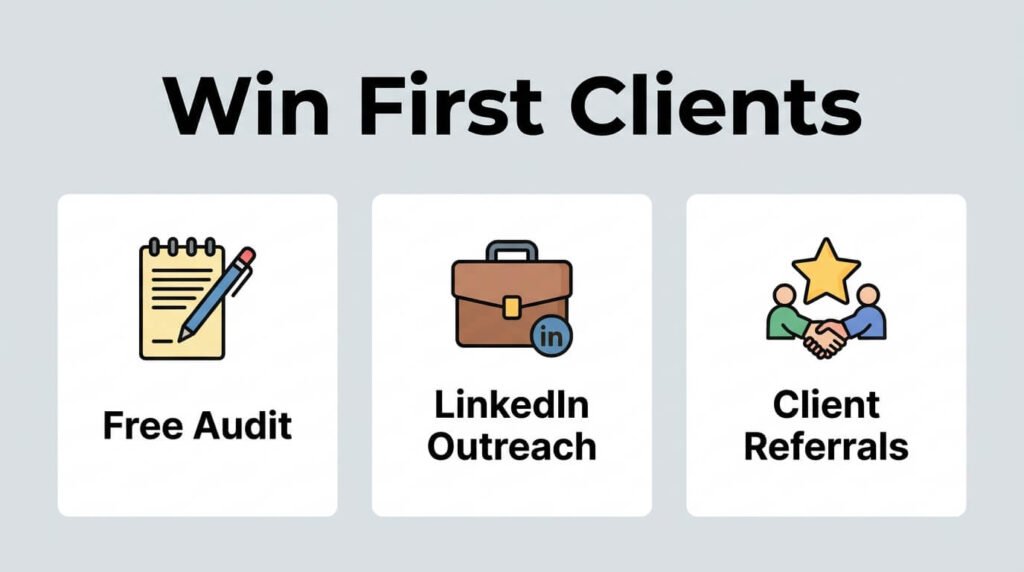
This step stops most people. You do not need years of experience. You need proof you can produce results.
Try these methods first:
- Offer a free 30-day trial to one local business in exchange for a testimonial
- Post case studies of your own social accounts if they perform well
- Reach out directly on LinkedIn to business owners in your niche
- Ask your network for warm introductions
- Join local business groups and offer a free audit
A free audit works better than a cold pitch. Show a business owner three things wrong with their current posts. Show one clear fix. That builds trust fast.
I landed my second client through a five-minute audit video sent over email. No sales call. No pressure. Just a clear fix they could see right away.
Once you land a client, deliver more than promised in month one. Early results turn into referrals. Referrals remove your need to cold pitch forever.
Build a Pipeline So You Are Never Starting From Zero
One client is a start. A pipeline is a business. Set up a simple sales process you repeat every week.
- Send five outreach messages a day, even after you land clients
- Track every lead in one sheet or a free CRM like HubSpot CRM
- Book a short discovery call before you send any proposal
- Follow up twice before you drop a lead
Write down your ideal client profile too. Know their business size, budget, and pain points. This makes every pitch faster and sharper. It also stops you from taking on clients who drain your time for little pay.
Step 6: Build Systems So You Can Scale
A one-person shop caps your income fast. Systems let you take on more clients without burnout.
Build these four systems early:
- Content calendar template: Reuse the same structure for every client
- Onboarding checklist: Collect brand assets and goals in one form
- Reporting template: Send the same monthly report format to every client
- Approval workflow: Set clear turnaround times for content review
Standard operating procedures matter more than talent alone. A modern social media business runs on systems, not just creative output, according to Mifu’s 2026 industry analysis.
I built my onboarding form after missing a brand guideline on client number four. That mistake cost me a redo on ten posts. One form fixed it for good.
Know When to Hire Your First Team Member
Most owners wait too long to hire. Watch for these signs instead:
- You turn down new clients because you have no time
- You spend more hours on admin work than content
- Your profit margin lets you cover a part-time wage
Start small. Hire a virtual assistant for scheduling and admin tasks first. Then bring on a freelance designer or video editor as client work grows. Full-time hires come later, once revenue stays steady for three or more months in a row.
Keep Clients Longer Than Your Competitors
New clients cost more to win than old clients cost to keep. Build retention into your process from day one.
- Send a short win report every month, not just numbers
- Book a quarterly strategy call with every client
- Ask for feedback before a client thinks about leaving
- Offer an upsell path, like ads management or video, once results show
A social media management company that keeps clients past year one grows faster than one that only chases new leads. Churn quietly kills more agencies than bad pitches do.
What Realistic Income Looks Like
Most new owners want to know one thing. Can this pay the bills? Here is a fair picture based on common first-year numbers.
- Month 1 to 3: One to two clients, $600 to $1,500 in monthly revenue
- Month 4 to 6: Three to five clients, $2,500 to $5,000 in monthly revenue
- Month 7 to 12: Five to eight clients, $5,000 to $12,000 in monthly revenue
These numbers shift based on your niche and your pricing. Full-time effort speeds up growth. Part-time effort stretches this timeline out. Either way, treat months one to three as the proof phase, not the profit phase.
Why Most Social Media Management Companies Fail
Knowing how to start a social media management company matters. Knowing why so many fail matters just as much.
This is the part most guides on how to start a social media management company leave out.
Common failure points include:
- No contract, leading to scope creep and unpaid work
- No niche, leading to weak, generic pitches
- No system for reporting, leading to client churn
- Pricing too low, leading to burnout before profit
- No pipeline, leading to feast-or-famine income
Avoid these five traps and you outlast most competitors in your first year alone.
What Experts Say About 2026
Industry experts back this focused approach. Content strategist Robert Rose says success in 2026 depends on trust.
Brands need systems that scale human judgment. Volume alone won’t cut it. He shared these views with the Content Marketing Institute.
Marketing consultant Bert van Loon agrees. He says relationships give brands their edge this year. Attention spans keep shrinking. Brands can’t afford to spread themselves thin.
Executive Jacqueline Loch takes it further. She warns that spreading effort across every platform fails.
Brands should pick channels where they already perform well. Then they should double down there.
All three experts point to one lesson. A new social media management company wins by going deep on fewer platforms. It shouldn’t try to cover them all.
Common Mistakes That Slow You Down
Avoid these early errors:
- Charging too little just to win the first client
- Skipping a written contract before starting work
- Managing every platform instead of picking two or three
- Ignoring analytics and only posting on gut feeling
- Doing everything manually without templates or tools
- Waiting too long to raise prices once results show up
Each mistake costs time you cannot get back. Fix your contract template before client one. Fix your reporting template before client two. Small fixes early save large headaches later.
Final Thoughts
Every big agency started with one small client and one honest pitch. Yours can start the same way.
The demand is already there. Businesses just need someone willing to show up for them. That someone can be you.
Stop planning. Start today. Pick your niche. Send one message. Let your first client be the proof the rest of your career stands on.
FAQ
Do I need a business website before I start pitching clients?
No. A simple one-page site or a strong LinkedIn profile works fine at first. Add a full website once you have three or more clients.
Should I operate under my own name or create a separate business name?
Use a separate business name once you register your LLC. It looks more professional and makes it easier to build a brand you can sell later.
How many clients can one person manage without burnout?
Most solo owners manage 4 to 6 clients well. Past that, quality drops unless you bring in a VA or freelancer.
Can I run a social media management company part-time alongside a full-time job?
Yes. Many owners start part-time and take on 1 to 2 clients first. Move to full-time once monthly income covers your basic expenses.
What should I do if a client wants to cancel mid-contract?
Check your termination clause first. Most contracts require 14 to 30 days notice. Bill for any work already completed before the cancellation date.
Should I offer paid ads management or stick to organic content only?
Start with organic content only. Add paid ads once you have the budget, experience and a client asks for it. Ads mistakes cost clients real money fast.
Do I need a certification to prove my skills to clients?
No, but a free certification like Meta Blueprint or HubSpot Academy adds credibility to your proposals and LinkedIn profile.
Should I take on international clients or focus on local businesses only?
Local clients are easier to close at first since trust builds faster in person or on local calls. Add international clients once you have a strong portfolio and clear time zone availability.
How do I handle a client who asks for unlimited revisions?
Set a revision limit in your contract, usually 2 rounds per piece of content. Charge extra for anything beyond that limit.
Do I need to sign a non-disclosure agreement with clients?
Only if the client handles sensitive data or unreleased product information. Most small business clients do not require one, but keep a template ready in case one asks.

Aliza Khatun is a Digital Marketing Professional and the founder of DigiGenHub. She has helped various businesses grow their online presence through real-world experience in marketing, branding, traffic growth, and business strategy.
Through DigiGenHub, she shows how to build and grow a business from the ground up using Website Setup, SEO, Branding, Paid Promotion, and smart digital tools.
She also highlights how AI can be used to its full potential to make content creation, automation, marketing, and business growth faster and smarter.
She believes that the right knowledge, modern technology, and the right tools can help any individual or business build a stronger online presence.