Finding the right customers is a battle against rising costs and fading tracking. Many advertisers rely on broad interests only.
This brings clicks but no sales. This gap is the engagement trap. Audience research on Facebook blocks weak leads.
You must move beyond basic age and location data. The best solution lies in Signal Quality and Behavioral Overlap.
By combining your own sales data with Meta’s AI tools, you can find hidden buyer patterns. This method secures your budget from low-quality traffic.
Audience Research on Facebook to Fix the Gap
My client Camelia sold luxury office chairs. She spent $3,000 every month on Facebook ads.
Her ads reached millions, but her sales were zero. She targeted broad interests like “Office Furniture.”
This was her mistake. She reached people looking for cheap desks, not her premium chairs.
We switched her strategy to Behavioral Overlap. We targeted people who liked “High-End Coffee” AND “Remote Work.”
This method found professionals with money to spend. Within three months, her sales grew by 50%. Her ad spend stayed the same.
The Signal Quality Bridge: Guide the Machine
Most marketers look at age and location and stop there. This is a common trap. AI is a fast car, but you are the driver.
If you feed the machine poor data, it hunts for poor leads. To win, you must link your actual sales results to your bidding goals.
This tells the machine what a profit looks like. This human-led narrowing is the only way to turn a faceless audience into a profit engine.
To build this foundation, track these 3 Essential Authority Resources:
U.S. Digital Consumer Trends
Use eMarketer Insider Intelligence Reports to track how U.S. users shift behavior on Meta.
Privacy & Data Policy
Follow the Meta Newsroom – Privacy Progress to stay updated on new state-level privacy laws.
Ad Benchmarks
Review WordStream State of Social Ads 2026 to compare your results with U.S. industry averages.
The Best Facebook Audience Research Strategies
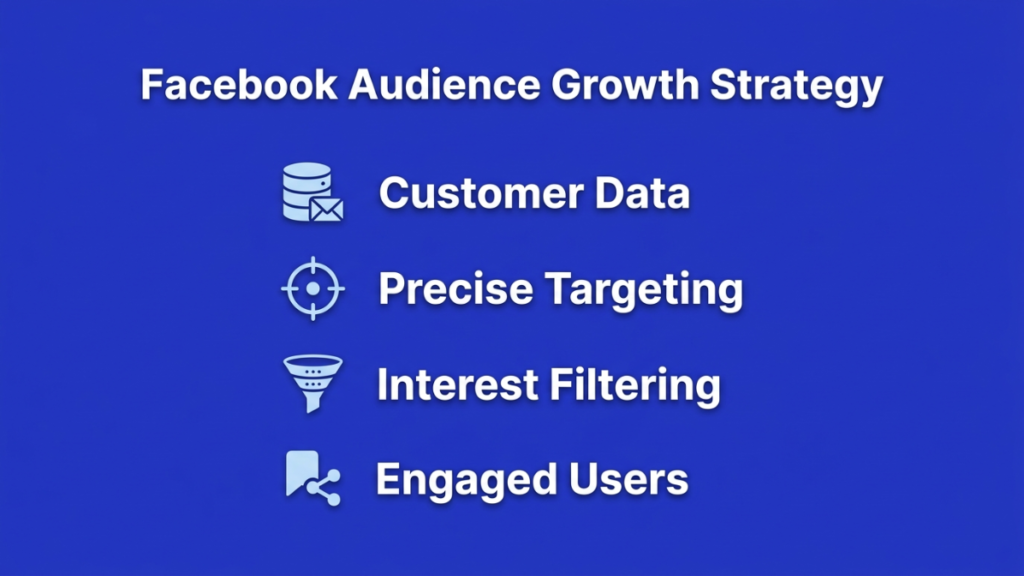
The most effective Facebook audience research solution is a three-step Signal-First framework.
These steps replace broad interest targeting with high-intent data loops. First, you must integrate first-party data through the Conversion API. This helps to define your ideal buyer.
Second, you apply behavioral overlap by layering specific interests to filter for spending power.
Finally, you track interaction depth to prioritize users who “Save” or “Share” content over those who simply “Like.”
This method allows Meta’s AI to build Digital Twins of your customers. Let’s explain more:
Step 1: Feed the Machine with First-Party Data
Cookies are no longer dependable. To find high-value buyers, you must give Meta a “Seed” of your actual customers. This is called First-Party Data Integration.
How it works
You upload your customer email list or connect your website through the Conversion API (CAPI). This creates a direct server-to-server link.
The Benefit
Instead of guessing who might buy, you show the AI exactly who already bought. The AI then finds millions of other U.S. users who act just like your customers.
Example
A U.S. fitness brand uploads its list of “Yearly Membership” buyers. The AI ignores casual gym-goers and targets “High-Commitment” profiles across the country.
Step 2: Filter for Wealth with Behavioral Overlap
Broad interests like fashion or technology are too crowded and expensive. Behavioral Overlap is the practice of combining two or more specific traits to find a niche market with money.
How it works
Use the AND logic in your targeting menu. Target “Interest A” AND “Behavior B.”
The Benefit
This removes window shoppers and focuses on people with specific lifestyles.
Example
If you sell organic baby food, do not just target parents. Target parents AND frequent International travelers.
This overlap ensures you reach parents who have the disposable income to afford premium organic products.
Step 3: Measure Profit via Interaction Depth
A like on Facebook is a low-value signal. Successful research focuses on Interaction Depth. This measures how much effort a user puts into your brand.
How it works
Analyze your Meta Business Suite to see which users “Save” your posts for later or “Share” them with friends.
The Benefit
A save means the user wants to return to your product. A “Share” means they trust you enough to tell others. These are the highest-intent signals available.
Example
A home decor brand notices that their “How-to Style a Living Room” Reel has 500 saves but only 100 likes.
They immediately create a custom audience based on those savers because those individuals are in the active planning and buying phase of their journey.
Conclusion
Your research is now a powerful map. You have the tools to find real buyers in the U.S. market.
Use your data to build a brand that lasts. Trust the machine to handle the math while you drive the vision. Every smart choice today builds a wealthier tomorrow.
Start your fresh campaign with confidence. Watch your ROI grow as you lead with logic. You are now the authority in your niche. Your path to profit is clear and steady.
FAQ
How does predictive AI change Facebook research in?
Meta now predicts future buyer needs before they search. Analyze lapsed user signals in your Business Suite.
Identifying these patterns helps you target the exact moment a customer is ready to return. This increases your retention by 20%.
Can I research audience life milestones for better ads?
Yes. Users often share events like new jobs or home purchases. Use the Life Events filter in the Potential Audience tab.
Researching these transitions helps you time your offers when spending habits shift.
What is the impact of visual sentiment on research?
Visual sentiment analyzes which colors and styles your audience reacts to in Reels.
Run a Creative Cluster Test. Group your ads by visual style to see which aesthetic your U.S. demographic trusts most.
How do niche Facebook groups help in audience research?
Groups provide honest user feedback. Use Keyword Alerts within industry groups.
This lets you research pain points in real-time. You get fresh ad copy ideas that competitors miss.
How does voice intent affect audience targeting?
Users now use voice-to-text for many searches. Include natural language phrases in your interest search. Look for conversational tags that mirror how people actually speak.
Can I research audience brand loyalty levels?
Yes. Use the Audience Overlap tool to see which other brands your fans follow.
Identify complementary companies that sell to the same person. This builds a persona based on their overall lifestyle.
What is micro-moment research on Facebook?
This tracks activity during small breaks like lunch. Analyze hourly engagement heatmaps in Business Suite.
Finding these windows helps you catch your U.S. audience during peak impulse moments.
How does cross-app behavior influence research?
Users act differently on Instagram than on Facebook. Use Linked Account Insights to compare actions.
Researching why a user saves on Instagram but comments on Facebook helps you tailor your message.

Aliza Khatun is a Digital Marketing Professional and the founder of DigiGenHub. She has helped various businesses grow their online presence through real-world experience in marketing, branding, traffic growth, and business strategy.
Through DigiGenHub, she shows how to build and grow a business from the ground up using Website Setup, SEO, Branding, Paid Promotion, and smart digital tools.
She also highlights how AI can be used to its full potential to make content creation, automation, marketing, and business growth faster and smarter.
She believes that the right knowledge, modern technology, and the right tools can help any individual or business build a stronger online presence.