
Building a product is hard. Picking the right product development services is harder. Every year, thousands of founders and business owners search this exact phrase because they need one thing. A clear path from idea to a working product that sells.
The market for turning ideas into real products just crossed $268 billion, and it’s still climbing. That growth tells you something important.
Businesses everywhere are done guessing. They want proof before they spend, and support long after they launch.
Here’s what you need to know upfront. Most new products still fail, not because the ideas were bad. But because nobody tested them properly first. You don’t have to repeat that mistake.
Whether you’re building your prototype, choosing between an agency and a freelancer, or trying to figure out what this should actually cost you. So you deserve straight answers.
What Product Development Services Include
Searching for product development services now? You’re not alone, and you’re asking the right question at the right time.
Still, most people search this term without knowing the full scope. Let me explain, please:
- Concept validation: test if an idea solves a problem people will pay for
- Product design: shape how the product looks and feels
- Engineering: build the technical structure behind the product
- Prototyping: create an early sample to test function
- Testing and validation: check safety, usability, and performance
- Manufacturing handoff: prepare the design for mass production
- Post-launch support: fix issues and improve the product after release
Product development services cover this entire chain. Some firms handle one piece. Others manage the full journey from idea to shelf.
Why This Search Term Is Growing Fast in 2026
The demand is not random. Numbers back it up.
The global product design and development services market hit $268.51 billion in 2026. It should grow to $555.94 billion by 2034, according to Fortune Business Insights. That is a massive jump in less than a decade.
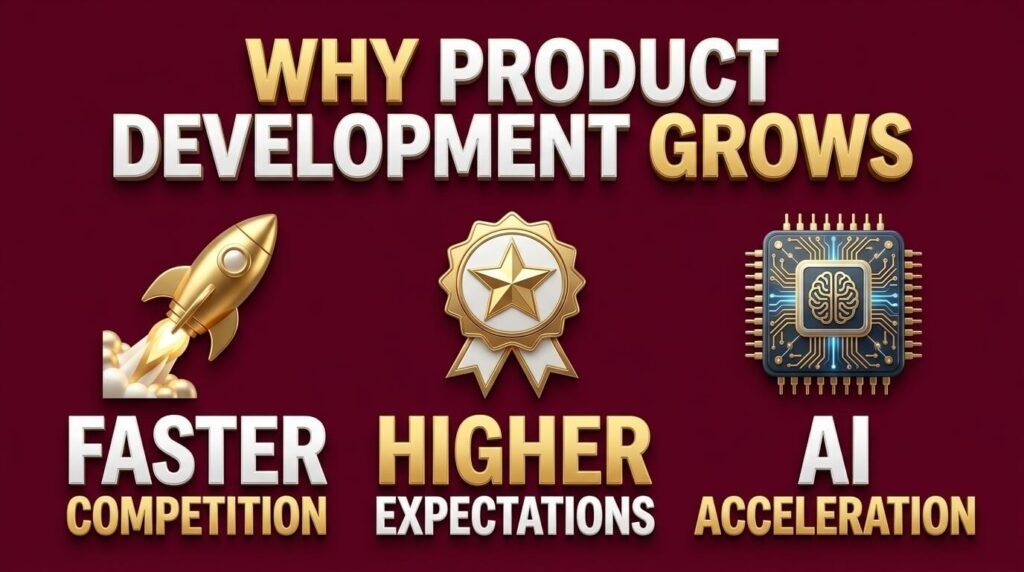
Why the rush? Three forces push companies toward product development services right now.
- Competitors launch faster, so companies must move quicker
- Customers expect a polished product on the first try
- AI tools now speed up design work that once took months
North America leads this demand. The region held a major market share of 38.60% in 2025, driven by digitalization and the push for creative visual communication. Precedence Research.
The Hard Truth: Most New Products Fail
Here is the part nobody likes to hear. People search for product development services after a failed launch. Not before one.
MIT Professional Education reports that nearly 30,000 new products launch each year. 95% of them fail. This figure traces back to Harvard professor Clayton Christensen.
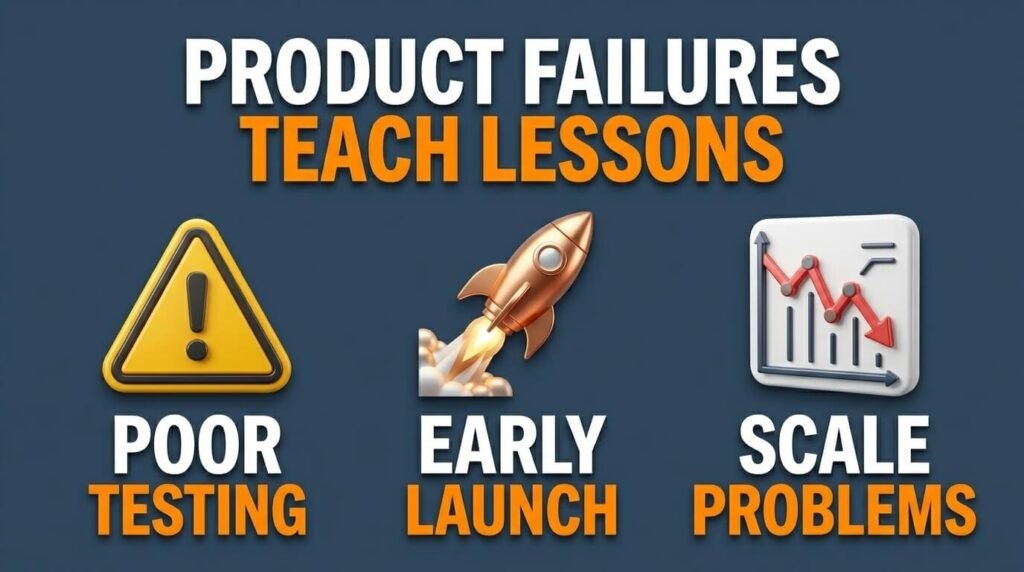
Why so many flops? Three patterns repeat.
- Teams build first and ask customers later
- Launch dates get rushed before testing finishes
- Nobody checks if the market wants the product
This is the gap product development services close. A structured process catches these mistakes early. It saves money before problems grow big.
Three 2026 Product Lessons Worth Studying
Numbers tell half the story. Product stumbles from 2026 tell the rest. They show what proper product development services prevent.
Humane’s AI Pin shows what happens when hype replaces testing. The wearable launched at $699. It promised to replace smartphones. Reviewers found it slow.
It overheated. It failed basic tasks. Humane raised over $230 million before launch. The company later sold its assets to HP for $116 million.
That is a fraction of what it raised. Every device stopped working once the servers shut down. The mistake was simple. Skip proper testing, and scale fails with you.
Rabbit’s R1 device shows a different mistake. The team shipped ahead of what the product could do. Demos worked in a controlled setting.
They broke down in daily use. Rabbit sold 100,000 units. Daily active use dropped fast once the gap between promise and delivery became clear.
The team later rebuilt the software with a simpler interface. The lesson cuts deep for hardware makers in 2026. Never launch based on a roadmap. Launch based on what the current build can prove today.
OpenAI’s Sora points to a cost problem, not a design problem. The video tool burned heavy daily compute costs. Revenue stayed far below that cost. The project shut down.
High demand and praise did not build a sustainable business. A working demo does not equal product-market fit. Someone still has to pay enough to cover what the product costs to run.
Each story points to one root cause. Skipped validation. Rushed launches. Ignored cost math. Structured product development services exist to catch these problems early.
The Old Way vs The New Way
Product development used to take years. The timeline has changed now. Here is a direct comparison.
| Stage | Old Method (Pre-2020) | Current Method (2026) |
| Concept testing | Focus groups, months of surveys | AI-driven demand testing in days |
| Design | Manual sketches, slow revisions | Generative design tools, instant changes |
| Prototyping | Physical models, weeks to build | 3D printing, fast digital mockups |
| Engineering review | Long email chains, manual checks | Digital twin simulations before build |
| Time to market | 12 to 24 months average | 4 to 9 months for most consumer products |
This shift did not happen by chance. In April 2026, PTC added an AI assistant inside its Windchill platform.
It helps engineers find engineering records through natural language. Search time across large product teams dropped fast. SkyQuest market report.
The lesson is simple. Product development services that use these tools move faster and cost less than teams stuck on old workflows.
Step-by-Step: How Product Development Services Work
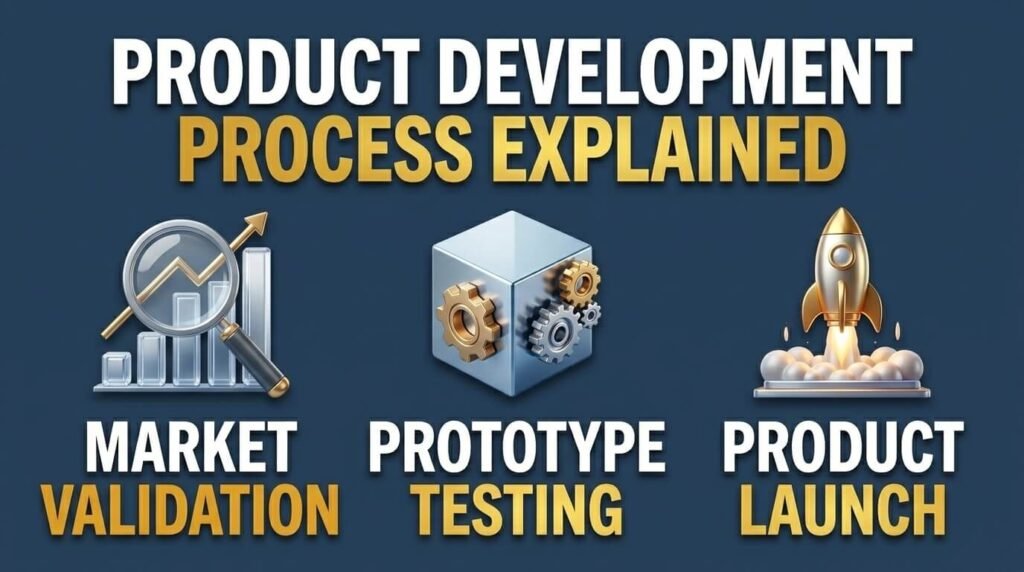
Here is the process. Check any provider you hire against these steps.
- Discovery call: define the problem, not the product yet
- Market check: confirm demand exists before spending money
- Concept sketches: rough visuals to align on direction
- Prototype build: a working sample, not a finished item
- User testing: people try it and give feedback
- Design refinement: fix what testing exposed
- Engineering for manufacturing: adjust the design for scale
- Small batch production: test the manufacturing process
- Full launch: release to the wider market
- Post-launch fixes: patch issues from early customer use
Skip step two, and you risk joining that 95% failure number above. Skip step five, and you launch something nobody tested.
I once helped a remote client with website maintenance who skipped user testing to save two weeks.
Their checkout button broke on mobile screens. Nobody caught it before launch. They paused sales. They fixed the button after 200 orders failed. Two weeks saved cost them two months of lost sales.
Comparing Service Delivery Models
Buyers often do not know which delivery model fits their budget and timeline. Here is a clear view.
| Model | Best For | Average Cost | Speed | Control Level |
| In-house team | Large companies with steady product pipelines | High (salaries, tools, space) | Slow to start, fast once running | Full control |
| Full-service agency | Startups needing end-to-end help | Medium to high | Fast, structured timelines | Shared control |
| Freelance specialists | Small budgets, single-task needs | Low to medium | Fast for small tasks | High control, more oversight needed |
| Offshore development firm | Cost-sensitive projects | Low | Medium, time zone dependent | Lower day-to-day control |
| Hybrid (in-house + outside help) | Growing companies scaling fast | Medium | Fast, flexible | Balanced control |
No single model wins for everyone. A five-person startup rarely needs a full in-house engineering team.
A medical device company rarely trusts a freelancer for regulatory-heavy work.
Core Categories of Product Development Services in 2026
Service types shift as tools and markets change. Here is the current breakdown, grouped by the problem each one solves.
- Market validation services – confirm demand before spending on design or engineering
- MVP build services – create a stripped-down working version to test with early users
- Full digital product development – apps, platforms, and connected software builds
- AI-integrated product design – built-in machine learning features, not added later
- Physical prototyping and engineering – hardware builds ready for manufacturing handoff
- Post-launch iteration support – ongoing fixes, feature updates, and scaling help after release
Notice the shift from a decade ago. Back then, most requests centered on design and engineering alone.
Now validation and post-launch support carry equal weight. Buyers in 2026 want proof before they spend.
They want support after they launch too. Product development services that skip either end leave gaps buyers notice fast.
What Product Development Services Cost in 2026
Budget questions dominate this search term. Here is an honest range based on current market activity.
- Concept validation only: $2,000 to $10,000
- Basic prototype (consumer product): $10,000 to $50,000
- Full product design and engineering: $50,000 to $250,000
- Medical or regulated device development: $250,000 and up
- Software or digital product build: $20,000 to $150,000 depending on complexity
Costs shift by industry too. The manufacturing segment leads the market with a 19.16% share in 2026, per Fortune Business Insights. Physical product development sees the highest overall spend right now.
A friend running a kitchen gadget brand spent $8,000 on a validation sprint before full engineering.
That small spend told them their first idea would not sell. They pivoted to a second concept. It became their top seller. Skipping that step would have cost them ten times more later.
How to Pick the Right Provider: A Checklist
Use this list before you sign any contract.
- Ask for three past projects with clear outcomes, not just pictures
- Confirm who owns the design files and intellectual property
- Get a written timeline with milestones, not vague estimates
- Ask how they handle manufacturing handoff
- Check if they test with actual users, not just internal staff
- Confirm total cost including revisions, not just the starting quote
- Ask what happens if the concept fails testing
A provider who avoids these questions sends a warning sign. A trustworthy one answers each point without hesitation.
What Changed in Product Development Services for 2026
A few shifts define this year.
- AI-assisted design now handles early-stage concept generation. It cuts weeks off timelines.
- Digital twins let engineers test products virtually before building physical prototypes.
- Sustainability requirements now shape material choices from the start.
- Consolidation among agencies means fewer standalone shops. Full-service firms absorb specialists instead.
The competitive landscape runs on consolidation and technology now. Large consultancies buy specialist design and engineering teams through acquisitions, according to SkyQuest’s market analysis.
This matters for buyers. Small boutique firms now partner with bigger platforms instead of competing alone.
Related Terms Worth Knowing
Searches around this topic often overlap with these phrases:
- Product design services
- MVP development
- Product engineering services
- Concept to market strategy
- Rapid prototyping
- New product introduction (NPI)
Knowing these terms helps you search smarter. You find providers who specialize in your exact need.
Final Thoughts
Every product starts as a rough idea. Product development services turn that idea into something people want to buy. That is the whole point.
The path is not a mystery anymore. Validate first. Build a prototype. Test it. Fix what breaks. Then launch.
Skip a step, and you gamble with your time and money. Follow it, and you stack the odds in your favor.
The market keeps growing for a reason. Businesses want proof before they spend. They want support after they launch. Product development services give them both.
Your idea deserves the same path. Start small. Test often. Build with confidence. The next success story could be yours.
FAQ
Do I need a technical co-founder before starting?
No. A development firm brings the technical skill. Your job is knowing the problem you want solved.
What is the difference between a fixed price and hourly contract?
Fixed price locks the total cost upfront. Hourly billing tracks actual time spent, which can shift as the project grows.
Who owns the CAD files or source code once the project ends?
Ownership depends on the contract. Ask this before signing. Most firms transfer full ownership once final payment clears.
What happens if I want to change the design mid-project?
Most contracts allow changes. Expect added cost and a longer timeline once a change request comes after work starts.
How many design revisions are normal before final approval?
Two to three rounds is standard. More rounds usually signal unclear direction at the start, not a provider problem.
Do I need a lawyer, or is a standard contract enough?
A standard NDA and service agreement covers most small projects. Bring in a lawyer once patents or large manufacturing deals enter the picture.
What is a minimum order quantity, and why does it matter?
Factories often require a minimum batch size to start production. This number affects your upfront cost far more than the product design itself.
How do I check if a provider’s portfolio is trustworthy?
Ask to speak with a past client directly. A portfolio image tells you nothing about how the project actually went.
Should hardware and software teams work on the same project together?
Yes, when the product needs both. Separate teams working apart often cause mismatched timelines and integration problems late in the process.
Is website maintenance part of product development services?
Yes, for digital products. Ongoing maintenance keeps a live product stable after launch, separate from the initial build phase.

Aliza Khatun is a Digital Marketing Professional and the founder of DigiGenHub. She has helped various businesses grow their online presence through real-world experience in marketing, branding, traffic growth, and business strategy.
Through DigiGenHub, she shows how to build and grow a business from the ground up using Website Setup, SEO, Branding, Paid Promotion, and smart digital tools.
She also highlights how AI can be used to its full potential to make content creation, automation, marketing, and business growth faster and smarter.
She believes that the right knowledge, modern technology, and the right tools can help any individual or business build a stronger online presence.