Business growth isn’t about working more hours. It is about building assets that make money while you focus on other things.
If you have ever wanted to build a business that earns money while you sleep, digital product businesses with AI are the closest thing to that dream.
You do not need a big team, a large budget, or years of technical experience. You need a laptop, a free AI tool, and a problem worth solving.
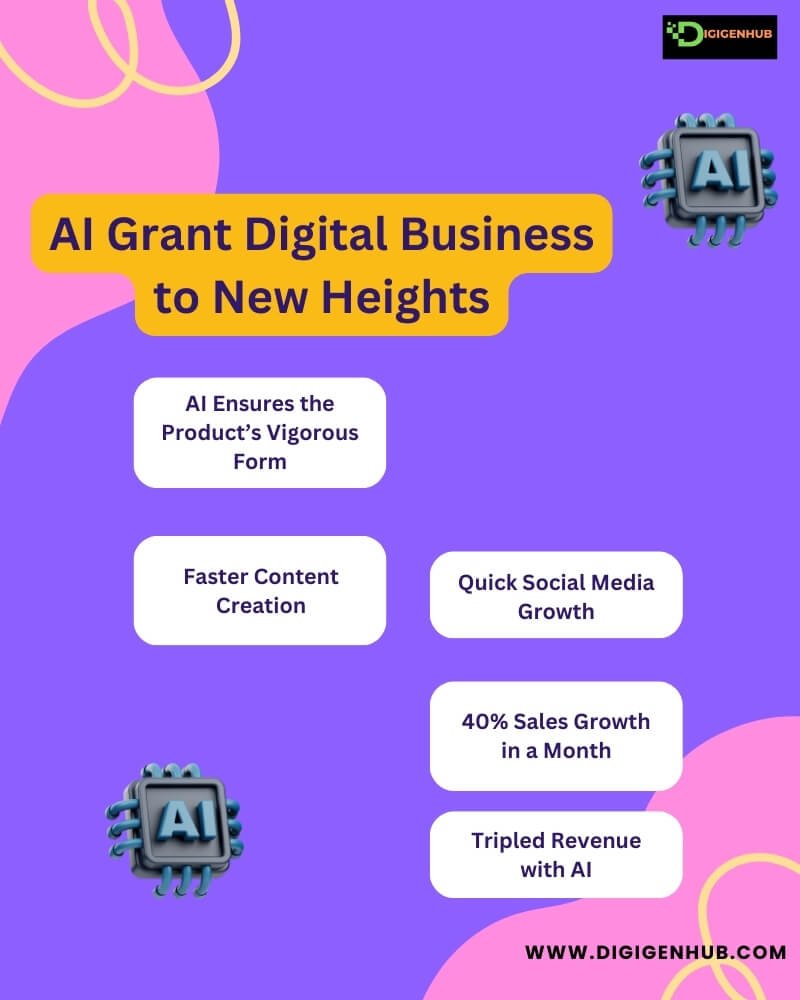
The digital product industry is now worth $2.5 trillion globally. AI has cut product creation time by up to 70%.
So, one person working a few hours on the weekend can build, launch, and sell a product that competes with full teams.
You can start with $0 and realistically earn $500 to $5,000 per month within 6 to 12 months.
Why Now Is the Best Time to Start a Digital Product Business with AI
Three years ago, running digital product businesses with AI was a niche experiment.
Today it is a mainstream income strategy used by teachers, designers, coaches, marketers, and complete beginners.
Digital product transactions surged 70% between 2022 and 2024, and the pace keeps climbing.
Meanwhile, 68% of U.S. small businesses now use AI regularly, up from just 48% in mid-2024.
Buyers have been trained to purchase digital products instantly. They expect to download a template, guide, or course the moment they pay for it. That expectation is your opportunity.
One of the biggest shifts happened in 2025. AI-referred shoppers now convert 31% higher and spend 45% more time on seller pages than organic visitors.
This means that if you use AI to create content, build products, and drive traffic, you attract buyers who are more engaged and more ready to spend money.
The barrier to entry has never been lower. Free AI tools handle the hardest parts of creation.
Platforms like Gumroad and Etsy manage your payments, file delivery, and storefront automatically.
What used to take a team of five and a $10,000 budget now takes one person and a free ChatGPT account.
The window is open. It will not stay this wide forever.
Statistics at a Glance
70%: Reduction in product creation time thanks to AI tools.
$2.5 trillion: Global digital product industry size in 2026. source WhopWhop
70%: Rise in digital product transactions from 2022 to 2024.
68%: U.S. small businesses now using AI regularly. ColorWhistle
$0: What it costs to launch your first digital product.
How to Start Digital Product Business with AI
The biggest mistake new creators make is waiting until everything is perfect before launching. Here is the shortest, most direct path from zero to your first sale.
Step 1: Pick One Painful Problem
Do not start with a topic. Start with a problem. Not “fitness” but “how to stay consistent with workouts when you have a full-time job.” Not “business” but “how to track freelance invoices without missing payments.” The more specific the problem, the easier it is to sell the solution.
Step 2: Choose One Product Type
Pick a single product format from the six models above. Do not try to build a course and a template and a prompt pack at the same time. One product. One launch. Learn from it before adding more.
Step 3: Use AI to Create a First Draft
Give your AI tool a detailed prompt. Include the audience, the specific problem, the desired outcome, and any format requirements. The AI will give you a starting point, not a finished product. That distinction matters.
Step 4: Edit for Accuracy and Voice
AI gets facts wrong sometimes. AI also writes in a generic voice that sounds like everyone else. Your job at this stage is to review every section, fix any inaccurate information, and rewrite key parts in your own voice. Buyers are paying for your expertise, not a raw AI output.
Step 5: Design It Cleanly
Clean always beats fancy for digital products. A well-organized Canva template with consistent fonts and colors looks far more professional than an overdesigned mess. Use Canva’s free templates as a starting point. Adjust colors and fonts to match your audience.
Step 6: Set Up Your Selling Page
Gumroad takes 20 minutes to set up. Write a clear headline that states exactly what the product does and who it helps. Add three to five bullet points that list specific benefits. Upload a clean product preview image. Set your price.
Step 7: Drive Traffic from One Source
Pick one traffic channel and commit to it for 30 days. Pinterest works well for visual products like templates and planners.
TikTok works for how-to content and process videos. Reddit works for niche communities that already search for your solution. Do not spread yourself across five platforms. Own one first.
Speed Tip
Your first product does not need to be perfect. A decent product launched today earns more than a perfect product launched in six months. Real buyer feedback will improve version two more than any amount of self-editing before launch.
The 6 Best AI Digital Product Business Models Right Now
Not every digital product is worth your time. Some take three hours to build and sell for years. Others take three weeks and earn the same.
The six models below are the ones working best right now for people running digital product businesses with AI.
Model 1: AI-Built Spreadsheet Templates and Trackers
Budget planners, income trackers, subscription managers, habit trackers, and business dashboards are in constant demand.
People search for these products every single day on Etsy, Google, and Pinterest.
AI changes the game here completely. What used to require hours of formula writing, conditional formatting research, and layout design now takes 30 minutes.
You give an AI tool a detailed prompt, and it generates the full architecture. The formulas, the dropdown logic, and the layout suggestions.
Once you have the structure, you refine it in Google Sheets or Excel, add clean formatting, and export it as a shareable template.
List it on Etsy for $15 to $40 per download. A strong spreadsheet template can generate hundreds of sales with zero ongoing work.
Quick Win
Search “budget spreadsheet” on Etsy. Filter by bestsellers. Look at what the top sellers have in common.
Build a better version using AI in one afternoon. Price it slightly lower to get your first reviews, then raise the price once social proof builds.
Model 2: Notion Templates for Niche Audiences
Notion templates are one of the fastest-growing categories inside digital product businesses with AI in 2026.
Business owners use them to manage projects, content pipelines, and client relationships.
Students use them for semester planning. Freelancers use them to replace expensive software.
The keyword is niche. A generic “productivity Notion template” competes with thousands of listings.
A “freelance copywriter client portal” or “nursing student study tracker” targets a specific buyer with a specific pain. That specificity is what drives sales.
AI helps you map out the workflow your buyer follows every day, then translate that into Notion pages, properties, and views.
What would take days of trial and error now takes a focused afternoon.
Price these between $10 and $30 per template. List them on Notion’s own template gallery for free organic traffic alongside your Etsy or Gumroad page.
Model 3: AI Prompt Packs
Prompt packs are the newest high-margin category in digital product businesses with AI, and they are growing fast.
Millions of people already pay for AI tools like ChatGPT, Midjourney, and Claude. But they struggle to get results that match what they see online. A well-crafted prompt pack solves that problem immediately.
You can build a 50-prompt pack targeting a specific profession- content creators, real estate agents, HR managers, teachers, or therapists, in 3 to 5 hours.
The margin is 100% because there is nothing to produce beyond the document itself. Price these between $12 and $39.
The best prompt packs are organized by use case, include brief instructions for each prompt, and show examples of the output. That extra effort separates a $12 listing from a $39 one.
“Buyers want faster results from tools they already pay for. Prompt packs are where the majority of my digital product sales come from.” — Independent creator, March 2026
Model 4: Short E-Books and PDF Guides
Short and practical always beats long and theoretical when it comes to digital product businesses with AI.
A 20-page guide that solves one specific painful problem outsells a 100-page general overview every single time. Buyers want transformation, not information overload.
AI handles the structure, the outline, the section headers, and the first draft. Your job is to add real experience, check the facts, fix anything inaccurate, and give it your own voice.
That combination of AI speed and human accuracy is what builds trust with buyers.
Export the final product as a clean PDF using Canva or Google Docs. Price it between $9 and $47 depending on depth and specificity. List it on Gumroad or your own website.
Model 5: Done-For-You Brand Kits
Small businesses need logos, color palettes, font pairings, social media templates, and brand voice guidelines.
Branding agencies charge $2,000 to $8,000 for this work. Most small businesses have $100 to $500 to spend and need something professional fast.
Digital product businesses with AI can fill that gap perfectly. Use AI for the brand voice guidelines and copywriting.
Use free logo tools like Looka or Canva for the visual assets. Use Canva’s brand kit feature for packaging everything together. Bundle all files into a ZIP download and sell it for $49 to $149.
These sell well on Etsy under searches like “brand kit template,” “small business branding,” and “Canva brand kit.” One well-designed brand kit can sell for years with zero updates needed.
Model 6: Mini Online Courses
A mini course with 3 to 7 short video lessons solves one specific problem for one specific audience.
It does not need to be an academy-level production. It needs to be useful, clear, and focused.
AI helps you write scripts, build slide outlines, generate quiz questions, and plan your module structure.
You record lessons on your phone or laptop. Platforms like Teachable or Gumroad handle enrollment, payments, and delivery.
According to research published in 2026, online courses remain one of the most profitable digital product types with high audience reach and strong niche growth.
The key difference between courses that sell and courses that flop is specificity. Teach one skill to one person with one clear outcome.
Tools to Run a Digital Product Business with AI

You do not need to pay for every tool to run successful digital product businesses with AI.
Most creators start with free plans and only upgrade when revenue justifies it.
| Tool | Best For | Free Plan | Paid Price | Difficulty Level |
| ChatGPT | Writing, e-books, outlines, prompt packs | Yes | $20/month | Easy |
| Claude | Long-form content, brand copy, detailed guides | Yes | $20/month | Easy |
| Google Gemini | Research, writing, brainstorming, and data analysis | Yes | $20/month | Easy |
| Canva AI | Brand kits, PDF design, templates, presentations | Yes | $15/month | Easy |
| Midjourney | AI image generation for covers, mockups, and assets | No | From $10/month | Medium |
| Notion AI | Notion templates, workflow mapping | Limited | $10/month | Easy |
| Google Sheets + AI prompts | Spreadsheet templates, dashboards, formulas | Free | $0 | Easy |
| Gamma | Slide decks, mini course presentations | Yes | $10/month | Easy |
| ElevenLabs | AI voiceover for video lessons | Limited | $5/month | Medium |
| Gumroad | Product delivery, sales pages, payments | Yes | 10% per sale | Easy |
| Lemon Squeezy | Alternative digital storefront, global tax compliance | Yes | 5% + $0.50 per sale | Easy |
| Make / Zapier | Business automation and linking backend apps | Yes | From $9/month | Medium |
How Much Can You Earn With AI Digital Products?
People make unrealistic income claims about passive digital products. Let’s see what the data actually shows for digital product businesses with AI in:
| Stage | Time to Reach | Estimated Monthly Revenue | Weekly Hours | Primary Focus |
| Beginner | 1 to 3 months | $200 to $500 | 5 to 8 hours | Launch first product, build first reviews |
| Growing | 3 to 6 months | $500 to $2,000 | 8 to 12 hours | Add 3 to 5 products, test traffic sources |
| Established | 6 to 12 months | $2,000 to $5,000 | 10 to 15 hours | Build email list, create product bundles |
| Full-time | 12 to 24 months | $5,000 to $15,000 and beyond | 20 to 30 hours | Add courses, memberships, or coaching |
Digital products deliver $1,000 to $5,000 per month within 6 to 12 months at 5 to 10 hours of weekly work.
That outperforms almost every other passive income category for effort-to-return ratio.
Common Mistakes in AI Digital Product Businesses
Most people who try and fail at digital product businesses with AI make the same mistakes. Knowing them in advance saves you months of frustration.
Mistake: Topic is too broad
Why it happens: Fear of limiting your audience
Fix: Pick a specific job title or lifestyle plus one specific problem. “Freelance designers” and “invoice tracking” beats “creative professionals” and “productivity.”
Mistake: Overbuilding before launching
Why it happens: Perfectionism disguised as preparation
Fix: Set a hard 7-day deadline from idea to published listing. Ship it. Improve it after you see real buyer feedback.
Mistake: No consistent traffic source
Why it happens: Assuming that listing a product automatically brings sales
Fix: Commit to posting on one platform every day for 30 days. Results compound.
Mistake: Ignoring the product title and description
Why it happens: Creators focus on the product instead of the listing
Fix: Research the titles and descriptions of bestselling products in your category on Etsy or Gumroad. Model what is already working.
Mistake: Pricing too low
Why it happens: Fear that no one will pay
Fix: Match or slightly beat the market average. Low prices attract bargain hunters, not loyal buyers.
Mistake: Publishing raw AI output without editing
Why it happens: Trying to save time
Fix: Always review every AI-generated section. Add personal experience. Fix inaccurate numbers. Remove generic filler phrases. Buyers pay for your expertise, not a machine’s draft.
Mistake: Quitting after 30 days
Why it happens: Unrealistic expectations about speed
Fix: Commit to 90 full days before evaluating results. Most real traction starts between days 45 and 90.
A Note on Using AI for Digital Product Business
AI gives you speed. You give it accuracy and trust. These two things together are what create digital products worth buying.
Always review AI drafts before publishing. Add your real experience. Fix numbers and claims.
Remove generic phrases that sound like every other AI-written page. Your buyers are paying for your expertise applied through AI tools, not for raw machine output.
The creators who succeed in digital product businesses with AI are not the ones who use the most tools. They are the ones who combine AI efficiency with genuine human knowledge and care about the quality of what they sell.
Start Your Next Chapter Today
This is the truth about digital product businesses with AI i: the people who win are not the most talented, the most experienced, or the best funded. They are the ones who start.
The tools have never been more accessible. The platforms have never been more buyer-ready.
The demand for practical, downloadable solutions to real problems has never been higher. Everything that used to make this path difficult, design skills, writing ability, technical knowledge, a big budget, AI has removed or reduced.
You already have what it takes. You have knowledge that someone else needs.
You have experience that a beginner would pay to skip. You have a perspective that no AI can fully replace. What you need now is a first step.
Pick one problem. Open ChatGPT or Claude or Gemini or any other one you love. Type a prompt. See what comes back. Edit it. Upload it. Price it. Post about it. That cycle, repeated with patience and consistency over 90 days, is the entire strategy. It is not complicated. It is just consistent.
The creators earning $3,000, $7,000, and $12,000 per month from digital product businesses with AI today were exactly where you are now one year ago. They did not have a secret. They had a start date.
FAQ
Do I need technical skills to start digital product businesses with AI?
No. The tools designed for digital product businesses with AI require no coding, no design background, and no technical expertise.
ChatGPT, Claude, Gemini, Canva and others all use plain language inputs. If you can type a sentence, you can use these tools. The learning curve for most creators is less than one week.
How much money do I need to start?
You can start with $0. ChatGPT or Claude or Gemini. Each has free plans. Canva has a free plan. Google Sheets is free.
Gumroad only takes a 10% cut when you make a sale, which means you pay nothing until you earn something. Most successful creators spend $0 on tools for their first 3 months, then reinvest early revenue into paid plans.
How long does it take to make my first sale?
Most creators make their first sale within 2 to 6 weeks of listing on Etsy, assuming the product is well-described and the title uses words buyers actually search.
Sales come faster if you also post on one social platform. Some creators make their first sale within 48 hours on Etsy because of built-in search traffic.
Can I use AI to create the entire product, or do I have to write it myself?
You can use AI to create the structure, the first draft, and the layout. However, you must edit and review everything before selling it. AI makes factual errors.
AI produces generic writing. Buyers pay for accuracy and expertise, which only you can provide. Think of AI as a highly capable assistant that needs your supervision, not a replacement for your knowledge.
Are digital product businesses with AI sustainable long-term, or just a trend?
Digital products are not a trend. People have been buying e-books, templates, and courses online for over 20 years. What AI changes is the speed and accessibility of creation.
The demand for practical, downloadable solutions to everyday problems is not going away. If anything, it grows as more people spend time online and expect instant results. Creators who build quality products and strong listings now are building long-term assets.
How do I protect my digital products from being stolen or shared for free?
No digital product is 100% theft-proof. However, a few steps reduce risk significantly. Watermark preview images. Use PDF password protection for e-books.
Sell through reputable platforms like Etsy or Gumroad that have policies against unauthorized redistribution. Most importantly, keep creating. Your next product is always more valuable than worrying about someone sharing an old one.
What should I price my first digital product at?
Research 10 to 15 bestselling products in your exact category on Etsy. Find the average price. Price your product within 20% of that average.
Do not price below the market floor because it signals low quality. Do not price far above the market unless you have strong reviews and a clear premium reason. Start at market rate, collect reviews, and raise your price once social proof builds.
Can I run digital product businesses with AI as a side hustle while working full-time?
Yes, and most successful creators start this way. The hours required are manageable alongside a full-time job.
In the beginner phase, 5 to 8 hours per week is enough to build and launch a first product. By the growing phase, creators often have products earning passively while they focus on their day jobs.
Many reach the point where passive income exceeds their salary within 12 to 24 months, at which point the choice to go full-time becomes an option rather than a gamble.

Aliza Khatun is a Digital Marketing Professional and the founder of DigiGenHub. She has helped various businesses grow their online presence through real-world experience in marketing, branding, traffic growth, and business strategy.
Through DigiGenHub, she shows how to build and grow a business from the ground up using Website Setup, SEO, Branding, Paid Promotion, and smart digital tools.
She also highlights how AI can be used to its full potential to make content creation, automation, marketing, and business growth faster and smarter.
She believes that the right knowledge, modern technology, and the right tools can help any individual or business build a stronger online presence.