

The difference between revenue and profit is the most misunderstood gap in business.
Revenue is every dollar you collect. Profit is what stays after every bill is paid.
Most sellers track revenue and ignore profit. That single mistake quietly drains businesses every day.
One number sits at the top of your income statement. The other decides if your business actually survives.
Thousands of online sellers hit six figures in sales. Still, they can’t pay their bills. The bank account looks empty.
The sales dashboard looks great. That gap between the two numbers is exactly where businesses quietly die. Know both numbers or risk losing everything you built.
The Difference Between Revenue and Profit
Revenue = every dollar collected from sales before a single bill is paid.
Profit = what remains after every expense, fee and tax is settled.
A business with $500,000 in revenue can still lose money. A business with $50,000 in revenue can be deeply profitable.
The size of your sales number means nothing without knowing what survives after costs.
Revenue proves people want what you sell. Yet, profit proves your business model actually works.
Many new sellers chase revenue. They want to show off big sales numbers.
Dedicated business owners chase profit. You cannot buy food with revenue. You only spend profit.
Revenue vs Profit
| Feature | Revenue | Profit |
| Meaning | Total money brought in by sales. | Money left over after paying all bills. |
| Math Formula | Price per unit × Number of units sold | Total Revenue – Total Expenses |
| Main Goal | Measures sales volume and market demand. | Measures financial health and survival. |
| Report Spot | The very top line of your income statement. | The very bottom line of your income statement. |
| What It Proves | Customers want to buy what you sell. | Your business makes money efficiently. |
How to Calculate Profit Margin Right Now
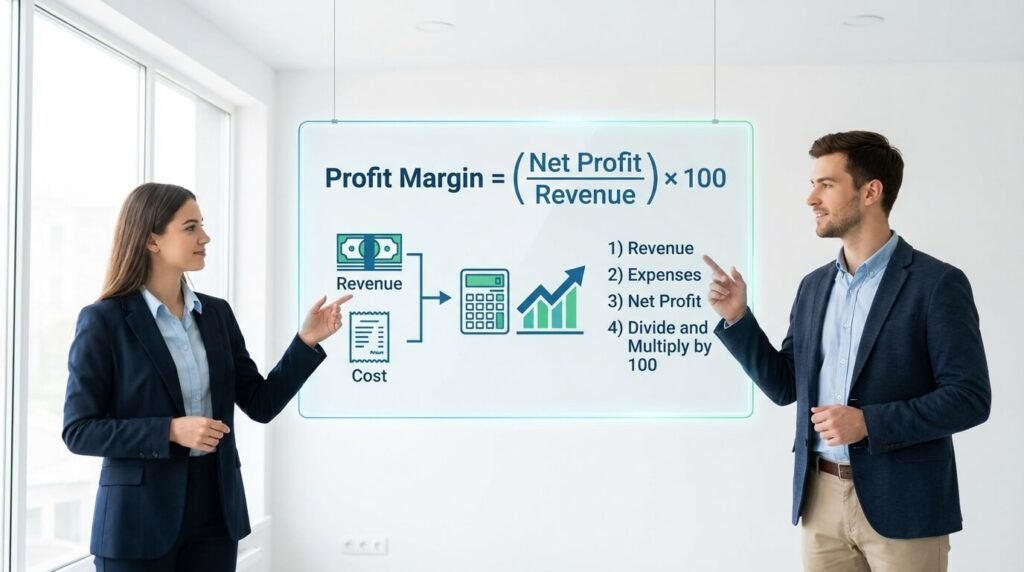
You only need basic math to find your margin. You do not need a fancy degree.
You use a specific formula to see how much cash you keep from every dollar you make.
The Exact Procedure You Need
First, find your Net Profit (Total Revenue minus Total Costs).
Second, divide your Net Profit by your Total Revenue.
Third, multiply that result by 100 to get your percentage.
Process: (Net Profit / Revenue) x 100 = Profit Margin Percentage
Imagine you run an online store selling digital courses to US customers.
1 . You make $10,000 in sales this month. This is your revenue.
2 . You pay $6,000 for web hosting, software tools, and digital ads. This is your total cost.
3 . You subtract $6,000 from $10,000. You have $4,000 left. This is your net profit.
4 . You divide 4,000 by 10,000. You get 0.40.
5 . You multiply 0.40 by 100. Your final number is 40%.
6 . Your margin is 40%. You keep 40 cents from every single dollar you make.
What Are the 3 Major Types of Profit Margin?
You cannot group all your expenses. You must break them down. Different costs tell you different stories about your company. You have three main numbers to track.
3 Major Types of Profit Margins
| Name of Margin | What It Measures | The Math Formula |
| Gross Margin | Production efficiency | (Revenue – Cost of Goods Sold) / Revenue x 100 |
| Operating Margin | Daily business efficiency | (Operating Profit / Revenue) x 100 |
| Net Margin | Total financial survival | (Net Profit / Revenue) x 100 |
1. Gross Profit Margin
This number tells you if your product costs too much to make. You only subtract the direct costs of making your item.
We call this the Cost of Goods Sold (COGS). If you buy a physical product from a factory for $20 and sell it for $100, your gross profit is $80. Your gross margin is 80%.
New US tariffs make COGS higher for many sellers. This pushes gross margins down.
2. Operating Profit Margin
This number tells you if your daily business habits cost too much. You take your gross profit and subtract everyday bills.
These bills include rent, staff wages, and marketing ads. You do not include taxes or bank loans yet.
If you waste money on bad Facebook ads, your operating margin drops fast.
3. Net Profit Margin
This is the final bottom line. You take your operating profit and subtract everything else. You pay your taxes.
You pay your bank interest. The cash left over is your net profit. You divide this by your total revenue.
This final percentage proves whether your company actually makes money.
Why Do People Confuse Margin With Markup?
This is the biggest math error new business owners make. They think these two words mean the same thing.
They do not. Mixing them up causes you to set prices too low.
Margin shows the percentage of the selling price that is profit.
Markup shows the percentage added to your cost to create the selling price.
Margin bases its math on the final sale price.
Markup bases its math on the factory cost.
An Easy Example of the Difference
You buy a desk for $60. You sell it for $100. You make $40 in profit.
Your Margin: You divide the $40 profit by the $100 sale price. Your margin is 40%.
Your Markup: You divide the $40 profit by the $60 cost. Your markup is 66.6%.
If you want a 40% margin, you cannot just mark up your product by 40%. If you buy a desk for $60 and mark it up 40% (adding $24), you sell it for $84.
If you sell it for $84, your actual margin drops to 28%. You will lose money if you do this math backward.
Why Does High Revenue Not Guarantee Business Success?
High sales do not equal success. Your expenses might grow faster than your sales. Paid ads can eat all your money.
Imagine an online store that sells $200,000 worth of goods this month. The owner feels great. But they spent $120,000 on Facebook ads.
They spent $60,000 on product manufacturing.
They spent $30,000 on staff. Their total expenses equal $210,000. They generated huge sales. But they lost $10,000.
How Can You Increase Profit Margins Without Losing Revenue?
You do not always need more customers. You need better money habits. You can extract more cash from the sales you already have. Here is how you do it today.
1. Audit Your Recurring Software
Many online businesses waste money here.
How to resolve
Download your bank statements right now. Look at the last 90 days. Find every monthly charge. Cancel tools you do not use. I run a digital content hub. I recently found I was paying for three different email tools. I canceled two. I saved $200 a month immediately. That is pure profit.
2. Increase Your Average Order Value
Getting a new buyer costs money. Make them spend more at checkout.
How to address
Add a simple upsell. If you sell a physical product, offer fast shipping for $5 more. If you sell digital products, offer a small audio guide for $10 extra. This costs you almost nothing to fulfill.
3. Adjust Pricing Strategically
US inflation is real. Your costs went up. Your prices must go up too.
Solution for
Do not change everything at once. Pick your best product. Raise the price by 4%. Most buyers will not care or even notice. You keep that extra money.
4. Negotiate Better Rates
You can get better prices just by asking.
How to handle
Contact three different software or shipping providers. Ask them for a price quote. Take the lowest quote to your current vendor. Ask them to match the price. They usually will.
What Is a Good Profit Margin for US Sellers?
A good margin depends entirely on what you sell. A grocery store and a software company cannot share the same benchmark.
Print-on-demand hits around 26% net margin. Dropshipping sits at 18%, high ad costs eat the difference.
A local grocery store survives on just 2% because it moves thousands of units daily.
Digital product businesses regularly hit 70% because shipping costs nothing and inventory doesn’t exist.
Your number only matters when measured against your own industry. Chasing someone else’s benchmark is how sellers make bad pricing decisions.
Why These Margin Numbers Are Getting Harder to Hit
Knowing your benchmark is one thing. Hitting it in 2026 is another problem entirely.
Ad costs are the biggest margin killer right now. Average eCommerce customer acquisition costs have increased 40–60% since 2021.
If your ad spend grows faster than your revenue, your profit shrinks even when sales look strong. One bad campaign can wipe out an entire month of earnings.
Returns make it worse. Average eCommerce return rates hit 16.5% in 2025 and are trending toward 18% in 2026.
Every return costs you shipping, restocking time and often the product itself. High returns quietly turn profitable months into losing ones.
Two numbers decide your survival. Gross margin tells you if your product is worth selling.
Net margin tells you if your business model is worth running. Track both every week, not monthly. Revenue alone tells you nothing useful.
Conclusion
You now know how revenue and profit differ. You know why tracking both will save your business.
Open a simple spreadsheet today. List your total revenue for last month. Below it, list every single expense, tax payment, and software fee.
Subtract the expenses from the revenue. Look at that final number. That is your real profit. Find one unused software tool today and cancel it.
Find one product and raise the price by 3%. Start protecting your cash right now.
FAQ
How do US revenue rules (ASC 606) change when I record a sale?
Under US accounting rules, you cannot record revenue just because you signed a contract.
You only recognize the revenue when you actually deliver the product or service to the customer.
What is deferred revenue in an online subscription business?
If a customer pays you $1,200 today for a one-year software plan, you do not have $1,200 in recognized revenue.
You have $100 in revenue for the first month. The remaining $1,100 is deferred revenue. This acts as a debt on your balance sheet until you provide the service.
Does selling gift cards count as instant profit?
No. When someone buys a gift card from your store, you collect cash, but you owe them a product.
You cannot count that cash as revenue or profit until the customer actually spends the gift card.
How does inventory counting (LIFO) change my tax bill?
If you use the Last-In, First-Out (LIFO) method, you count your most expensive, recently bought items as sold first.
This lowers your paper profit and legally reduces your tax bill.
Do I record payment processor fees before or after calculating revenue?
You record your full revenue first. If a customer pays $100, your revenue is exactly $100.
The $3 fee taken by a credit card processor is an operating expense. You subtract it later to find your net profit.
Can a business have negative profit but positive cash flow?
Yes. If you take out a large business loan, your bank account fills with cash. However, a loan is not revenue.
If your daily expenses still exceed your daily sales, your profit remains negative even though your bank balance looks high.
What happens to my profit if a customer demands a refund?
A refund directly reverses your recorded revenue. You must subtract the refunded amount from your top-line sales.
Because your operating expenses (like original shipping and ad costs) remain the same, a single refund hurts your final profit margin heavily.

Aliza Khatun is a Digital Marketing Professional and the founder of DigiGenHub. She has helped various businesses grow their online presence through real-world experience in marketing, branding, traffic growth, and business strategy.
Through DigiGenHub, she shows how to build and grow a business from the ground up using Website Setup, SEO, Branding, Paid Promotion, and smart digital tools.
She also highlights how AI can be used to its full potential to make content creation, automation, marketing, and business growth faster and smarter.
She believes that the right knowledge, modern technology, and the right tools can help any individual or business build a stronger online presence.