
AI PPC Management uses high-speed automation to handle bidding, targeting, and ad testing. This helps you to stop guessing and start using data to find real buyers.
I once worked with a client named Sarah. She ran a boutique home decor brand in the U.S. and spent $4,000 a month on ads with zero growth.
She spent every night manually changing bids for different cities. Sarah was exhausted and losing money.
I helped her switch to an automated bidding system that analyzed auction signals in milliseconds.
Within two weeks, the system found that her ads performed best on Thursday evenings in coastal states.
It moved her budget there instantly. Her sales increased without increasing her spend. This proved that humans must drive the strategy, but machines must handle the math.
How Does AI PPC Management Improve Audience Targeting
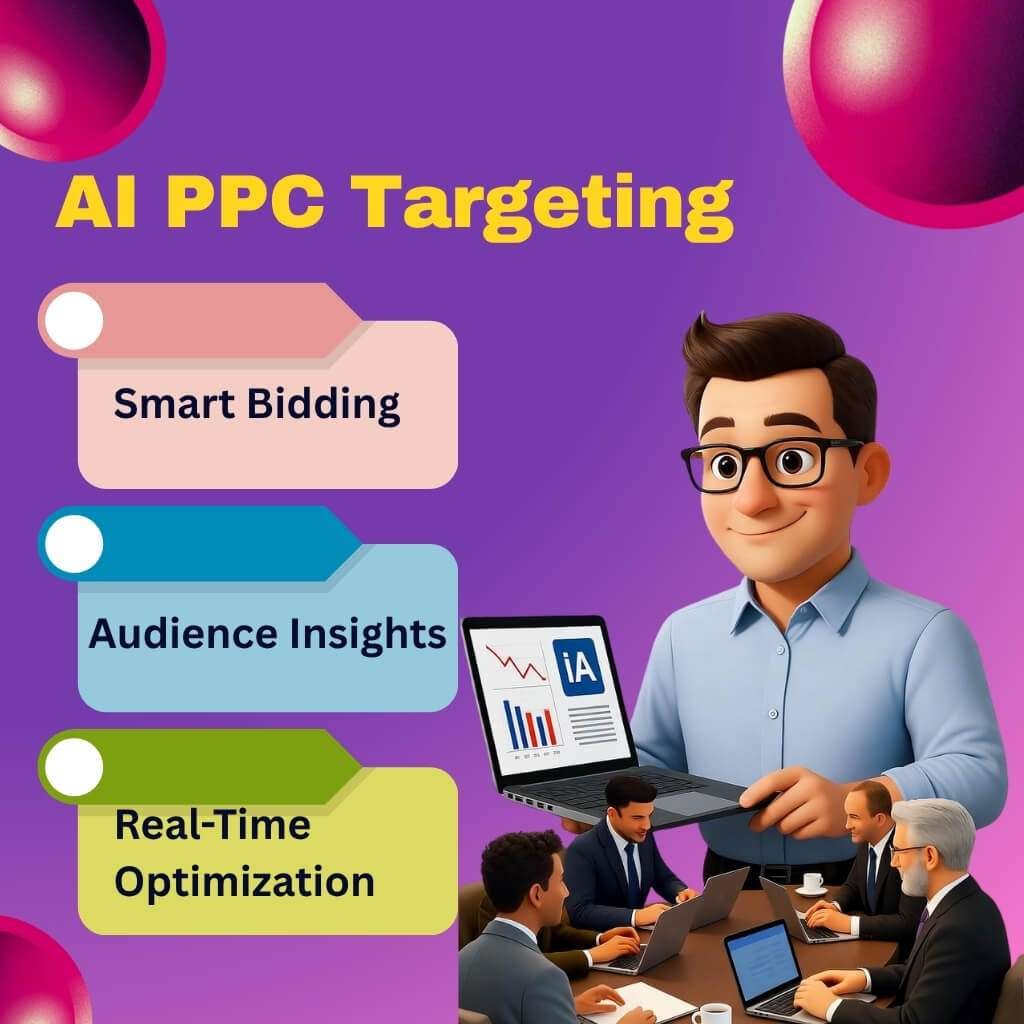
In the past, PPC campaigns were controlled by human hands. Marketers picked keywords. They set bids for the digital business.
They watched the metrics and adjusted each day. This worked when data was limited and campaigns were smaller.
Now things are different. Platforms handle far more user-signals, channels, formats and bids than humans can track manually.
Tools apply algorithms that monitor millions of interactions. The human role shifts from doing every tweak to supervising the machine’s work.
Agencies are reporting that firms relying solely on manual adjustments find it hard to keep up.
For example, a recent article highlights how PPC operations are merging into “AI-first formats … the granular controls you used to rely on keep disappearing.” Search Engine Journal
So, how does AI manage data and every aspect of PPC campaigns? Let’s explain through its components:
Machine learning for bids & budgets
The system reviews past results, user behaviour, device, geography and time of day. Then it raises or lowers bids to reach your goal (e.g., cost-per-acquisition).
Predictive analytics
The system forecasts which keywords, audiences or placements will convert. It then shifts the budget or targeting ahead of time.
Creative optimization
Instead of one headline per ad group, AI tests tens or hundreds of combinations: text, image, video. It picks top performers and drops weak ones.
Advanced targeting
The system uses patterns (search history, on-site behaviour, demographics) to build high-value segments or “lookalike” groups. It spots audiences you didn’t think to use.
Multi-channel orchestration
AI integrates across search, display, social and shopping. It allocates budget and creative assets in all places — not just Google Search.
Which Trends Make AI PPC a Must-Have?
We’re at a moment where several forces collide:
Privacy and data shifts
Third-party cookies are fading out. Apple and Google limit tracking. Advertisers must rely more on first-party data and smarter modelling. AI systems handle less complete, more complex data better than purely manual ones.
More channels, more formats
People use voice, video, mobile, TV, social and search. Ads must appear in many places. A manual person can’t coordinate all channels well. AI can.
Scale pressure
Big and mid-sized advertisers run dozens or hundreds of campaigns. The workload grows fast. Manual monitoring becomes a bottleneck.
AI tools have matured
Platforms like Optmyzr, AdCreative.ai and built-in features in Google Ads or Meta Ads Manager are no longer experimental. They deliver measurable gains.
Competitive urgency
Because advertisers adopt these systems, staying with manual methods may cost more in CPC/CPA. One 2025 report even calls PPC in 2026 “AI, Automation And The Fight For Visibility.”
What Benefits Can AI Bring to Your PPC Campaigns?
So, what advertisers can expect from using AI PPC management. Let’s count he major benefits worth your attention:
1. Saving time and resources
Running big PPC programs by hand takes hours. You manage bids, swap keywords and rotate ads daily.
With automation, much of that work gets handled by tools. That means staff shift from manual tasks to planning and insight work. A recent study found agencies using automation saw up to a 30% rise in ROI.
For advertisers in high-cost verticals, this means you don’t need large teams just to keep up. Your team can focus on growth and direction.
2. Better cost-effectiveness
Automated systems put more money where it pays off. They shift the budget away from low-performers and push it into strong performers.
In sectors like finance or SaaS, where each click costs a lot, this matters.
Google’s own documentation says automated bidding works to hit your target cost or value. (business.google.com)
For you: define CPA or ROAS goals clearly, let the system apply them and review regularly.
3. More personalized ads at a mass scale
People expect ads that speak to them. Today’s tools track behaviour, device, audience, past activity—then tailor ads accordingly.
In one U.S. ecommerce example, dynamic ads that used behaviour signals and machine-driven asset rotation improved conversion rates within weeks.
If you feed clean audience data and enable variation, you’ll see stronger relevance and higher conversions.
4. Scaling across channels with less friction
Managing search, shopping, social and video all separately drains resources and creates inconsistency. Modern platforms allow connected campaigns.
If one channel performs well, tools can move the budget to another channel faster. For high-CPC advertisers, scaling without a giant team is huge.
Your setup should include unified data, clear goals across channels and a dashboard view that shows how everything fits.
5. Discovering hidden demand
Traditional keyword lists will miss many converting search paths. Systems now find intent patterns, long-tail phrases and niche users.
For instance, a U.S. ecommerce brand uncovered a low-volume search phrase that converted at double their usual CPA. The system bid on it once the data confirmed the value.
You must allow your campaigns enough learning phase and avoid shutting off exploration too early.
6. Better forecasting and seasonal readiness
Campaigns that wait for bad performance to correct themselves lose time and money. Modern tools forecast demand shifts, seasonal trends and performance dips.
In U.S. markets where competition intensifies at specific times (holiday retail, tax season), that foresight gives you an advantage.
You should examine forecast outputs, decide budgets ahead of peaks and let tools apply suggestions.
7. Aligning creative assets with performance
Creative fatigue costs a lot when your CPCs are high. Automation helps rotate creatives, test assets and discover what works.
A U.S. brand improved its click-through and conversion numbers when it added creative testing with automation.
Action: create asset libraries, upload variations and allow the system to test without threatening brand integrity.
8. Clearer reports and faster insight
When you have large budgets, decision-makers want fast, accurate insight. Modern systems track signals humans often miss and clean up data into useful visuals.
Agencies report that automated reporting reduces dashboard build time from days to hours.
Make sure your reporting platform covers all channels and gives simple summaries for stakeholders.
9. Lower risk of human error
Manual work introduces mistakes—wrong bid caps, paused ad groups that should run and mis-defined audiences. Automation applies rules consistently and watches for anomalies.
For high-CPC accounts, even small errors cost big dollars. One U.S. legal advertiser found dozens of mis-set campaigns within weeks of switching to automated monitoring.
Your job: define your rules clearly, give the system the right inputs and check performance regularly.
10. Staying competitive in high-cost markets
If your cost per click is high and your competition adopts newer tools, doing things the old way puts you at a disadvantage.
Many U.S. marketers say ignoring modern PPC tools means higher costs or slower growth.
Why AI PPC Management Needs a Human Pilot
You will fail when you let the machine run without a plan. You should not set a budget and wait for a miracle.
But you will be a winner when you control signal quality. AI is a fast car, but you are the driver. If you feed the machine poor data, it will hunt for poor leads.
According to the 2026 Search Engine Journal PPC Report, 50% of experts now identify inconsistent data quality.
This is the biggest barrier to success. This link is the only way to hold authority without burning your bank.
The AI PPC Problem: Why Most Campaigns Burn Cash
Most advertisers fail because they feed the AI thin data or generic goals. Without a specific human guardrail, the machine chases low-cost clicks.
This never turns into high-value sales. This automation gap leads to wasted budgets and invisible brands in a crowded U.S. market.
The Strategy Bridge: The Signal Quality Loop
In my experience leading online growth groups, I have seen millions of dollars lost to “Black Box” automation.
AI is a fast engine, but you are the fuel. If you send the machine “junk” leads, it will find more junk.
To succeed today, you must manually connect your CRM sales to your ad bidding.
This tells the machine exactly what a profit looks like. This link between your real sales and the machine’s speed is how you hold authority without burning capital.
Automated Bidding Logic
Bidding is no longer about picking a number. It is about predicting a result. Modern systems analyze millions of signals like a user’s device, time of day, and even local weather, before they place a bid.
In the U.S. market, where competition is high, this ensures you only pay for the most likely buyers.
According to Forresters 2026 AdTech Report, firms using predictive bidding see a 35% drop in cost-per-acquisition.
Expert Suggestion
Set “Max Bid Caps” on your campaigns. Even the best AI can overbid during a holiday rush.
For example, if your average sale is $100, do not let the machine bid more than $10 per click.
Predictive Keyword Discovery for High-Intent Buyers
Keywords have shifted from “What” people type to “Why” they type it.
Traditional keyword lists are dying. Predictive models now cluster search phrases by thematic intent.
They find “long-tail” opportunities that humans miss. In 2026, Google Ads Smart Bidding Data shows that intent-based matching captures 40% more traffic than exact-match lists.
How to do this
Don’t just add words. Add “Negatives” daily. If you sell “Premium Coffee,” the AI might show your ad for “Free Coffee.”
You must manually block words like “Free” or “Cheap” to save your budget. This keeps your brand aligned with high-value U.S. customers.
Advanced Audience Targeting and Digital Twinning
AI targets behaviors, not just demographics.
We use “Digital Twinning.” This creates a virtual profile of your ideal buyer based on your first-party data.
The machine then finds real people who act like that twin. This avoids the privacy issues of 2025 and focuses on actual buying patterns.
HubSpot’s 2026 State of Marketing reports that first-party targeting improves conversion rates by 42%.
Personal Overview:
I often tell my clients that demographics (age/gender) are too broad for the USA.
A 25-year-old in New York buys differently from one in Texas. Use behavior signals, like how long they stayed on your site, to build your audience. This is more dependable than any age bracket.
Generative Ad Creative and Variation Science
Machines can now generate 100 versions of an ad in seconds. They test which headline works best for which user.
This ensures your audience never sees a “boring” ad. Statista Ad Trends 2026 shows that dynamic creative assembly reduces ad fatigue by 60%.
How to do this:
Provide five different headlines and three distinct images. Let the machine mix them.
For example, use one headline that focuses on “Speed” and another on “Quality.”
The machine will learn which one your customers prefer. Then it spends money there.
Fraud Protection and Click Security
Ad fraud costs businesses billions each year. Modern AI tools now track “Behavioral Biometrics,” how a mouse moves or how fast a form is filled, to spot bots.
According to FTC Truth-in-Advertising Standards, protecting your ad spend from invalid traffic is a top priority for sustainable growth.
Top Ad Management Methods
| Feature | Manual Management | Basic Automation | AI Strategy |
| Bidding Speed | Weekly/Daily | Hourly | Milliseconds |
| Data Source | Keywords | Platform Data | First-Party CRM |
| Fraud Check | Manual Audits | Blacklists | Behavioral AI |
| Creative | 1-2 Static Ads | Simple Rotation | Dynamic Assembly |
Conclusion
AI PPC Management is a powerful engine that requires a human pilot. To secure your profits, you must bridge your sales data with the machine.
This ensures you buy high-value leads and block wasted spend. Combine your internal sales data with predictive bidding.
This creates a “Signal Loop” that makes your brand the authority in your niche. Stop chasing clicks and start hunting profit.
FAQ
Can AI adjust bids based on shipping delays?
Yes. Systems track U.S. logistics. If a storm delays trucks in the Midwest, the AI pauses ads there. This protects your brand from negative reviews.
What is zero-party data for ads?
This is data customers share willingly, like quiz results. AI uses this to build personal product paths. This creates a higher conversion rate.
How does AI manage green bidding for U.S. brands?
Younger buyers want eco-friendly brands. AI tracks your carbon-neutral badges. It shows them only to users who care about sustainability.
Does AI PPC help with store foot traffic?
AI uses geofencing with intent. It shows ads to people near your store who searched for your products. This drives them through your door.
How does AI handle biorhythm bidding?
AI adjusts bids based on the time of day. It raises bids for coffee in the morning and sleep aids at night. This matches the user’s natural needs.
What is cross-device identity without cookies?
AI links a search on a phone to a sale on a Mac. It uses private emails to prove the path. This gives you a clear view of your sales journey.
How does AI manage buy-now-pay-later intent?
AI detects price-sensitive users. It shows flexible payment ads to them. It shows premium-quality ads to high-income earners.
Can AI block competitor click wars?
AI tracks IP patterns. If many clicks come from one office building, the AI hides your ad from them. This saves your capital from attacks.
How does AI handle second-screening during TV events?
U.S. users browse phones while watching TV. AI raises bids when your industry is mentioned on live shows. This captures sudden curiosity.

Aliza Khatun is a Digital Marketing Professional and the founder of DigiGenHub. She has helped various businesses grow their online presence through real-world experience in marketing, branding, traffic growth, and business strategy.
Through DigiGenHub, she shows how to build and grow a business from the ground up using Website Setup, SEO, Branding, Paid Promotion, and smart digital tools.
She also highlights how AI can be used to its full potential to make content creation, automation, marketing, and business growth faster and smarter.
She believes that the right knowledge, modern technology, and the right tools can help any individual or business build a stronger online presence.