
TL;DR
You already have the content. Most of your audience never saw it.
The average person uses nearly seven social platforms monthly. One blog post can feed all of them.
Pull five ideas from it. Adapt each one for a different platform. Schedule them across two weeks.
This is how to repurpose content for social media without burning out or starting from scratch.
A solid content repurposing strategy lifts results by 75 percent without proportional effort.
Short-form video drives the highest ROI. LinkedIn rewards frameworks. Instagram rewards carousels.
Reddit and YouTube feed AI search engines that answer your audience’s questions daily.
Write every post to answer one question in the first two lines. Track saves, profile visits, and click-through weekly.
One piece of content, distributed smart, reaches audiences you have never touched before.
The Problem Most Marketers Have
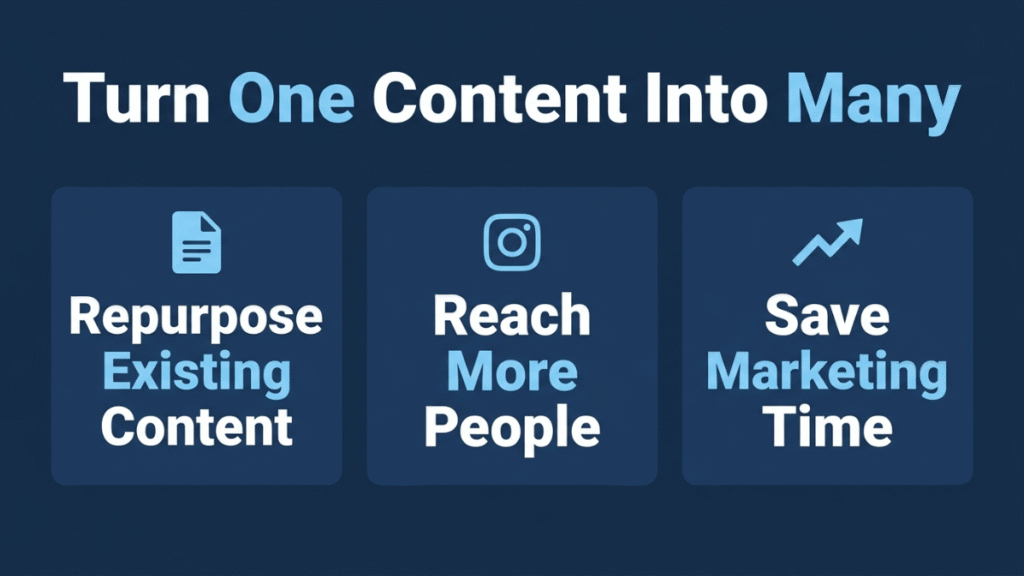
You already wrote the blog post. You already recorded the video. You already answered those customer questions fifty times over email.
None of that content is working hard enough yet.
The average person uses 6.8 different social media networks per month. They spend more than 14 billion hours on social platforms every single day.
Yet most marketers still create channel-specific content from scratch on every cycle.
That is the gap. It is costing you time, reach, and revenue.
My next-floor neighbour runs a small online fitness coaching program for women. She posted on Instagram every day.
Traffic stayed flat. Her content was good. Her problem was simple: she treated every platform as a separate job.
I showed her one thing. Take your best blog post. Pull it apart. Five Instagram carousel slides.
Two LinkedIn posts. Three YouTube Shorts scripts. One email newsletter. All from one article she already wrote. Her profile visits doubled in five weeks. She created nothing new.
That process is called content repurposing for social media. It is now the fifth most popular digital marketing trend of the year, according to HubSpot’s 2026 State of Marketing Report.
Why Creating Fresh Content Every Day Is Hurting You
Every time you start from scratch, you lose.
You lose time on research. You lose energy on writing. You lose consistency on publishing. Then the post disappears in 48 hours and you repeat the cycle.
A long-form blog post can become 10 LinkedIn posts, 3 Instagram carousels, a YouTube script, 5 TikTok videos, and an email newsletter, with a fraction of the effort required to create each from scratch.
That math changes everything.
Still, most people skip it. 48 percent of B2B marketers identify not enough content repurposing as one of their biggest challenges in scaling content production.
The knowledge is there. The system is not.
Here is the difference between repurposing and copy-pasting:
| Copy-Paste | True Repurposing |
| Same caption on every platform | Adapted tone and format per platform |
| Posted once, forgotten | Distributed over 2 to 4 weeks in stages |
| Looks lazy to algorithms | Feels native, earns more reach |
| One audience sees it | Every platform audience sees it |
| Zero extra value created | Each post stands alone with a new angle |
Identical captions and hashtags posted across platforms can result in accounts being flagged for spam.
At minimum, customize the caption, format, and hashtags for each platform. Repurposing done right is adaptation, not duplication.
What Content Is Worth Repurposing First
Not everything deserves repurposing. Pick the wrong pieces and you waste your time.
Start with these three types:
1. Your highest-traffic blog posts
Check your Google Analytics. Find your top five posts by traffic. Those already proved audience interest. They are your best starting material.
2. Customer questions you answer repeatedly
Every question a client asks in a DM or email is a validated content idea. Someone else is searching for that exact answer right now. Turn your reply into a post.
3. Evergreen content
Evergreen content lasts up to two years. That happens when you keep it updated and push it into fresh formats.
A typical social media post dies within hours. A blog post peaks in four to six weeks without active promotion. Evergreen content beats both.
Skip time-sensitive posts. Skip platform-specific jokes. Skip anything tied to old news. Those confuse new audiences fast.
Start with your strongest material. Pick blog posts already pulling organic traffic. Pick videos people watched all the way through.
Pick podcast episodes your listeners shared or quoted. Pick webinars, original research, and customer case studies. Those are proven. They work once. They can work again.
Weak content stays weak across six platforms instead of one. Choose your best before you repurpose anything.
Real-World Repurposing Breakdown: One Piece, Five Platforms
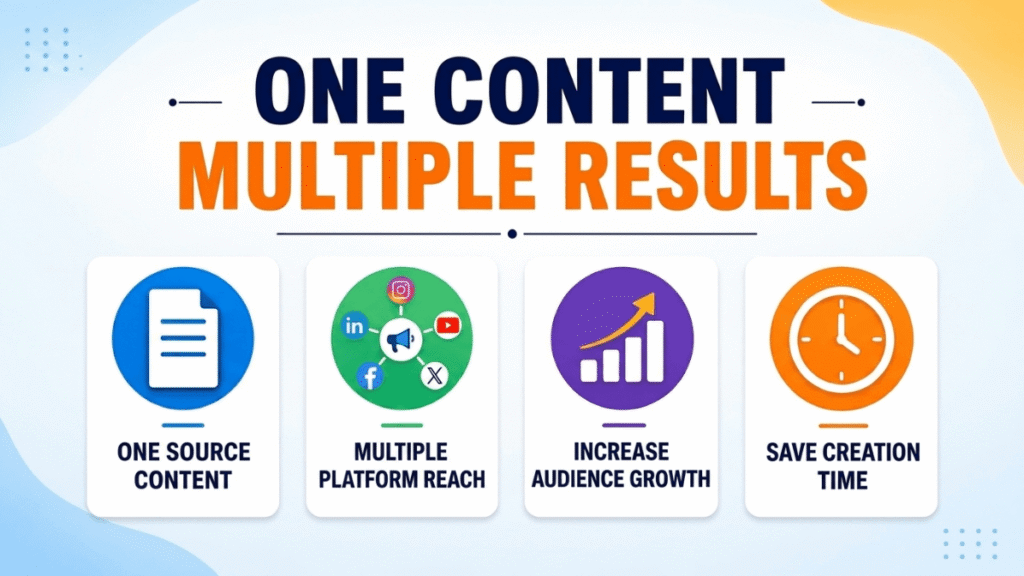
Here is what repurposing looks like in practice, not theory.
Source piece: a 1,500-word blog post titled “Why Small Businesses Lose Customers in the First Week.”
- LinkedIn: A numbered post listing the top three reasons, plain text, no images. 847 impressions. 34 profile visits.
- Instagram Carousel: Five slides, one reason per slide, bold headline on each. 412 saves. Best-performing post that month.
- TikTok Script: Pulled the most surprising stat. Recorded in 38 seconds. 6,200 views.
- Email Newsletter: Three takeaways, two sentences each, one link. 31 percent click-through rate.
- Reddit Thread: Posted the core argument as a question in r/smallbusiness. 74 upvotes, 19 comments, and ranking in AI search results within two weeks.
Total new content created: zero. Total time to adapt: 80 minutes.
The Exact Formats That Win on Each Platform
Each platform rewards a different format. Use this as your targeting guide every week.
Carousels outperform raw infographics in 2026. Here is why. If someone views your first slide without engaging, Instagram may show them a different slide later. That gives your post a second chance at attention.
Take one blog post. Pull five tips. Put one tip per slide. Write a strong hook on slide one. That is your carousel done.
LinkedIn is not just a networking tool anymore. It is a full content and community platform. Video adoption is growing fast there. For B2B content distribution, it remains one of the highest-value platforms available.
Take a blog post. Turn it into a numbered framework post. Plain text only. Short paragraphs. One insight per line. Cut everything else.
TikTok and Instagram Reels
Short-form video drives the highest ROI of any format right now. 48.57 percent of marketers call it their top-performing format, according to HubSpot’s 2026 State of Marketing Report.
Pull the most surprising fact from your content. Record a 30- to 45-second video. Your phone works fine.
YouTube Shorts
YouTube Shorts hit a 5.91 percent engagement rate in Q1 2024. That was the highest of all short-form video platforms at the time.
Find the strongest 45-second moment in any long video. Add captions. Post it as a Short. No new recording needed.
X (Twitter)
Find one strong statistic or a contrarian point. Turn it into a thread. Open with a bold one-liner. Expand across five to seven short posts. Close with a link to the full piece.
Build a discussion thread from your article’s main argument. End with a direct question. Reply to comments without pitching anything.
Reddit sits among the most-referenced domains by major AI models. Every post you publish there feeds AI search results. Your content reaches two audiences at once: your followers and the AI systems millions of people use to find answers.
Email Newsletter
Repurposing blog content into email sequences delivers a median return of $36 per dollar spent, according to research cited by multiple marketing sources. It also cuts the pressure of producing fresh email content every week.
Pick three takeaways from your post. Write two sentences on each. Add one link. Send it. That is a complete newsletter issue.
The Weekly Repurposing Workflow
Run this once a week in 90 minutes.
Step 1: Pick one strong source piece
Choose a blog post, podcast episode, webinar, or interview. It needs at least 1,000 words or 15 minutes of content to extract enough material.
Step 2: Pull your content atoms
A content atom is one standalone idea. Pull these from your source piece:
- Two to three key statistics with named sources
- One step-by-step process or framework
- One surprising or contrarian insight
- One before-and-after result or example
- Three direct answers to questions your audience asks
Each atom becomes a separate post.
Step 3: Match each atom to a platform
- The framework goes to LinkedIn as a numbered post
- The surprising insight goes to TikTok or Reels as a hook video
- The step-by-step goes to Instagram as a carousel
- The statistic goes to X as a thread opener
- The Q&A answer goes to Reddit as a discussion post
- All three takeaways go to your email newsletter
Step 4: Adapt tone for each platform
LinkedIn reads professional. Instagram reads casual. TikTok reads conversational. Each platform has its own language. Write for the platform, not for yourself.
Step 5: Batch and schedule in one session
Create everything at once. Schedule it all across the week. Then close the tab and move on.
This content batching workflow dramatically reduces the daily cognitive load of maintaining a social media presence.
Step 6: Stagger the posts over two to four weeks
Publish variations over two to three weeks, not two to three days. Use different hooks, different angles such as mistakes versus checklists versus myths, and different formats like carousels versus short video versus text.
Your audience follows you on multiple platforms. Staggering prevents repetition from becoming obvious.
Writing Repurposed Posts That Get Found by AI Search
In 2026, your audience does not only scroll feeds. They ask ChatGPT, Perplexity, and Google AI for answers.
Over 60 percent of Google searches now end without a click to a third-party website, and AI-generated answers are accelerating this shift. AI-referred sessions jumped 527 percent year-over-year in the first five months of 2025.
Every post you publish on LinkedIn, Reddit, and YouTube feeds AI systems. Large language models index public posts from these platforms constantly to answer user queries. When someone asks an AI a question your post answers, your content has a chance of being cited.
Write every post so it directly answers one specific question in the first two lines. Use numbered steps instead of long paragraphs. Add one verifiable fact with a named source. Keep one topic per post, not a mix of ideas.
That writing style earns engagement from social followers. It also earns citations from AI systems that answer questions for millions of people every day. Social media, SEO, content marketing, and PR all contribute critical data that large language models consume to generate their responses.
Post consistently on Reddit, LinkedIn, and YouTube. Those are among the most-referenced domains by major large language models. Every post you publish there is visible to two audiences: your followers and the AI engines your potential customers use.
One piece of content. Written once. Distributed smart. Found everywhere.
How to Know If Your Repurposing Is Working
Track one metric per platform each week. Just one.
On Instagram, watch saves. Not likes. Saves mean someone found your post useful enough to come back to it. On LinkedIn, check profile visits after each post goes live. On email, track click-through rate back to your original article.
A strong repurposing system lifts source content traffic by 15 to 30 percent within the first month. That is the benchmark to aim for.
If one format underperforms for four straight weeks, swap the format. Not the content. Your source material is fine. Only the delivery needs changing.
Keep a simple weekly scorecard. Three numbers only: reach, saves, clicks. It takes five minutes. Those numbers tell you exactly where to focus next week.
Algorithm changes affect reach. They do not affect content quality. When a platform shifts its algorithm, some formats drop temporarily. That is normal.
Watch your analytics every week. If a format loses reach for two consecutive weeks, test something different. Carousels dropping? Pull the same material into a short video. The content holds its value. Only the format needs a swap.
Who Gets the Highest ROI from Repurposing
Repurposing pays off most for creators publishing at least one solid piece per month. Less than that? Build your source library first.
Publishing weekly? This system scales directly. One new piece feeds four platforms for the full month. One writing session. No daily scramble.
Solo creators and small teams gain the most. You skip the overhead of a content team while matching the output of larger brand accounts through smarter social media content distribution, not more hours.
Top Tools to Repurpose Content for Social Media in 2026
Pick one based on your main starting format. You do not need all of them.
| Tool | Best For | Starting Price | Free Plan |
| Opus Clip | Long video to AI-highlighted short clips | ~$19/mo | Yes |
| Descript | Edit video and audio by editing text | $15/mo | Yes |
| Castmagic | Podcast or webinar to posts, show notes, newsletter | ~$29/mo | Trial |
| Lumen5 | Blog post to video | $29/mo | Yes |
| Canva | Text or blog to carousel graphics and visuals | $13/mo | Yes |
| Buffer | Schedule posts and AI caption generation | $6/mo per channel | Yes |
| Repurpose.io | Auto-distribute video and audio across platforms | ~$21/mo | No |
Choose by your starting format:
- You start with video or audio: Opus Clip, Descript, or Castmagic
- You start with a blog post: Lumen5 or Canva
- You need auto-distribution: Repurpose.io
- You need scheduling with AI captions: Buffer
For solo creators and small businesses, start with Canva and Buffer. Both have free plans and cover 80 percent of what most people need.
Three Mistakes That Kill Repurposing Results
Most people start repurposing and see weak results. They blame the strategy. The strategy is not the problem. The execution is.
These three mistakes are the most common. They are also the easiest to fix.
Mistake 1: Repurposing weak content
Start with your proven pieces, not your newest ones. Weak content becomes weak posts on six platforms instead of one.
Mistake 2: Skipping captions on video
Most people watch video without sound. With over 99 percent of social media users logging in via mobile, every piece of content needs to be mobile-first. Captions are not optional.
Mistake 3: No call to action
Every repurposed post needs one specific next step. Save this. Comment below. Read the full article. No CTA means no conversion.
How to Keep Repurposed Content Feeling Fresh
Two techniques that prevent content fatigue:
Change the angle, keep the data
A post about “5 ways video increases conversions” becomes “The video mistake that cuts your conversions in half.” Same research. Completely different angle. New audience response.
Update the statistic
Find a number in your old content. Search for the 2026 version of that stat. Swap it in. That one change makes six-month-old content feel current and adds new value for returning readers.
I once worked with a client who runs an e-commerce accessories store. He had a detailed FAQ page sitting on his website that nobody read.
We pulled twelve individual questions from it. Each one became a separate Instagram carousel.
Each carousel performed better than any of his paid ads that month. The content existed for two years. It just needed a new format and a new home.
Posting less but delivering content that feels native to each platform cuts through clutter far better than posting more.
Conclusion
Your audience is scattered across seven platforms. Most of them never saw what you published last month.
46 percent of marketers identify content repurposing as the single best-performing content marketing strategy, outperforming both original content creation and content updating separately, according to ReferralRock.
The businesses growing fastest on social media in 2026 are not creating more. They are distributing smarter.
Pick one piece of existing content today. Pull five ideas from it. Adapt each one for a different platform. Write each post so it directly answers one specific question. Schedule them for this week.
That is the full system to repurpose content for social media in 2026. No extra budget. No new research. Just the work you already did, placed in front of the people who were not there the first time.
FAQ
Can I repurpose content for social media from the competitors top-performing posts?
You cannot copy their content. But you can use their top posts as inspiration legally.
Find a competitor’s post with high engagement. Identify the topic angle that attracted attention.
Create your own original content on that same topic with your own perspective, data, and examples.
This is called topic mining. It is 100 percent legal and widely used by professional content strategists. The idea belongs to no one. The execution belongs to you.
Does posting repurposed content at different times of day affect performance?
Yes, significantly. Each platform has peak activity windows. LinkedIn performs best Tuesday through Thursday between 8 AM and 10 AM in your audience’s time zone.
Instagram peaks on weekdays between 11 AM and 1 PM. TikTok performs strongest between 7 PM and 9 PM.
Posting the same repurposed content at peak times versus off-peak times can double your reach without changing a single word. Always check your platform analytics for your specific audience’s active hours.
Should I repurpose content for social media differently for B2B versus B2C audiences?
Yes. B2B audiences respond to data, frameworks, and professional insights. LinkedIn carousels with numbered steps and case study results work well.
B2C audiences respond to emotion, storytelling, and visual appeal. Instagram Reels and TikTok videos with relatable scenarios perform better.
The source content can be identical. The tone, format, and platform choice must shift based on who is reading and why they care.
How do I handle outdated statistics in older content before repurposing it?
Never publish repurposed content with expired data. Before adapting any old piece, run a quick search for the most current version of every statistic it contains.
Replace outdated numbers with 2025 or 2026 figures from named sources. Add the year next to every stat.
This signals credibility to readers and to AI search engines that surface your content as a current reliable answer. One updated stat can make two-year-old content feel completely current.
What happens to repurposed content performance when a platform changes its algorithm?
Algorithm changes affect reach but not content quality. When a platform shifts its algorithm, formats that previously performed well may drop temporarily.
Monitor your analytics weekly. If one format drops in reach for two consecutive weeks, test a different format from the same source content.
Carousels underperforming? Switch to short video from the same material. Your source content stays valuable. Only the delivery format needs adjusting when algorithms shift.

Aliza Khatun is a Digital Marketing Professional and the founder of DigiGenHub. She has helped various businesses grow their online presence through real-world experience in marketing, branding, traffic growth, and business strategy.
Through DigiGenHub, she shows how to build and grow a business from the ground up using Website Setup, SEO, Branding, Paid Promotion, and smart digital tools.
She also highlights how AI can be used to its full potential to make content creation, automation, marketing, and business growth faster and smarter.
She believes that the right knowledge, modern technology, and the right tools can help any individual or business build a stronger online presence.