
You may come online with one clear goal. You want to run a product business without a warehouse, without upfront inventory, and without taking a big financial risk.
The Print on demand niches give you that opportunity. But the 1 pain point? Most new sellers still pick the wrong niche and wonder why nothing sells.
So, you must identify the exact questions people search most about print on demand niches right now.
Which niches earn money now? Which ones are already too crowded?
How do you pick a winner before you waste time designing? What does your store need to look like? And how do you go from zero to first sale?
Why Niche Focus Is the Factor in POD Success
Generic stores do not sell. This is not an opinion. The data confirms it.
Sellers who combine a buyer’s identity with their specific interest create products that big brands will never bother making. That intersection is where the money lives in print on demand niches.
Think about this:
- A “funny shirt” store speaks to no one
- A “funny shirts for ER nurses who love hiking” store speaks to a real, identifiable person
- That person buys faster, pays more, and tells coworkers
Profitability in POD comes from emotional pull. People pay more for products that reflect their identity, not just their taste.
The core formula: Niche = Identity + Interest
| Winning Micro-Niche | Identity | Interest |
| Golden Retriever Coffee Mugs | Golden Retriever Owner | Coffee Lover |
| Veteran Woodworker Tees | Retired Veteran | Woodworking |
| Grandma Gardener Apparel | New Grandma | Gardening |
| Dev-meets-Trail Merch | Software Engineer | Hiking |
| Nurse True Crime Humor Products | ER Nurse | True Crime |
| Cat Zodiac Home Decor | Cat Mom | Astrology |
A neighbor of mine, Rachel, runs a small dog-sitting business from home. She came to me frustrated.
She had uploaded 40 generic “dog lover” designs to her Etsy store and made exactly three sales in four months.
I sat with her for one afternoon and showed her one shift: breed-specific pet products only.
We narrowed her entire shop to Golden Retrievers. Within 60 days, she had 27 sales and her first repeat customer.
The niche did not change what she sold. It changed who she spoke to. That one shift changed everything.
25 Most Profitable Print on Demand Niches in 2026
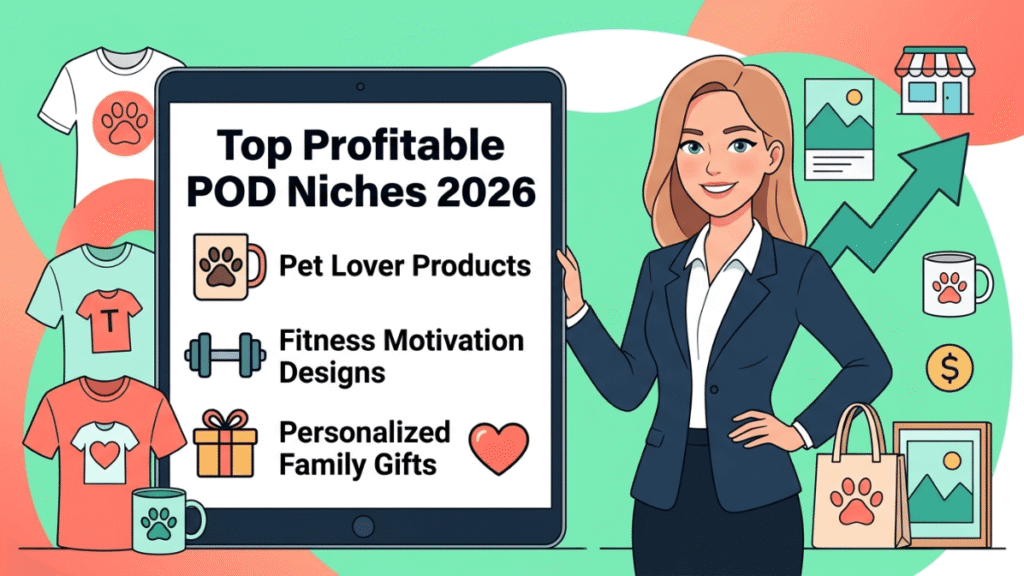
Let’s explain the niche below that targets a clearly separate audience, product type, and buyer motivation.
1. Breed-Specific Pet Products (with AI Personalization)
Roughly 66% of American households own a pet. The US pet care market is worth over $150 billion. It grows at over 5% every year.
However, “pet lover” is too broad for a store. Top sellers focus on specific breeds.
They combine these specific breeds with AI personalization tools. This strategy brings in the highest profits.
A Golden Retriever owner rejects generic paw print mugs. They want a mug that only Golden Retriever owners find funny.
The market has shifted toward deeper personalization. AI now generates custom dog portraits inside famous paintings.
It turns pets into cartoon heroes. It creates personalized prints with specific breed details and names.
Every pet owner thinks their animal is unique. AI proves them right on a physical product.
Best products: Custom mugs, framed canvas prints, personalized blankets, tote bags, phone cases
Sub-niches that convert: Dog mom by breed, cat dad humor, pet memorial tribute art, AI pet portrait canvas, breed-specific “only owners get it” humor
Margin range: 25–55%
2. Profession-Specific Apparel
Nurses, firefighters, truck drivers, tradespeople, and veterinarians carry a strong identity around their job.
These workers buy merchandise made specifically for them. Profession-focused products outperform generic designs. Buyers ignore high prices when an item matches their personal identity.
Best products: T-shirts, hoodies, mugs, tote bags, stickers
Sub-niches that work: “Night shift ER nurse who runs on caffeine,” “Electrician dad who fixes everything except the attitude,” “Dental hygienist humor” — go deep, not wide.
Margin range: 20–38%
3. Teacher Appreciation and Classroom Culture
Teachers form one of the most loyal and vocal POD buyer communities online. They follow teacher accounts, share teacher humor on TikTok, and shop heavily around Teacher Appreciation Week in May and Back to School in September.
This niche sits apart from general profession-based apparel. Teachers have a standalone cultural identity, dedicated seasonal spikes. A gifting economy driven by parents, students, and fellow teachers.
Best products: T-shirts, tote bags, mugs, personalized classroom signs, sticker sets, desk prints
Sub-niches: Grade-specific (“Kindergarten teacher life”), subject-specific (“English teacher who also over-annotates grocery lists”), “coffee keeps teachers teaching” humor
Margin range: 20–35%
4. Faith and Inspirational Decor
Faith-based POD is one of the most consistent earners across all platforms. Buyers have high intent and low price sensitivity.
Gift categories like faith decor carry approximately 2 times higher willingness to pay than self-purchase categories and show slower demand decay across seasons.
Best products: Canvas prints, wall art, mugs, journals, apparel
What sells best: Scripture combined with a profession (Christian nurse, faith-based veteran), church community merch, milestone anniversary faith art, baptism and confirmation gifts
Margin range: 25–50%
5. Home Decor and Premium Wall Art
The home decor segment is growing at approximately 28% CAGR, faster than the overall POD market. Coherent Market Insights
A canvas print that costs $15 to produce sells for $45–80. A framed poster costs $10 and sells for $35–60. Margins run 2 to 3 times higher than apparel, with far less competition.
Emerging sub-trends for 2026 include plaster-look, impasto, and 3D-effect printed canvases commanding premium prices at almost no competition.
Best products: Canvas prints, framed posters, metal wall art, throw pillows, wood signs, textured art prints
Sub-niches: Minimalist botanical prints, astronomy and space wall art, city skyline collections, abstract geometric patterns, vintage map reproductions
Margin range: 30–65%
6. Mental Health Awareness Apparel
People now wear their mental health identity openly. Designs around therapy humor, self-care affirmations, and anxiety awareness convert especially well with millennials and Gen Z buyers.
The wellness industry tied to personalization is projected to jump from $4.6 billion in 2025 to over $26 billion by 2035.
Best products: T-shirts, hoodies, tote bags, mugs, journals
Angle that works: Relatable and warm humor, not clinical language. “My therapist knows everything,” “anxiety is my cardio,” and “unbothered (mostly)” style copy converts consistently.
Margin range: 20–35%
7. Nursery Decor and New Parent Gifts
New parents spend heavily and gift generously. This niche carries a high average order value. Buyers rarely price-shop for a gift for a newborn.
Grandparents, aunts, and close friends drive most purchases, making this a gift-driven niche with emotional urgency.
Gender-neutral designs in soft pastel hues perform well for minimalist-minded parents, while personalized name prints with birth date and weight details are top sellers.
Best products: Personalized name canvas prints, custom baby milestone blankets, nursery wall art sets, baby onesies, growth chart prints
Sub-niches: Gender-neutral minimalist nursery art, personalized birth announcement prints, “big sibling” announcement tees, grandparent gift sets tied to the new baby
Margin range: 30–55%
8. Sustainability and Eco-Conscious Living
Shoppers are increasingly drawn to products that reflect sustainability, clean living, and conscious consumption.
A McKinsey 2026 report highlights a consumer shift toward durability and environmental responsibility.
And 64% of Gen Z will pay a premium for sustainably marketed products, a trend tracked closely.
POD has a built-in sustainability story: items are only produced after a sale, eliminating overproduction waste.
Best products: Organic cotton totes, eco mugs, canvas bags, reusable drinkware, plant-based apparel
Sub-niches: Plant parent lifestyle, zero-waste home culture, “cottage core” eco aesthetic, eco-minimalist home decor
Margin range: 20–38%
9. Humor and Sarcasm Apparel
Humor is one of the most shareable niches in POD. Funny, witty content spreads organically on TikTok and Pinterest, which cuts your marketing cost.
Simple graphics or text-based sarcasm sell well and are fast to produce and test.
The winning formula is niche humor, not broad humor. “I survived another meeting that could have been an email” speaks to a far more specific person than any generic funny shirt.
Best products: T-shirts, mugs, hoodies, phone cases, coasters, posters
Sub-niches: Office worker sarcasm, parent life humor, introvert humor, “overthinker” identity jokes, profession-specific dark humor (nurse, IT worker, accountant)
Margin range: 20–38%
10. Outdoor and Adventure Lifestyle
The outdoor clothing market is projected to grow by $7.4 billion from 2025 to 2029. This is an identity niche.
People who hike, camp, kayak, fish, and live in a van do not just enjoy the outdoors. They build their entire identity around it.
Target low-competition sub-activities: bowfishing, spearfishing, glamping, and solo backpacking have far less competition than broad “hiking” or “camping.”
Best products: Hoodies, t-shirts, water bottles, beanies, stickers, hats
Sub-niches: National Park obsession, trail running culture, lake life, RV and van life, fly fishing humor, glamping lifestyle
Margin range: 20–42%
11. Astrology and Zodiac Culture
A significant share of U.S. society follows astrology as a hobby or self-discovery tool.
Products featuring Sun signs, Moon signs, rising signs, and constellation elements sell year-round with a clear spike around birthdays.
Gen Z drives this niche hard. 49% of them want products made specifically for them.
Best products: T-shirts, mugs, tote bags, wall art, phone cases, custom candle labels
Sub-niches: “Chaotic Gemini” sarcasm style, birth chart art prints, zodiac home decor, astrology meets pet owner crossover (“my dog is such a Scorpio”)
Margin range: 20–40%
12. Wedding and Bachelorette Party Merch
Wedding-adjacent apparel creates a group purchasing dynamic — one bride drives 6 to 12 purchases.
Bachelorette party shirts, bridesmaid hoodies, and “team bride” merchandise have predictable search patterns and high average order values. One sale here often means one buyer purchasing for an entire group.
Best products: Matching hoodies, custom T-shirts, tote bags, personalized mugs, satin robes
Sub-niches: “Bride tribe” sets, destination bachelorette city tees, bridal party role titles (MOH, bridesmaid, flower girl), wedding anniversary keepsakes
Margin range: 30–52%
13. Graduation and Senior Year Merch
Class of 2026 shirts and graduation hoodies have a clear seasonal peak in May–June but sell year-round for December and spring ceremonies.
A generic “Class of 2026” shirt sells for $20. A personalized one with name, degree, and school colors sells for $35–50. The personalization premium is consistent and predictable.
Best products: T-shirts, hoodies, canvas keepsakes, custom mugs, phone cases, graduation photo frames
Sub-niches: High school senior merch, college major humor (“I survived pre-med”), first-gen graduate celebration designs
Margin range: 25–45%
14. Age Milestone Birthday Gifts (30, 40, 50, 60+)
Every year, millions of Americans turn 30, 40, 50, and 60. Their friends and family search for a personalized milestone gift.
This niche has no seasonal dependency, low competition, and predictable year-round demand.
Friends and siblings drive most purchases, making this a strong gifting niche.
Best products: T-shirts, hoodies, mugs, personalized canvas prints, wine glasses with custom labels
Copy that converts: “30 and Thriving,” “Fabulous at 50,” “Sixty, Sexy, and Still Going” style humor
Margin range: 25–45%
15. Couple and Relationship Merch
Matching couple hoodies, anniversary shirts, and “his and hers” personalized products peak around Valentine’s Day but carry strong year-round tail demand.
Couples pay significantly more for a product designed specifically for their relationship story. It makes price sensitivity low in this niche.
Best products: Matching hoodies, personalized mugs, couples canvas prints, anniversary pillows, custom couple name signs
Sub-niches: “How we met” date prints, long-distance relationship merch, “married my best friend” keepsakes, newlywed home decor
Margin range: 28–48%
16. LGBTQ+ Sub-Identity Products
Pride Month in June drives a significant seasonal spike, but LGBTQ+ apparel sells year-round.
The conversion opportunity is not in broad rainbow designs; those are saturated.
It lives in sub-identity merchandise: bi pride, non-binary pride, trans pride, asexual awareness, and specific flag combinations. Each sub-identity is a distinct and underserved niche.
Best products: T-shirts, hoodies, tote bags, mugs, phone cases, canvas prints
Sub-niches: “Bi visibility” designs, non-binary pride humor, “queer and caffeinated” lifestyle merch, LGBTQ+ pet parent crossover
Margin range: 20–40%
17. Remote Work and Digital Nomad Lifestyle
Remote work has created its own identity category. “Work from home” evolved into “work from anywhere,”.
This community is proud, growing, and eager to buy products that reflect their lifestyle. This audience skews younger, tech-savvy, and willing to spend.
Best products: Mugs, hoodies, tote bags, laptop sleeves, desk prints, stickers
What sells: “My commute is 12 steps,” “WiFi is my love language,” “Office views change daily” style copy. Self-aware and slightly funny always converts here.
Margin range: 20–35%
18. Fishing and Hunting Lifestyle
Recreational fishing alone involves 55 million Americans. Hunting adds tens of millions more.
Both communities have strong identity attachment and spend freely on gear and lifestyle products. Go species-specific or activity-specific to cut competition fast.
Best products: T-shirts, hoodies, hats, mugs, tote bags, cooler wraps
Sub-niches: Fly fishing culture, bass fishing dad humor, bow hunting identity, duck hunting family merch, “the one that got away” fishing humor
Margin range: 22–42%
19. Book Lovers and Reading Culture
The number of people reading eBooks worldwide is on its way to reach 1.1 billion by 2027.
Reading communities on TikTok (BookTok) and Instagram are enormous, passionate, and very purchase-driven. This audience buys products that signal their reading identity to the world.
Best products: Tote bags, mugs, bookmarks, t-shirts, hoodies, reading-themed candles with custom labels, and wall art.
Sub-niches: BookTok aesthetic designs, “I’d rather be reading” humor, genre-specific identity (fantasy reader, romance addict, historical fiction nerd), “one more chapter” lifestyle merch
Margin range: 20–40%
20. Custom Trading Cards and Tabletop Games
Profit margins in this niche routinely hit 60% to 80%. Indie board games eliminate the traditional $15,000 minimum order barrier and deliver $40-plus profit per unit.
Custom trading cards unlock repeat purchases through “blind pack” mechanics. Customers buy multiple packs chasing rare cards, which skyrockets customer lifetime value.
Best products: Custom card games, indie tabletop board games, travel mini-games, puzzle sets
Why this works: This niche requires more setup than a t-shirt but competes in a market where most sellers are still on apparel. The barrier to entry creates the margin.
Margin range: 50–80%
21. Tarot, Oracle, and Shadow Work Products
The global tarot card market is projected to reach $2.1 billion by 2030, with 40% of millennials using them as secular mindfulness tools.
Creators designing “Shadow Work” prompt cards for daily psychological journaling see strong social media shareability and consistent repeat sales.
The “Green Witch” demographic pays $45–70 for indie, nature-based art on premium 350gsm linen-finish cards. Generic decks do not appeal to them at all.
Best products: Custom oracle decks, shadow work journals, affirmation card sets, botanical art card collections
Margin range: 45–65%
22. Fitness and Gym Culture
Gym culture has its own language, inside jokes, and tribal identity markers. Personalized fitness products are fueled by growing demand for self-improvement and motivation-driven purchases.
This audience buys products that match their training identity, not just their interest in exercise.
Best products: T-shirts, hoodies, gym bags, custom water bottles, yoga mats, workout towels
Sub-niches: Powerlifting humor (“sleep, lift, eat, repeat”), “5 AM club” culture, yoga lifestyle, marathon running community, CrossFit identity, pilates aesthetic
Margin range: 20–40%
23. Local Pride and Micro-Geographic Designs
Big markets like “New York” or “California” are flooded. Micro-local signals neighborhoods, area codes, lake names, elevation marks, zip codes. These turn generic state pride into a wearable identity badge.
As Gelato’s profitable niches research confirms, outsiders will never think to search these phrases, which keeps competition low and conversion high.
One layout can be cloned for 50 different towns by swapping the location line, coordinates, and color palette.
Best products: T-shirts, hoodies, canvas prints, tote bags, mugs, license plate frames
Sub-niches: Small-town pride, lake house lifestyle, mountain town identity, specific highway or route culture (“Highway 1 forever”)
Margin range: 20–42%
24. Tech Accessories and Custom Phone Cases
Around 68% of smartphone owners use a phone case, and roughly a billion cases are sold every year.
A phone case that costs $10 to produce sells for $35–60. Margins run 50–70% and feedback loops are fast. You see what sells within days of listing.
Phone cases also act as a testing ground. A design that sells on a case likely sells on other products too.
Best products: Custom phone cases, laptop sleeves, tablet covers, controller skins, custom mouse pads
Best angles: Niche humor cases, astrology sign cases, minimalist aesthetic cases, breed-specific pet cases, “reading girl” BookTok aesthetic cases
Margin range: 30–58%
25. Homeschool Families and Secular Education Community
This is one of the fastest-rising low-competition print on demand niches in 2026. The U.S. homeschool population grew sharply post-pandemic and has not reversed.
This community actively seeks identity-based merch and pays premium prices because mainstream retail ignores them entirely.
Parents in this community wear “we homeschool” as a badge. They buy for themselves and gift heavily within the community.
Best products: T-shirts, tote bags, canvas prints, custom planner covers, family rules signs, educational game sets.
Sub-niches: “World is our classroom” lifestyle designs, secular homeschool humor, “delight-directed learning” community merch, homeschool co-op group identity products.
Margin range: 22–42%
2026 POD Market: Numbers That Matter
Before picking a niche, see what kind of market you are entering.
The global print-on-demand market is booming. Grand View Research valued the industry at $12.96 billion.
Experts expect it to reach $102.99 billion by 2034. The market grows at a massive 26% yearly rate.
This makes print-on-demand one of the fastest-growing sectors in all of e-commerce.
About 228,000 active POD stores operate globally in 2025. Shopify hosts 62 to 62.8% of them. Only 24% of new stores remain active past three years.
That last number is critical. Three out of four stores fail. The primary reason? No clear niche.
Most print-on-demand sellers earn an average profit margin of about 20% on their products. Printful’s 2026 POD statistics.
In some categories like Hawaiian-themed apparel, margins climb to 30% to 60%.
The U.S. POD market is expected to grow at a 23% CAGR from 2026 to 2033, reaching $15.5 billion in U.S. revenue alone.
If you target a USA audience, you are in the world’s single most active POD buying market right now.
How to Validate Any Print on Demand Niche Before You Design
Most people design first, then check if anyone wants the product. That is the wrong order.
Here is a 3-step validation process that takes less than 48 hours.
Step 1: Check Etsy listing density
A profitable print on demand niche shows sustained or growing demand, between 5,000 and 50,000 active Etsy listings.
Niches with under 1,000 listings typically lack demand. Niches with 200,000 or more listings are usually saturated for new entrants without a strong differentiated angle.
Step 2: Use Google Trends for 24-month direction
Go to Google Trends and check your niche keyword over 24 months. You want a stable or rising line. A spike that already crashed means the trend passed.
Step 3: Check design quality in the top 10 results
Search your niche on Etsy. Look at the top 10 results. If the designs are all ugly, generic, or repetitive, that is your opening.
A niche can be competitive. If the visual quality is low, you can still win by making something cleaner, funnier, or more premium. Low-quality competition is not a warning. It is an invitation.
The Micro-Niche Strategy: Lower Competition, Higher Buyer Intent
The era of broad, generic categories is over. To find profitable print on demand niches, stop thinking in single words like “Yoga” and start thinking in equations that combine identity with interest.
A generic “foodie” shirt is a commodity, but a design featuring a “Corgi eating Ramen” targets two high-passion groups at once. Dog breed enthusiasts and Japanese cuisine lovers. This system creates immediate demand.
The micro-niche formula works like this:
Broad → Specific → Micro-Specific
- Dog lover → Golden Retriever owner → Golden Retriever mom who does yoga
- Nurse → ER nurse → Night shift ER nurse who loves true crime
- Gamer → Retro gamer → 80s arcade collector who collects vinyl
Each step narrows your audience. But it increases the “this was made exactly for me” feeling that drives purchases and kills price resistance.
Evergreen Niches vs. Trending Niches: Which to Choose
The right answer is both, in the right order.
Evergreen niches (pets, professions, faith, hobbies) sell all year long. A design uploaded today can still generate sales three years from now. That is your foundation.
Trending niches can spike revenue hard short-term but do not have staying power. Use them to boost revenue around your evergreen base.
Seasonal spikes to plan for (USA market):
| Month | Best Niche Play |
| February | Valentine’s Day, couple merch, pet gifts |
| May | Mother’s Day, teacher appreciation week |
| June | Graduation, Father’s Day, Pride Month |
| September | Back to school, teacher niche |
| October | Halloween, fall home decor |
| November–December | Holiday gifts, family milestone products |
Q4 concentrates approximately 40% of annual POD sales. Merchants should plan designs 90 days ahead of November.
Tools for Finding Print on Demand Niches
| Tool | Best For | Free Option? |
| Google Trends | Trend direction over 24 months | Yes |
| Etsy Search Bar | Autocomplete = live buyer intent | Yes |
| EverBee | Etsy revenue + search volume data | Limited free |
| Semrush | Keyword volume + competition data | Limited free |
| Merch Informer | Amazon Merch niche research | Paid trial |
| Alura | Etsy product and niche analysis | Limited free |
| Pinterest Trends | Visual trend direction + audience | Yes |
Fastest free method: Type your niche into the Etsy search bar. Watch what autocomplete suggests.
Those suggestions are live buyer intent signals. If Etsy suggests it, real people are searching for it.
For keyword volume and search demand data, Semrush’s keyword overview tool gives you current U.S. search volume that no internal POD tool can match.
For POD-specific Etsy revenue data, EverBee shows estimated monthly revenue for any Etsy listing. So you can see what the top sellers in your niche actually earn before you spend time designing.
What Kills POD Stores Before They Start
These four mistakes are the most common. All of them are avoidable.
1. When you target everyone
No niche means no message. No message means no sales. Pick one audience and build entirely for them.
2. If you copy top sellers directly
Copying what already exists does not work. A niche can be competitive. But if the designs are all ugly, generic, or repetitive, that is your opening. Upgrade what buyers already want. Do not duplicate it.
3. When you skip product samples
New store owners often launch without ordering samples. One sample order can prevent weeks of refunds and bad reviews. Order at least one sample before you scale any design.
4. If you treat fulfillment as an afterthought
A well-designed product printed on flimsy material or shipped late does not just lose one sale.
It loses the review, the repeat purchase, and every referral that customer would have brought in.
How to Get Your First 10 Sales
Getting traction in a new print on demand niche is the hardest part. Here is a short, direct plan.
- Pick one niche only. Do not split attention between two niches at launch.
- Create 15 listings, all in the same niche, all with keyword-rich titles.
- Post 3 pieces of niche content on Pinterest per week. Pinterest drives more POD traffic than most sellers expect.
- Join one niche Facebook group or Reddit community. Do not sell there. Listen to what buyers say they cannot find.
- Run a small Etsy ad test. $1–$3 per day on your best listings for 30 days gives real data.
- Double what works. When one design sells, create 5 color and product variations of it.
- Order one sample. Check print quality, sizing, and packaging before you scale.
Conclusion
The print on demand market is booming. It is now a multi-billion dollar industry with massive yearly growth. Success is wide open for anyone who targets specific audiences.
The best print on demand niches focus on deep identity. People want products made just for them.
Highly targeted items like profession apparel, custom pet art, and local pride designs outperform broad categories every single time. Home decor and custom cards offer excellent profit margins.
The opportunity is massive, especially in the US market. You just need to choose who you want to serve.
Speak directly to that audience through your designs. Start planning your unique products today, and watch your business thrive.
FAQ
How should I price my POD products to stay profitable?
Do not copy Amazon prices. Etsy and Shopify buyers want unique items, not cheap ones. They pay more for designs that feel personal.
Use a simple formula: multiply your production cost by 3 or 4. If a mug costs $8 to make, sell it for $24 to $32. If a canvas print costs $15, sell it for $45 to $60. High prices require highly specific designs. The more your item speaks to a narrow niche, the less buyers care about the cost.
Never price below 2.5 times your cost. Platform fees, shipping, and returns will destroy your profit.
Should I sell POD products on TikTok Shop or stick to Etsy and Shopify?
Use both, but understand their differences. Etsy relies on search traffic. Buyers there already know what they want. TikTok Shop relies on discovery. People buy when a video grabs their attention.
Different niches work on different platforms. Funny shirts, mental health themes, and astrology items thrive on TikTok. They trigger quick emotions and shares. Home decor and faith-based items do better on Etsy or Pinterest.
Start on Etsy to build organic sales. Move to TikTok Shop once you have 5 to 10 winning designs. Always use video clips of physical products. Flat digital mockups fail on TikTok.
How long does it take to get steady sales in a new POD niche?
Success takes time. Do not expect huge results in two weeks.
- Weeks 1–4: Expect little to no traffic. Etsy needs time to index new listings.
- Weeks 5–8: Optimized listings start appearing in search. You should see your first sales here.
- Month 3+: Listings with reviews gain ranking momentum. Winning designs sell repeatedly without ads.
Track your conversion rate closely. If people click your listing but do not buy, fix your photo or price. If nobody clicks at all, change your keywords or your niche.
What copyright mistakes destroy POD stores, and how do I avoid them?
Copyright issues shut down stores instantly. Most violations happen by accident. Avoid these three common traps:
First, stay away from professional sports. Team names, logos, and color combinations are trademarked. Even text like “Go Chiefs” causes takedowns. Focus on local town pride instead.
Second, avoid pop culture references. Movie quotes, TV show names, and character titles belong to big networks. Keep your text entirely original.
Third, check your fonts. Many free fonts forbid commercial use. Only use fonts with verified commercial licenses from safe sites like Font Squirrel.
If a major brand owns the idea, skip it. Create something new.
Is there a specific product type or niche you want to apply these formulas and rules to next?

Aliza Khatun is a Digital Marketing Professional and the founder of DigiGenHub. She has helped various businesses grow their online presence through real-world experience in marketing, branding, traffic growth, and business strategy.
Through DigiGenHub, she shows how to build and grow a business from the ground up using Website Setup, SEO, Branding, Paid Promotion, and smart digital tools.
She also highlights how AI can be used to its full potential to make content creation, automation, marketing, and business growth faster and smarter.
She believes that the right knowledge, modern technology, and the right tools can help any individual or business build a stronger online presence.