
Millions of people search for micro SaaS business ideas every month. They want recurring income. They want freedom. But most never start because they don’t know which idea works perfectly.
Last year, my friend Ashley ran a small freelance agency. She chased clients every month. Income was never stable.
I helped her build a simple invoice reminder tool for other freelancers. She charged $29 a month.
Within six months, she had 140 paying users. No ads. No team. Just one focused micro SaaS product solving one pain point.
You don’t need a big idea. You need the right one. Pick a niche you know. Solve one painful problem. Charge from day one. Solo founders hit $5K to $20K monthly doing exactly this in 2026.
What Is Micro SaaS (And Why It’s Different Now)?
Micro SaaS is a small, focused software product solving one specific problem for one specific audience. It runs with 1 to 3 people, charges a recurring monthly fee, and keeps overhead low.
It’s not a startup trying to become the next Salesforce. It’s a lean business built to generate $5,000 to $50,000 per month consistently.
Here’s what changed in 2026:
- AI cut build time by 50 to 70%. What took 3 months in 2023 now takes 2 to 3 weeks.
- No-code tools matured. You can ship a working product without writing code.
- Buyers prefer focused tools. Big enterprise suites feel bloated. People pay for tools doing one thing well.
The micro SaaS market is projected to grow from $15.7 billion to $59.6 billion by 2030. This shows at roughly 30% annual growth. Solo founders routinely hit $5K to $50K MRR by targeting niche pain points.
What Does the Revenue Picture Actually Look Like?
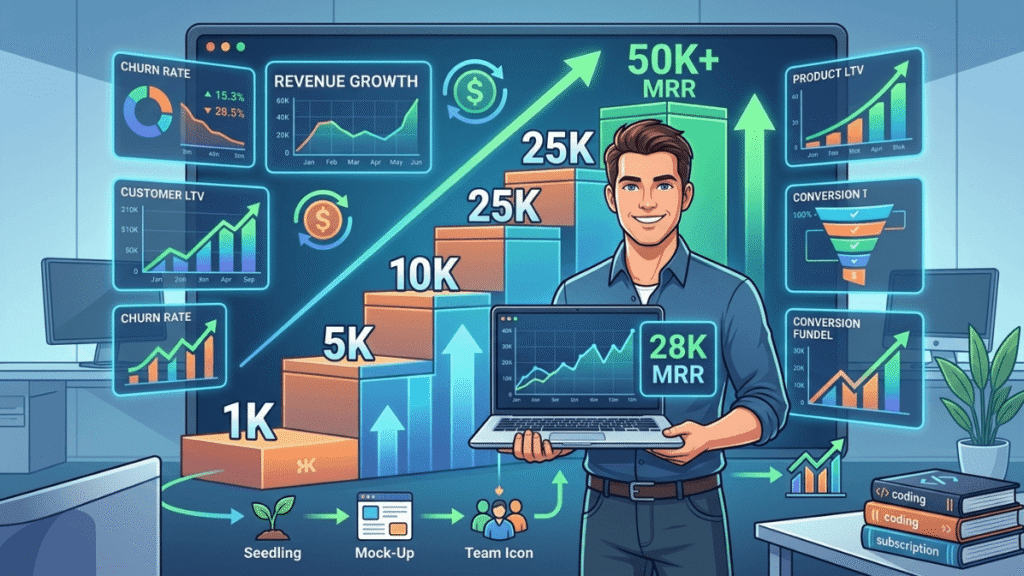
Before picking an idea, know the real numbers.
Based on data from Indie Hackers and MicroConf surveys:
- 40% of micro SaaS products never reach $1K MRR (most are abandoned early)
- 30% reach $1K to $5K MRR and plateau, often a solid side income
- 20% reach $5K to $20K MRR, enough to replace a full-time salary
- 10% break $20K+ MRR, becoming high-value lifestyle businesses or acquisition targets
For founders without an existing audience, realistic monthly targets are: Month 1 ($500 to $2K), Month 3 ($2K to $10K), Month 6 ($5K to $25K), Month 12 ($10K to $50K).
77% of solopreneurs were profitable in their first year. That number matters. Most traditional businesses take 2 to 3 years just to break even.
Infrastructure cost stays low
At the MVP stage, total monthly costs typically run $30 to $100. At $10K MRR with 80% margins, that’s $96K per year take-home, competitive with a senior developer salary.
The 3 Questions Every Winning Idea Answers
Before building anything, run every micro SaaS idea through these three filters:
- Does someone already pay to solve this problem? If not, you’re creating a market, not entering one.
- Can an AI update destroy your product overnight? Gartner predicts 35% of point-product SaaS tools will be replaced by AI agents by 2030. Build tools with data moats, workflow integrations, or niche expertise that AI can’t replicate easily.
- Can you reach the customer? The best product fails without a clear distribution channel.
12 Micro SaaS Business Ideas with Real Demand in 2026
These ideas come from analyzing Reddit threads, Product Hunt launches, founder reports, and search trends. Each solves a documented pain point with proven willingness to pay.
1. Niche CRM for a Specific Profession
Generic CRMs are too broad. Vertical CRMs consistently make money. Industry-specific tools for fitness coaches, photographers, real estate agents, and freelancers outperform generic solutions because they understand domain-specific workflows.
Example pain point: A photography studio tracking 200+ clients, shoots, payments, and galleries inside spreadsheets.
Pricing: $29 to $79/month per user Revenue potential: $8K to $30K MRR
2. Invoice Recovery and Dunning Automation
Freelancers and agencies lose 5 to 10% of revenue to late or unpaid invoices. Manual follow-up is awkward and inconsistent.
A simple tool that sends polite, escalating reminders automatically, attaches payment links, and tracks overdue balances removes one of the most uncomfortable parts of running a freelance business.
Pricing: $19 to $49/month Revenue potential: $5K to $20K MRR Why it sticks: Once payment workflows are set up, nobody cancels.
3. API Uptime Monitor for Small Dev Teams
Existing tools like Datadog and New Relic are expensive and complex for small teams.
A simple uptime plus response time monitor for indie developers at $9 to $19/month has a revenue potential of $5K to $20K MRR.
When an API goes down, it damages customer trust fast. A lightweight monitor with an automatic public status page solves this without enterprise pricing.
4. AI-Powered Code Review for Solo Founders
Solo founders and small teams don’t have bandwidth for thorough code reviews.
An AI-powered PR reviewer that catches bugs, suggests improvements, and enforces standards has a revenue potential of $10K to $50K MRR.
This is a high-retention product. Once developers trust a code reviewer inside their workflow, they won’t remove it.
5. Customer Feedback Automation
Most small businesses know they need customer feedback. They just never collect it consistently.
A tool that triggers automated surveys after key events (a purchase, a support ticket, a subscription renewal) then organizes results into a visual dashboard solves this completely.
The true value isn’t just collecting feedback. It’s closing the loop. Features that help businesses respond to feedback and track how their improvements impact sentiment over time build the strongest retention.
Pricing: $39 to $99/month Target: eCommerce stores, SaaS companies, service businesses
6. Compliance Tracker for Niche Industries
Compliance costs small businesses over $12,000 per year according to Forbes. A micro SaaS that automates compliance tracking for GDPR, HIPAA, or tax norms in niche industries like healthcare, logistics, or finance targets regulation-heavy sectors with recurring, essential needs.
When compliance is mandatory and fines are rising, this is not a “nice to have.” It’s a must-pay tool.
Pricing: $49 to $199/month Why churn stays low: Compliance never stops being required.
7. Content Repurposing Tool for Solo Creators
A tool that takes a long-form blog post and automatically generates Twitter threads, LinkedIn posts, email newsletters, and short-form video scripts from it targets solo content creators posting across 4+ platforms. Creating 5 pieces of derivative content from one blog post used to take 2 hours. A tool doing it in 30 seconds at $29/month is an easy sell.
Revenue potential: $5K to $20K MRR Distribution: Creators talk to other creators. Word of mouth is fast.
8. Freelancer Finance Tracker
Many freelancers struggle to track their income. Payments often come from different platforms and clients. This makes it hard to see earnings clearly.
A simple tool could connect all payment sources in one place. Users could view income trends, track earnings by client, and estimate taxes with ease.
The target market includes freelancers, consultants, and gig workers. With strong demand, this type of tool could generate $9 to $19 per user each month.
Simple, sticky, and solves a problem every freelancer faces at tax time.
9. Async Standup Bot
Daily standups waste 15 to 30 minutes and don’t work across time zones. A bot that collects async text or video updates and creates a digest, integrating with Slack, has a revenue potential of $5K to $20K MRR.
Remote teams pay for anything reducing meeting fatigue. Slack integrations create strong switching costs.
10. Social Proof Widget
Adding testimonials, review counts, and “X people bought this” notifications to websites is harder than it should be. A drop-in widget pulling from multiple sources like G2, Capterra, and Twitter has a revenue potential of $5K to $20K MRR at low difficulty.
eCommerce stores and SaaS landing pages both need this. Setup takes minutes.
11. Competitor Monitoring Tool
SaaS founders often keep an eye on competitors. The problem is that checking websites every day takes time.
This tool watches competitor landing pages automatically. It takes daily screenshots and tracks important changes. Users get alerts when pricing, messaging, or page design changes.
Many founders want this information. Few enjoy collecting it by hand. The tool saves time and makes competitor monitoring much easier.
Pricing: $29 to $79/month Best audience: SaaS founders and marketing leads
12. Niche Appointment Scheduling
The most profitable micro SaaS products in 2026 solve repeat business needs. These include niche CRMs, workflow automation tools, and appointment scheduling software.
One strong idea is niche scheduling tools. Build for a single profession. Focus on tattoo artists, dog groomers, personal trainers, or immigration lawyers.
Add features that fit the industry. Do not rely on generic functions. Solve problems they face every day.
Charge $49 per month. Focus on one vertical. Own that space and grow within it.
Which Platforms Do Solo Micro SaaS Founders Use
Every founder asks the same question first. What tools do I actually need? The answer is simpler than most people expect.
You don’t need expensive tools to launch. Most solo founders run their entire micro SaaS on free tiers and one or two paid tools. Let’s see exactly what they use:
Launch Faster With These Micro SaaS Tools
| Platform | Best For | Cost to Start | Code Required | AI Features |
| Bubble | Full web apps, no-code | Free tier | No | Yes (via plugins) |
| Supabase | Database + auth backend | Free tier | Minimal | Limited |
| Vercel | Hosting Next.js apps | Free tier | Yes | No |
| Lovable | AI-generated full apps | $20/month | No | Yes |
| Stripe | Subscription billing | 2.9% + $0.30 | Minimal | No |
| Dodo Payments | Global billing + tax | Flat fee | Minimal | No |
| Resend | Transactional email | Free tier | Minimal | No |
AI coding assistants cut development time by 50%. Supabase and Vercel handle infrastructure, and Stripe makes billing straightforward.
For total infrastructure at MVP stage, most founders spend $30 to $100 per month.
How to Validate a Micro SaaS Idea in 30 Days (Without Building Anything)
This is where most people go wrong. They build first, then look for customers.
The validated approach runs like this:
- Weeks 1 to 2: Create a landing page and drive targeted traffic to collect email signups. Twenty or more qualified signups indicate genuine interest.
- Weeks 2 to 3: Conduct 10 to 20 problem validation interviews, focusing on past behavior rather than hypothetical futures.
- Weeks 3 to 4: Offer beta access at a discount and measure who actually commits to paying.
Where to find your first users:
- Reddit communities in your niche (r/freelance, r/smallbusiness, r/startups)
- Facebook Groups for your target profession
- LinkedIn outreach to exact job titles
- X (Twitter) builder communities
Google Trends and Exploding Topics help spot rising searches in niche categories.
Product Hunt and Indie Hackers let you test audience appetite with early access pages. The golden rule: if customers are not ready to pay, it’s not worth building.
Vital stat to know before you start
Analysis of 1,000+ micro SaaS businesses found that 70% generate under $1,000/month, and only 1 to 2% exceed $50,000/month. Plan for 12 to 18 months to reach meaningful revenue.
Personal Experiences: What I’ve Seen Work
Experience 1
A freelance designer in my network built a simple PDF proposal generator for interior designers.
Charged $29/month. Reached $4,200 MRR in eight months with zero paid ads.
He distributed it entirely in two Facebook Groups for interior design professionals.
Experience 2
A developer I follow on Indie Hackers built a compliance checklist tool for HIPAA-covered small clinics. Charged $99/month.
Said his biggest surprise was how little support customers needed once onboarded. Most just set it up and paid forever.
Experience 3
I watched a content marketer build a repurposing tool specifically for LinkedIn creators.
She used no-code tools, launched in six weeks, and charged $39/month. The key to her retention was sending weekly usage reports showing how many posts she’d helped create. Users felt the value every single week.
Experience 4
A solo developer built a simple async standup tool for agencies with remote teams.
Reached $6K MRR in five months. His entire distribution strategy was posting once per week on LinkedIn about remote work frustrations.
He didn’t pitch. He just described problems his tool solved. Customers came to him.
The Niches with the Highest Willingness to Pay in 2026
Not all niches pay equally. Target audiences that feel financial pain directly spend more without hesitation.
| Niche | Typical Price Range | Why They Pay |
| Healthcare / HIPAA compliance | $99 to $299/month | Fines are existential |
| Legal workflow tools | $79 to $249/month | Time saved = billable hours |
| Fintech/accounting | $49 to $199/month | Money is the product |
| Freelancer/agency ops | $29 to $99/month | Directly saves revenue |
| eCommerce automation | $29 to $149/month | ROI is measurable |
| Dev tools and monitoring | $9 to $99/month | Downtime costs real money |
Picking the wrong niche wastes months. The most profitable micro SaaS niches in 2026 are clear.
Payment recovery tools hit 70 to 90% profit margins. Compliance tools for regulated industries charge $99 to $299 monthly with low churn.
AI workflow automation attracts daily active users fast. B2B integrations lock customers in deeply. These niches generate income that compounds every month.
What Makes a Micro SaaS Product Stick (Low Churn)
High churn kills a micro SaaS faster than anything. These three factors keep users paying month after month:
- Data lock-in. If your product stores customer data (analytics history, uploaded files, completed checklists), switching means losing that history. Users stay.
- Deep integrations. Tools wired into Slack, Gmail, Shopify, or Stripe become part of the daily workflow. Removing them breaks other things.
- Recurring need. Compliance tracking, invoice follow-ups, uptime monitoring, and feedback collection aren’t one-time tasks. They repeat forever.
Customers stay when leaving costs them something. Stored data, connected workflows, and built-in integrations create that cost.
Nobody wants to lose their history or rebuild their setup. That’s your moat. Keep gross margins above 80%. That number separates sustainable micro SaaS from ones that slowly die.
How to Price Your Micro SaaS
Founders consistently underprice. Here’s a practical framework:
- Start at $29/month minimum. Anything lower signals low value and attracts high-churn customers.
- Price for the value delivered, not the cost to build. If your tool saves a freelancer 5 hours per month, and they charge $100/hour, your tool is worth $500. Charging $39 is a bargain.
- Add a higher tier immediately. A $79/month or $99/month plan with team features or higher usage limits captures buyers who want more.
- Test annual pricing. Offering a 2-month discount for annual payment improves cash flow and reduces churn significantly.
AI-powered content tools are the hottest niche with proven willingness to pay $19 to $99 per month.
No-code tools eliminate the coding barrier, letting founders describe a micro SaaS idea and have a working app without writing code.
The Biggest Mistake Founders Make with Micro SaaS Business Ideas
Many founders build products they find interesting. They ignore problems customers urgently need solved.
Domain knowledge is often the biggest factor behind micro SaaS success. Start with an idea that matches your skills and experience.
Build a simple version first. Focus on solving one clear problem. Charge from the beginning. Listen to customer feedback and improve as you learn.
Many failed micro SaaS products looked polished and impressive. The problem was simple.
Nobody wanted them. A basic product that fixes a painful problem will usually win. A beautiful product with no demand will not.
Final Thought
The best micro SaaS business ideas in 2026 share one thing: they solve a painful, recurring, specific problem for an audience that already pays for solutions. You don’t need a massive idea. You need the right one.
Pick the niche you know. Validate before building. Charge from day one. The path to $5K to $20K MRR is repeatable, documented, and achievable for a solo founder willing to move fast and stay focused.
The opportunity is real. The tools are ready. The only question is which specific problem you’ll own.
FAQ
Do I need to register a business before launching a micro SaaS product?
Not immediately. Many founders get their first 10 paying customers before registering anything. Once revenue becomes consistent, register an LLC in the USA. It protects personal assets and builds trust with paying customers. Delaware and Wyoming are the most popular states for online business registration due to low fees and flexible laws.
How do I handle taxes as a solo micro SaaS founder?
Set aside 25 to 30% of every payment for taxes from day one. Use quarterly estimated tax payments to avoid penalties.
A simple spreadsheet tracking income and software expenses works fine early on. Once revenue crosses $3K monthly, hire a CPA familiar with online software businesses. They save more than they cost.
When should a micro SaaS founder hire the first person?
Hire when one specific task consistently pulls you away from building or selling. That’s the signal.
Most founders hire a part-time customer support person first. Do this when monthly revenue stays above $8K for three consecutive months. Hiring too early burns cash. Waiting too long burns you out.
How do I name my micro SaaS product effectively?
Pick a name that describes the outcome, not the process. Short names under three syllables stick faster.
Check domain availability before falling in love with any name. Search the name on the US Patent and Trademark Office database to avoid legal issues later. A clear name reduces your marketing effort significantly.
Can micro SaaS products work with an affiliate or referral program?
Yes, and it’s one of the fastest free growth channels. Offer existing customers 20 to 30% recurring commission for every referral they bring.
Recurring commissions motivate affiliates far more than one-time payouts. Start this after reaching 50 paying customers. Earlier than that, focus purely on finding product-market fit first.
Does seasonal demand affect micro SaaS revenue?
Some niches feel it strongly. Tax tools spike between January and April. Education tools peak in August and September.
Most B2B workflow tools stay flat year-round, which makes them safer for solo founders relying on predictable income. Check Google Trends for your niche before committing to a seasonal category.

Aliza Khatun is a Digital Marketing Professional and the founder of DigiGenHub. She has helped various businesses grow their online presence through real-world experience in marketing, branding, traffic growth, and business strategy.
Through DigiGenHub, she shows how to build and grow a business from the ground up using Website Setup, SEO, Branding, Paid Promotion, and smart digital tools.
She also highlights how AI can be used to its full potential to make content creation, automation, marketing, and business growth faster and smarter.
She believes that the right knowledge, modern technology, and the right tools can help any individual or business build a stronger online presence.