
TL;DR
- Pinterest keeps growing, and demand for skilled managers grows with it
- Brands have the budget but not the time or skill to run it well
- That gap is the whole reason this job exists right now
- Start by growing your own account first, so you have proof
- Pick one niche, since focused profiles get hired faster than general ones
- Learn Canva design, Rich Pins, and Idea Pins early on
- Take free courses through Pinterest Academy to build trust fast
- Pitch clients with results you already achieved, not promises
- Price by outcome, not just hours, and always use a contract
- Send short updates every two weeks to keep clients confident
This is exactly how to become a Pinterest manager clients keep hiring, not just try once
Pinterest is not a photo app anymore. It works like a search engine. People use it to plan purchases they will make.
Brands know this now. That is why so many people search how to become a Pinterest manager every month. This guide gives you the exact steps.
Pinterest just posted its tenth straight quarter of double-digit user growth. The platform hit 631 million monthly active users in Q1 2026, up 11% year over year.
CEO Bill Ready said the company delivered strong first quarter results, with revenue topping $1 billion and users climbing to a record high.
That growth is why brands need skilled Pinterest managers right now. This job is not going away. It is expanding.
What Does A Pinterest Manager Do?
A Pinterest manager runs a business or creator’s Pinterest account. That is the short answer. The full job covers more ground.
Here is what the role includes:
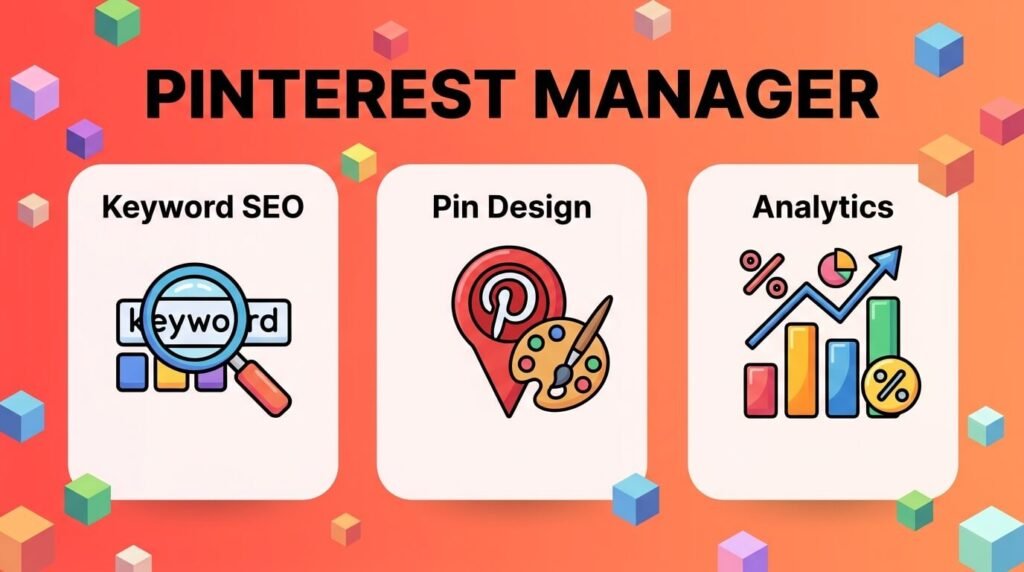
- Keyword research for pin titles and descriptions
- Designing pins in Canva or similar tools
- Scheduling pins at the right times
- Setting up and optimizing boards
- Tracking analytics and adjusting strategy
- Running or advising on Pinterest ad campaigns
- Setting up Rich Pins and Idea Pins
- Reporting monthly results to the client
A Pinterest manager is different from a Pinterest virtual assistant. A virtual assistant follows instructions.
A manager builds the strategy. If you want higher pay, aim for the manager role, not just the assistant role.
Freelance Or In-House: Two Paths Into The Role
Most guides on this topic focus only on freelancing. That leaves out half the picture. Right now, companies also post salaried Pinterest Manager openings on job boards.
Listings on ZipRecruiter show in-house Pinterest roles paying anywhere from $38,000 to $99,000 a year, often bundled with broader social media duties.
Pick your path based on how you like to work.
Freelance path
You set your own hours. You choose your clients. You handle your own taxes and invoicing. Income grows as you add clients, but so does the workload.
In-house path
You work for one company. You get a steady paycheck and benefits. You often manage Pinterest alongside other platforms. So the job asks for broader social media skills too.
Neither path is better. Pick freelance if you want control over your schedule. Pick in-house if you want stability while you learn.
Many people learning how to become a Pinterest manager start in-house, then move to freelance once they have a portfolio.
So, how to become a Pinterest manager. Follow these 8 steps in order. Skipping steps slows you down.
Step 1: Learn Pinterest Like A Search Engine, Not A Social App
Pinterest ranks content based on keywords, engagement, and relevance. It works closer to Google than Instagram.
Spend time studying how pin titles, descriptions, and board names use keywords. Type search terms into the Pinterest search bar.
Study the results that rank first. Notice the pin design, the wording, and the board setup.
This step used to feel confusing. Now it is simple. Type any topic into Pinterest Trends and the tool shows exact phrases people search. That trick used to take hours of guesswork. Now it takes minutes.
Step 2: Set Up Your Own Pinterest Business Account
Before you manage anyone else’s account, run your own. Create a Pinterest business account. Build five to ten boards around one niche. Design pins. Write keyword-rich descriptions. Track what works for thirty days.
Use this account to practice the technical side too. Set up Rich Pins so your pins pull in live data like price or article details.
Turn on Idea Pins to test video content, since Pinterest now pushes video harder in the feed. Join three to five group boards in your niche.
Pin other people’s strong content once in a while. This builds reciprocity and gets your own pins in front of new eyes.
This step builds proof. Clients want to see results, not promises.
Step 3: Get Free Training Through Pinterest Academy
Skip expensive courses at first. Pinterest itself offers a free training platform.
Pinterest Academy lets you take courses, watch webinars, and get certified to prove your skills. You do not need ten certificates to start. One or two solid ones prove you know the platform.
Pinterest Academy covers campaign setup, targeting, creative strategy, and measurement.
These certifications tie to hands-on experience, so they carry weight with clients who check your credentials.
Step 4: Build A Portfolio Before You Have Clients
No client history yet? Build one anyway. Manage a friend’s small business account for free or low cost.
Or keep growing your own account and screenshot the growth charts. A portfolio does not need ten clients. It needs proof that pins you designed and posted performed well.
Step 5: Pick A Niche And Stick To It
This step gets skipped the most, and it costs new Pinterest managers money.
A niche makes you the obvious choice instead of one option among many. Food bloggers want a manager who knows food content.
Coaches want someone who understands coaching funnels. General profiles get ignored.
Pick one lane: e-commerce, food, home decor, fashion, coaching, or wellness.
These niches pay the highest retainers because Pinterest drives strong return on investment in these categories.
This is a core part of learning how to become a Pinterest manager who stands out instead of blending in.
Step 6: Find Your First Clients
Do not wait until you feel ready. You will never feel fully ready. Start reaching out once your own account shows results.
Where to find clients:
- Freelance platforms like Upwork
- Facebook groups for bloggers and small business owners
- Direct outreach to brands whose Pinterest looks outdated
- Referrals from your own network
- Local business owners who sell physical products
- Job boards like ZipRecruiter, if you want an in-house role instead
Keep your pitch short. Show one or two proof points. Explain the outcome you will deliver, not just the tasks you will perform.
A good outreach message stays under 100 words. Open with a specific observation about their account. Mention a fix you would make first.
Close with a simple next step, like a 15 minute call. Skip long introductions about yourself. Business owners care about their own results, not your resume.
Facebook groups work well for this. Search for groups built around blogging, e-commerce, or your chosen niche.
Read the pinned posts first. Many groups allow a weekly thread just for offering services.
Post there instead of cold messaging members, since cold messages inside groups often get you removed.
Cold outreach to brands works too, but pick brands carefully. Look for businesses with a website but a stale or missing Pinterest account.
Check their board activity date. If nothing has posted in three months, that is a strong opening line for your pitch.
Step 7: Set Your Pricing And Package Your Services
Do not guess your rates. Base them on market data. New Pinterest marketers with less experience often charge around $35 an hour.
Marketers with a proven track record charge between $50 and $75 an hour. Top Pinterest marketers charge $80 to $100 or more an hour, based on current freelancer rate data.
Here is a pricing breakdown to guide your own rates:
| Experience Level | Hourly Rate | Typical Monthly Retainer |
| Beginner (0-1 year) | $15-$35/hr | $300-$800/mo |
| Mid-level (1-3 years) | $30-$60/hr | $800-$2,000/mo |
| Senior/Specialist (3+ years) | $60-$100+/hr | $2,000-$3,500+/mo |
A 2026 freelance rate benchmark puts most full-service Pinterest retainers between $700 and $3,000 monthly. e-commerce and product brands pay the most.
One-time services also add income between clients:
- Pinterest account audit: $150-$500
- Full account setup: $150-$1,000
- Pinterest ads campaign setup: $300-$1,000
- Keyword research package: $200-$500
Pricing based on outcomes, not just hours, pushes your income higher over time.
Ashot Nanayan, founder of B2BSEO.io, said freelancers often underprice themselves when they sell social media management as a plain service instead of a clear business outcome.
Tie your pitch to results like traffic growth or sales, and clients stop comparing you to cheaper generalists.
Step 8: Protect Yourself With A Contract And A Clear Scope
New Pinterest managers often skip this step, then pay for it later. Before you start any paid work, write down the scope.
List exactly what you will deliver each month. Pins per week, boards managed, reports sent, ad spend covered if any.
Send a short contract for every client, even a small one. Cover the start date, the monthly fee, the payment date, and what happens if the client wants to cancel. Ask for payment upfront or on a set day each month, not after the work is done.
Keep an invoice template ready. Send it on the same day every month. This one habit saves hours of chasing payments later and makes your business look established from day one.
What Clients Expect From A Pinterest Manager In 2026
The job has grown past pin design and scheduling. Clients now want Pinterest tied into their full marketing plan.
One Pinterest manager writing about the role in 2026 put it simply: clients want to know how Pinterest supports email growth, product sales, and their paid ad strategy, not just pin views.
This changes what you report on. Do not just hand over impressions and click counts.
Show how Pinterest traffic connects to email signups or sales. Explain how organic pins and paid pins work together instead of treating them as separate jobs.
Client management is now its own skill inside this role. Set expectations early. Pinterest builds traffic slowly, over months, not days.
Say this clearly before a client signs on, so nobody expects overnight results. Send a short update every two weeks, not just one big report a month.
A quick note about a pin that performed well keeps a client confident between full reports. Clients rarely cancel a service they feel informed about.
Skills You Need to Become a Pinterest Manager
Forget the long checklists floating around online. These are the skills clients pay for:
- Pinterest SEO: keyword placement in titles, descriptions, and board names
- Design basics: Canva Pro skills are now a standard expectation for most clients
- Analytics reading: knowing which numbers predict growth
- Content planning: seasonal pinning calendars that match shopping trends months ahead
- Rich Pins and Idea Pins setup: connecting product feeds and testing video formats
- Communication: clear monthly reports clients can understand fast
You do not need coding skills. You do not need a marketing degree. You need a clear roadmap. Practice continuously with a willingness to treat this like a skill you build over time.
Practice each skill on your own content first. Open Canva and design ten pins in one sitting.
Time yourself. Speed matters once you manage several clients at once. Check your own account’s analytics weekly and write down what changed.
Patterns show up after a few weeks of tracking, and spotting those patterns is what separates a strong manager from a beginner who is still guessing.
Tools Every Pinterest Manager Should Know
| Tool | Purpose | Cost |
| Canva Pro | Pin design | ~$13/month |
| Pinterest Trends | Keyword and trend research | Free |
| Tailwind | Scheduling and analytics | Paid plans available |
| Metricool | Scheduling and cross-platform analytics | Free plan, paid tiers available |
| Pinterest Analytics | Native performance tracking | Free with business account |
| Pinterest Ads Manager | Paid campaign management | Free to access, ad spend varies |
Start with the free tools first. Add paid tools only once a client’s budget covers them.
Common Mistakes That Slow New Pinterest Managers Down
Avoid these early mistakes:
- Trying every platform at once. Spreading across Instagram, TikTok, and Pinterest at the same time slows your growth on all three.
- Skipping your own account. Clients ask for proof. No personal results means a weak pitch.
- Underpricing your first packages. Low prices attract clients who churn fast and value your work the least.
- Ignoring seasonal planning. Pinterest users search for holidays and seasons months ahead. Miss that window and you miss the traffic.
- Skipping the contract. Verbal agreements lead to scope creep and missed payments. Put terms in writing every time.
- Copying old pin advice. What worked in 2022 does not work now. Pinterest updates its algorithm often, and content style shifts fast.
How Pinterest SEO Changed For 2026
Pinterest keeps shifting toward a true visual search engine. This changes how a Pinterest manager should work day to day.
Key shifts happening now:
- Video pins are growing fast. Organic video pins grew sharply this year, and Pinners act on video content more than static images.
- Visual search is replacing typed search for many users. So image quality and relevance now carry more ranking weight.
- Shopping pins drive direct sales, not just clicks, which means Pinterest managers now report revenue numbers, not just traffic numbers.
- Seasonal timing matters more than ever. Pinterest indexes content weeks or months before a trend peaks. So planning beats reacting late.
Pinterest publishes a yearly trend forecast. It is called Pinterest Predicts. This report names the colors, styles, and topics about to grow.
It covers fashion, food, home, and travel. The report comes from billions of search queries.
Smart Pinterest managers use this report. They build their content calendar around it. They do not sit and wonder what might trend next.
Search is changing fast. AI tools now answer questions directly. Pinterest managers write pin descriptions differently now.
They write the way a person would ask a question out loud. They do not stuff keywords into a sentence anymore.
This one change helps pins get found. It works inside Pinterest’s own search. It also works across AI-powered search tools.
Alt text matters too. Pinterest reads image content through recognition tools. But alt text still confirms the context.
It helps the platform understand the pin. It also helps with accessibility. A pin without alt text loses ranking chances. A pin with alt text wins that spot instead. This step takes ten extra seconds per pin. Beginners skip it constantly.
Board descriptions need the same care as pin descriptions. Many new Pinterest managers write one line and stop there.
A strong board description does more. It says what the board covers. It says who the board helps. It says what problem the board solves.
Two or three short sentences are enough. This step used to take hours of digging. Keyword tools did not exist back then. Now Pinterest Trends shows exact search volume for free. The work is already done for you.
How Much Can A Pinterest Manager Earn?
Earnings depend heavily on your client count and your niche. Here is an income breakdown for different stages:
| Stage | Clients | Monthly Income Range |
| Just starting | 1-2 clients | $300-$1,500 |
| Growing | 3-5 clients | $1,500-$5,000 |
| Established | 6-10 clients | $5,000-$15,000+ |
| Agency owner | Team-based | $15,000+ |
One Pinterest manager shared her early business journey. Managing even one client felt like a lot at first.
Then she built her systems. She built her workflow too. She got more efficient over time.
Later she handled as many as 18 clients at once. This pattern repeats across the field. Systems and workflow matter more than raw hustle.
Consistency also drives client retention. Logan McFarland founded the Pinterest management company 84Pins.
He said most business owners do not lack knowledge. They lack bandwidth. They know Pinterest works. They just cannot run it alone. That gap is where a Pinterest manager earns their fee.
A 30-Day Launch Plan
Use this plan to move from beginner to first client fast.
Week 1
- Set up your own Pinterest business account
- Build 5 boards in one niche
- Design 15 pins in Canva
Week 2
- Start Pinterest Academy courses
- Post pins daily
- Study keyword patterns in your niche
Week 3
- Track early analytics
- Set up Rich Pins on your own account
- Build a one-page portfolio with screenshots
- Write your pitch and pricing sheet
Week 4
- Reach out to 10 potential clients
- Apply to 5 freelance listings or job postings
- Ask your network for referrals
Thirty days is enough time to move from zero knowledge to your first outreach message.
Many new Pinterest managers land their first paid client inside sixty days when they follow a plan like this instead of guessing their way through it.
How To Scale Past Your First Few Clients
Most people learning how to become a Pinterest manager stop planning too soon. They land one client. Then they stop growing. That is a mistake. Scaling takes a different plan than starting.
Once you manage three or more accounts, systems save your time. Build templates for pin design.
Do not start fresh each time. Keep a swipe file of pin descriptions that performed well. Adapt the wording for new clients.
Do not write from zero every time. Batch your work by task, not by client. Design all pins for the week in one sitting.
Schedule all of them in one sitting too. Switching between clients slows you down. It slows you down more than most beginners expect.
Raise your rates every few months. Do this as your results improve. Many freelancers keep old pricing.
They fear a client will leave. But clients rarely leave over a fair increase. Not when that increase is tied to results.
They leave more often for another reason. Service quality drops when you spread too thin. Too many accounts at the same old price causes this.
At some point, hiring becomes the next step. A part-time assistant can handle scheduling. They can handle basic design too.
This frees you up. You can focus on strategy and client calls. This shift changes your business model.
You move from one income stream into an agency model. Your income scales beyond your own hours. This path is not required. But it stays open for anyone who wants it.
Burnout is a risk in this field. Too many accounts without support cause problems. Pins get missed. Strategy gets weaker.
Clients get unhappy. Set a clear cap on how many accounts you manage alone. Get help before you hit that cap. This protects your workload. It protects every client relationship you have built.
Final Thoughts
Learning how to become a Pinterest manager takes clear steps. Study the platform first. Build your own account.
Get free training through Pinterest Academy. Pick one niche and own it. Set fair prices. Back every deal with a written contract. Then pitch clients with proof, not promises.
Brands need this skill more than ever. Most cannot manage Pinterest alone. Few have the time. Fewer have the know how. That gap is wide open right now.
Walk through it. Stay consistent. Build the skill once, and it pays you for years.
FAQ
Do I need my own website or blog to become a Pinterest manager?
No. A website helps for credibility, but many managers work directly on client accounts without owning a site themselves.
Is Pinterest management a legitimate work-from-home career?
Yes. It is a real remote role, not a side gimmick. Agencies, e-commerce brands, and solo creators hire for it year-round.
How many hours does one Pinterest account really take each week?
Most single accounts take 3 to 6 hours a week once your workflow is set, covering pin design, scheduling, and light reporting.
Do I need a written contract before starting with a client?
Yes. A short contract covering scope, payment terms, and cancellation notice protects both sides and prevents scope creep.
Do I need to register a business or get an LLC before taking clients?
Not at the very start. Many begin as a sole proprietor and formalize the business once income becomes steady.
How soon should a client expect to see real results? Most accounts
show early traffic movement within 60 to 90 days. Pinterest rewards consistency over time, not overnight spikes.
Can someone with no social media background become a Pinterest manager?
Yes. Pinterest works more like a search engine than a social feed, so SEO instincts matter more than social media experience.
Is free Canva enough to start, or do I need Canva Pro right away?
Free Canva covers the basics. Canva Pro becomes worth it once you manage multiple clients and need brand kits and faster templates.
How do I prove my Pinterest work is actually driving sales for a client?
Use Pinterest’s own analytics dashboard alongside the client’s website analytics to track saves, outbound clicks, and conversions tied to specific pins.
What’s the normal wait time between posting a pin and seeing traffic from it?
A pin often takes several weeks to gain traction, and strong pins can keep sending traffic for months or even years after posting.

Aliza Khatun is a Digital Marketing Professional and the founder of DigiGenHub. She has helped various businesses grow their online presence through real-world experience in marketing, branding, traffic growth, and business strategy.
Through DigiGenHub, she shows how to build and grow a business from the ground up using Website Setup, SEO, Branding, Paid Promotion, and smart digital tools.
She also highlights how AI can be used to its full potential to make content creation, automation, marketing, and business growth faster and smarter.
She believes that the right knowledge, modern technology, and the right tools can help any individual or business build a stronger online presence.