Customers decide in seconds to order the desired product. The order management process should be proactive. So, product managers use AI to illuminate market trends, competitors actions, and global shifts.
AI reduces manual work by 4+ hours per task and frees PMs to make high-judgment decisions. It tracks customers feelings and reduces data breaches.
Still, how product managers can use AI. They use AI to write PRDs, sort backlogs, analyze user feedback, run competitive research, build prototypes, and track KPIs.
Over 70% of companies invest in AI. More than 60% of new software includes AI from day one.
Even slow markets like smartphones rely on AI to plan stock and features.
As AI handles routine work, product managers focus on vision, ethics and leading teams.
How Product Managers Can Use AI for Strategic Objectives?
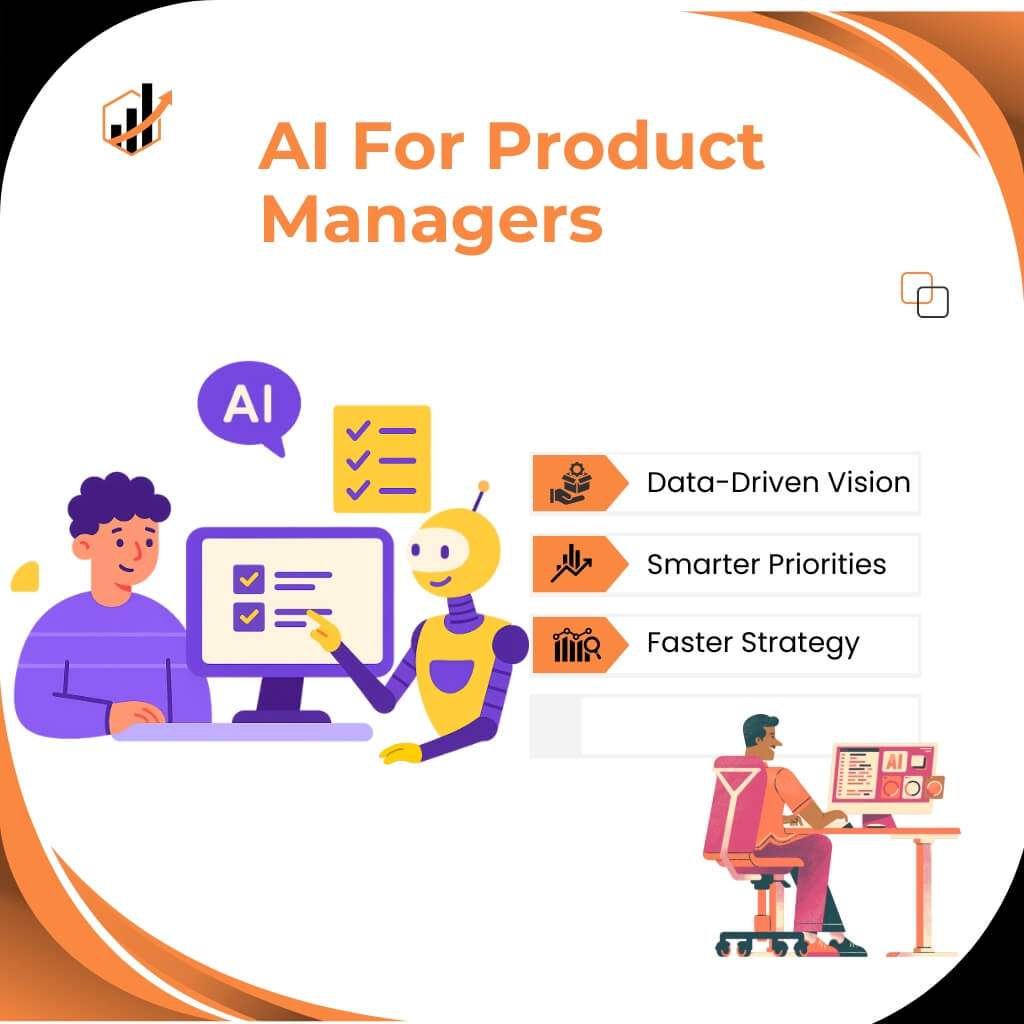
AI is now the core of how PMs plan, build, and ship. 94% of product professionals use AI daily, and nearly half have it embedded deep in their workflows. That saves 1 to 2 hours every single day.
AI reads millions of online talks, reviews and news. It also helps them to maintain cybersecurity.
It finds new ideas or problems months before others do. This helps companies build products for the future.
This also cuts the time to launch new things by 20-30%. Strategic plans are now based on quick, solid data.
I used to spend an entire Tuesday just organizing a messy backlog. Now I do it in 20 minutes with AI. That time goes back to strategy.
Quick-Start Checklist
Use this in your first week:
- Write your next PRD with an AI first draft
- Export 100 support tickets and ask AI to find the top five themes
- Set up one AI alert for a key metric drop
- Run a competitive summary on your top two competitors
- Build one rough prototype before your next sprint planning
What AI Does for Product Managers
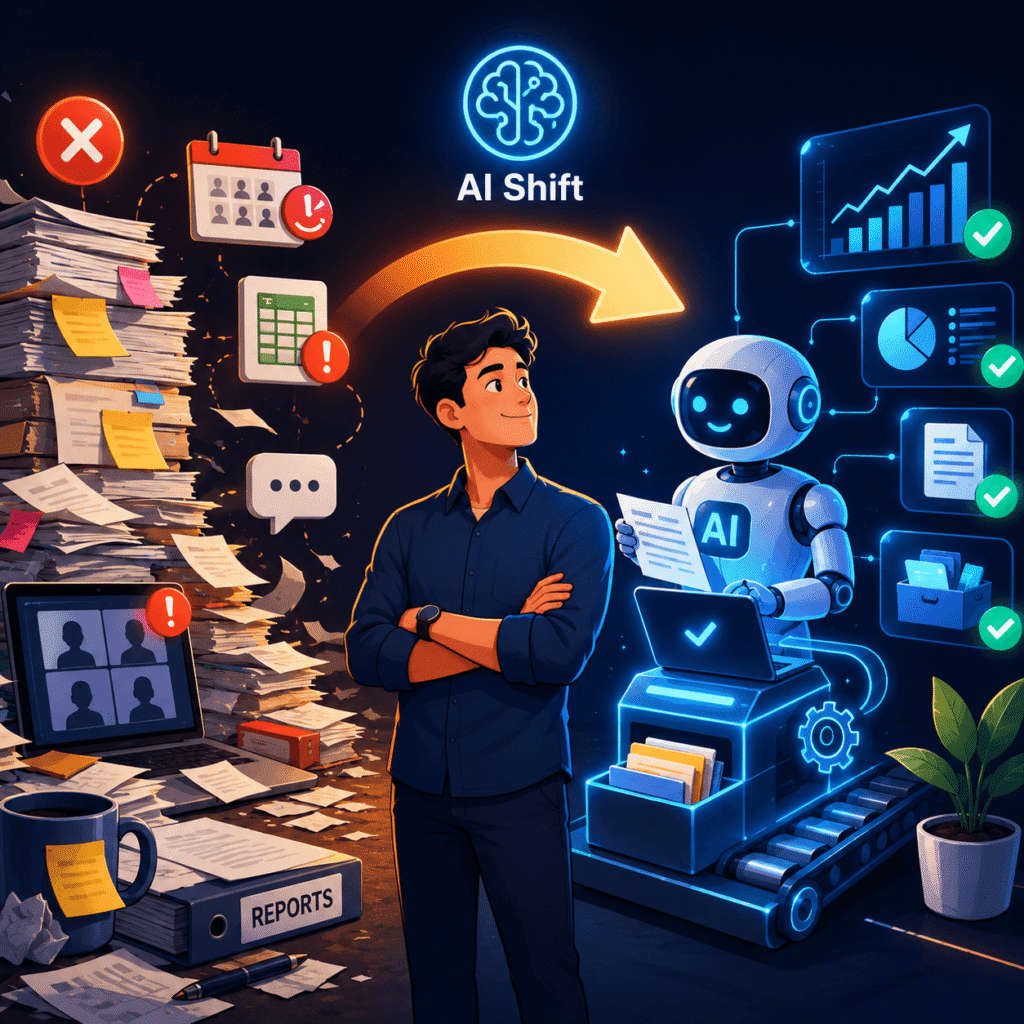
Old way: PMs spent 60% of their time on documentation, meetings, and manual data sorting.
New way: AI handles the manual parts. PMs focus on decisions that need human judgment. Let’s learn the core tasks where AI helps product managers:
1. Writing PRDs and User Stories Without the Grind
Writing a Product Requirements Document used to take days. You had to pull context from five Slack threads, two Confluence pages, and a Notion doc nobody updated.
Now a PM enters a short goal prompt. AI generates a full PRD with:
- Problem statement
- Success metrics
- User stories
- Acceptance criteria
- Edge cases
The scaffolding appears in seconds. The PM fills in the judgment parts.
I ran a two-week sprint where I used AI to write the first draft of every user story. I reviewed, trimmed, and adjusted.
Total writing time dropped by 70%. The quality was higher because the structure forced me to address gaps I would have skipped.
Forbes Tech Council reports that AI assistants now integrate directly with development platforms, turning brief strategic goals into complete, phased PRDs.
How to do this:
- Write a two-sentence goal for the feature.
- Add your target user and the core problem they face.
- Paste both into your AI writing tool.
- Review the output against your actual product context.
- Edit the parts that need human judgment.
2. Backlog Management: Stop Sorting Tickets by Hand
A growing backlog is one of the top pain points for PMs. Tickets pile up. Priorities blur. Teams argue about what to build next.
AI fixes this directly.
What AI does with your backlog:
- Groups similar Jira or Linear tickets automatically
- Tags tickets by theme, user type, or impact area
- Scores items using RICE or Kano models
- Surfaces tickets tied to recurring user complaints
Jira Product Discovery scored 90/100 as the best overall AI PM tool in 2026, especially for teams already in the Atlassian ecosystem. Linear follows closely with AI-powered auto-triage that works in real time.
3. User Feedback Synthesis: No More Spreadsheet Hell
Reading every Zendesk ticket, NPS comment, and app store review by hand is not scalable. Most PMs read only a sample. That means missing patterns.
AI reads everything.
What AI finds in your feedback:
- Top complaints grouped by category
- Features users request most
- Sentiment trends over time
- Specific friction points in the user journey
Airtable’s 2026 report found that 40% of product leaders still use humans to parse large feedback volumes. AI cuts this to near zero while covering every channel at once.
How to run AI feedback synthesis:
- Export feedback from Zendesk, Intercom, or your support tool.
- Upload to a tool like NotebookLM or your AI workspace.
- Ask specific questions: “What are the top five pain points users mention?”
- Cross-check themes with your usage analytics.
- Use the output to rank backlog items.
4. Competitive Analysis in Hours, Not Weeks
Tracking competitor feature launches used to mean subscribing to product newsletters, monitoring app store updates, and reading industry reports manually. A full competitive audit took two to three weeks.
AI agents now do this continuously.
They monitor:
- Feature rollouts on competitor products
- Pricing page changes
- App store review sentiment shifts
- Press releases and blog posts
Scrum Alliance notes that AI market intelligence agents now save product teams weeks of manual competitive tracking every quarter.
5. Rapid Prototyping: Build Before You Code
Testing an idea used to require a designer and at least a week. Many PMs skipped prototyping entirely because it felt too slow.
AI changed the cost of prototyping to near zero.
Two methods PMs use now:
Vibe coding (text-to-code): Describe a feature in plain English. An AI coding tool generates a working prototype. No engineering time needed for the test phase.
AI UI generation: Describe a screen layout. AI generates a clickable mockup. Share with five users. Get feedback before anyone writes production code.
This means PMs can now test three or four versions of an idea in the time it used to take to build one.
I prototyped an onboarding flow redesign using AI-generated UI in one afternoon. I tested it with six users the next day. Two of my key assumptions were wrong. I avoided building the wrong thing. That saved two sprints.
6. Real-Time Analytics and KPI Monitoring
Waiting for a BI report used to mean one to two weeks of delay. By the time a PM saw a drop in activation, the problem was already affecting retention.
AI analytics engines now alert PMs the moment something changes.
What AI monitors in real time:
- User activation rates
- Drop-off points in key funnels
- Feature adoption curves
- Anomalies in session length or engagement depth
A 2026 Deloitte study found that 66% of organizations now report measurable gains from AI in product operations. That includes faster anomaly detection and shorter response cycles.
How to set this up:
- Connect your analytics tool to an AI query layer (Amplitude AI or Mixpanel AI work well).
- Set alert thresholds for key metrics.
- Ask natural language questions: “Why did DAU drop 12% this week?”
- Review the AI-suggested causes before digging deeper manually.
7. Evaluating AI Features You Ship
Many PMs now build products with AI inside them. That adds a new layer of responsibility. You are not just shipping features. You are shipping model behavior.
What this requires:
- Automated test cases covering edge cases on every deployment
- LLM-as-a-judge systems to evaluate AI output quality at scale
- Negative feedback loops treated as bug reports
- Human-in-the-loop calibration for outputs that affect users directly
A thumbs-down on an AI interaction is a bug. PMs who treat it that way ship better AI features than teams who ignore it.
AI Tools for Product Managers
| Tool | Best For | AI Feature | Starting Price |
| Jira Product Discovery | Backlog + roadmapping | AI grouping, priority scoring | Free tier available |
| Amplitude | Behavioral analytics | Natural language queries, anomaly alerts | Free up to 10M events |
| Mixpanel | Funnel analysis | AI copilot for query building | Free up to 20M events |
| Perplexity | External research | Cited web research, live sources | ~$20/mo Pro |
| NotebookLM | Internal feedback synthesis | Grounded Q&A from uploaded docs | Free |
| Linear | Sprint management | Auto-triage, issue clustering | Free tier available |
| Granola | Meeting intelligence | AI notes without a bot joining | Paid |
| Gamma | Stakeholder decks | PRD outline to slides in minutes | Free tier available |
The Methodology-First Rule
Let’s learn where most PMs go wrong with AI.
They type a vague prompt and hope for useful output. The result is generic. It reads like a template.
The PMs who get the best output from AI do this first:
- Define the environment (team size, product type, stage).
- State the current problem clearly.
- Describe the ideal outcome.
- Then ask AI to generate.
This is methodology-first. It takes 30 minutes of setup. The output is specific, accurate, and usable.
Ainna’s PM methodology guide shows that methodology-first prompting produces documents investors and stakeholders take seriously. Prompt-first approaches require hours of fixing afterwards.
What AI Cannot Replace
Being direct here matters.
AI does not replace:
- Judgment calls on user tradeoffs
- Stakeholder relationships and negotiation
- Ethical decisions about what to build
- Deep qualitative insight from user interviews
- Context about your company’s strategy that lives in your head
A May 2026 PM tools analysis found that the best tools surface ambiguity early. They make confidence levels and failure boundaries visible. That helps PMs trust AI output without being blind to its limits.
I once trusted an AI-generated competitive analysis without checking sources. One data point was wrong. I presented it to executives. That was a bad meeting. Now I verify every stat AI gives me before it leaves my desk.
Conclusion
Product managers who use AI well share one trait. They treat AI as a force multiplier for clear thinking, not a replacement for it.
The biggest gains come from six areas. PRD writing, backlog management, feedback synthesis, competitive analysis, rapid prototyping, and real-time KPI monitoring. Each one used to drain hours every week. With AI, each takes a fraction of that time.
How product managers can use AI is no longer a skill gap question. It is an adoption question. The PMs moving fastest are not chasing every new tool.
They pick two or three that fit their current workflow, build a habit around them, and measure the time they get back. Then they expand.
AI does not close the gap on human judgment. It clears the path to it. Less time sorting tickets means more time talking to users.
Less time formatting PRDs means more time pressure-testing assumptions. Less time waiting on reports means faster decisions on what actually matters.
That is the shift. Use AI to remove friction. Use the time you get back for the work only you can do.
FAQ
How do product managers use AI for sprint planning?
PMs feed their backlog into an AI tool. It groups tickets by theme, scores them by impact and effort, and suggests a sprint order. Planning sessions that used to take two hours now take 30 minutes.
Is AI useful for junior PMs or only senior ones?
Both. Junior PMs use AI to write their first PRDs faster and avoid common structure mistakes. Senior PMs use it for faster competitive research and cross-functional reporting.
How does AI help with stakeholder communication?
AI drafts weekly product updates, sprint summaries, and roadmap presentations from raw data. The PM reviews and adjusts tone. Output time drops from hours to minutes.
Can AI tools connect directly to my existing product stack?
Yes. Tools like Jira Product Discovery, Linear, and Amplitude integrate with Slack, Salesforce, GitHub, and Intercom. AI reads data from these sources and surfaces insights without manual export.
What is the biggest mistake PMs make when using AI?
Accepting the first output without review. AI drafts are starting points. They need the PM’s product context, user knowledge, and judgment applied before anything goes to a stakeholder or engineer.
How does AI improve user interview analysis?
After interviews, PMs paste transcripts into a tool like NotebookLM. The AI identifies recurring themes, emotional signals, and specific feature requests. A two-hour synthesis becomes a 15-minute task.
Does using AI in product management raise any data privacy risks?
Yes. Pasting customer data, support tickets, or internal strategy into public AI tools creates risk. Use enterprise-tier tools with data processing agreements, or keep sensitive content in private AI environments.
How do PMs evaluate the quality of AI-generated content?
They check every claim against a primary source. They run AI output through a second review before sharing. For AI features they ship, they set up automated test cases and treat negative feedback like bug reports.
What is an LLM-as-a-judge system and why do PMs use it?
It is an AI model that reviews and scores the output of another AI model. PMs who ship AI features use this to check output quality across hundreds of edge cases on every new deployment. It replaces manual QA at scale.
How do product managers use AI for roadmap prioritization?
AI takes input signals from feedback data, usage analytics, and business goals. It applies frameworks like RICE or Kano automatically and produces a ranked feature list with supporting rationale. PMs adjust based on context AI cannot see.

Aliza Khatun is a Digital Marketing Professional and the founder of DigiGenHub. She has helped various businesses grow their online presence through real-world experience in marketing, branding, traffic growth, and business strategy.
Through DigiGenHub, she shows how to build and grow a business from the ground up using Website Setup, SEO, Branding, Paid Promotion, and smart digital tools.
She also highlights how AI can be used to its full potential to make content creation, automation, marketing, and business growth faster and smarter.
She believes that the right knowledge, modern technology, and the right tools can help any individual or business build a stronger online presence.