
A missing part stops a technician cold. It delays a customer. It turns a profitable job into a loss within minutes.
Weak automotive parts inventory management causes this every single day. But it is completely avoidable.
Good automotive parts inventory management does three things at once. It keeps enough stock to meet demand.
It avoids excess that drains capital. It reorders at exactly the right time. Most shops treat these as separate problems. That is where the money leaks.
Now, AI forecasting and automated reordering make precision inventory control accessible to shops of all sizes.
Dead stock gets flagged early. Stockouts drop sharply. Emergency order costs fall within 90 days.
Shops that track fill rate, turnover, and carrying costs monthly stay profitable even under supply chain pressure. The right system does not just track parts. It protects your bottom line.
Why Most Shops Are Losing Money Right Now

A single emergency parts order costs an average of $1,400 per incident. Many dealerships and repair shops deal with several every week. That adds up fast.
The root cause is poor inventory control.
I spoke with a fleet manager in Texas who ran a 40-vehicle operation. Every Monday, his team scrambled for parts that should have been in stock.
He spent over $6,000 a month on rush orders. After moving to a structured system, that number dropped below $800 in 60 days.
That kind of waste is more common than most shop owners admit.
The auto parts inventory management software market is growing fast. It is expected to reach $12.9 billion by 2030. The growth rate is about 12.4% per year.
AI optimization drives this growth, along with cloud systems and real-time demand tracking. (The Business Research Company, 2026)
What Is Automotive Parts Inventory Management?
Automotive parts inventory management is the process of tracking, ordering, storing, and using auto parts.
So, the right part is always available at the right time without tying up too much cash in excess stock.
It is the system a shop, dealership, or fleet uses to control its parts supply. It covers:
- How many parts to keep on hand
- When to reorder
- Where parts are stored
- How parts connect to jobs and vehicles
- What parts are going obsolete
Get this right and your service bays run smoothly. Get it wrong and you bleed money through stockouts, dead stock, and unhappy customers.
The 5 Biggest Problems Shops Face
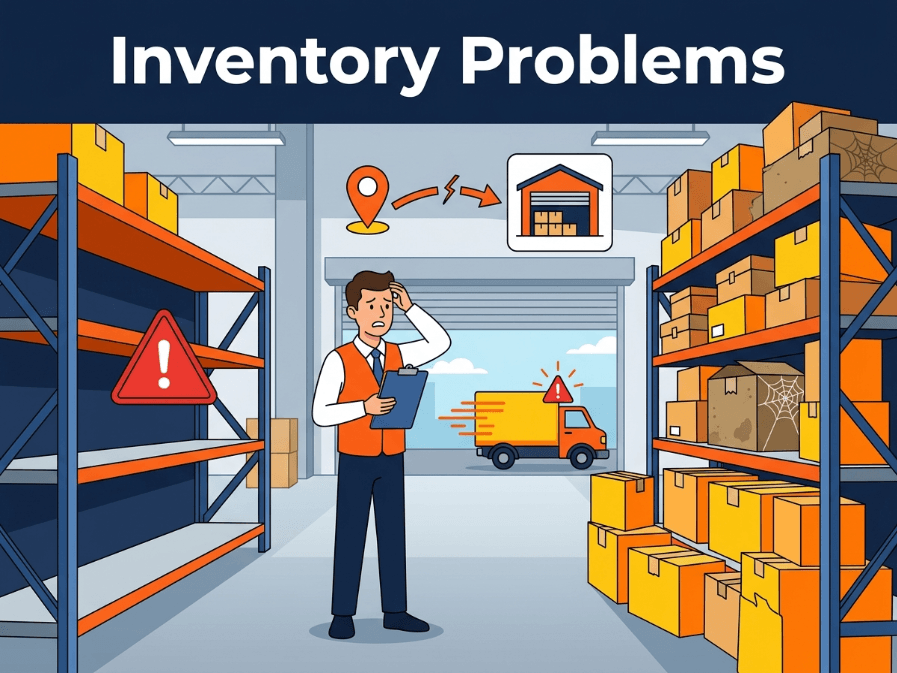
Inventory problems cost shops time and money every day. Small mistakes in stocking quickly turn into bigger operational issues. Let’s discuss the five biggest problems most shops face.
1. Stockouts Stop Work Cold
A technician pulls a vehicle into the bay. The part is not there. The job stalls. The customer waits. You lose labor time and customer trust at the same time.
Stockouts force teams into costly emergency scenarios. On the other hand, overstocking wastes capital, clogs storerooms, and drives up carrying costs.
2. Obsolete Parts Drain Cash
Many dealerships ended 2025 with too much slow-moving or obsolete stock. These parts take up space and lock up cash.
Many of them may never sell, especially as vehicles get older or models are discontinued. (Pro Count West, 2026)
3. High Carrying Costs Hurt the Bottom Line
With interest rates still elevated, inventory carrying costs have become a serious drag on profits. Overstocking is not “safe”. It is expensive. (Brady Ware, 2026)
4. No Real Visibility Across Locations
Multi-location operations often have no idea what sits at each site. Part A sits unused at Location B while Location A pays emergency shipping for the same part.
5. Reactive Ordering Instead of Proactive Planning
Most operations order parts only after running low. That reactive habit creates a constant cycle of stockouts, rush orders, and wasted spend. (ThroughPut.AI, 2026)
How AI Is Fixing What Spreadsheets Could Not
Traditional forecasting relies on averages and best guesses. In today’s volatile supply chain, guesswork is not good enough.
AI analyzes historical usage, upcoming schedules, and lead times to forecast exactly which parts you need and when. (MaintainX)
I spoke with a parts manager at a mid-sized dealership in Ohio. Before AI forecasting, he updated reorder points in a spreadsheet once a quarter.
He was always behind. After switching to an AI-assisted platform, the system updated thresholds automatically from real usage data. His stockout incidents dropped by more than half in 3 months.
AI looks at many data sources. It checks past usage, maintenance schedules, seasonal changes, fleet age, and failure patterns.
It uses this data to predict what parts will be needed. It helps keep 98% of parts available. It also cuts inventory costs by up to 40%. (HVI App)
How fast does this pay off?
- Savings appear within 30 days through fewer emergency orders
- Carrying cost reductions appear in 60 to 90 days
- Full financial impact typically hits within 6 months
- Average payback period is 4 to 6 months
The Core Strategies That Work
Inventory problems do not fix themselves. They get worse when processes stay manual or outdated. The right strategies can bring control back into the system. Let’s learn the core strategies that work better for inventory management.
Use Demand Forecasting, Not Gut Feel
Data-driven forecasting uses historical data and predictive analytics to forecast demand accurately. (Netstock, 2026)
Pull your last 12 months of parts usage. Group parts by how often they move. Fast movers, slow movers, and dead stock. Set reorder points based on actual velocity, not what feels right.
Connect Parts Directly to Work Orders
The best automotive parts inventory management systems link every part to a specific vehicle and job.
When a work order opens, the system already knows what parts that job typically needs. It pre-stages those parts before the technician touches the vehicle.
The strongest 2026 tools combine barcode/QR scanning, supplier catalog sync, multi-location stock pooling, and automatic reorder thresholds tied to actual usage velocity. (OxMaint, 2026)
Set Min/Max Thresholds and Let Them Auto-Update
Every part needs a minimum quantity (the reorder trigger) and a maximum quantity (the ceiling you never exceed). What most shops miss is that these numbers need to change over time.
A brake pad that moves 20 units a month in summer may only move 8 in winter. Static thresholds create both overstocking and understocking at the same time.
AI systems update these thresholds automatically. Manual systems need quarterly reviews at minimum.
Run Cycle Counts, Not Just Annual Counts
An annual inventory count gives you one snapshot per year. By the time you find a discrepancy, it has already cost you.
Weekly or monthly cycle counts on high-value, high-movement parts catch errors fast. Reserve full physical counts for year-end reconciliation.
Tackle Obsolete Stock Proactively
Your options for slow or dead stock:
- Return to manufacturer under return programs
- Sell to other shops or distributors
- List on B2B parts exchanges
- Write off and clear space for parts that actually move
The longer you hold obsolete stock, the less it is worth. (Pro Count West)
Core Performance Indicators Every Parts Manager Needs
You cannot improve what you do not measure. Inventory performance depends on clear numbers, not assumptions. These are the core KPIs every parts manager should track.
| KPI | What It Tells You | Target |
| Parts Fill Rate | % of orders filled without delay | 95%+ |
| Inventory Turnover Rate | How many times stock cycles per year | 8–12x for fast movers |
| Stockout Frequency | How often you run out of a needed part | Near zero for critical parts |
| Days on Hand | Average days a part sits before use | Under 30 for fast movers |
| Obsolescence Rate | % of inventory classified as dead stock | Under 5% |
| Emergency Order Rate | % of orders placed at rush cost | Under 3% |
| Carrying Cost % | Annual carrying cost as % of inventory value | 20–30% typical |
Failing to track these KPIs leaves dealerships guessing about inventory health. Review them monthly. Flag anything trending in the wrong direction before it gets expensive.
Automotive Parts Inventory Management Tools
Choosing the right tool depends on the size of your operation and how complex your inventory is.
Different platforms solve different problems, from small repair shops to large distributors. Let’s see the main automotive parts inventory management tools.
| Platform | Best For | Key Strengths | Pricing Range |
| Epicor Prophet 21 | Wholesale distributors, large dealers | Multi-location, lot tracking, deep ERP integration | Custom enterprise |
| Shopmonkey | Auto repair shops | VIN-based lookup, Nexpart/Worldpac integrations, real-time stock | Mid-range SaaS |
| Shop-Ware | Independent repair shops | Automated reordering, multi-vendor pricing, cloud-based | Mid-range SaaS |
| PartsTech | Shops needing fast supplier access | 200+ supplier integrations, real-time pricing, fitment data | Subscription |
| Limble CMMS | Fleet and maintenance operations | Work order integration, parts tied to assets, mobile app | Starts ~$45/user/mo |
| MaintainX | Maintenance teams with AI needs | AI forecasting templates, PM scheduling, mobile-first | Free tier; scales up |
| Blue Link ERP | Mid-size distributors | QuickBooks sync, multi-location visibility, e-commerce | ~$200+/month/location |
Step-by-Step: Fix Your Inventory System This Month
You do not need a six-figure deployment to improve right now.
Week 1: Get a clear count
- Count your top 50 fastest-moving parts physically
- Compare to what your system shows
- Fix every discrepancy before anything else
Week 2: Classify your parts
Sort every SKU into three buckets:
- Fast movers — used at least once per week
- Slow movers — used 1 to 3 times per month
- Dead stock — nothing moved in 6+ months
Week 3: Set reorder points
Use this formula for each fast-moving part:
Reorder Point = (Average Daily Usage × Lead Time in Days) + Safety Stock
Example: A brake pad you use 2 per day, 3-day lead time, 4-unit safety stock:
Reorder Point = (2 × 3) + 4 = 10 units
Week 4: Review your dead stock
List everything with zero movement in 6 months. Start returns, sell-offs, or write-offs. Do not carry that cost into next quarter.
A parts director I know at a regional repair chain ran this exercise across 4 locations.
He freed up over $38,000 in capital from dead stock in one month. That cash went straight into fast-moving inventory that actually generated revenue.
Multi-Location Management: The Pooling Advantage
Running more than one location? Real savings hide here.
When Location A runs low on a part that Location B has in excess, a centralized system flags the transfer.
That eliminates one emergency order. Over a month, those small transfers save thousands.
Modern ERP systems provide centralized, real-time dashboards across multiple facilities.
They optimize stock levels by pooling resources and tracking turnover rates across all sites. (Netstock)
The key is one shared inventory database, not separate spreadsheets or disconnected software per location.
Supplier Performance: The Hidden Variable
You can have perfect internal systems and still get burned by a supplier who ships late.
Track on-time delivery rates for every vendor. If a supplier consistently runs 2 days late, build that into your reorder point, not the quoted lead time.
Rate your suppliers quarterly on:
- On-time delivery %
- Order accuracy %
- Return process ease
- Pricing consistency
Shift more volume toward high performers. Use underperformers only when necessary. (ThroughPut.AI)
Barcodes and RFID: What to Use now
Manual parts tracking is the number one source of inventory error. Scanning fixes this.
Major 2026 trends include growth of RFID and barcode tracking alongside cloud-based inventory platforms. (Business Research Company)
Barcodes
Low cost, works with any smartphone scanner. Scan when receiving, scan when pulling for a job. Your system stays accurate in real time.
RFID
Higher upfront cost, but no line-of-sight scanning required. Best for high-volume warehouses.
One reader can log 100 items in seconds. For most independent shops and small dealerships, barcode scanning is the right move.
It costs almost nothing to implement with modern shop management software.
Parts Inventory Monthly Checklist This Time
Stock Health
- Review turnover rates for all parts categories
- Flag parts with zero movement in 90+ days
- Identify parts with more than 2 stockout incidents this month
Ordering and Replenishment
- Confirm reorder points are set for all fast-moving SKUs
- Check that automated reorder triggers fired correctly
- Review supplier on-time delivery rates
Financials
- Calculate current carrying cost as % of inventory value
- Tally emergency order spend for the month
- Calculate cost of any stockout incidents
Accuracy
- Run cycle counts on top 50 fastest-moving SKUs
- Reconcile system count vs. physical count
- Update min/max thresholds based on recent usage
Final Word
Automotive parts inventory management used to mean counting shelves once a year and hoping for the best. Now it means AI-driven forecasting, real-time stock visibility, automated reordering, and supplier performance tracking, all working together.
The technology is accessible. Even small shops can use barcode scanning, basic demand forecasting, and structured cycle counts without enterprise software costs.
Starting the year with a clear inventory strategy is one of the most effective ways to improve profitability, reduce waste, and keep your service department running smoothly. (Pro Count West, 2026)
The question is not whether you can afford to fix your system. The question is whether you can afford not to.
FAQ
What is a good inventory turnover rate for automotive parts?
Fast-moving parts should turn 8 to 12 times per year. Speciality or low-demand parts may turn 2 to 4 times. Anything with zero turns in 6 months is a candidate for return or write-off.
How much does a stockout actually cost?
Direct costs include emergency shipping and premium pricing averaging $1,400 per incident. Indirect costs include lost labor time, delayed delivery, and lost repeat business.
How do I reduce obsolete inventory?
Stop buying based on guesses. Use historical data to set reorder quantities. Set a 90-day review trigger; anything not moving gets flagged. Then initiate manufacturer returns or sell to other shops before the part loses all value.
Is cloud-based parts inventory software worth it?
Yes, for most operations. Cloud systems give real-time visibility from any device, automatic updates, and multi-location access without server costs. For shops running 2 or more locations, it is the only practical option.

Aliza Khatun is a Digital Marketing Professional and the founder of DigiGenHub. She has helped various businesses grow their online presence through real-world experience in marketing, branding, traffic growth, and business strategy.
Through DigiGenHub, she shows how to build and grow a business from the ground up using Website Setup, SEO, Branding, Paid Promotion, and smart digital tools.
She also highlights how AI can be used to its full potential to make content creation, automation, marketing, and business growth faster and smarter.
She believes that the right knowledge, modern technology, and the right tools can help any individual or business build a stronger online presence.