

You worked hard to build your business. Now you need money to grow it. But a bank loan means debt.
An investor means giving up control. That is where grants for small businesses change everything.
Grants are free money. You do not pay them back. You do not give away equity. But they are competitive. And most owners apply the wrong way.
What Are Grants for Small Businesses? (And What They Are Not)
A grant is funding from a government agency, corporation, or nonprofit. You apply, you qualify, you win. No repayment. No interest. No ownership loss.
But here is what many owners get wrong:
- Grants are not automatic
- Most grants do not fund business startups from scratch at the federal level
- Federal grants mainly target research, innovation, and community impact
- Most do not cover general operating expenses
If you need $10,000 to run ads or pay rent, a grant may not help. But if you need funds for R&D, workforce training, technology, or community impact, small business grants are a real path.
The 4 Types of Grants Available in 2026
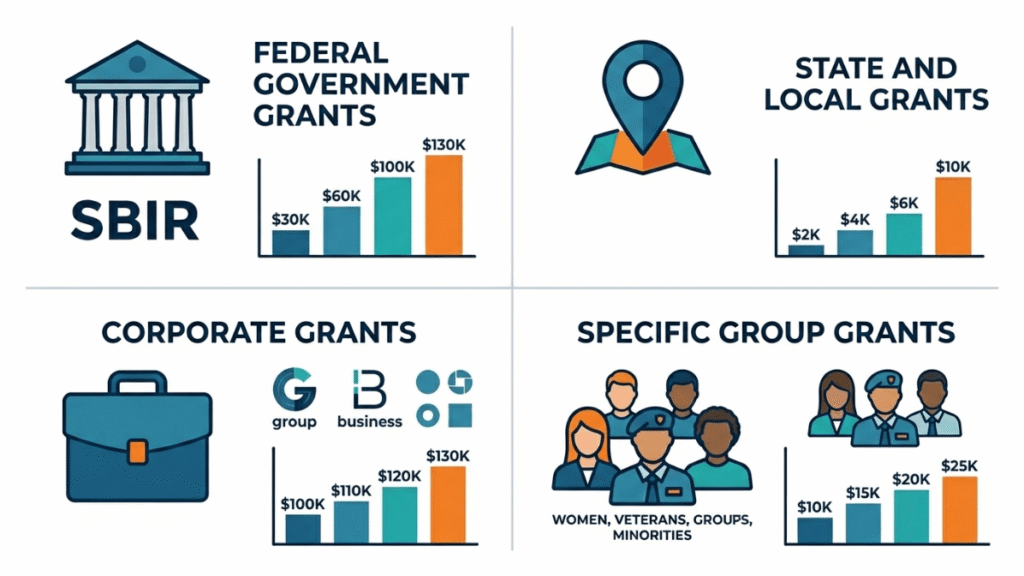
Not all grants work the same way. Some come from the government. Some from big corporations. Some target specific groups like women or veterans.
Knowing which type fits your business saves you weeks of wasted applications. Let’s see the four main sources of grants for small businesses.
1. Federal Government Grants
The federal government distributes over $800 billion in grants annually, with a meaningful portion available to small businesses. (GrantMetric)
The biggest federal program is SBIR/STTR (Small Business Innovation Research / Small Business Technology Transfer).
It operates across 11 federal agencies, including NIH, NSF, and the Department of Defense.
Important 2026 update: SBIR/STTR congressional authorization expired in September 2025. Reauthorization is still pending. Check current status at sbir.gov before applying.
When active, SBIR pays:
- Phase I: $150,000 to $300,000 (proof of concept)
- Phase II: $1,000,000 to $2,000,000+ (scale up)
You must be a for-profit U.S.-owned company with fewer than 500 employees.
2. State and Local Grants
State programs are often more accessible than federal ones. They fund restaurants, retail shops, salons, and service businesses. Many have higher approval rates for small businesses, ranging from 25% to 50%. (GrantWatch)
San Francisco, for example, recently announced $6.3 million in new small business grants for equipment purchases and storefront upgrades.
Find your state programs through your state’s commerce or economic development website.
3. Corporate Grants
Big companies run grant competitions open to any small business. These are real, competitive, and often overlooked.
| Grant Program | Amount | Eligibility |
| FedEx Small Business Grant | $15,000 to $50,000 | Innovative small businesses |
| American Express Shop Small | $20,000 | Brick-and-mortar, under 20 employees |
| Intuit QuickBooks Small Business Hero | $20,000 | Under $5M revenue, product-based |
| Venmo Small Business Grant | $20,000 | Under 10 employees, under $50K revenue |
| Breva Thrive Grant | $5,000 quarterly | Underrepresented community impact |
| NASE Growth Grant | $4,000 quarterly | NASE members |
| Skip’s Summer Grant | $10,000 | Small business owners |
4. Grants for Specific Groups
Many programs target owners who face traditional funding barriers.
Women-owned businesses:
- Amber Grant Foundation (monthly $10,000 grants)
- WomensNet ($50,000 end-of-year grants)
- IFundWomen (rolling grants)
- The Breakthrough Grant by Her Agenda ($5,000, deadline September 18, 2026)
Veteran-owned businesses:
- StreetShares Foundation
- Hivers and Strivers Pitch Competition
Minority-owned businesses:
- Hello Alice Grant Platform (partners with Progressive, DoorDash, and more)
- Secretsos Small Business Grant ($2,500 quarterly, for underserved entrepreneurs)
Startups and first-time founders:
- Freed Fellowship ($2,500 grant plus two months of mentorship)
Real Success Rates: What the Numbers Say
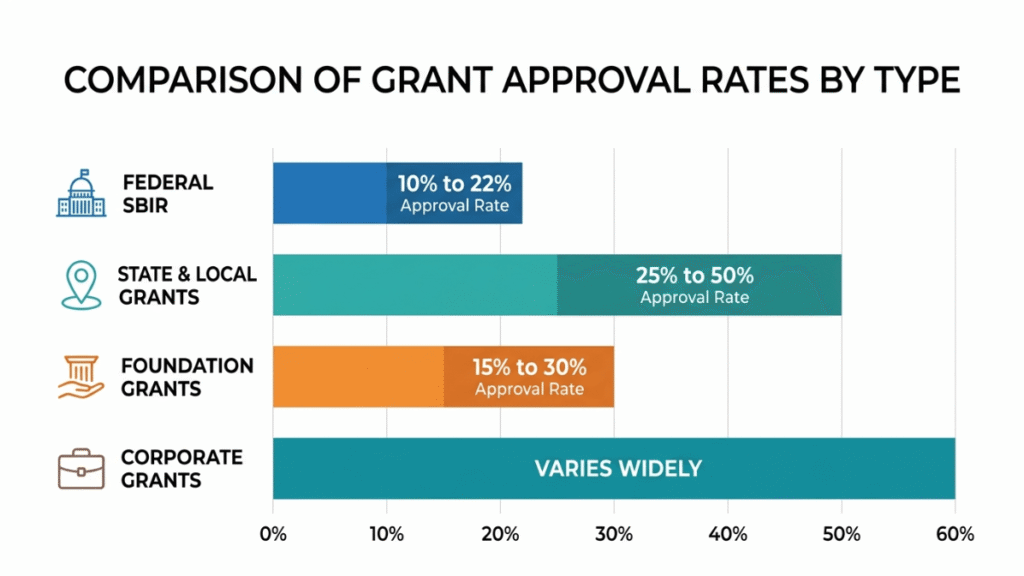
Most people apply for free business funding without knowing the odds. Here is what the data shows:
| Grant Type | Approval Rate |
| Federal (SBIR/STTR) | 10% to 22% |
| State and local | 25% to 50% |
| Foundation grants | 15% to 30% |
| Corporate grants | Varies by competition size |
The SBIR Phase I actually has a ~20% success rate, which is higher than most federal programs.
That is because strong applications from first-time applicants are accepted. Good preparation beats experience every time.
My cousin Riya runs a small online handmade jewelry store from home. She sells on her own website and Etsy.
Last year her sales dropped badly after Instagram changed its algorithm and her organic reach fell nearly 60%.
She could not afford paid ads. She found a local small business digital recovery grant through her city’s economic development office.
She applied with a simple one-page budget showing exactly how she would spend $6,000 on targeted ads and product photography.
She got the full amount. Within four months, her monthly revenue doubled. Her words to me: “I almost did not apply because I thought it was only for physical shops. It was not.”
Where to Find Grants for Small Businesses in 2026
Do not waste time on random searches. Go to these sources directly:
- Grants.gov – All federal grant listings. Filter by NAICS code and location.
- SBIR.gov – Federal R&D grants across 11 agencies (check reauthorization status first)
- U.S. Chamber of Commerce – Updated corporate and foundation grant list
- Your state commerce website – Search “[your state] small business grant 2026”
- Hello Alice – Free account, personalized grant alerts based on your business profile
How to Apply and Actually Win
Most applications fail not because the business is weak but because the application is vague.
Step 1: Register your business
Before applying for any federal grant, you need a Unified Entity Identifier (UEI) and active registration on SAM.gov. Allow 2 to 4 weeks for this process.
Step 2: Prepare your documents
Every strong application needs:
- Updated business plan with market analysis and financial projections
- Profit and loss statement (last 12 months)
- Balance sheet
- Cash flow statement
- EIN from the IRS
- A specific, itemized budget showing exactly how you will use the grant
Step 3: Match the grant to your business
Do not apply broadly. Read the grant description carefully. If you are a restaurant, apply to grants for hospitality or community-focused businesses.
If you do R&D, go to SBIR. Mismatched applications waste your time and the reviewer’s.
Step 4: Tell a clear story
Funders fund people, not just plans. Write in plain language. Say what your business does, who it serves, and what this money will change.
Be specific. Avoid vague phrases like “grow our business.” Say “hire two part-time employees and purchase a $4,000 commercial printer.”
Step 5: Apply early
Grant portals get heavy traffic near deadlines. Apply at least one week before the closing date.
Step 6: Apply to multiple grants
The biggest mistake is applying to one grant and waiting. Apply to three to five grants at once.
Many successful business owners received their first grant only after two or three rejections. Rejection feedback is free coaching. Use it.
Grants vs. Other Funding: Which One Fits You?
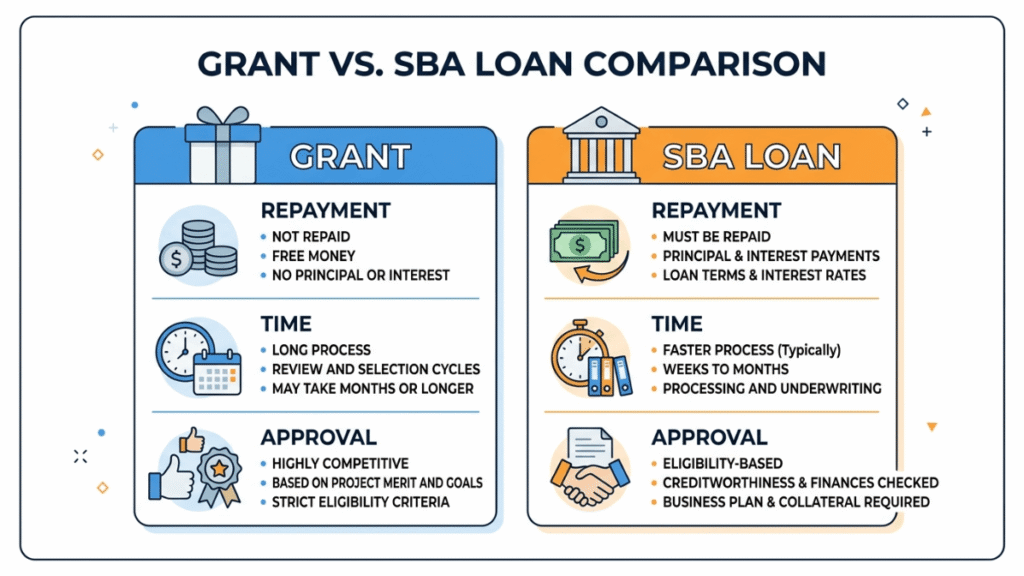
Many business owners ask if they should go for a grant or a loan. The answer depends on your situation.
| Factor | Grant | SBA Loan |
| Repayment required | No | Yes |
| Equity given up | No | No |
| Time to receive funds | 3 to 12 months | 2 to 8 weeks |
| Approval difficulty | High (merit-based) | Moderate (credit-based) |
| Best for | R&D, innovation, community impact | Working capital, equipment, expansion |
| Amount range | $1,000 to $2M+ | Up to $5 million |
Many successful owners use both. They get an SBA 7(a) loan for operations and use grants for specific projects. The combination builds credibility with all funders.
Grant Scams: Avoid These in 2026
Fraud in the grant space is rising. These are the warning signs:
- Any program that charges a fee to apply for a “government grant”
- Unsolicited messages claiming you have already won
- Requests for your bank account or Social Security number upfront
- Promises of guaranteed approval
The federal government never charges fees to apply. Real grants are listed on Grants.gov or official agency websites. If it sounds too easy, it is not real.
Your Action Plan
Grants for small businesses are not lottery tickets. They are competitive awards for prepared owners. Here is how to move this week:
- Go to Grants.gov and search your industry category
- Check U.S. Chamber of Commerce for the latest corporate grants with open deadlines
- Register on Hello Alice for personalized grant alerts
- Complete or update your business plan and financial statements
- Register on SAM.gov now if you plan to apply for federal grants
- Pick three grants that match your business type, apply to all three
Conclusion
The owners who win grants for small businesses are not the most talented. They are the most prepared.
They applied multiple times. They told a clear story. They matched their application to the right program.
You can do the same. Start with one search today. The right grant could be three months away.
FAQ
Are there grants for small businesses that adopt AI tools?
Yes. AI adoption is now an active grant priority. The NSF SBIR program lists Artificial Intelligence as a dedicated funding topic.
Some state agencies are also launching digital modernization grants tied to AI, CRM software, and cloud tools.
If your business already uses or plans to use AI to serve customers or cut costs, highlight that clearly in your application narrative.
It signals forward-thinking operations, which funders actively reward in 2026.
Can a home-based business qualify for grants for small businesses?
Yes. Most corporate and foundation grants do not require a physical storefront. What matters is legal registration, a valid EIN, and meeting the program’s specific criteria.
Some state grants do require a commercial address, so read each program’s eligibility rules carefully.
Federal programs like NSF SBIR focus on innovation, not your physical location. Start with corporate grant programs if you operate from home.
Do grants for small businesses affect your taxes?
Yes. The IRS treats most business grants as taxable income. You report the full amount in the year you receive it.
Some disaster relief grants qualify for exclusion, but those are rare. Keep every receipt tied to grant spending.
Many programs require a post-grant expense report, and clean records protect you with both the funder and the IRS. Talk to a CPA before spending any grant funds.
Can a brand-new business with no revenue apply for grants?
It depends on the program. Most federal grants require proof of existing operations and financial records.
However, many corporate and foundation grants accept early-stage businesses with little or no revenue.
Programs like the Freed Fellowship and some quarterly micro-grants specifically target new founders.
The key is showing a clear plan, not a long track record. New businesses should start with foundation and corporate grants before targeting federal programs.
What happens if you use grant money for the wrong purpose?
You may have to return it. Grant agreements include specific spending rules called allowable costs.
Spending funds outside those rules is a compliance violation. For federal grants, it can also trigger an audit under federal financial regulations.
Always read your grant agreement before spending a single dollar. Keep every receipt, invoice, and proof of purchase organized from day one. Misuse is one of the most common reasons small businesses lose future grant eligibility.
Will grant opportunities for small businesses increase or decrease in 2027?
The trend points upward in targeted areas. Green technology, AI adoption, workforce development, and community revitalization are all growing funding priorities at both federal and state levels.
Corporate grant programs are also expanding, with more companies launching quarterly grant competitions each year.
However, broad general-purpose grants remain limited. Businesses that position themselves around innovation, sustainability, or underserved communities will have the most options entering 2027.

Aliza Khatun is a Digital Marketing Professional and the founder of DigiGenHub. She has helped various businesses grow their online presence through real-world experience in marketing, branding, traffic growth, and business strategy.
Through DigiGenHub, she shows how to build and grow a business from the ground up using Website Setup, SEO, Branding, Paid Promotion, and smart digital tools.
She also highlights how AI can be used to its full potential to make content creation, automation, marketing, and business growth faster and smarter.
She believes that the right knowledge, modern technology, and the right tools can help any individual or business build a stronger online presence.