

Finding the right investor takes more than a good idea. It also takes more than a clean slide deck.
Yet, how to find business investors? Most founders lose months chasing the wrong people. They send cold emails into silence.
They miss signals that could move a deal forward. Some give away too much equity too early. Others wait too long.
Then they run out of cash before a single dollar lands. You need to know which investors fit your stage. Also, must know which ones fit your industry and growth plan.
How to Find Business Investors
Money does not show up just because you have a good idea. It shows up when you match your stage to the right investor type.
Friends and family fund early ideas. Angel groups fund early traction. Venture firms fund fast growth and big markets.
Equity crowdfunding fits consumer brands with a fan base. Build proof before any pitch goes out. A paying client beats any forecast slide. Get a warm introduction instead of a cold email.
Keep your pitch deck under fifteen slides. Lead with your strongest proof, not a long story. Prepare your data room early: papers, cap table, bank statements, and a one-page financial model.
Ask for a number tied to a clear plan. Track every outreach in one sheet. Follow up once after five days, then stop after two tries.
This is how to find business investors fast without wasting months on the wrong people.
What Investors Check Before They Say Yes
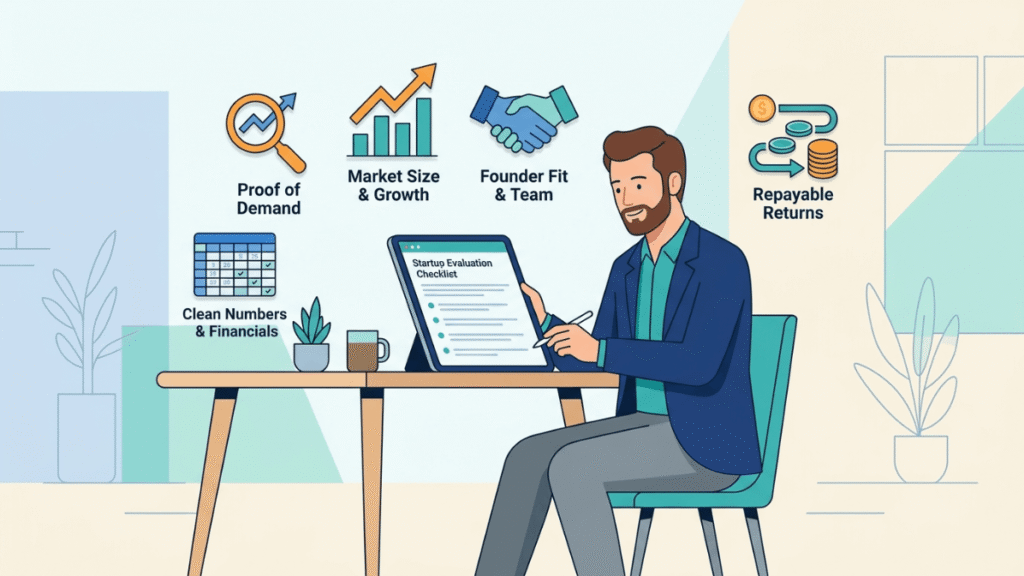
Investors run through the same short checklist before they write a check. This holds for big checks. It holds for small ones too.
- Proof of demand. People already pay for your product. Even small numbers beat any forecast slide.
- Market size. Give a clear answer. How big does this get if the plan works?
- Founder fit. Show why you can pull this off. Show why you can do it better than someone else.
- Clean numbers. Use a cap table that makes sense. Use a budget that makes sense too.
- A repayable path. Show how the investor gets money back. This could come from a sale. It could come from a buyout. It could come from steady profit sharing.
- Use of funds. Answer where every dollar goes. Break it down by category. Do not leave it vague.
The Quick Way to Find Business Investors
Let’s break it into five steps. You can start today.
- Pick your stage first. Pre-seed, seed, Series A, and growth rounds are different. Each one attracts different investors. Each has its own rules and check sizes.
- Build proof before you pitch. A waitlist helps. A paying pilot client helps more. Three steady months of revenue beats any projection.
- Match the investor type to your stage. See the table below.
- Get a warm introduction. A cold email gets ignored most of the time. A short note from a trusted friend gets opened.
- Track every outreach in one sheet. Note the name. Note the date sent. Note the response. Note the next step. Founders lose deals to disorganization more than to rejection.
The latest Federal Reserve survey backs this approach. Eighty-six percent of small firms use some form of financing regularly.
Sixty percent applied for new funding in the past year. Only 42% of applicants got the full amount they asked for.
Thirty-six percent got part of it. Twenty-two percent walked away with nothing.
Firms that matched their ask to the right lender did better. Firms that applied everywhere at once did worse.
Get your books in order before any outreach. Clean financial management makes every later step faster. Investors ask for the same documents your accountant should already keep ready.
Types of Business Investors
Different investors play different roles. Let’s learn how the main types stack up.
| Investor Type | Typical Check Size | Equity Given Up | Speed to Close | Best Fit |
| Friends & Family | $1,000 to $25,000 | 0 to 5% | Days to weeks | Idea stage |
| Angel Investors | $10,000 to $100,000 | 5 to 15% | 3 to 8 weeks | Early traction |
| Angel Groups & Syndicates | $25,000 to $500,000 | 10 to 20% | 6 to 12 weeks | Seed stage |
| Venture Capital Firms | $1 million and up | 15 to 25% | 2 to 4 months | Fast growth, large market |
| Equity Crowdfunding | $500 to $5 million total raise | Varies by offer | 6 to 10 weeks | Consumer brands |
| Revenue-Based Financing | $25,000 to $2 million | None, repaid from sales | 1 to 3 weeks | Steady revenue, no equity loss |
| Strategic & Corporate Investors | $250,000 and up | 5 to 20% | 2 to 6 months | Industry-specific products |
How to Find Business Investors by Type
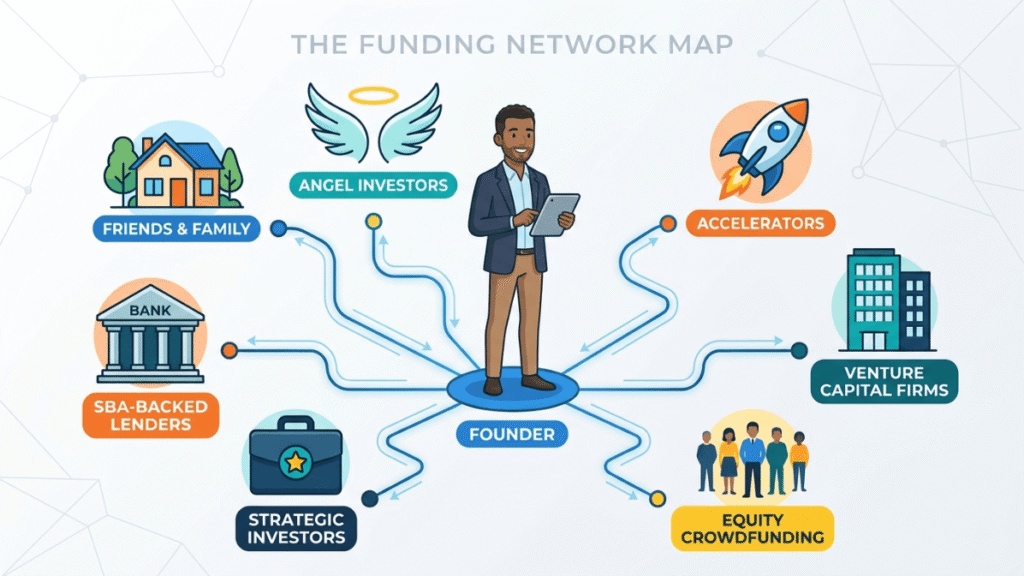
This is the part everyone wants answered first. Where do these people sit? How do you reach them without wasting weeks?
Friends & Family
Start with people who already trust your judgment. Skip strangers off a list. Put the terms in writing anyway.
Do this even for a small check from a relative. A verbal deal can hurt family ties. A signed note protects them instead.
Angel Investors & Groups
Local angel networks meet in nearly every major US city. Many meet monthly. Many post open application windows on their own sites. Search your state name plus “angel network.” You will likely find a group nearby.
Accelerators & Incubators
Join a three to six-month program. It ends with a demo day. The room fills with investors.
This fits founders who want structure plus capital. You also get a built-in peer group of other early founders.
Venture Capital Firms
Most fund deals come through referrals. Build relationships with other founders. Build relationships with lawyers and accountants too.
They already work with VC-backed companies. They make the warm introductions that matter. Attend local startup meetups for six months before you raise. This pays off more than a hundred cold emails sent in one week.
Equity Crowdfunding
SEC-registered funding portals open this door. Everyday US adults can invest small amounts in early companies.
The Regulation Crowdfunding rules cap a single raise. The cap sits at $5 million in a rolling 12-month period. Non-accredited investors face limits too. Those limits tie to income and net worth.
Strategic & Corporate Investors
Look at companies that already sell to your future customers. They invest to lock in a future partner. They want more than a future return. They often move faster than a typical fund. The decision serves their own roadmap too.
SBA-Backed Lenders
Not every founder needs to give up equity. SBA loan programs fund many small businesses.
Some owners would rather pay interest than sell a stake. Compare a few small business loan options against equity terms. Decide which path fits your stage.
I worked with a small hardware brand. They spent four months emailing venture firms. They got zero response.
We switched strategy. We reached out to three regional angel groups instead.
These groups meet over coffee once a month. Two invited the founder to pitch. This happened inside three weeks. Fit mattered more than the size of a firm’s name.
Know how seed capital works before you raise anything. Compare it to a loan. The two solve different problems at different stages.
Accredited vs Non-Accredited Investors: Why the Label Matters
This label decides how much money someone can legally invest. The Securities and Exchange Commission sets this rule. The investor’s bank balance alone does not decide it.
- An accredited investor meets one of two tests. Their net worth sits above $1 million outside their home. Or their yearly income tops $200,000, or $300,000 with a spouse, for two years straight. They face no cap on how much they invest in most private deals.
- A non-accredited investor can still invest. They use equity crowdfunding to do it. But the SEC caps their yearly amount. The cap ties to income and net worth. It often lands at a few thousand dollars per company per year.
Most angel groups deal only with accredited investors. Most venture firms do the same. The paperwork stays simpler that way.
Does your plan lean on smaller checks from regular fans? Equity crowdfunding stays the more open door. It welcomes both groups under one offering.
How Much Should You Ask For?
Pick a number tied to a plan. Do not pick a number based on a feeling. Add up payroll, marketing, and product costs.
Cover the next 12 to 18 months. Add a buffer of three months on top. That total is your ask.
Asking for too little forces another round soon. This dilutes your stake twice. Asking for too much without a plan makes investors nervous.
They worry about how the money gets spent. A founder who asks for $400,000 shows exactly where each dollar goes.
This founder closes faster. A founder who asks for $1 million with a vague plan closes slower.
Know your valuation range before the first call. Seed pre-money valuations climbed past $18 million in early 2026.
This applies to venture-backed startups. The figure more than doubled since 2021. Angel and friends-and-family rounds still close lower. Those numbers tie to actual revenue and traction.
Build a Pitch That Gets a Yes
A pitch deck does one job. It earns a second meeting. Keep it short.
- The problem, in one sentence anyone can follow.
- Your solution. Show why it beats current options.
- Market size. Give a source behind the number.
- Business model. Show how money comes in.
- Traction so far. Show sales, signups, or pilot results.
- Team. Show why this group can execute.
- The ask. State the exact amount and what it funds.
Keep the deck under 15 slides. Investors skim the first three slides in a minute. Put the strongest proof early. Do not bury it on slide 12.
Build a small data room behind the deck. Include incorporation papers. Include a cap table. Include three months of bank statements.
Include a one-page financial model. Investors move faster when records stay organized. Founders who chase paperwork after the first meeting lose time.
A SaaS founder I advised kept losing investor interest. This happened at the second meeting stage every time.
Her deck was strong. But she had no data room ready when asked. By the time she sent files, the investor had moved on.
We fixed it. We prepped every document before her first outreach email went out. Her next three meetings all turned into term sheets. This happened within five weeks.
Every step in how to find business investors works faster once your paperwork stops being the holdup.
How to Reach Out Without Sounding Desperate
A first email decides whether an investor opens the deck at all. Keep it to five short lines.
State who you are. State what the company does in one sentence. Give one proof point. State the ask. Give a date you can meet. Skip the life story.
A few rules hold up across every channel:
- Send the email yourself. Use your own address. Skip the generic founder@ alias.
- Mention the mutual contact by name. Put this in the first line if you have one.
- Attach the deck as a link. Skip the heavy file. A link opens fast on a phone.
- Follow up once after five business days. Never follow up sooner. Add one new piece of news. Do not repeat the same email.
- Stop after two follow-ups with no reply. A third message reads as pressure. It does not read as interest.
Phone calls follow the same shape. In-person pitches do too. State the ask early. Do not build up to it for ten minutes.
Investors hear thousands of pitches a year. The ones that respect their time get remembered.
What Happens After an Investor Says Yes
A yes in a meeting is not money in your account yet. Four steps usually sit between that yes and a wire transfer.
- Term sheet. This short document covers price. It covers equity percent. It covers investor rights. Read every line twice. Have your lawyer check it once before you sign.
- Due diligence. The investor checks your financials. They check your contracts. They check any past legal issues. This stage usually runs 2 to 6 weeks for an angel deal. It runs longer for venture rounds.
- Final agreements. A stock purchase agreement gets drafted. An updated cap table gets drafted too. Any board seat terms get added. Both sides sign.
- Funding. Money lands in your business account. This often happens 30 to 45 days after the signed term sheet. Smaller angel checks can move faster.
Keep running the business like the deal might still fall through. Do this until cash sits in your account.
Rounds collapse during due diligence more often than founders expect. A messy cap table causes this.
An unclear ownership history causes this too. Numbers that shift between the pitch deck and the bank statements cause it as well.
What Issues Scare Investors Away
Skip these before you ever hit send on a pitch email.
- Mixing personal and business money in one account. Pick the right business bank account before you take any outside cash.
- Asking for a number with no math behind it.
- A cap table packed with too many small checks. No clear lead investor in sight.
- Quoting a market size with no source attached.
- Chasing every investor type at once. Not matching your stage.
- Going quiet for weeks after the first meeting. Send a short update instead.
A founder I spoke with last year opened every pitch the same way. He asked for a $5 million valuation.
He had no paying customers yet. Every meeting ended the same way too. Polite, then silent. He dropped the number.
He matched it to his actual traction. He added two paying pilot clients to the deck. He closed a smaller round in seven weeks.
The lesson holds for anyone working out how to find business investors on a tight timeline. Match the ask to the proof. Skip the dream number.
What’s Changing for Investors
A few shifts matter right now if you want fast results.
AI dominance in venture money
More than half of the largest venture deals in early 2026 went to AI-focused companies. The 2026 Venture Monitor tracks this. Non-AI founders need a sharper story. Show why your market still earns attention.
Crowdfunding rules got clearer
The SEC issued new guidance in February 2026. It covers the Regulation Crowdfunding 12-month cap. The guidance shows how the cap rolls between closings. This matters if you plan more than one raise in a year.
Bank lending stayed tight
More founders turn to revenue-based financing now. More founders turn to angel money too. Fewer wait on a traditional loan.
Angel money spread beyond the usual hubs
Groups in Austin, Denver, and Nashville closed deals fast in early 2026. Some coastal cities moved slower. This comes from Angel Capital Association reporting.
| Metric | 2026 Figure | Source |
| Q1 venture deal value | $267.2 billion | PitchBook & NVCA |
| Reg CF annual raise cap | $5 million | SEC |
| Small firms using regular financing | 86% | Federal Reserve |
| Applicants who got full funding | 42% | Federal Reserve |
| Seed pre-money valuation (median) | $18.4 million | PitchBook & NVCA |
Shifts like these change how to find business investors fast in nearly any industry.
Check these numbers again soon. Do not lock in a strategy older than a few months.
Conclusion
You now have a working plan for how to find business investors in 2026. Know what investors check first.
Match your stage to the right investor type. Build proof before you pitch. Keep paperwork ready before anyone asks.
Skip the mistakes above. Watch the numbers shift through the year. Treat every rejection as feedback.
Do not treat it as a dead end. The founders who close rounds fastest are rarely the loudest pitchers. They show up organized. They ask for the right amount at the right time.
FAQ
How much equity should I give up to an investor?
Most early rounds trade 10% to 20% total equity. This covers every investor in that round. Give up less early. This keeps room to raise again later without losing control.
What separates an angel investor from a venture capital firm?
An angel invests personal money. The check often runs $10,000 to $100,000. A venture capital firm invests money raised from outside partners. Their checks usually start at $1 million.
Do I need a lawyer before I take investor money?
Yes. A securities lawyer checks your term sheet. They check your stock agreements too. Do this before you sign anything. Skipping this step costs more later than the legal fee costs now.
Can I find business investors without a warm introduction?
Yes, but it takes longer. Equity crowdfunding portals accept direct applications. Accelerator open calls do too. Neither one needs an introduction.
How long does it take to close a funding round?
Angel rounds often close in 6 to 12 weeks. Venture rounds take 2 to 4 months on average. Multiple firms negotiating terms together can slow this down further.
What documents do investors ask for first?
A one-page summary comes first. Your pitch deck comes next. Three months of bank statements follow. A full data room comes once an investor wants to move forward.
Is crowdfunding a good way to find investors?
It works well for consumer products with an existing fan base. Equity crowdfunding caps a single raise at $5 million a year under SEC rules. This fits smaller rounds best.
What should I do when investors keep saying no?
Ask each one for a specific reason. Do this before you leave the room. A pattern across their answers points to the exact fix. This could be traction, team, or market size.
Do investors fund a business with no revenue yet?
Some angel investors do. Some pre-seed funds do too. They base this mostly on team and market size. Revenue-based lenders need steady income first. Most banks do too. Know which group fits your current stage.
Should I take a loan instead of giving up equity?
A loan keeps full ownership. But it adds monthly payments. Equity skips the payments. But it gives away a share of future profit. Base the choice on how steady your cash flow is. Check how to manage your cash flow before you decide either way.

Aliza Khatun is a Digital Marketing Professional and the founder of DigiGenHub. She has helped various businesses grow their online presence through real-world experience in marketing, branding, traffic growth, and business strategy.
Through DigiGenHub, she shows how to build and grow a business from the ground up using Website Setup, SEO, Branding, Paid Promotion, and smart digital tools.
She also highlights how AI can be used to its full potential to make content creation, automation, marketing, and business growth faster and smarter.
She believes that the right knowledge, modern technology, and the right tools can help any individual or business build a stronger online presence.