
New SBA loan requirements caught many owners off guard in 2026. Every owner needs U.S. citizenship and U.S. residency now. Your debt ratio needs to hit 1.10 or higher.
Old federal debt or a past SBA default will stop you cold. Loan caps moved too, with 7(a) Small Loans capped at $350,000. This combined limit now reaches $10 million.
Here’s the good part: most denials come from small, fixable gaps, not bad businesses. Fix those gaps first, and approval feels a lot closer than you think.
That’s the core of it. Now let’s go deeper into each rule, what changed, and how to fix gaps before you apply.
The Core Rules Everyone Must Meet
The SBA doesn’t lend money directly. A bank or credit union lends the money. The SBA guarantees part of it. That guarantee comes with baseline rules.
Here’s what every applicant needs:
- Your business must operate for profit.
- Your business must operate in the U.S. or its territories.
- You must have invested your own time or money into it.
- You must show you can’t get the same funds elsewhere on reasonable terms.
- Your business must fit SBA size standards for your industry.
These basics stayed steady. Everything else changed.
I’ve talked to three business owners this year. Each got denied for reasons that didn’t exist in 2024. One lost approval over a foreign co-owner.
Another forgot about an old EIDL balance. A third had strong cash flow but missed the credit floor by ten points.
These cases aren’t rare anymore. This is the new normal for SBA loan requirements.
The Citizenship Rule That Catches People Off Guard
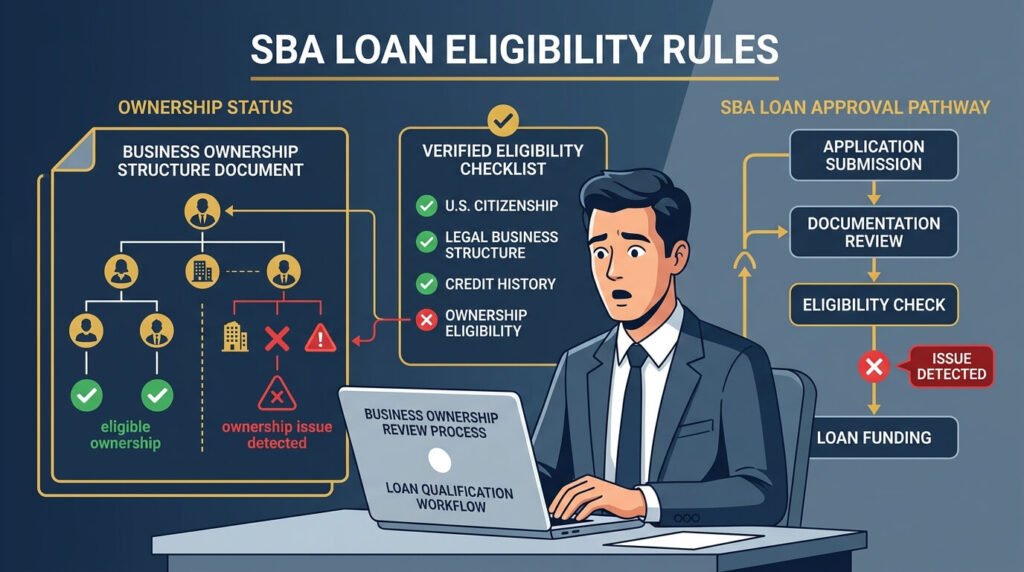
This is the biggest shift in SBA loan requirements for 2026.
Starting March 1, 2026, every owner must be a U.S. citizen or U.S. national.
Every owner must also live in the U.S., its territories, or possessions. This comes from a policy notice issued February 2, 2026.
These revised lending procedures apply to SBA’s main loan programs. Source (sba.gov). America’s Credit Unions
Old rules allowed up to 5% foreign ownership. That flexibility is gone now. Green card holders can no longer hold any ownership stake in a business that applies for an SBA loan.
This rule covers operating companies too. It covers passive holding entities linked to the loan. America’s Credit UnionsAmerica’s Credit Unions
If one owner is a non-citizen, your application gets rejected. No exceptions exist right now.
What you should do: Check your ownership list today. If a non-citizen holds even 1% equity, talk to a business attorney. Fix the structure before you apply. Don’t wait for underwriting to catch it.
Credit Score Rules Got Stricter
The SBSS score used to sit at 155. It rose to 165 in 2025. Lenders now treat it as a hard cutoff.
But 2026 brought a bigger shift. The SBA is phasing out SBSS scoring for federally regulated lenders.
Starting March 1, 2026, these lenders must use their own commercial credit models instead. Starfieldsmith
This sounds flexible. It’s not. It means more paperwork, not less.
| Credit Factor | Old Standard | 2026 Standard |
| SBSS minimum | 155 | 165 (still used by some lenders) |
| Scoring method | SBA-wide SBSS | Lender’s own commercial model |
| Debt service coverage ratio | Often skipped | Must hit 1.10:1 or higher |
| Bank statement review | Sometimes skipped | Two recent months required |
Lenders must now check your debt service coverage. They must review two months of bank statements. They must check projected earnings for new businesses.
A client’s story
A landscaping business owner in Texas had a 680 personal score. He thought that was enough. It wasn’t. His debt service ratio sat at 1.05. The floor is 1.10. He paid off a vehicle loan to fix the ratio. He got approved three weeks later.
Collateral and Paperwork You’ll Need

SBA loans don’t always require full collateral. But lenders must now write down why they approved a loan without it. This wasn’t standard before.
If your business has few hard assets, expect more questions. Service businesses feel this most.
Get ready with these steps:
- List every asset you can pledge. Equipment. Receivables. Inventory. Real estate equity.
- If collateral falls short, offer personal real estate equity. Or accept a smaller loan.
- Pull two months of business bank statements now. Lenders will ask right away.
- Clear any federal debt issues first. CAIVRS checks flag unpaid debt, defaulted student loans, and old SBA losses as automatic blocks.
A restaurant owner I know had a 12-year-old SBA default. He thought it aged off his record. It didn’t.
The check flagged it instantly. His loan stalled for two months. He worked with SBA’s resolution office to clear it. Check your CAIVRS status before you submit anything.
Loan Limits Changed in 2026
Planning a bigger loan? The numbers shifted recently.
SBA Administrator Kelly Loeffler announced that the combined 7(a) and 504 loan limit doubled to $10 million. This took effect July 4, 2026. NAGGL
Core numbers to remember:
| Loan Type | Max Individual Loan | Max SBA Guaranteed Exposure |
| 7(a) Standard | $5 million | $3.75 million ($4.75M for export loans) |
| 7(a) Small Loan | $350,000 (cut from $500,000 in April 2025) | Same guaranty cap applies |
| 504 | Varies by project | Combined up to $10 million with 7(a) |
Your 7(a) balance won’t reduce your 504 loan amount. A single 504 project can finance multiple assets at once (naggl.org).
This helps if you’re combining working capital with a real estate purchase. You have more room now than last year.
Watch Out for Merchant Cash Advance Debt
This trips up more applicants than any other rule. SBA loans can’t refinance Merchant Cash Advance debt anymore.
That debt also hurts your debt service ratio. Your revenue can look strong, and you’ll still fail the math.
Pay down MCA debt before you apply. Or restructure it. Otherwise it will pull your ratio below 1.10 and stop your application early.
Microloans: The Easier Route Most People Skip
Most owners jump straight to 7(a) loans. They skip Microloans, which come with lighter rules. Microloans cap at $50,000. Nonprofit lenders handle them, not banks.
Microloans fit well for:
- New businesses under two years old
- Owners with thin credit files
- Small equipment or inventory purchases
- Working capital under $50,000
The process moves faster. Approval doesn’t depend on SBSS thresholds. If you need under $50,000, this path skips most of the friction above.
SBA Program Comparison
| Program | Best For | Max Amount | Typical Timeline |
| 7(a) Standard | Working capital, acquisitions, refinancing | $5 million | 30 to 90 days |
| 7(a) Small Loan | Smaller working capital needs | $350,000 | 2 to 4 weeks |
| 504 | Real estate, large equipment | Up to $10M combined with 7(a) | 30 to 90 days |
| Microloan | Startups, small equipment, thin credit | $50,000 | 1 to 3 weeks |
| SBA Express | Fast working capital | $500,000 | Decision in 36 hours |
Your Pre-Application Checklist
Follow this order. Skipping steps causes most delays.
- Check your CAIVRS status. Fix any federal debt flags.
- Confirm every owner’s citizenship and residency.
- Calculate your debt service ratio. Aim for 1.10 or higher.
- Pull two months of business bank statements.
- List your collateral. Prepare paperwork for any gaps.
- Pay down or restructure MCA debt.
- Pick your program. Choose based on amount and timeline.
Lenders Add Their Own Rules Too
Meeting SBA requirements doesn’t guarantee approval. The SBA sets the floor. Lenders build rules on top. Standards shift bank to bank.
A bank in Ohio might approve a 690 score with strong cash flow. A bank in California might deny that same file. Both choices are normal. One denial doesn’t mean you’re done.
Another remote client story
A bakery owner in Georgia got denied by her local credit union. Her credit file was thin. She applied with a different SBA lender two states over.
That lender specialized in food service loans. She got approved in five weeks. The SBA rules stayed the same. The lender’s risk appetite didn’t.
Recent Rule Changes at a Glance
| Date | Change | Impact |
| April 2025 | 7(a) Small Loan cap cut to $350K | Smaller deals need other programs |
| April 2025 | SBSS floor raised to 165 | Borderline files get filtered early |
| May 2025 | CAIVRS and federal debt checks made mandatory | Old debt blocks approval automatically |
| March 2026 | SBSS sunset for regulated lenders | Lenders build their own credit models |
| March 2026 | 100% citizen ownership required | Foreign owners and green card holders excluded |
| July 2026 | Combined limit doubled to $10 million | Bigger combined financing now possible |
Final Thoughts
SBA loan requirements moved fast this year. Ownership rules tightened. Credit checks went deeper. Limits grew for big projects. Limits shrank for small 7(a) deals.
None of this makes SBA loans harder to use. It just means you need more prep before you apply.
Check your CAIVRS record first. Confirm every owner’s citizenship. Calculate your real debt service ratio before a lender does it for you. These three steps solve most denial reasons I’ve seen this year.
Handle these details early. SBA loan requirements stop feeling confusing. They start feeling like a simple checklist.
FAQ
Can I apply for an SBA loan if my business is brand new?
Yes. Startups qualify, but lenders look more closely at your industry experience and personal financial strength since you have no business track record yet.
Does an SBA loan require a personal guarantee?
Yes. Anyone who owns 20% or more of the business must sign a personal guarantee. This puts personal assets at risk if the business defaults.
Can a franchise qualify for an SBA loan?
Yes, if the franchise appears on the SBA Franchise Directory. SBA checks the franchise agreement for control clauses before approving any loan tied to it.
Can I use an SBA loan to buy out a business partner?
Yes. SBA loans cover partner buyouts under change-of-ownership rules, but you’ll need a business valuation and a clear transition plan for the lender.
Will applying for an SBA loan affect my credit score?
A soft inquiry during prequalification won’t hurt your score. Once you accept a formal offer, the lender runs a hard credit pull, which can lower your score slightly.
Is there a penalty for paying off an SBA loan early?
Some SBA loans charge a prepayment penalty if you pay off 25% or more of the balance within the first three years. Shorter-term loans usually skip this fee.
Are seasonal businesses eligible for SBA loans?
Yes. Lenders just adjust how they calculate cash flow, often averaging revenue across peak and off-peak months instead of using a flat monthly figure.
Can nonprofits apply for SBA loans?
No. SBA loans only go to for-profit businesses. Nonprofits need to look at separate grant programs or nonprofit-specific lenders instead.
What happens if I default on an SBA loan?
The lender tries to recover funds through your collateral first. The SBA covers its guaranteed portion, then pursues you directly for any remaining balance owed.

Aliza Khatun is a Digital Marketing Professional and the founder of DigiGenHub. She has helped various businesses grow their online presence through real-world experience in marketing, branding, traffic growth, and business strategy.
Through DigiGenHub, she shows how to build and grow a business from the ground up using Website Setup, SEO, Branding, Paid Promotion, and smart digital tools.
She also highlights how AI can be used to its full potential to make content creation, automation, marketing, and business growth faster and smarter.
She believes that the right knowledge, modern technology, and the right tools can help any individual or business build a stronger online presence.