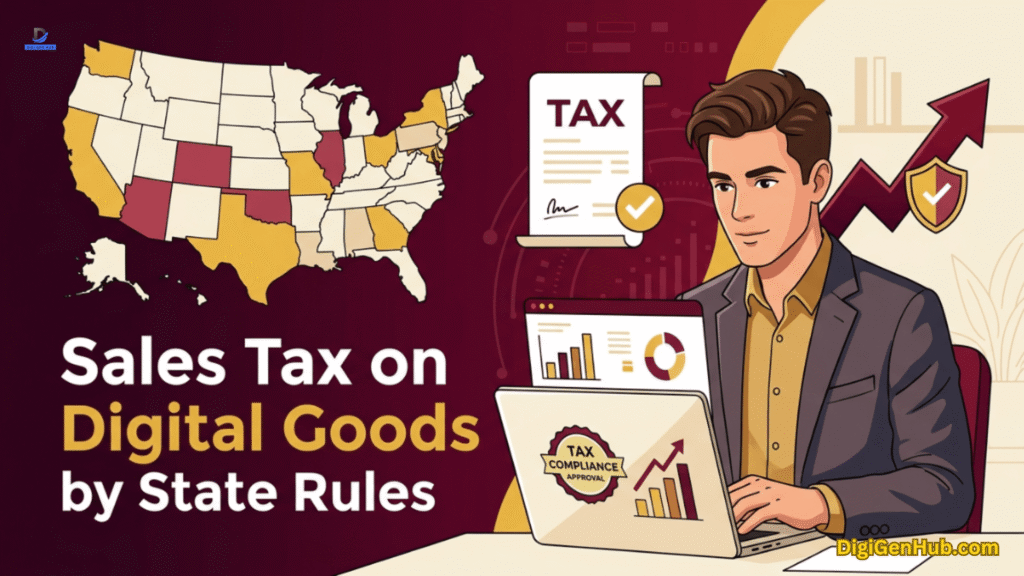
If you searched sales tax on digital goods by state, you want one answer: what you owe, where, and why it keeps changing.
No federal rule covers this. Every state writes its own law, and several rewrote those laws in 2025 and 2026 alone.
Today, we will walk through what gets taxed, what doesn’t, and how to stay on the right side of each state line.
Sales Tax on Digital Goods by State
Every state dictates its own digital tax rules. No federal framework exists.
Three main categories dominate the landscape: downloads, streaming, and SaaS.
A single product faces different tax rates depending entirely on the buyer’s location. For example, California taxes downloads but exempts SaaS. Texas taxes both.
Economic nexus triggers your collection duties. You owe tax once your sales cross a state’s specific financial threshold.
Texas and California set this limit at $500,000. Most states use a $100,000 baseline.
Crucially, states like New Jersey still enforce a 200-transaction trigger. This rule traps low-cost sellers quickly.
Major 2026 shifts are happening right now. Illinois removed its transaction count on January 1. Utah taxes streaming starting July 1. Kentucky drops its transaction rule on August 1.
To stay safe, track buyer locations, categorize products accurately, monitor thresholds, and register early.
What Counts as a Digital Good
Three categories drive almost every tax decision in this space.
- Downloads. Software, ebooks, music files, apps, and game files a customer keeps on a device after the purchase.
- SaaS and cloud access. Software the customer reaches through a browser or app, with nothing stored on their device. Project management tools, CRMs, and most subscription software fall here.
- Streaming. Netflix, Spotify, audiobook platforms, and any service where access ends if the subscription stops.
States rarely treat these three the same way. A product can be taxed as a download and exempt as a stream in the same state.
That gap causes most of the confusion around sales tax on digital goods by state.
Why the Same Product Gets Taxed Differently Everywhere
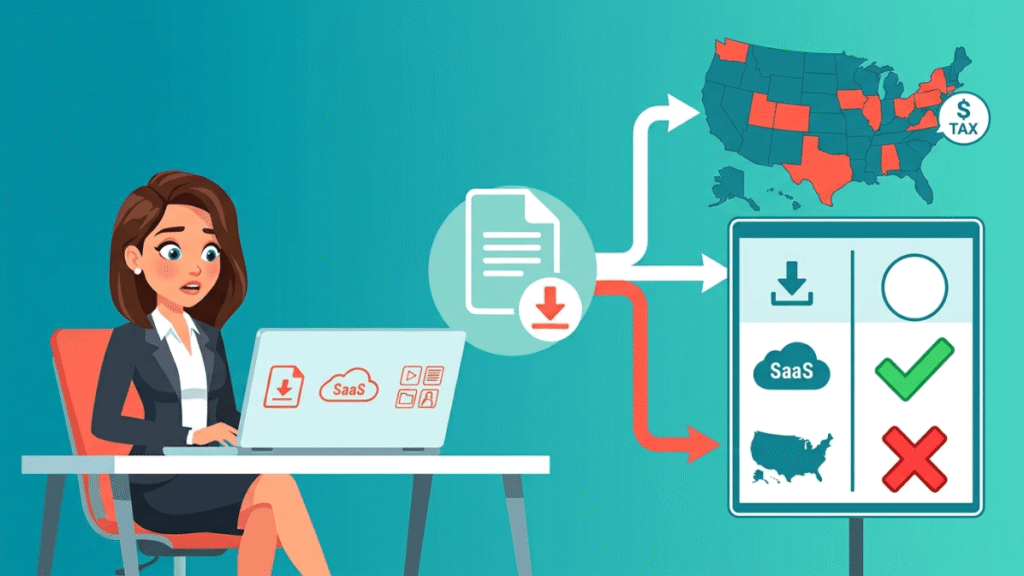
Sales tax was built for physical goods you could see and touch. A download often counts as “tangible personal property” because the buyer ends up with a copy.
The same legal logic used for a CD or a printed book. SaaS usually doesn’t get that label, because the customer never receives a copy, just access to something hosted elsewhere.
California shows this split clearly. A downloaded app is taxed because the customer receives a file.
A SaaS subscription for the same kind of tool is exempt, because the customer only gets remote access.
Texas takes the opposite approach to SaaS: it treats cloud software as a “data processing service,” taxes 80% of the charge, and exempts the remaining 20% by rule.
States that joined the Streamlined Sales Tax Agreement use shared definitions for digital audio works, audiovisual works, and digital books.
But each state still decides on its own which of those categories to tax. You can check any member state’s exact position in the taxability matrix the Governing Board keeps current.
State by State: What Gets Taxed in 2026

Here’s the breakdown of sales tax on digital goods by state for the products people ask about most. Always confirm directly with the state before you file, since these rules shift often.
| State | Downloads | SaaS | Streaming |
| Texas | Taxed | Taxed (80% of charge) | Taxed |
| California | Taxed | Exempt | Exempt |
| Florida | Exempt | Exempt | Varies, separate communications tax may apply |
| Illinois | Exempt statewide | Exempt statewide | Exempt statewide, but Chicago has a local tax |
| Maryland | Taxed at 6% | Taxed, 3% B2B / 6% B2C | Taxed at 6% |
| Kentucky | Taxed | Taxed | Taxed |
| Louisiana | Taxed since 2025 | Taxed since 2025 | Taxed since 2025 |
| Utah | Taxed from July 2026 | Taxed | Taxed from July 2026 |
| Virginia | Exempt | Exempt | Exempt |
| West Virginia | Exempt, except custom software | Not clearly defined | Taxed |
| Massachusetts | Varies by product type | Not clearly defined | Generally exempt |
| New Mexico | Taxed under gross receipts tax | Taxed under gross receipts tax | Taxed under gross receipts tax |
| Maine | Taxed from 2026 | Not addressed in the 2026 update | Taxed from 2026 |
A few notes worth pulling out:
- Florida doesn’t treat digital goods as tangible property at all, so most downloads skip sales tax entirely. Video and satellite-style services fall under a separate communications tax instead.
- Maryland repealed its custom software exemption on July 1, 2025, so software once treated as exempt now gets taxed.
- Kentucky taxes SaaS outright, including AI-powered tools delivered the same way, whether downloaded or accessed remotely.
The Five States With No Sales Tax at All
If your buyer lives in one of these states, no statewide sales tax applies to a digital purchase:
| State | Status |
| Alaska | No state tax, but some local governments tax remote sales through a shared commission |
| Delaware | No sales tax at any level |
| Montana | No sales tax at any level |
| New Hampshire | No sales tax at any level |
| Oregon | No sales tax at any level |
Alaska is the one exception worth flagging. Dozens of local governments there coordinate through the Alaska Remote Seller Sales Tax Commission. So a buyer in one Alaska city might owe local tax even with no statewide rate.
When You Actually Owe the Tax: Economic Nexus
Knowing the rate is only half of sales tax on digital goods by state. The other half is knowing when you owe it at all.
You only collect in a state once you have “nexus” there, meaning a connection strong enough to trigger the duty.
A warehouse, employee, or office creates physical nexus immediately. Most digital sellers never deal with that.
Economic nexus is the one that matters here: cross a state’s sales threshold and you owe tax there, even with zero physical presence.
| State | Threshold |
| Texas | $500,000 in sales, no transaction count |
| California | $500,000 in sales, no transaction count |
| New York | $500,000 in sales AND 100 transactions, both required |
| New Jersey | $100,000 in sales OR 200 transactions |
| Alabama | $250,000 in sales |
| Illinois | $100,000 in gross receipts, transaction count removed Jan 1, 2026 |
| Kentucky | $100,000 OR 200 transactions until Aug 1, 2026, then $100,000 only |
| Maryland | $100,000 OR 200 transactions |
| Most other states | $100,000 in sales is the common default |
Two details trip up digital sellers in particular. First, several states count exempt and taxable sales together toward the threshold.
So even non-taxable revenue can push you over the line. Second, low-priced digital products rack up transaction counts fast.
Sell 200 game codes at $5 each in a state with a transaction rule, and you owe tax there on $1,000 of revenue.
How 2026 Redefined Everything
The fastest-moving part of sales tax on digital goods by state right now is the wave of rule changes landing this year.
| State | Change | Effective |
| Illinois | Removed the 200-transaction rule, now $100,000 only | January 1, 2026 |
| Maine | Added streaming subscriptions to taxable services | January 1, 2026 |
| Chicago, IL | New Social Media Amusement Tax on top of state rules | January 1, 2026 |
| Utah | New law taxes streaming, digital books, and gaming services | July 1, 2026 |
| Kentucky | Removing its 200-transaction threshold | August 1, 2026 |
| Virginia | Bill introduced to start taxing digital goods, not yet law | Introduced January 2026 |
The direction is consistent across nearly every state moving this year. Broader definitions, fewer carve-outs, and a steady retreat from transaction-count thresholds in favor of revenue-only rules.
The Sales Tax Institute’s 2026 outlook tracks this shift across all fifty states if you sell in more than a handful of them.
How This Looks in Practice
Picture a course creator in Ohio selling pre-recorded video lessons from her own site.
Once her sales into Illinois cross $100,000, she has nexus there, but Illinois doesn’t tax downloaded courses at the state level.
So she registers but collects nothing on those specific sales. If a chunk of her buyers are in Chicago specifically, the local Chicago tax can still apply on top.
Picture a SaaS founder in Austin running a project management tool. He pulls in $300,000 a year from Texas customers.
Texas treats his product as a data processing service, taxes 80% of each invoice, and exempts the rest by rule. He builds that 80/20 split directly into his billing system instead of guessing at checkout.
Picture an indie game developer selling $5 download codes nationwide. New Jersey’s 200-transaction rule means he can hit nexus there on $1,000 of total revenue, long before he’d expect to owe anything based on dollars alone.
Picture a music producer selling beat licenses as downloads to buyers in California and Florida.
California taxes that download because the buyer receives a file. Florida exempts the same download outright, since Florida never treats digital goods as tangible property in the first place.
Same products, four completely different outcomes, all legal and all current as of 2026.
A Simple Process to Stay Compliant
- Sort each product into one of the three categories: download, SaaS, or streaming.
- Pull a list of which states your buyers actually live in.
- Check that specific category against each state’s current rule, not a general “are digital goods taxed here” answer.
- Track cumulative sales by state against that state’s nexus threshold.
- Register before you cross the threshold, not after the state notices.
- Collect tax based on the buyer’s address, not your own.
- File on the schedule the state assigns, monthly, quarterly, or annually.
- Recheck every January, since several states change these rules at the start of the year.
Common Mistakes That Cause Trouble
- Treating “digital goods” as one bucket instead of three separate categories with separate rules.
- Assuming SaaS follows the same rule as downloaded software in a given state. They often don’t.
- Skipping local add-on taxes like Chicago’s, which sit on top of the state rule.
- Counting only revenue in a state that still uses a transaction count too.
- Assuming marketplace collection covers every state you sell into, when it may only cover some.
- Waiting until a state sends a notice instead of tracking thresholds proactively.
Compare Your Options for Handling Collection and Filing
Once you know your sales tax on digital goods by state obligations, the next question is how you actually handle them day to day.
| Approach | Setup effort | Who files | Best fit |
| Manual tracking and filing yourself | High | You | One or two states, low volume |
| A tax calculation tool plugged into checkout | Medium | You, with automated math | Growing sales across many states |
| A merchant-of-record service | Low | The service, on your behalf | Sellers who want this off their plate entirely |
| A CPA or tax firm | Medium | You, with professional guidance | Complex, multi-state, or already past due |
Pick based on how many states you’re in and how much of this you want to own directly.
A handful of states with simple rules rarely justifies outside help. Twenty states with mixed download, SaaS, and streaming rules usually does.
The Bottom Line
Sales tax on digital goods by state will keep shifting every year. Illinois, Kentucky, Utah, and Maine all changed their rules in 2026 alone, and Virginia has a bill in motion that could change its answer too.
Sort your product by category, check the exact state rule for that category, track your thresholds, and recheck the list each January. That’s the whole job, repeated state by state.
FAQ
Do all states tax digital downloads?
No. More than 30 states tax at least one digital category, but several, including Florida and Virginia, currently exempt most downloads outright.
Is Netflix or Spotify taxed where I live?
More than 30 states now tax streaming subscriptions as of 2026, including Maryland, Texas, Kentucky, Louisiana, and Maine. Check your specific state’s department of revenue site for a direct answer.
Is SaaS taxed the same as downloaded software?
Rarely. California taxes downloads but exempts SaaS. Texas taxes both, but at different rates through its data processing rule.
How much do I need to sell before I owe tax in a new state?
$100,000 in sales is the most common threshold, though California and Texas sit at $500,000, and a shrinking number of states still add a 200-transaction trigger.
Are the five no-tax states completely free of digital goods tax?
Mostly yes. Alaska is the exception, since local governments there can still apply tax through a shared commission even without a statewide rate.
Do I need to register in every state where I have a single customer?
No. Registration only kicks in once you cross that state’s nexus threshold, whether physical or economic.

Aliza Khatun is a Digital Marketing Professional and the founder of DigiGenHub. She has helped various businesses grow their online presence through real-world experience in marketing, branding, traffic growth, and business strategy.
Through DigiGenHub, she shows how to build and grow a business from the ground up using Website Setup, SEO, Branding, Paid Promotion, and smart digital tools.
She also highlights how AI can be used to its full potential to make content creation, automation, marketing, and business growth faster and smarter.
She believes that the right knowledge, modern technology, and the right tools can help any individual or business build a stronger online presence.