Thinking about how to become an AI consultant? You don’t need a tech degree. You don’t need years of coding.
You need one clear niche, one solid AI skill, and proof you can solve a particular business problem.
Right now, companies everywhere want AI help but can’t find people who speak both business and AI.
That gap is your opening. Pick an industry you already know. Add one certification with no coding required.
Build a small case study using free AI tools. Then pitch that exact win to five warm contacts this week. That’s it, no years of waiting.
No expensive courses required. Businesses are paying $150 to $700 an hour for this skill now.
Again, demand keeps climbing every month. Your path starts smaller than you think, and faster too.
What Does an AI Consultant Actually Do?
An AI consultant helps a business use AI effectively. You don’t need to build models. You don’t need a PhD. You need to solve business problems with AI tools.
Your daily work might include:
- Auditing a company’s workflows for AI opportunities
- Picking the right AI tools for a specific task
- Training staff on prompts and AI safety
- Building simple automation with no-code tools
- Writing AI policy and governance documents
- Measuring ROI after an AI rollout
That’s the real job. Not coding. Not research. Problem-solving.
How to Become an AI Consultant
You want to know how to become an AI consultant. Good news. The path is shorter than you think.
Just six steps that turn your current skills into paid AI work. Each step builds on the last. Skip none of them.
Follow them in order, and you move from curious to hired faster than most people expect. Here’s exactly how to start.
Step 1: Pick Your Entry Point (No Coding Needed)
You do not need to write code to become an AI consultant. Most successful consultants come from business roles, not engineering.
Common starting points:
- Marketing or sales background. You already know customer pain points. Add AI tools for content, lead scoring, and personalization.
- Operations or finance background. You know process inefficiency. Add AI for forecasting, reporting, and automation.
- HR or L&D background. You know change management. Add AI training and adoption programs.
- Fresh start, no prior corporate role. Pick one industry. Go deep on AI use cases for that industry only.
Pick one lane first. Generalists struggle to get hired. Specialists get paid more and get hired faster.
Step 2: Build Real AI Literacy (Not Just Theory)
You need working knowledge, not a computer science degree. Focus on:
- Prompt writing for business tasks
- How large language models actually work at a high level
- AI limitations, bias, and hallucination risks
- Basic data privacy and compliance rules (EU AI Act, U.S. state AI laws)
- No-code automation tools like Zapier or Make
Spend two to four weeks here before touching certifications. Skipping this step is the top mistake new consultants make.
Step 3: Get One Credential That Signals Skill
Certifications don’t guarantee clients. But they open doors, especially with corporate buyers who want proof before they trust you.
Here’s a fair comparison of the most relevant options in 2026:
| Certification | Best For | Coding Required | Typical Time | Cost |
| Google AI Essentials | Business beginners | No | Under 10 hours | ~$49/month |
| Microsoft Azure AI Fundamentals (AI-901) | Cloud-focused consultants | No | 2-4 weeks | Free exam voucher options |
| AWS Certified AI Practitioner | AWS-based clients | No | 3-5 weeks | ~$100 exam fee |
| DeepLearning.AI “AI For Everyone” | Executives and managers | No | 1 week | Free to low-cost |
| IABAC AI Business Track | Strategy and governance consultants | No | 4-8 weeks | Varies |
Dataquest’s certification guide backs this up. Beginner options need no coding at all. Google AI Essentials works this way.
AI for Everyone works this way too. More technical programs ask for basic Python. You can pick that up as you go. Dataquest
Choose one certification tied to your niche. Don’t collect five badges. One focused credential beats a stack of unfinished courses.
Step 4: Choose a Niche (This Is the Real Growth Lever)
“AI consultant” alone is too broad. Broad titles get you low rates and slow replies. Specific titles get you fast callbacks.
Try positioning yourself as:
- AI consultant for law firms
- AI automation consultant for e-commerce brands
- AI governance consultant for healthcare
- AI adoption consultant for real estate teams
A niche gives you a story. A story gets you clients. Generalists compete on price. Specialists compete on value.
Step 5: Build Proof Before You Have Clients
You need a portfolio before your first paid gig. Here’s how to build one fast:
- Pick a real problem in your niche.
- Solve it with free or low-cost AI tools.
- Document the before and after.
- Turn it into a short case study.
- Post it on LinkedIn with clear numbers.
This single step replaces years of “waiting for experience.” Clients trust proof, not promises.
Step 6: Find Your First Paying Client
Skip cold outreach at first. Start with warm paths:
- Past coworkers and managers
- Local small business owners in your niche
- LinkedIn posts showing your case study
- Niche Slack and Discord communities
- Freelance platforms with AI-specific filters
Charge less for your first two projects. Trade a lower rate for a strong testimonial and referral. That trade pays off fast once your pipeline builds.
What Do AI Consultants Earn in 2026?
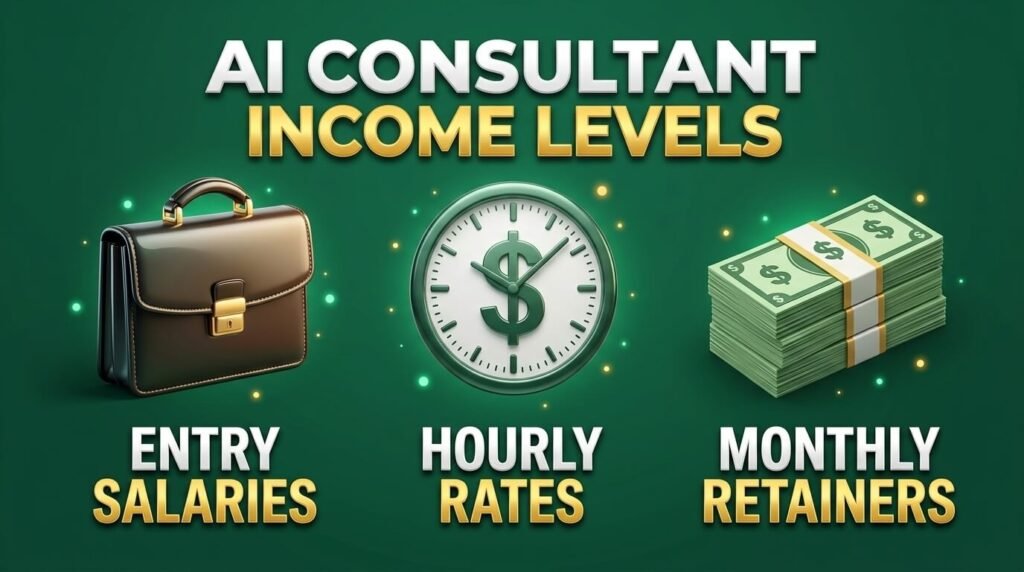
Pay varies a lot depending on employment type. Here’s the honest breakdown across multiple sources:
| Path | Typical 2026 Range | Source |
| Entry-level employed consultant | $80,000 – $120,000/year | Industry salary data |
| Mid-level employed consultant | $120,000 – $180,000/year | Industry salary data |
| Senior employed consultant | $180,000 – $365,000+/year | Industry salary data |
| Independent hourly rate (generalist) | $150 – $300/hour | Market benchmarks |
| Independent hourly rate (specialist, gen AI/agentic) | $350 – $700/hour | Market benchmarks |
| Monthly retainer (small business) | $2,000 – $15,000/month | Market benchmarks |
Glassdoor’s 2026 data tells a clear story. The average AI consultant salary sits near $208,223 a year. Top earners reach close to $377,319.
That range looks wide. Here’s why. Titles get used loosely. A junior “AI prompt consultant” gets the same label as a senior “AI strategy partner.” Both get lumped together in the data. Glassdoor
Don’t anchor on one number. Anchor on your niche, your proof, and your delivery model.
The Right Pricing Model Matters More Than the Rate
Hourly billing caps your income. Value-based pricing does not. Consulting clients increasingly want fees tied to outcomes.
Three common models in 2026:
- Hourly. Simple but limits growth. Good for your first few projects.
- Project-based fixed fee. Set price for a defined scope. Rewards speed and skill.
- Retainer. Monthly fee for ongoing support. Best for recurring income.
- Outcome-based. A percentage of savings or revenue gained. Highest upside, hardest to sell early.
Move from hourly to project-based as soon as you land your third client. That single shift changes your income curve.
Tools You Should Actually Compare
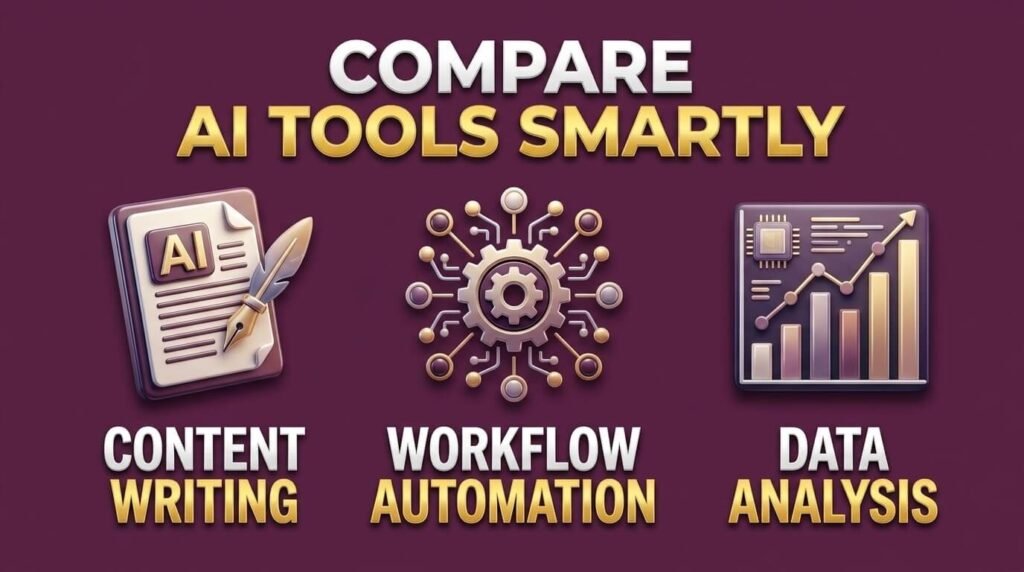
Every new consultant asks which tools to learn. Skip vendor hype. Compare tools by job, not by brand name.
| Task | Tool Category | What To Check Before Choosing |
| Writing and content drafts | General chat AI models | Accuracy, tone control, context length |
| Workflow automation | No-code automation platforms | Integration count, pricing per task |
| Data analysis | Spreadsheet AI add-ons | Formula accuracy, file size limits |
| Meeting notes and transcripts | Transcription AI tools | Language support, privacy policy |
| Client-facing chat support | Customer service AI bots | Escalation rules, hallucination controls |
Test three tools per category with your own real task before picking one. Vendor demos always look better than daily use.
Personal Lessons From the Field
I’ve watched three patterns repeat over and over with new consultants trying to figure out how to become an AI consultant the fast way.
A friend of mine spent two months chasing every certification badge she could find. Zero clients came from it.
The moment she picked one niche (AI for dental clinics) and posted one case study, she landed her first $3,000 project within three weeks.
My cousin Lisa charged $50/hour on her first project because she feared rejection. The client happily would have paid double. Undercharging early cost her thousands in lost income and set a low anchor for future negotiations.
Someone in my network tried to sell “full AI transformation” to a 12-person company. Way too big a pitch. He shrank the offer to a single automation for their invoicing process. That small win turned into a six-month retainer.
A consultant I spoke with skipped compliance knowledge entirely. Her client got flagged during a data privacy review.
She lost the contract and had to rebuild trust from zero months later. Skipping governance basics is a costly shortcut.
The lesson across all four stories stays the same. Small, proven, focused work beats big, vague promises every time.
Common Mistakes That Slow You Down
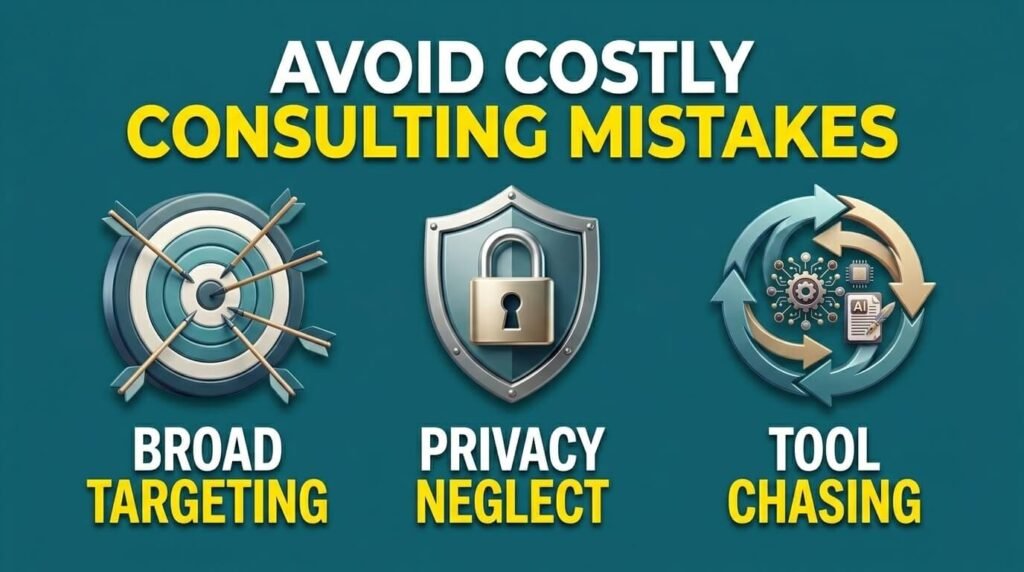
Avoid these traps:
- Trying to serve every industry at once
- Ignoring data privacy and AI compliance rules
- Charging hourly forever instead of moving to value pricing
- Skipping a portfolio because you feel “not ready”
- Chasing every new AI tool instead of mastering a few
Each mistake above costs new consultants months of wasted effort. Fix them early.
How Long Does It Take to Become an AI Consultant?
Most people move through this timeline:
| Phase | Time Needed |
| AI literacy building | 2-4 weeks |
| First certification | 2-6 weeks |
| Niche selection and portfolio | 2-4 weeks |
| First paid client | 1-3 months after portfolio |
| Steady income stream | 6-12 months total |
Faster paths exist if you already work in a business role and simply add AI skills on top. That’s the quickest route into how to become an AI consultant without starting from zero.
Why Demand Is Exploding in 2026
The numbers back this up. McKinsey’s latest State of AI survey found something big.
88% of organizations now use AI in at least one business function. 72% use generative AI. That’s up from just 33% in 2024. This jump happened in only two years. 200OK Solutions
But adoption and success stay two different things. Deloitte’s newest enterprise report proves it.
Two-thirds of organizations report productivity gains from AI. Revenue growth still feels distant for most.
Only 20% see revenue gains today. 74% just hope for them. That gap between hope and result is where your job sits. Deloitte
Here’s the short version:
| Trend | 2026 Data Point | Source |
| Enterprise AI adoption | 88% use AI in one function | McKinsey |
| Companies still stuck in pilot mode | Nearly two-thirds not scaled yet | McKinsey |
| Talent shortage | 72% of employers struggle to fill AI roles | ManpowerGroup |
| Job growth for AI-adjacent roles | 20% growth through 2034 | BLS |
| Skills gap named top barrier | #1 barrier to AI integration | Deloitte |
Businesses have budget. They lack skilled people who can bridge AI and business goals. That’s your opening.
Final Steps to Start This Week
Here’s your short action list:
- Pick one niche based on your current background.
- Spend two weeks on core AI literacy.
- Get one certification, not five.
- Build one case study using a real problem.
- Reach out to five warm contacts with your case study.
- Price your first project fairly, not cheaply.
- Move to value-based pricing after client three.
Conclusion
That’s your full path forward. No wasted steps. No filler. Just clear moves that get you paid.
You can start today. Pick one niche. Prove one win. Send one pitch. Momentum builds fast once you begin.
This is how to become an AI consultant who gets hired, gets trusted, and gets paid well in 2026. Your first client is closer than you think.
FAQ
Do I need to form an LLC before taking clients?
Not at first. Start as a sole proprietor. Set up an LLC once you land steady contracts. Protects your personal assets once real money moves.
Can I work with clients outside my own country?
Yes. Most AI consulting happens over video calls and shared docs. Time zones matter more than borders. Pick overlap hours that work for both sides.
What’s the difference between an AI consultant and an AI engineer?
Engineers build systems. Consultants advise on strategy, tools, and adoption. You don’t need to write software to do this work well.
Do I need business insurance?
Consider it once you handle sensitive client data. Errors and omissions coverage protects you if a recommendation goes wrong. Cheap peace of mind.
How do I handle a client who distrusts AI?
Start small. Show one low-risk win first. Trust builds from results, not arguments. Never push a skeptical client into a big rollout early.
Should I work through an agency or find clients directly?
Agencies give you steady work with lower pay. Direct clients pay more but take longer to land. Many consultants do both while starting out.
How do I keep my skills current as AI tools change fast?
Set aside two hours weekly for testing new releases. Follow a few trusted newsletters. Skip chasing every trend. Depth beats breadth here.
Do I need to stick with one AI vendor like OpenAI or Google?
No. Stay vendor neutral. Clients trust advice more when it isn’t tied to one company’s product. Recommend what fits their actual need.
What happens if a project scope grows mid-contract?
Set boundaries in writing before you start. Charge extra for added work. Scope creep quietly drains your time and your profit margin.
Can I do this part-time while keeping my current job?
Yes, and most people should. Build your first few clients on evenings and weekends. Move full-time once income covers your current salary.

Aliza Khatun is a Digital Marketing Professional and the founder of DigiGenHub. She has helped various businesses grow their online presence through real-world experience in marketing, branding, traffic growth, and business strategy.
Through DigiGenHub, she shows how to build and grow a business from the ground up using Website Setup, SEO, Branding, Paid Promotion, and smart digital tools.
She also highlights how AI can be used to its full potential to make content creation, automation, marketing, and business growth faster and smarter.
She believes that the right knowledge, modern technology, and the right tools can help any individual or business build a stronger online presence.