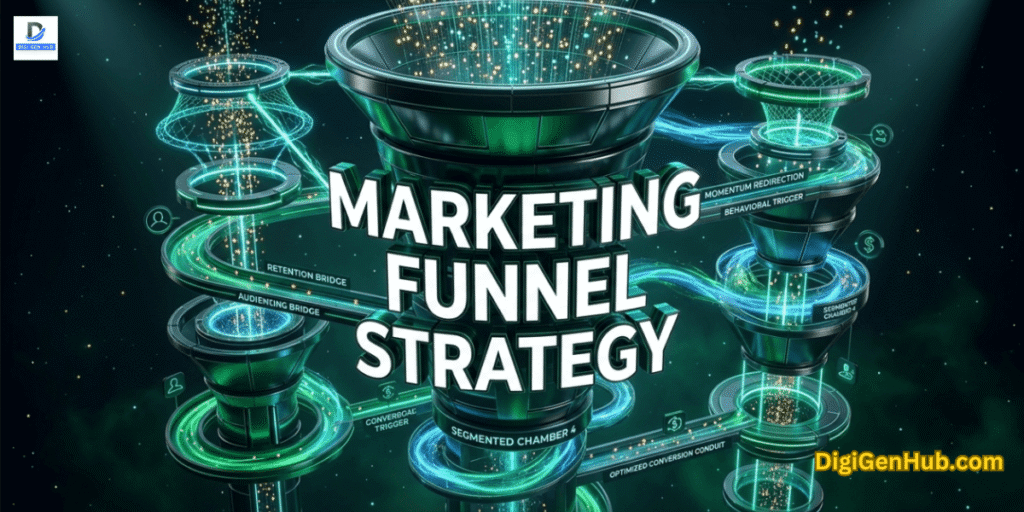
A marketing funnel strategy guides people from first seeing your brand to becoming paying customers. It follows a clear step-by-step path.
Now, strong funnels use short videos to grab attention. Email automation keeps people engaged.
Retargeting ads bring visitors back before they leave. Real-time data helps track what works at every stage.
Most businesses spend money on ads. Then they wait. Nothing comes back. The ad was not the problem. The system behind the ad was.
That system is your marketing funnel strategy. Without it, every visitor you pay for just disappears. With it, every visitor has a clear next step. So, you can see where they drop off and why.
Indeed, let’s learn everything from how funnels work in 2026 to which tools help, what the data says, and what I have personally tested and seen work.
What Is a Marketing Funnel Strategy?
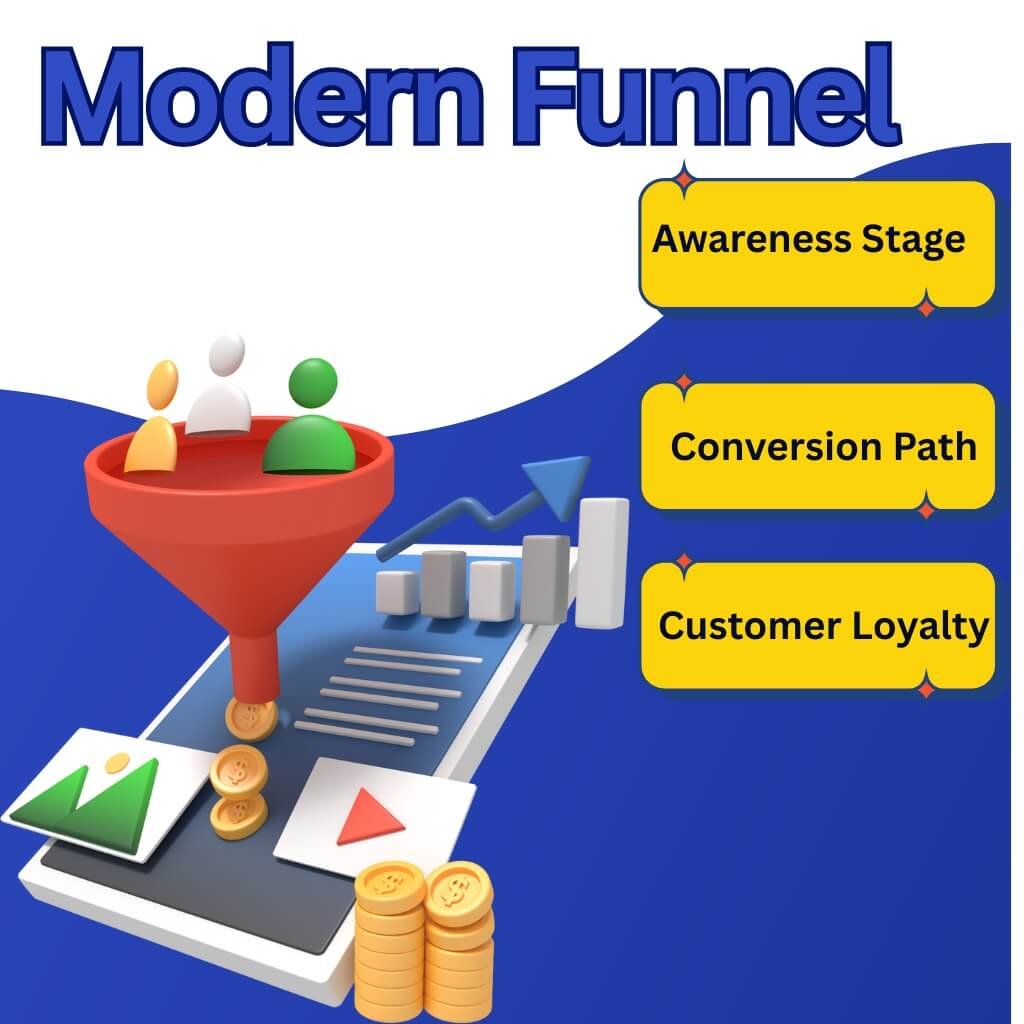
A marketing funnel strategy is a planned path your audience takes from first discovering you to buying from you and then buying again.
Each stage has one specific job:
- Awareness – Get in front of the right people.
- Interest – Build enough trust to earn their contact info.
- Decision – Remove the last objection before purchase.
- Retention – Turn one-time buyers into repeat customers.
It sounds simple. The hard part is that most businesses skip at least one stage. They run ads straight to a checkout page. Or they collect emails but never follow up. Or they close a sale and go completely silent.
That gap is where revenue leaks. And in 2026, that gap is wider than ever because buyers are more skeptical, more distracted, and have more options in every market.
Why Most Funnels Fail in 2026
Here is what the data actually shows:
- 68% of businesses have no defined or documented funnel. (Cropink, 2025)
- 79% of leads never convert because they are not properly nurtured. (Marketing LTB, 2025)
- 96% of website visitors are not ready to buy on their first visit. (Outbrain Full-Funnel Report, 2025)
- Only 17% of marketers currently have a fully functioning sales funnel. (shno.co, 2026)
Most businesses treat their funnel like a one-time event. Someone lands on the site, either buys or does not, and that is the end of it. That is not a funnel. That is a gamble.
A strong marketing funnel keeps your brand in front of people who are not ready to buy yet. It stays visible until the right time comes and they decide to take action.
The Four Major Funnel Stages
Let’s explain the vital funnel stages simply:
Stage 1: Awareness (Top of Funnel)
This is where people first learn you exist. They are not looking to buy yet. They have a problem and they are looking for answers.
Your job here is not to sell. Your job is to show up with something useful.
What works at this stage right now:
- Short-form video on TikTok, Instagram Reels, or YouTube Shorts.
- SEO blog posts that answer specific questions your audience types into Google.
- Podcast appearances or your own show.
- Threads and posts on Reddit, LinkedIn, or niche forums.
- AI tools to write content with human research.
My experience: In early 2025, I published a focused FAQ post targeting a question my audience was asking ChatGPT directly.
Within six weeks, that page was being cited in AI-generated search responses.
Google traffic to that page climbed 34% without a single paid click. The only investment was one afternoon of clear, structured writing.
Stage 2 : Interest and Lead Capture (Mid Funnel)
Once someone finds you, the clock starts. You have maybe 30 seconds before they leave and forget you exist.
The goal here is to get their email in exchange for something genuinely useful. Not a generic checklist. Something specific to one painful problem they already have.
The lead magnets that convert best nowadays:
- Free tools, calculators, audit templates, swipe files
- Email mini-courses, 5-day sequences solving one specific problem
- Personalized quizzes that give a custom result at the end
- Original research or data reports that they cannot find anywhere else
After they opt in, your email sequence takes over. This is where most of the actual conversion happens, not on the landing page.
Nurtured leads produce 20% more sales opportunities than non-nurtured leads. They close 23% faster, according to Venturz’s 2026 sales funnel data.
My experience: I replaced a 3-email welcome series with a 7-email sequence tied to the exact lead magnet each subscriber downloaded. The results changed fast.
Open rates jumped from 19% to 41%. Everything else stayed the same. The list size did not change.
The send time stayed the same. The email platform stayed the same. The only difference was that the content matched what people actually wanted.
Stage 3: Decision (Bottom of Funnel)
The prospect knows you. They like what they have read. But they have not bought yet.
Something is stopping them. Your job is to find that objection and remove it.
What removes objections best:
- A free trial or low-cost entry product that lets them try before committing
- Real case studies with real numbers and real names
- Retargeting ads that speak directly to the page they visited
- Testimonials placed next to every buy button, not buried on a separate page
- A genuine deadline or limited offer, not a fake countdown timer
I used the same landing page for four months. It converted at only 0.8%. Then I changed the whole approach.
I rewrote the page in plain language. I removed the flashy design. I focused on one clear offer.
The same traffic started converting at 3.4%. Clear and direct messaging worked much better than a polished page with unclear value.
Stage 4: Retention and Referral
Most marketers stop at the sale. That is the most expensive mistake in this whole list.
Keeping a customer costs roughly five times as much as finding a new one. And a happy customer who refers someone is worth more than any ad you will ever run.
What a retention system looks like:
- A 3-email post-purchase onboarding sequence.
- A clear next step inside the product or service itself.
- A loyalty reward or referral program.
- Regular value-only emails between sales pitches.
- A re-engagement sequence for anyone who goes quiet after 30 days.
I added a simple 3-email onboarding sequence after purchase for a digital product. Refund requests dropped 28% in 60 days.
Upsell conversions from that same audience doubled. Nothing about the product changed. The follow-up did everything.
Funnel Conversion Rate Benchmarks for 2026
Now is the time to learn what a healthy funnel looks like by the numbers:
Standard B2B Marketing & Sales Funnel Conversion
| Funnel Stage | Average Conversion Rate |
| Visitor to Lead (Opt-in) | 2% to 5% |
| Lead to Marketing Qualified Lead (MQL) | 15% to 21% |
| MQL to Sales Qualified Lead (SQL) | Around 20% |
| SQL to Opportunity | Around 30% |
| Opportunity to Closed Sale | Around 20% |
The steepest drop happens at the MQL-to-SQL transition. That is where email nurturing does the most work.
If your open rates are under 20% and click rates under 2%, fix your mid-funnel before spending anything else on ads.
Top Funnel Tools Comparison in 2026
You do not need five tools. You need the right one for your stage and budget.
Marketing Funnel Software Comparison
| Tool | Best For | Funnel Stage | Free Plan | Starting Price |
| HubSpot | All-in-one CRM & full funnel | All stages | Yes | $0 |
| ActiveCampaign | Email automation & lead scoring | Mid and bottom | Trial only | $15/mo |
| ClickFunnels | High-converting sales page funnels | Bottom of funnel | No | $97/mo |
| GetResponse | Email marketing & ecommerce funnels | Mid funnel | Yes | $9/mo |
| Leadpages | Fast landing page creation | Top and mid | Trial only | $37/mo |
| Klaviyo | E-commerce email flows | Mid and retention | Yes (500 contacts) | $20/mo |
| MailerLite | Budget email & basic automation | Mid funnel | Yes (1,000 contacts) | $9/mo |
Prices verified May 2026.
If you are just getting started, HubSpot free CRM with GetResponse or MailerLite is enough for most funnel stages. The cost stays very low in the beginning.
Move to ActiveCampaign or ClickFunnels when your business starts bringing in steady revenue and you need more advanced features.
For e-commerce stores, Klaviyo works well once you have an active product catalog and regular customer activity.
For B2B businesses with a longer sales process, ActiveCampaign gives you lead scoring. And CRM tools without the high cost of large enterprise platforms.
How to Build Your Funnel From Scratch (Step by Step)
Follow this order. Skipping steps is the most common reason funnels do not work.
Step 1
Pick one audience problem, not a niche. A specific problem that keeps a specific person up at night.
Your whole funnel answers that one problem. Everything else is a distraction at this point.
Step 2
Choose one top-of-funnel channel. Stay on it for 90 days before adding a second. Trying to be everywhere at once produces mediocre results everywhere. Pick the one channel where your audience already spends time.
Step 3
Create a lead magnet that solves a small version of the big problem. The more specific it is, the higher it converts.
“A guide to marketing” is too broad. “A 5-day email sequence template for online course creators” is specific enough that giving an email for it feels worth it.
Step 4
Write a 5 to 7-email welcome sequence. Each email solves one small problem. Email 1 delivers the lead magnet.
Emails 2 through 6 build trust and address objections. Email 7 makes one clear offer. Do not pitch before email 5.
Step 5
Set up one retargeting ad. Target anyone who visited your sales page but did not buy.
Show them a customer result or a testimonial. Keep the copy short. One sentence, one image, one link.
Step 6
Add a post-purchase onboarding email with a minimum. Help the buyer get a quick win with what they just purchased.
A buyer who succeeds early seldom asks for a refund and almost always buys again.
Step 7
Review drop-off points every 30 days. Use Microsoft Clarity (free) or Hotjar to watch how real visitors move through your pages. You will spot the exit points in minutes. Fix one thing per month.
Common Funnel Mistakes to Fix Right Now
Most people build a funnel once and assume it works. They drive traffic, check the numbers, and wonder why nothing converts. The traffic is not always the problem. The funnel usually is.
These five mistakes show up in almost every funnel I have reviewed. Each one quietly kills conversions at a different stage.
Still, every single one has a direct fix you can apply today without rebuilding anything from scratch.
1. Sending All Traffic to Your Homepage
Your homepage serves people who already know you. Cold traffic lands there and leaves confused.
The fix: Build a dedicated landing page for each offer. One headline. One promise. One button.
Example: A Meta ad for a free email marketing checklist should lead to a simple landing page.
The page should clearly say: “Get your free email marketing checklist. Enter your email below.”
Keep the page focused. Remove the menu. Remove extra links. Don’t add unrelated sections.
This simple setup often brings much higher opt-in rates. Many businesses increase conversions from 5% to 20% or more with the same traffic.
2. Putting Multiple CTAs on One Page
Every extra button competes with the main one. More choices mean fewer decisions.
The fix: One page, one goal, one CTA. If you sell two products, build two separate funnels.
Example: An online coach had three buttons on her landing page. One said, “Book a Call.”
Another offered a guide download. The third asked people to join a newsletter.
She removed two buttons and kept only “Book a Call.” That single change increased bookings by 61% in one week. Traffic stayed the same.
3. Going Silent After the Opt-In
Most people need four to seven touchpoints before they trust a brand enough to buy. One welcome email is not enough.
The fix: Set up a 5 to 7 email sequence that starts the moment someone opts in. Each email solves one small problem. The offer comes last.
Example: A digital product seller started with a simple email flow. One welcome email went out first.
A sales pitch followed on day two. By the third email, open rates dropped to 8%.
Later, the full sequence was rebuilt into six emails. Each email answered a real customer concern and explained the product more clearly.
The results improved fast. Open rates stayed around 38% until the last email. Sales conversions also tripled.
4. Ignoring Mobile Experience
Over 70% of email opens happen on a phone. A page that looks fine on a desktop can look broken on a 375px screen.
The fix: Test every landing page and email on mobile before it goes live. Use tools like Google’s Mobile-Friendly Test (free) to catch layout issues instantly.
Example: A course creator ran ads for three weeks. His landing page converted at only 0.9%.
Then he checked the page on an iPhone. He noticed the opt-in button sat too far down the screen. Most visitors never saw it.
He moved the button higher on the page. The next week, the conversion rate jumped to 3.2% with the same traffic.
5. Not Tracking Each Stage Separately
A funnel with no stage-by-stage data is just guesswork with extra steps.
The fix: Track three numbers separately: your opt-in rate, your email click rate, and your sales page conversion rate. These three tell you exactly where your funnel breaks.
Example: A SaaS founder believed his ads were failing because sales had stopped growing. Then he checked the funnel data more closely.
The opt-in rate looked good at 22%. But the email click rate was only 0.8%. The problem was not the ads. The problem was the email sequence.
He rewrote two emails in the funnel. The next month, revenue increased by 40% without spending more on ads.
AI Tools Inside Your Funnel (What Helps)
AI tools in 2026 are useful for specific funnel tasks. They are not a replacement for human judgment or your own voice.
What AI does well inside a funnel:
- Writing five subject line variations in two minutes for split testing
- Generating first drafts of email sequences, you rewrite in your own tone
- Building lead scoring rules in your CRM based on subscriber behavior
- Summarizing heatmap and analytics data into clear action points
- Writing retargeting ad copy variations quickly
What AI still does poorly:
- Writing with genuine personal experience or a specific brand voice
- Making judgment calls about audience trust and timing
- Creating original research or proprietary data
- Replacing a real human conversation at the decision stage of a high-ticket sale
According to Funnel.io’s 2026 Marketing Intelligence Report, 54% of marketers say AI helps them create faster. But 23% also say it often sounds repetitive and generic.
Use AI to speed things up. Remove friction. Don’t let it write the final version.
Always edit the output. Shape it in your own voice before it goes to your audience.
How to Measure Your Marketing Funnel Strategy
Track these numbers. Review them monthly. Fix the lowest one first.
Marketing Funnel KPI Benchmarks
| Stage | What to Measure | Healthy Benchmark |
| Awareness | Organic reach & impressions | Growing month over month |
| Top of Funnel | Website traffic & click-through rate | CTR: 2% to 5% organic / 1% to 3% paid |
| Lead Capture | Landing page opt-in rate | 15% to 25% on dedicated pages |
| Email Nurture | Open rate & click rate | Opens: 30% to 45% / Clicks: 3% to 8% |
| Sales Page | Conversion rate | 1% to 5% cold traffic / 5% to 15% warm |
| Retention | Repeat purchase rate & churn | Monthly churn under 5% |
If your opt-in rate is under 10%, the issue is the offer or the page. Not the traffic source.
If your email open rate is under 20%, the problem is the subject line or sender trust.
If your sales page converts under 1%, trust is missing. Add testimonials. Add case studies. Fix that before changing anything else.
Conclusion
A marketing funnel strategy is the company’s supply chain for trust. It is the sales pipeline’s twin engine.
It works like a stock market with automation tools. It is a contract between attention and action. Run it well and the funnel becomes not a cost center, but a profit machine.
FAQ
How can micro‑experiences improve my marketing funnel strategy?
Micro‑experiences are tiny, interactive moments like polls or short quizzes. They engage users quickly. Each small action moves them closer to a bigger conversion.
Can storytelling alone shape a funnel in 2026?
Yes. Stories create context and emotion. They help users remember your brand. A strong story can guide users through awareness to interest naturally.
How do niche communities affect my funnel next year?
Small online communities like Discord or private groups act as mini-funnels.
They nurture loyal users. Engagement here can lead to organic referrals and conversions.
What is “funnel gamification” and how does it work?
Gamification adds rewards, levels, or challenges. Users engage more. They explore, interact and progress through your funnel faster.
How do subscription models impact funnel design?
Focus shifts from one-time purchase to repeated value. Early steps show ongoing benefits. Renewal and usage milestones drive long-term engagement.
Can hybrid digital‑physical experiences fit in my funnel strategy?
Yes. Combine offline events with online content. QR codes, pop-ups, or live demos link physical and digital steps. Users feel connected across channels.
How does social proof evolve for the next generation of buyers?
Dynamic endorsements matter more than static reviews. Micro-influencers and community testimonials carry weight. Real-time proof increases trust and action.
Will AI avatars or virtual assistants replace traditional funnel touchpoints?
Not fully. They add personality and interaction. AI can suggest content, answer questions and guide users like a live assistant.
How can environmental or ethical positioning integrate into a funnel?
Show your values early. Sustainability or social causes attract the right audience. Users convert faster when they connect with your purpose.
What new funnel formats are emerging beyond linear models?
Funnels are becoming flexible, web-like paths. Users can enter and exit at different points. This keeps engagement high while still guiding them toward action.
How long does it take to see results from a new marketing funnel?
Most funnels need 60 to 90 days of consistent traffic before the data becomes reliable.
The first 30 days show you where people drop off. Days 31 to 60 let you test one fix at a time.
By day 90, you have a funnel that either works or gives you a clear reason why it does not.
Do I need a website to build a funnel in 2026?
No. Many strong funnels start simple. They use a landing page tool, an email platform, and a social media profile.
A full website can help later. But it is not needed at the start. Focus on one offer first. Make it convert. Build everything else after that.
How often should I email my list once they finish the welcome sequence?
Two to three times per week is the sweet spot for most audiences. Once a week is too easy to forget.
Every day feels aggressive unless your content is exceptionally strong. Consistency matters more than frequency. A reliable Tuesday email beats an unpredictable daily one.
What is the difference between a landing page and a sales page?
A landing page captures a lead, usually in exchange for something free. A sales page closes a paid transaction.
They have different jobs, different lengths, and different structures. Mixing them up is one of the most common conversion killers in any funnel.
Should I run paid ads before my funnel is fully tested?
No. Paid traffic amplifies what is already there. If your funnel converts at 1% on free traffic, ads will burn your budget at that same 1%.
Test your funnel with organic traffic first. Once it converts consistently, then scale with paid.
How do I know if my lead magnet is the problem or my landing page copy?
Run a simple test. Split your traffic into two versions.
Keep the copy the same. Change the lead magnet on one. Keep the lead magnet the same, but change the copy on the other.
Watch what happens to your opt-in rate. The change will show you the real problem.
Never change both at once. You won’t know what actually made the difference.
Can a simple email funnel still compete with complex automated systems?
Yes. A plain-text 6-email sequence written with genuine insight and a clear offer still outperforms complicated automation built on weak copy. The technology is secondary. The message and timing are everything.
What is the right funnel length for a high-ticket offer versus a low-ticket one?
Low-ticket offers under $100 can close faster. Usually within 3 to 5 emails. The nurture period is short.
High-ticket offers above $500 need more time. Often 10 to 21 days of follow-up. A call or demo usually sits in the middle. More proof is needed along the way.
Price changes trust. A higher price means slower decisions and longer trust-building.

Aliza Khatun is a Digital Marketing Professional and the founder of DigiGenHub. She has helped various businesses grow their online presence through real-world experience in marketing, branding, traffic growth, and business strategy.
Through DigiGenHub, she shows how to build and grow a business from the ground up using Website Setup, SEO, Branding, Paid Promotion, and smart digital tools.
She also highlights how AI can be used to its full potential to make content creation, automation, marketing, and business growth faster and smarter.
She believes that the right knowledge, modern technology, and the right tools can help any individual or business build a stronger online presence.