

Starting a business does not require a fixed amount. The cost can vary depending on what you want to build and how you plan to start.
Some businesses can begin with a small budget, while others need more planning and investment.
Still, to start a business is not the same as it was even two years ago. The problem is not just money. It is the gap between what people think they need and what the market actually needs.
You may be confused about how much does it cost to start a business. Many investors spend $100,000 and stop.
Others start cheap and fail later. They ignore small hidden costs like tools, subscriptions, and compliance fees.
Still, most lean startups start with $3,000 to $12,000 now and meet success.
You can launch digital businesses under $5,000. But you may also expand $50,000 to $175,000 for bigger.
You must full $132 for LLC fees. Again, you may spend a $800 yearly tax in some states like California.
If you miss necessary filings, it can lead to $500 daily fines. Also, expect to spend $200 to $500 per month on AI tools and security. The right move is a Hybrid-Lean approach.
How Much Does It Cost to Start a Business?
I have seen people spend $20,000 on a custom website. It failed. A $200 template with $50 AI copy worked better.
Today, looking expensive is cheap. Being legal is harder.
Do not trust zero-dollar dreams. You still need money to start right.
Plan at least $2,000 to $5,000. This covers hosting, LLC setup, and insurance for a serious launch.
The Cost Range
In most cases, starting a business can cost anywhere from a few hundred to several thousand dollars.
The exact amount depends on your business type, the tools you use, and how you manage your setup.
The 3 Types of Business Costs
Understanding cost is easier when you break it into parts.
1. Startup Costs
These are one-time expenses, such as setting up a website, registering a business, or basic setup.
2. Ongoing Costs
These include monthly expenses such as hosting, marketing, or basic operations.
3. Hidden Costs
These are often ignored, like testing ideas, making mistakes, or upgrading systems later.
Cost Examples by Business Type
Different businesses require different levels of investment.
Online business: usually low cost to start.
Service-based business: moderate cost depending on skills and tools.
Physical or retail business: higher cost due to inventory and setup.
Why Cost Estimates Can Be Misleading
Many guides show fixed numbers, but real costs are not the same for everyone.
Your budget depends on your decisions, your approach, and how you manage your resources. Starting small and learning as you go often reduces risk.
How to Decide Your Budget
Instead of focusing on a large number, focus on starting smart.
Begin with only what you need
Test your idea before spending more
Improve step by step as your business grows
Common Mistakes to Avoid
Many new business owners make simple mistakes. These can be:
1 . spending too much at the beginning
2 . ignoring ongoing costs
3 . trying to scale too fast
4 . Avoiding these mistakes can save both time and money.
Cost & Category for Online Business Models
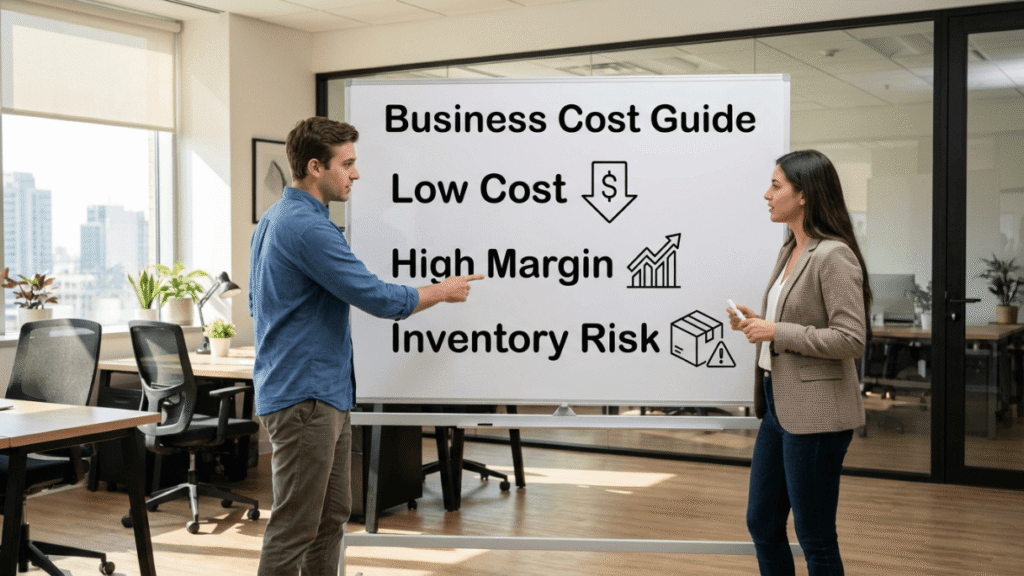
Choosing the right model is your biggest money decision. It sets your cost and risk.
The gap is clear. Digital and physical costs are far apart.
Digital products cost less. They have high profit margins. No shipping. No storage.
Physical products cost more. You need inventory and cash. But they help you to build strong brand trust in the market.
2026 Business Model Cost Snapshot
| Business Model | Product Type | Startup Cost (Low) | Startup Cost (High) | Top Expense in 2026 |
| AI Automation Agency | Digital Service | $1,200 | $5,000 | API Tokens & AI Software |
| Specialized Paid Newsletter | Digital Content | $500 | $2,500 | Growth Ads & Email Platform |
| Boutique E-commerce | Physical Goods | $4,000 | $15,000 | Initial Inventory & 3PL |
| Micro-SaaS (AI-Powered) | Software | $5,000 | $30,000 | Development & Cloud Hosting |
| Print-on-Demand (POD) | Physical Goods | $300 | $1,200 | Design Samples & Shopify |
| Digital Template Studio | Digital Product | $200 | $1,500 | Design Software (Canva/Figma) |
| High-Ticket Consulting | Digital Service | $1,000 | $4,500 | Personal Branding & LinkedIn |
| Subscription Box (Niche) | Physical Goods | $3,500 | $12,000 | Custom Packaging & Shipping |
| Online Education/Courses | Digital Product | $800 | $6,000 | Video Gear & LMS Platform |
| Affiliate Content Site | Digital Content | $600 | $3,000 | High-Quality SEO Content |
Many people start a general store. This is a mistake now.
US customers want specific products. They trust niche brands more.
A friend launched a mushroom coffee brand with $6,000. She spent on lab testing and strong packaging. She chose one niche. She recovered her money in four months.
If you go digital, focus on AI automation. Small law firms and plumbing companies need AI chatbots. Demand is high.
You can start for under $2,000. You can charge $500 per month per client.
How to Choose Between Digital and Physical Products
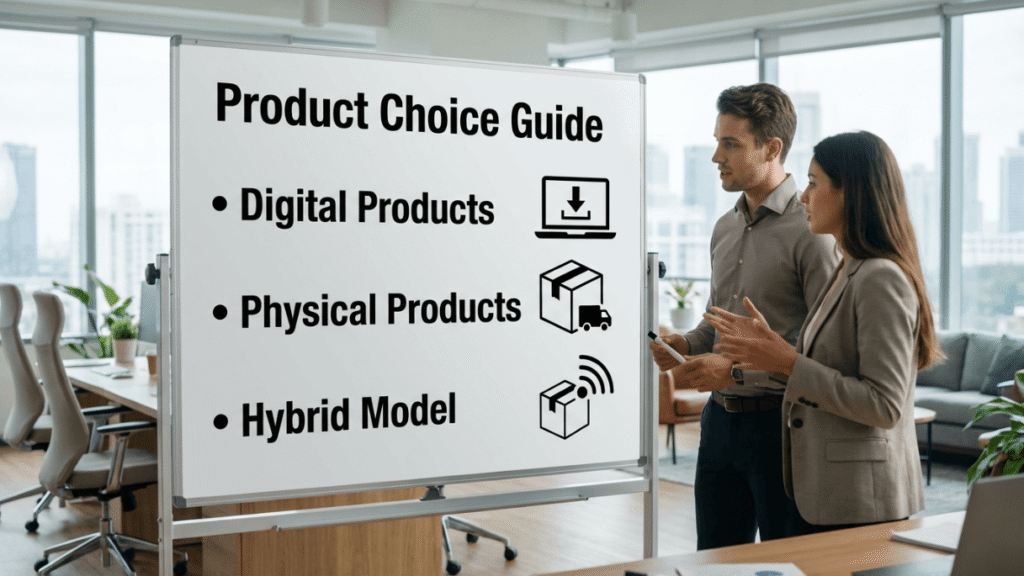
Choosing between digital and physical products is a key decision. It shapes your cost, time, and growth.
Each path has its own risks and rewards. You must pick based on your skills, budget, and goal. The right choice makes your launch faster and more profitable.
Digital Products (Best for Beginners)
Digital products are easy to start. You don’t need inventory or shipping. You just need a clear problem to solve. Focus on tools people can use right away.
The Problem
You need to be an expert. People won’t pay for generic info anymore because AI provides that for free.
The Solution
Sell “implementation.” Don’t sell a course on how to use AI; sell a “Prompt Pack” that is already tested for a specific job, like real estate writing.
Example: A “Notion Template for Small Law Firms” costs almost $0 to make but can sell for $99 over and over.
Physical Products (Best for Brand Builders)
Physical products build strong brands. They need more money and planning.
But they create trust and long-term value. You must manage stock and delivery carefully.
The Problem: Shipping costs in the US have gone up by 12% since last year.
The Solution: Use a 3PL (Third-Party Logistics) provider immediately. It costs more per item, but it saves you from renting a warehouse.
Example: Selling custom “Eco-friendly Yoga Mats.” You spend $4,000 on your first 200 units. You ship them to a 3PL center in Texas. They handle storage and delivery.
The Hybrid Approach: Many founders now mix both. They sell a physical product like a planner. They add a digital community or app. This increases profit without raising costs much.
Mandatory Legal and Tax Fees: What are the Unavoidable Costs?
You cannot ignore Uncle Sam. Business registration happens at the state level.
LLC formation costs $50 to $500. It depends on the state. Kentucky is $40. California charges $800 every year as a franchise tax.
A registered agent is needed for privacy. It costs $100 to $300 per year.
BOI reporting is free on FinCEN. But many pay $150 to $300 for software to avoid mistakes and missed deadlines.
Do not overthink states. File where you actually work. Some people try Wyoming while living in New York. It often creates extra tax and fees. Keep it simple.
The Tech Stack: How Much for Software and AI?

The tech stack is now your new office cost. In 2026, software replaces rent.
You don’t need a big setup. But you do need basic digital tools to run your business.
AI tools usually cost around $20 to $30 per month. They help with writing, research, and daily tasks.
Planning and document tools can add another $20 to $50 per month. They help you stay organized and investor-ready.
Security is no longer optional. Many small businesses now spend $50 to $150 per month to stay protected from cyber risks.
Example: If you run an AI-based content business, your monthly tool cost can reach around $250. This includes AI support, customer management, email, and hosting. It often costs more than basic office items.
Startup Guidelines for Entrepreneurs (Cost-Saving Rules)
Starting a business is not about doing more. It is about doing the right things early.
Every dollar matters in the beginning. Good decisions reduce future problems and protect your cash flow. You can follow these rules to build a stable and lean business:
Validate before you spend
Do not build based on assumptions. First, test if people care. A small test can save months of waste.
Example: Run a simple ad or landing page to see if people actually show interest before building the product.
Use fractional help
You don’t need full-time staff early. Buy skills only when you need them.
Example: Hire an expert for a few hours to solve a specific task instead of paying a full salary.
Automate your taxes
Poor tracking creates expensive mistakes later. Build clean records from day one.
Example: Record every income and expense weekly so you don’t face a costly cleanup at tax time.
Buy refurbished tech
New tools don’t always mean better results. Focus on function, not hype.
Example: A slightly older laptop can handle business tasks at a much lower cost.
Ignore fancy offices
Location does not build success. Execution does.
Example: Work from home or use a virtual address instead of paying high monthly rent.
Bundle your insurance
Separate plans increase cost and confusion. Combine coverage when possible.
Example: A single business policy can cover multiple risks at a lower total cost.
Watch subscription creep
Small monthly fees silently grow into big expenses.
Example: Review all software every few months and remove tools you no longer use.
Prioritize video marketing
People trust what they see. Video builds faster attention than text.
Example: A simple short video explaining your product can bring more leads than long posts.
Build a personal brand
Trust converts better than ads. People follow people, not companies.
Example: Share real experiences and insights to attract organic customers without ad spend.
Use free government help
You don’t always need paid advice. Free support exists.
Example: Use local business mentoring programs to get guidance in the early stages.
Keep a 6-month reserve
Cash flow failure kills more startups than bad ideas.
Example: Save enough money to survive slow months without stress or panic.
Focus on high-intent SEO
Traffic is useless without buyers. Focus on intent, not volume.
Example: Target search terms from people ready to buy, not just general curiosity.
Stay compliant
Legal delays can create serious financial penalties.
Example: File all required reports on time to avoid fines or legal issues.
Leverage no-code tools
You don’t need to code everything from scratch. Start simple and fast.
Example: Build a basic working version of your idea using drag-and-drop tools.
Think global, pay local
Scale your reach but stay legally structured.
Example: Work with global freelancers while keeping your business properly registered in one main country.
Conclusion
So, how much does it cost to start a business? Starting a business is not about how much you spend. It is about how well you plan and manage your resources.
A simple and clear approach can help you start with confidence and grow over time.
FAQ
Does it cost money to get a D-U-N-S number for business credit?
Standard registration for a D-U-N-S number through Dun & Bradstreet is free. It typically takes about 30 business days to process.
If you are in a rush to build business credit or bid on a government contract, you can pay an expedited fee of $200 to $500 to receive it in a few days.
How much is the penalty for missing the new BOI report?
The penalties for failing to file your Beneficial Ownership Information (BOI) report are severe.
You can face fines of up to $500 per day for as long as the report is late. While the filing itself is free, many founders pay a compliance service $150 once a year to ensure they never miss a deadline.
How much should I pay for a business contract template?
A business contract template usually costs $50 to $200 in the USA.
Free templates exist, but they are often basic. They may miss key clauses for AI use and data privacy.
A paid template gives more safety and clarity.
Some services offer monthly access to legal templates. This can be cheaper than paying a lawyer for one document.
Is there a yearly fee to keep my business name reserved?
If you form an LLC, your business name is protected in that state for free.
If you are not ready yet, you can reserve the name. Most states charge $10 to $50 for this.
This keeps your name safe for 30 to 120 days.
What is the cost of a business-grade VPN for security?
Cybersecurity is important for startups.
A business VPN usually costs $10 to $20 per user each month.
It is a small cost, but it protects your data.
It keeps bank logins and customer information safe.
It is very useful when working from cafes or public Wi-Fi.

Aliza Khatun is a Digital Marketing Professional and the founder of DigiGenHub. She has helped various businesses grow their online presence through real-world experience in marketing, branding, traffic growth, and business strategy.
Through DigiGenHub, she shows how to build and grow a business from the ground up using Website Setup, SEO, Branding, Paid Promotion, and smart digital tools.
She also highlights how AI can be used to its full potential to make content creation, automation, marketing, and business growth faster and smarter.
She believes that the right knowledge, modern technology, and the right tools can help any individual or business build a stronger online presence.