The debate over sales-led growth vs product-led growth has changed now. SaaS companies no longer pick just one.
They face a “Friction Gap.” This happens when you force a sales call on someone who just wants to try the app.
Or, you leave a big corporate buyer alone in a trial without help. This mistake kills your growth and wastes your money.
The best solution today is product-led sales (PLS). You use the product to hook the user.
You use data to tell your sales team when to step in. This satisfies the modern buyer. They want instant access but need human trust for large contracts
Sales-Led Growth vs Product-Led Growth: The Recent Verdict
Combine product and sales strategies for scalable business growth
The battle between Sales-Led Growth (SLG) and Product-Led Growth (PLG) has finally ended in a merger.
For years, businesses treated these as opposing systems. Now, data shows that the most successful SaaS firms use Product-Led Sales (PLS).
This hybrid model uses the product to hook users (PLG) and human sales teams to close the big corporate checks (SLG).
SLG vs. PLG vs. Hybrid (PLS)
| Feature | Sales-Led (SLG) | Product-Led (PLG) | Hybrid (PLS) |
| Primary Driver | Human Sales Reps | The Product Itself | Data-Driven Signals |
| Typical ACV | $50,000+ | $10 – $5,000 | $5,000 – $100,000+ |
| Sales Cycle | 3 – 9 Months | Instant / Self-Serve | Weeks (Post-Signal) |
| Target User | Executives / Decision Makers | End-Users / Employees | Power Users + IT |
| Key Metric | SQL (Sales Qualified Lead) | PQL (Product Qualified Lead) | PQA (Product Qualified Account) |
| Cost (CAC) | High ($8,000 avg) | Low ($500 – $2,000) | Moderate / Optimized |
My Experience on Sales-Led Growth vs Product-Led Growth
Last year, I worked remotely with a B2B startup in Austin, Texas. They were 100% Sales-Led. Every lead had to “Book a Demo.”
Their calendar was full of people who never bought. It costs them $5,000 to get one customer. That customer only paid $2,000. They were losing money fast.
We changed their strategy. We opened a 14-day “Full Access” trial. No credit card. No demo.
Within two weeks, an employee from a major U.S. airline signed up. We watched the data. That one employee invited 20 teammates in three days. The sales rep didn’t pitch. He sent a 30-second video.
He said, “I see your whole team is active. Want me to show you how to set up the security for 50+ people?”
That trial turned into a $150,000 contract. The product landed with the user. The human expanded the deal.
What is Product-Led Sales (The Hybrid)
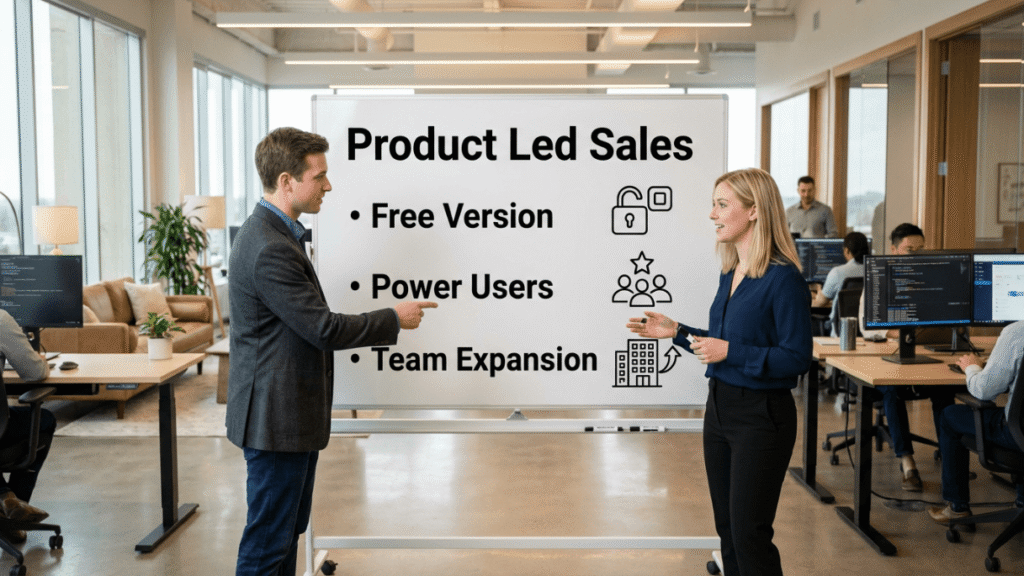
This is the most accurate solution. You use PLG for “Land” and SLG for “Expand.” You let the employees use the tool for free.
Once 20 people in the same company are using it, your salesperson calls the IT Director to offer a “Company-Wide License.”
The Step-by-Step Method
1 . Give away a free version that is actually useful.
2 . Track “Power Users” who invite others.
3 . Set an alert for your sales team when a company hits 10 users.
4 . Offer the “Enterprise Grade” features (SSO, Security, Admin Controls).
Why is Everyone Talking about Product-Led Sales (PLS)?
Win users fast then close enterprise deals with trust
The growth model hinges on a fast “Aha!” moment. Users must see value within five minutes or they leave.
Remove friction by dropping credit card requirements and demo walls. A simple email should be the only barrier to entry.
While the product hooks the user, sales must focus on the boss. Big companies need custom workflows to sign.
Enterprise deals now die instantly without SOC2 or HIPAA compliance. High-level trust is the only way to close these large contracts. Let’s explain:
1. Product-Led Growth (PLG): The Self-Serve Hook
PLG is your magnet. It works because U.S. users hate waiting. They want to solve problems at 2:00 AM without a meeting.
Fast Value: Users must see the benefit in under 5 minutes.
Easy Entry: Use one-click signup with Google or Slack.
Viral Power: The tool improves when users invite friends.
Example
Canva is a PLG leader. You don’t call a rep to make a flyer. You just need to make it. By the time a big company notices, 500 employees already use it.
2. Sales-Led Growth (SLG): The Enterprise Closer
SLG is your heavy hitter. It handles “Big Fish” deals. These buyers care about contracts and data safety.
Executive Trust: You sell to the boss, not just the worker.
Compliance: You handle the legal and security paperwork.
High Value: This is for deals worth $50,000 or more per year.
Example
Snowflake uses SLG for massive data deals. A CEO needs to trust a human with their data. A “Buy Now” button won’t close a million-dollar contract.
Reason behind The Growth Gap
The old way of selling is broken. Many U.S. startups face a massive problem: they hire expensive sales teams to chase $50-a-month customers.
This burns cash and kills the business. On the other side, “Product-Led” companies have thousands of free users. But they can’t get a single CEO to sign a $100k contract. They lack the human touch to close big deals.
The Solution
You must merge both. Use the product to get the user in the door. Use the human to open the boardroom.
This is called product-led sales (PLS). It focuses on the “Product Qualified Lead” (PQL).
When a user hits a specific goal in your app, your sales team calls them. This is not a cold call. It is a warm help call.
If you want to rank today, you must provide a “Zero-Click” solution while maintaining deep authority.
How do You Build a Winning Growth Strategy?
The shift between sales-led growth vs product-led growth requires a new playbook.
You cannot rely on old tactics like cold calling or hidden pricing. Buyers want speed, transparency, and value.
If you don’t give them these, they will find a competitor who does. Let’s explain how to bridge the gap between your product and your revenue goals.
Stop Cold Calling
Only call people who already have an active account. A rep calling a stranger is Sales-Led Growth. A rep calling a user who just signed up is Product-Led Sales.
Example: Use a tool to see when a lead from a big company logs in. Call them then.
Shorten Your Forms
Every extra field on a signup form kills 10% of your leads. U.S. users hate long forms. They want to see the product now.
Example: Ask only for an email. Use a database to find their company name and size automatically.
Video is Mandatory
Use personalized videos in your sales emails. It builds trust in a digital world.
Example: Record a 30-second clip of you using the client’s website with your tool. Send it via email.
Fix the Leaky Bucket
If users leave after 30 days, your product is the problem. No amount of Sales-Led Growth can save a bad product.
Example: If users stop using your tool after one week, simplify your setup process.
Use Reverse Trials
Start everyone on the pro plan. Downgrade them if they don’t pay. This lets them see the full value of Product-Led Growth.
Example: Give a user every feature for 14 days. If they don’t pay, move them to the “Free” plan.
Focus on Aha! Metrics
Know exactly which button click leads to a sale. This is the heart of Product-Led Growth.
Example: If users who upload a photo are 5x more likely to buy, make “Upload a Photo” the first step.
Optimize for AEO:
Answer questions like “How much does it cost?” directly on your page. AI search engines and buyers want fast answers.
Example: Create an FAQ section that clearly lists your pricing and features.
Incentivize Invites
Make the product better when more teammates join. This creates viral growth without a sales team.
Example: Give a user extra storage for every teammate they invite to the dashboard.
Hire Sales-Assist First
These are helpers, not “closers.” They bridge the gap in Sales-Led Growth vs Product-Led Growth.
Example: Hire a person to chat with free users and help them set up their first project.
Build a Public Roadmap
Users trust companies that show what they are building next. It proves you are a leader in your niche.
Example: Use a public Trello board to show which features you will release next month.
Check Your Speed
A slow dashboard is the fastest way to lose a user. In 2026, speed is a feature.
Example: If your page takes 5 seconds to load, you will lose half your signups. Aim for 1 second.
Target the Champion
Find the one person who loves your tool. Arm them with slides to sell it to their boss. This is the secret to Sales-Led Growth.
Example: Send a ready-to-use PowerPoint deck to your most active user so they can pitch it to their CEO.
Simple Pricing
Don’t have 10 tiers. Have three: Free, Pro, and Enterprise. U.S. buyers hate “choice paralysis.”
Example: List a free version for individuals, a $20 version for teams, and a custom version for big firms.
Use Social Proof
Buyers want to see “G2” and “Capterra” reviews. They trust other users more than your marketing.
Example: Place a 5-star badge from a review site right next to your “Sign Up” button.
Automate the Basics
Let AI handle password resets. This lets your humans focus on Sales-Led Growth for big deals.
Example: Use a chatbot to handle tech support so your sales team only talks to buyers.
Conclusion
If you are building a business, do not pick a side. Build a bottom-up product. Make it so easy that a college student can use it. But make it so secure that a bank can buy it.
Start with the free trial. Watch the data. When you see a user from a “bigcompany.com” email address logging in 5 days in a row, send them a manual email. Do not use a template. Say: “I saw you are using the tool for [X]. Here is a tip to do it faster.” That is how you win.
Audit your “Time-to-Value” right now. If it’s over 5 minutes, fix your product before you spend another dollar on ads.
FAQ
Is a product-led model more expensive to build than sales-led?
Yes, at the start. PLG requires a perfect UI and automated billing systems. While SLG relies on human salaries, PLG needs higher upfront engineering costs. You must ensure the product can sell itself without breaking.
How does dark social impact these growth models?
Most B2B buying now happens in private Slack groups or Discord servers.
PLG wins here because users can share a sign-up link in seconds. SLG struggles because you cannot easily share a book or a demo link in a private chat.
Can a service-based business use a product-led model?
Service firms now productize their work using client portals. By giving clients a dashboard to track progress or download files, you create a self-serve experience. This mimics PLG and reduces the need for constant status calls.
Does PLG work for highly regulated industries like Healthcare?
It is hard but possible through sandboxing. You provide a secure demo environment with fake data.
This lets the user try the tool while keeping the sales-led security rules in place for the final legal contract.
How do I prevent freemium fatigue?
This happens when a free plan feels too useless. The 2026 solution is usage-based gating.
Give users every feature, but limit the volume. For example, give them 3 reports instead of 50. This proves the value without annoying the user.
Should my sales team get credit for a self-serve sign-up?
To avoid internal fights, firms now use unified revenue quotas. If a user starts for free but moves to a big deal via a rep, both teams get credit. This stops sales reps from hiding the free trial from big leads.
What is the impact of cancel anytime on large SLG contracts?
Buyers now demand more flexibility. Rigid 3-year contracts are dying. They are being replaced by annual minimums with monthly extra fees.
This makes the jump from a free plan to a big contract feel safer for the buyer.

Aliza Khatun is a Digital Marketing Professional and the founder of DigiGenHub. She has helped various businesses grow their online presence through real-world experience in marketing, branding, traffic growth, and business strategy.
Through DigiGenHub, she shows how to build and grow a business from the ground up using Website Setup, SEO, Branding, Paid Promotion, and smart digital tools.
She also highlights how AI can be used to its full potential to make content creation, automation, marketing, and business growth faster and smarter.
She believes that the right knowledge, modern technology, and the right tools can help any individual or business build a stronger online presence.