

You searched for freelance writing niches because generic writing stopped paying. You feel it already.
Clients want specialists now, not another blogger who covers everything and nothing. Here’s the honest part.
Healthcare writers now can earn up to $1.25 per word, while general blog writers still fight over pennies. That gap isn’t random.
AI can write basic content in seconds, but it can’t fake clinical accuracy, financial judgment, or years of industry insight.
You don’t need ten years of experience to close that gap. You need one strong sample and the nerve to say no to random topics.
Pick a niche close to what you already know. Build proof fast. Pitch with confidence.
Clients paying premium rates are actively searching for someone exactly like you right now. Your freelance writing niche is closer than you think.
What Is a Freelance Writing Niche?
A freelance writing niche is a specific topic or content type you focus on. It could be healthcare blog posts.
It could be SaaS case studies. It could be fintech newsletters. Clients no longer want a “content writer.” They want someone who already knows their industry.
This shift did not happen by accident. AI tools now write basic blog posts in seconds.
Clients stopped paying for generic output. They now pay for judgment, research, and voice. That is why freelance writing niches matter more now than before.
The Highest-Paying Freelance Writing Niches Right Now
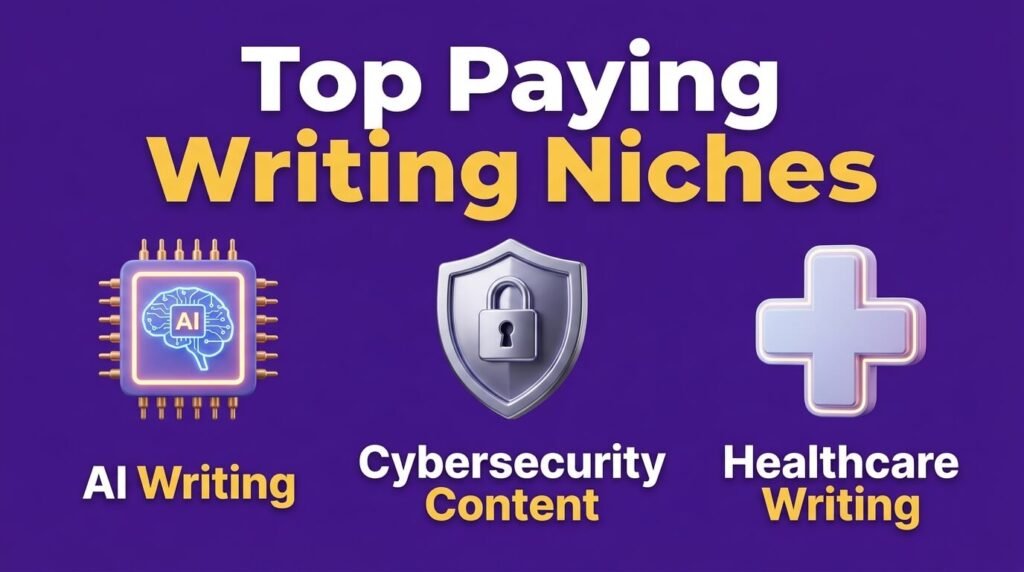
Let’s find out where the money sits in 2026.
| Niche | Typical Rate Range | Why Clients Pay More |
| AI and machine learning content | $0.40 to $0.75+ per word | Few writers can explain AI clearly and accurately |
| Cybersecurity writing | $0.30 to $0.70 per word | Technical accuracy protects client trust |
| SaaS and B2B software | $0.25 to $0.60 per word | Content ties directly to sales pipelines |
| Fintech and cryptocurrency | $0.30 to $0.95 per word | Compliance risk raises the bar |
| Healthcare and medical writing | $0.30 to $1.25+ per word | Accuracy is a legal and safety issue |
| Legal content | $0.25 to $0.65 per word | Mistakes carry real liability |
| General SEO blog content | $0.05 to $0.15 per word | Low barrier to entry, high competition |
Healthcare sits at the top for one reason. Clinical accuracy is hard to copy. Good medical writers understand both science and plain language. Therefore, they earn premium rates.
Experienced medical writers make between $70,000 and $109,000 annually.
Specialists in regulatory writing and clinical documentation earn the highest salaries. Solidgigs
Cybersecurity works the same way. AI content moves fast, but clients still need writers who catch the details that carry legal or reputational risk.
That is why medical and technical writing remain the top freelance writing niches for accuracy-driven industries.
Booming Freelance Writing Niches for 2026
These niches are growing right now. Each one solves a specific business problem for the client.
1. AI Explainer and AI Ethics Content
Software companies need writers who can explain machine learning without sounding like a textbook.
This niche did not exist five years ago. Now it drives some of the fastest rate growth in freelance writing.
Formats: Blog posts, whitepapers, product explainers, ethics guidelines
Who fits: Writers with tech curiosity, no coding degree required
I picked up my first AI explainer contract by writing a free sample piece on how recommendation engines work.
The client hired me the next week. No portfolio padding. Just one clear, accurate sample did the job.
2. Healthcare and Medical Writing
Clinics, health apps, and pharma brands need writers who slow down and get facts right. This niche rewards patience over speed.
Formats: Patient education articles, clinic blog posts, health app copy
Who fits: Writers with a science background or strong research habits
3. SaaS and B2B Software Content
SaaS companies publish constantly. Case studies, comparison guides, onboarding emails. Every piece needs to sound like it came from someone who has actually used the product.
Formats: Case studies, feature pages, comparison content, email sequences
Who fits: Writers who enjoy interviewing customers and mapping buyer journeys
A SaaS client once handed me a spreadsheet of churn data and asked me to write a retention email series from it. That project paid more than five general blog posts combined. Data-backed writing sells itself.
4. Cybersecurity Writing
Every company now worries about breaches. Cybersecurity vendors need writers who can translate technical threats into plain language for non-technical buyers.
Formats: Threat reports, vendor blog posts, incident response guides
Who fits: Detail-oriented writers willing to read security documentation
5. Fintech and Personal Finance
Money topics never go out of style. Fintech apps, investment platforms, and personal finance blogs all need writers who simplify complex rules without giving bad advice.
Formats: Investing guides, app onboarding copy, financial explainers
Who fits: Writers comfortable with numbers and regulatory caution
6. Sales Enablement and B2B Copywriting
This niche gets overlooked constantly. Sales teams need one-pagers, pitch decks, and email sequences that move deals forward. Low competition, high demand.
Formats: Sales one-pagers, cold email sequences, pitch deck copy
Who fits: Writers who understand persuasion and buyer psychology
7. Sustainability and ESG Content
Companies now publish sustainability reports and ESG updates as a standard practice. Writers who can research environmental data and present it clearly are still rare.
Formats: ESG reports, sustainability blog content, impact summaries
Who fits: Writers with research patience and an interest in climate policy
How to Choose the Right Freelance Writing Niche

Do not chase the highest rate blindly. Ask four questions first.
- What do I already know? Past jobs, hobbies, and degrees count. A former nurse has a head start in medical writing. A former accountant has a head start in fintech.
- Which niche has steady client demand? SaaS, healthcare, and finance companies publish content year-round. Seasonal niches like travel dry up fast.
- Can I stay interested for two years? Burnout kills more freelance careers than low pay. Pick a topic you can research without dread.
- Do I have one sample I can show today? If not, write one. A single strong sample beats a long list of vague skills.
Tools for Freelance Writers
Writers ask which tools actually help with research, editing, and SEO. Here is an honest side-by-side comparison, without picking a winner. Test each on your own workflow before you commit to one.
| Tool Type | Strength | Limitation |
| Grammar and style checkers | Catch surface errors fast, useful for non-native English writers | Miss factual and logic errors |
| AI research assistants | Speed up background research and outline drafts | Require fact-checking against primary sources |
| SEO content tools | Show keyword gaps and competitor structure | Cannot replace original research or expert quotes |
| Plagiarism checkers | Protect your reputation before delivery | Only catch exact-match text, not paraphrased copying |
| Invoicing and time tracking apps | Keep freelance income organized for taxes | Add another login to manage |
No single tool replaces subject knowledge. Clients hire writers, not software. Tools speed up the boring parts. They do not replace research or judgment.
How to Become an Expert Freelance Writer Across Multiple Niches
Expertise does not come from a certificate. It comes from a process you repeat every time you enter a new niche. Here is the exact process that works in 2026.
Step 1: Read primary sources first, not blog posts.
Skip general blog articles about your niche topic. Go straight to industry reports, company filings, government data, or research papers.
A fintech writer who reads SEC filings sounds different from one who reads recap blogs. Clients notice the difference in the first paragraph.
Step 2: Interview one person who works in the field.
A fifteen-minute call with a nurse, a developer, or a compliance officer teaches more than five hours of solo research.
Ask what confuses their customers most. That question alone gives you three article ideas and real credibility.
Step 3: Write one deep piece before you pitch anyone.
Pick one narrow topic inside the niche. Write it well. Publish it on your own site or LinkedIn. This single piece becomes your proof of skill. Clients trust one strong sample far more than a long list of claimed skills.
Step 4: Track the terms clients use, not just the topic.
Every niche has its own language. Healthcare clients say “patient adherence.” SaaS clients say “activation rate.” Fintech clients say “compliance exposure.” Save these terms in a running document. Use them naturally in your pitches and drafts.
Step 5: Build a feedback loop with editors.
Ask every editor what they changed in your first draft and why. This single habit builds niche judgment faster than any course. Most writers skip this step out of pride. Skipping it slows growth by months.
Step 6: Repeat the process in a second niche once the first pays steadily.
Do not spread thin early. Get one niche paying consistent work first. Then apply this same six-step process to a second, related niche.
A healthcare writer often moves into wellness tech. A fintech writer often moves into insurance. Adjacent niches share vocabulary and cut your ramp-up time in half.
I used this exact process to move from general blogging into fintech, then later into SaaS case studies.
Each transition took about six weeks of focused reading and one unpaid sample piece. Neither niche required a degree. Both required proof.
Where to Find Freelance Writing Niche Jobs in 2026

Job boards alone do not work well anymore. Client volume on generic boards has grown faster than the jobs themselves. Writers who succeed in 2026 spread their search across several channels at once.
- Niche-specific job boards. Search for job boards built around your topic, not general writing. A SaaS-focused job board attracts SaaS clients only. Fewer applicants compete for each post compared to general freelance sites.
- LinkedIn direct outreach. Marketing managers and content leads post hiring needs on LinkedIn before they ever list a job publicly. Comment with useful insight on their posts first. A cold message after that lands far better than a blind pitch.
- Referrals from past clients and editors. A short check-in message to a past client, asking if they know anyone hiring writers in your niche, still produces steady work. This channel costs nothing and converts at a high rate.
- Industry newsletters and trade publications. Most niches have one or two trade newsletters. These often list writer openings inside their own newsletter or accept guest pitches that lead to ongoing contracts.
- Reddit and niche online communities. Subreddits and private Slack or Discord groups tied to specific industries often post writer requests directly from business owners. Being active and helpful in these spaces before pitching builds trust fast.
- Cold email to companies publishing content already. Find companies in your niche that publish blog posts or case studies but show clear gaps or outdated content. A short, specific email pointing out one gap and offering to fix it outperforms generic pitch templates.
- General freelance marketplaces, used narrowly. These still work, but only when you filter tightly by niche keywords and skip broad “content writer” categories. Treat them as one channel among several, not the main strategy.
A mix works best. Relying on one single channel is the most common reason freelance writers report inconsistent income.
Writers who combine direct outreach, referrals, and one or two active communities report the steadiest pipeline of freelance writing niches work.
Why Freelance Writing Niches Pay More Now
The numbers back this up. The U.S. Bureau of Labor Statistics reports the median annual wage for writers and authors was $72,270 in May 2024.
But that number hides a huge gap. Generalists sit near the bottom. Specialists sit near the top. U.S. Bureau of Labor Statistics
Technical writers earn more. BLS data shows the median annual wage for technical writers was $91,670 in May 2024.
That’s almost $20,000 more than general writers and authors. The gap comes from one thing: specific knowledge clients cannot get from a generic writer or a chatbot. U.S. Bureau of Labor Statistics
Job growth backs this trend too. BLS projects employment of writers and authors will grow 4 percent from 2024 to 2034.
Slow but steady growth. The jobs that grow fastest inside that number are the specialized ones. U.S. Bureau of Labor Statistics
I switched from general blogging to fintech content in 2023. My per-word rate doubled within four months. Clients stopped negotiating.
They just wanted someone who already knew what APR compression meant. That single shift changed my entire freelance income.
Common Problems Freelance Writers Face
Freelance writing looks easy from the outside. You pick a niche. You land clients. You get paid well.
Then reality hits.
Clients ghost you. Rates stay flat. AI tools eat your workload. Your samples feel weak. Your content gets ignored, even by search engines.
These problems trip up almost every freelance writer. The good news? Each one has a clear fix.
Here are five common struggles freelance writers face, and how to solve them.
Problem: “I can’t find clients in my niche.”
Solution: Go where your niche clients already gather. Healthcare clients read industry newsletters, not general job boards.
SaaS clients hang out on LinkedIn and niche Slack groups. Match the platform to the industry, not the writing type.
Problem: “AI content flooded my niche and rates dropped.”
Solution: Move up the value chain. Instead of writing basic blog posts, offer strategy, interviews, and data-backed pieces AI cannot fake. Clients pay for judgment now, not typing speed.
Problem: “I don’t have enough samples in a new niche.”
Solution: Write two or three unpaid sample pieces on real, specific problems inside that niche. Publish them on a personal site or LinkedIn. One sharp sample beats ten vague ones.
Problem: “I keep undercharging.”
Solution: Price by project value, not by hours. A sales email that closes a $50,000 deal is worth more than the thirty minutes it took to write. Base your rate on outcome, not effort.
Problem: “My content doesn’t show up in AI search results.”
Solution: Lead with a direct answer. Add sourced statistics. Structure with headings and lists. This single change often does more than any keyword tool.
Final Thought
Freelance writing niches keep shifting. However, the main pattern stays the same. Clients pay for deep knowledge. AI cannot fake this expertise. General writers cannot deliver this accuracy fast enough.
A few industries sit at the top of the pay scale right now. These include healthcare, fintech, SaaS, cybersecurity, and AI explainer content. They will likely stay at the top.
Pick one niche close to your current knowledge. Build one strong sample article. Structure your writing carefully. Make sure both readers and AI search engines can trust it. This strategy solves most freelance writing problems.
FAQ
Do freelance writers need certifications to enter a specialized niche?
No, certifications help but rarely decide the deal. Clients care more about clear writing and accurate research than a diploma.
A strong sample piece often outweighs a certificate. Certifications matter most in regulated niches like medical or legal writing, where clients ask for proof of subject accuracy.
How do you know if a freelance writing niche is becoming saturated?
Watch job posting patterns closely. If client budgets shrink while applicant counts rise, saturation has started.
Another sign is falling response rates on pitches that once worked well. When five writers claim the same niche in your feed, it’s time to narrow further or shift focus.
Do clients expect freelance writers to disclose AI use in their process?
Many clients now ask this directly before hiring. Some require a written disclosure clause in contracts.
Others only care about the final quality and accuracy. Ask each client their policy upfront. Being upfront about your process builds trust faster than staying silent and risking a client finding out later.
How long should you stay in a niche before switching to a new one?
Give a niche at least six months of consistent pitching before judging it. Rates and trust both take time to build.
Switching too early wastes the credibility you already earned. Only leave sooner if demand clearly drops or the topic no longer holds your attention long term.
Do freelance writing niches pay differently for U.S. clients versus international clients?
Yes, U.S. and Western European clients typically pay higher rates for the same niche work. Currency strength and marketing budgets drive this gap.
Writers targeting high CPC countries like the U.S. often earn double what similar work pays in lower-budget markets, even within the same niche.
What happens to your niche rates during slow seasons?
Some niches slow down at predictable times. Finance content often dips after tax season.
Retail and e-commerce niches slow after major holiday campaigns end. Diversifying across two related niches helps smooth out these seasonal gaps without forcing you to abandon your primary specialty.
Should freelance writers sign a contract before starting niche work?
Yes, always, even for small projects. A contract protects payment terms, deadlines, and revision limits.
Niche work often involves sensitive client data or proprietary research. So a signed agreement also covers confidentiality.
Skipping this step is one of the most common regrets freelance writers report after a bad client experience.
Who owns the content after a freelance writer delivers a niche project?
Ownership depends entirely on the contract terms. Most standard agreements transfer full rights to the client after final payment.
Some writers negotiate to keep the piece for their own portfolio use. Always confirm ownership terms before starting, since niche content often carries specific licensing or confidentiality rules.

Aliza Khatun is a Digital Marketing Professional and the founder of DigiGenHub. She has helped various businesses grow their online presence through real-world experience in marketing, branding, traffic growth, and business strategy.
Through DigiGenHub, she shows how to build and grow a business from the ground up using Website Setup, SEO, Branding, Paid Promotion, and smart digital tools.
She also highlights how AI can be used to its full potential to make content creation, automation, marketing, and business growth faster and smarter.
She believes that the right knowledge, modern technology, and the right tools can help any individual or business build a stronger online presence.