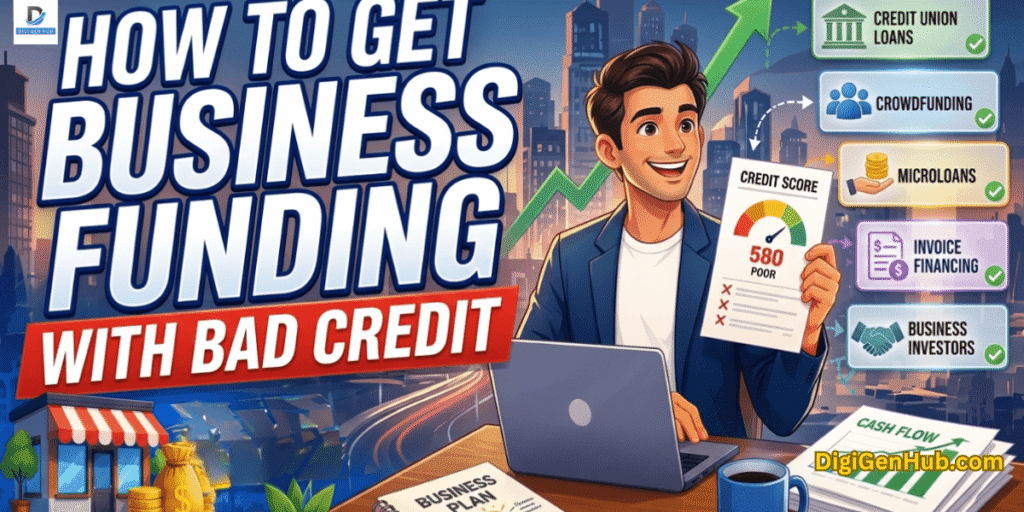
Your credit score took a hit. Bills piled up, a slow season drained your savings, or a personal crisis changed everything. Now your business needs capital and the bank just said no.
You are not alone. And you are not out of options. Yet, how to get business funding with bad credit?
Millions of small business owners hit this same wall every year. Less than half of all small businesses receive the full credit amount they request, according to Nav’s 2026 Small Business Credit Statistics.
But the gap between a bank rejection and zero funding is wide. That gap is full of real alternatives that work right now.
How to Get Business Funding with Bad Credit
Your credit score is just one number. It does not define your options. Focus on your monthly revenue first.
Pick the right funding type for your situation. Gather clean documents before you apply. Compare at least 3 offers.
Watch the total repayment cost, not just the monthly payment. Avoid any lender that promises guaranteed approval. Build your business credit from day one.
Do these things and getting business funding with bad credit becomes a process, not a gamble.
What Bad Credit Means for Business Lenders
Lenders use your personal FICO score as one filter. But it is not the only one. Let’s discuss how they sort credit now:
| Credit Score Range | Category | What It Means for Funding |
| 720 and above | Excellent | Banks and SBA loans open, lowest rates |
| 680 to 719 | Good | Most traditional lenders approve |
| 620 to 679 | Fair | Online lenders approve, rates climb |
| 580 to 619 | Poor | Alternative lenders only, higher APR |
| 500 to 579 | Bad | MCAs, equipment financing, microloans still possible |
| Below 500 | Very Bad | Secured options and credit repair come first |
The vital point
A score below 600 does not close every door. It closes bank doors. Alternative lenders, community programs, and asset-based financing run on completely different rules.
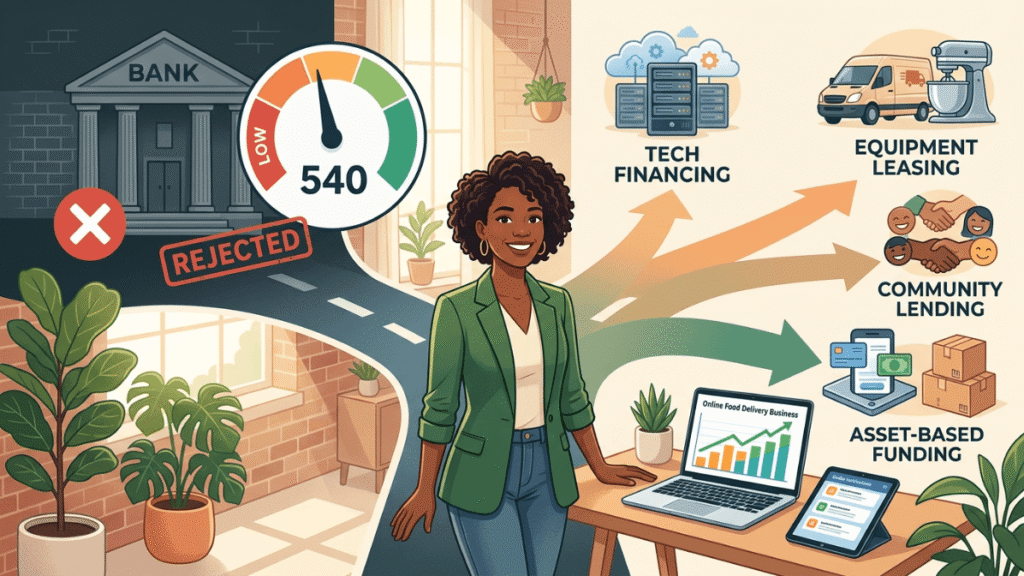
A friend of mine runs an online food delivery business in Ohio.
In 2022, she had a major medical emergency. It wrecked her finances. Her credit score dropped to 541.
She thought her dreams of growing the business were completely dead. She needed a major software upgrade and a bigger digital infrastructure to handle more orders. But she had no cash.
Then she found a specialized tech financing program. She managed to secure $28,000 for her expansion.
The security terms were simple. The lender used her existing digital platform and servers as collateral. They did not care about her low FICO score. Instead, they looked at her daily online sales receipts.
Her consistent digital order volume proved she could pay them back. Today, her online business is booming.
Why Banks Say No (and Why That Is Not the Full Story)
Traditional banks approve fewer than 1 in 10 applicants with bad credit. They use rigid scoring models built for low-risk borrowers with steady income history.
If you have missed payments, high utilization, or a thin credit file, the algorithm stops at the score.
Alternative lenders in 2026 work differently. Online lenders approve roughly 24% of bad-credit applications. And merchant cash advance providers approve 45% to 55%. Crestmont Capital’s 2026 Bad Credit Loan Statistics Report presents this. They focus on cash flow, monthly deposits, and time in business instead.
The digital lending market is growing fast. It is projected to expand from $19.35 billion in 2025 to nearly $80 billion by 2035.
This growth creates more lender competition, which often means better terms for you.
Understanding your financial position before applying is critical. Our guide on financial management for your business walks through how to read your own numbers. So you walk into any lender conversation with confidence.
7 Funding Options That Work When Credit Is Low
Low credit does not mean your business is out of funding options.
Many lenders now focus on revenue, cash flow, invoices, or business assets instead of just credit scores.
Some programs are specifically designed to help small business owners that traditional banks decline.
If you need working capital, equipment, or growth funding, these seven options are among the most realistic solutions available now.
Funding Options Side by Side
| Funding Type | Min. Credit Score | Typical APR / Rate | Speed | Best For |
| Revenue-Based Financing | 500 or none | 30%+ APR | 24 to 72 hours | Steady monthly revenue |
| Equipment Financing | 550 | 18% to 25%+ APR | 5 to 10 days | Buying business assets |
| SBA Microloan / CDFI | 550 (varies) | 8% to 13% APR | 2 to 6 weeks | Underserved founders |
| Invoice Financing | None (client credit matters) | 1% to 5% per cycle | 24 to 48 hours | B2B with slow-paying clients |
| Merchant Cash Advance | 500 | Factor 1.20 to 1.50 | Same day | Emergency short-term needs |
| Business Grant | None | Free (no repayment) | Weeks to months | Qualifying identity or sector |
| Secured Line of Credit | 550 | 25% to 60% APR | 1 to 2 weeks | Ongoing working capital |
1. Revenue-Based Financing
This ties your repayment to what your business earns each month. Lenders look at 3 to 6 months of bank statements. They base approval on your deposits, not your score. If your business brings in $8,000 or more monthly, you have a strong case.
- Minimum credit score: 500 or none at all
- Approval time: 24 to 72 hours
- Rates: Factor rates of 1.15 to 1.50 (equivalent to 30%+ APR)
- Best for: Businesses with steady monthly deposits but damaged credit
2. Equipment Financing
This is one of the most accessible paths with bad credit. The equipment you buy acts as collateral. That lowers lender risk dramatically. Lenders approve borrowers with scores as low as 550 because if you default, they recover the asset.
- Minimum credit score: 550 (sometimes lower with strong revenue)
- Loan amounts: $5,000 to $500,000 through alternative lenders
- Rates: 18% to 25%+ APR for bad credit borrowers
- Best for: Buying machinery, vehicles, kitchen equipment, or tech tools
I once worked with an online store owner who had a 565 credit score. He needed $40,000 to buy inventory and improve his website.
He applied through an alternative lender. He submitted four months of bank statements and sales records.
He got approved in seven days. His business earned about $20,000 a month. His revenue mattered more than his credit score.
3. SBA Microloans and CDFI Programs
Community Development Financial Institutions exist for one purpose: to fund businesses that traditional lenders ignore.
They look at your business plan, your character, and your community impact, not just your score.
In fiscal year 2025, the SBA Microloan Program helped over 4,500 small businesses, with an average loan of $16,131. 42% went to minority-owned businesses and 54% to women-owned businesses, according to Lending Valley’s 2026 Microloan Guide. These numbers show these programs are built precisely for founders who fall outside the traditional system.
- Loan range: $500 to $50,000
- Rates: 8% to 13% APR (among the lowest available for bad-credit borrowers)
- Credit requirement: Some accept scores as low as 550
- Approval rate: 55% to 70% for qualified applicants
- Time to funding: 2 to 6 weeks
Many CDFI programs also include free business coaching. Find a CDFI in your area through the CDFI Fund official directory.
4. Invoice Financing
If your clients take 30 to 90 days to pay, you are giving them an interest-free loan every single month.
Invoice financing turns those unpaid invoices into cash today. Lenders advance 80% to 95% of the invoice value and collect from your client when due.
The key advantage: lenders check your client’s credit, not yours. This makes it one of the most credit-agnostic options available.
- Minimum credit score: Often none required
- Advance rate: 80% to 95% of invoice value
- Best for: B2B businesses with slow-paying clients
- Cost: Usually 1% to 5% fee per invoice cycle
5. Merchant Cash Advance (MCA)
An MCA gives you a lump sum upfront in exchange for a percentage of your daily card sales. Approval is fast, sometimes same-day, and credit requirements are minimal. But this option carries serious cost.
Warning: MCA factor rates of 1.30 to 1.50 can translate to effective APRs above 100% in some cases.
Use MCAs only for urgent short-term needs when other options are too slow. Always calculate the total repayment before signing. Review SBA loan guidance at sba.gov to know what fair terms look like.
6. Business Grants
Grants do not require repayment. Most do not check your personal credit at all. Federal, state, and nonprofit organizations offer grants specifically for women-owned, minority-owned, veteran-owned, and rural businesses.
- No credit check in most programs
- No repayment required
- Competitive, so a strong business plan matters
- Search federal options at grants.gov
7. Secured Business Line of Credit
If you own business assets like equipment, inventory, or accounts receivable, you can pledge them as collateral for a credit line. This gives lenders a safety net, which makes approval more likely for scores in the 550 to 600 range. Bad credit business lines of credit typically carry APRs between 25% and 60% from online lenders in 2026.
What Lenders Check Besides Your Score
When you apply for business funding with bad credit, your score is just one piece. Here is what alternative lenders weigh heavily in 2026:
- Monthly revenue: Most require a minimum of $ 8,000 to $ 10,000 per month. Some set the bar at $300,000 annually.
- Time in business: Six months is the common minimum. Two or more years opens better rates and more products.
- Bank statement consistency: Lenders want 3 to 6 months of statements showing regular, predictable deposits.
- Existing debt: Heavy debt loads make even flexible lenders hesitant.
- Industry type: Restaurants and retail carry higher risk ratings and often face stricter terms.
Tracking cash flow daily protects your application. Our piece on small business taxes for beginners covers how to set up a clean financial system that makes your bank statements look organized and fundable.
Tip: Before you apply anywhere, pull your own credit report for free at annualcreditreport.com.
Check for errors. Disputing one wrong entry can add 20 to 50 points to your score within 30 days. That alone can open better options or lower your rate.
How to Strengthen Your Application Right Now
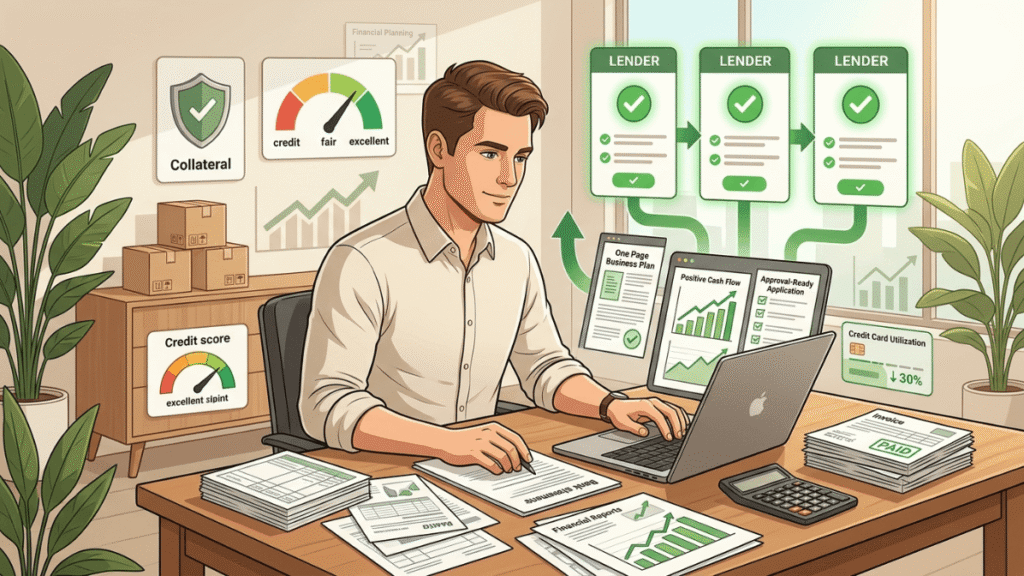
Even with a low score, a strong application tips decisions your way. Here is what moves the needle:
- Organize your bank statements. Clean PDFs for the last 6 months. Lenders use these as their primary underwriting tool for most bad-credit products.
- Write a one-page business summary. Especially for CDFIs and microloan programs. Explain your business, your market, and exactly how you will use the funds.
- Offer collateral where possible. Equipment, inventory, or unpaid invoices all reduce lender risk and raise your approval odds.
- Drop credit card utilization below 30%. This one move can add 20 to 50 points to your score within a month.
- Apply to multiple lenders. Pre-qualification usually triggers no hard inquiry. Compare at least 3 offers before committing.
- Borrow only what you need. Every extra dollar at 35%+ APR costs significantly. Keep the loan tight so payments stay manageable.
How to Build Business Credit While You Fund Now
Getting funded today is one step. Building credit for better options tomorrow runs in parallel. These steps work at the same time:
- Open a business bank account if you have not already. Lenders need to see business deposits separate from personal spending.
- Get a secured business credit card. Use it for small monthly purchases and pay it off in full. This builds a business credit file fast.
- Set up vendor credit lines. Net-30 accounts with suppliers report to business credit bureaus and build your profile with no personal credit check.
- Pay every bill on time. Consistent on-time payments move your score toward the 620+ range where options improve significantly within 3 to 6 months.
- Register with business credit bureaus. Make sure your business is visible to Dun & Bradstreet, Experian Business, and Equifax Business.
My neighbor sold plumbing supplies through a small online store. He had a 548 credit score and no business credit history.
He opened three vendor net-30 accounts and used a secured business card every month. Within 14 months, he built a much stronger business credit profile.
He later qualified for an SBA microloan with a 9.5% APR. That lower rate saved him thousands compared to the expensive financing options available to him before.
Traps to Avoid When Credit Is Low
When you need funding urgently, predatory lenders move fast. Here is what to watch for:
- Hidden fees buried in contracts. Always ask for the full APR equivalent, not just the factor rate. A 1.40 factor rate on a 6-month advance can equal 80%+ APR.
- Daily ACH debits that drain cash. Some MCAs pull payments daily. If your revenue dips, daily pulls cause a crisis fast.
- Guaranteed approval claims. No legitimate lender guarantees anything before reviewing your financials. Walk away from any that do.
- Loan stacking. Taking a second advance to pay the first is a debt spiral. One loan at a time.
- Unverified online lenders. Check reviews on the Better Business Bureau and confirm state licensing before submitting any documents.
Your Step-by-Step Action Plan for This Month
Here is the exact sequence if you need to get business funding with bad credit right now:
- Check your credit report free at annualcreditreport.com. Dispute any errors immediately.
- Gather 6 months of business bank statements in PDF format.
- Calculate your average monthly revenue. Know your exact number before any application.
- Decide what the money is for: equipment, payroll, inventory, or working capital. This determines which product fits.
- If monthly revenue exceeds $10,000, apply for revenue-based financing first. It is the fastest path.
- If you are buying equipment, go directly to equipment financing. Include the vendor quote with your application.
- If you need under $50,000 and can wait a few weeks, apply to a local CDFI or SBA microloan intermediary. Rates are far lower.
- Pre-qualify with at least 3 lenders before accepting any offer. Compare total repayment, not just monthly payment.
- Accept the offer with the lowest total cost that fits your cash flow.
- Start building business credit the same month you get funded.
What Is Changing Now That Helps Bad-Credit Borrowers
A few 2026 shifts are actually making this easier than three years ago:
- AI underwriting reduces bias. Automated systems evaluate cash flow consistently, without the subjective bias a human loan officer might bring. This benefits business owners whose story does not fit the traditional mold.
- Same-day bank statement verification. What used to take weeks of manual review now takes hours. Funding decisions arrive faster.
- More CDFIs receiving federal funding. Congress increased CDFI Fund allocations in 2025. More capital in community lending programs means more approvals.
- Fintech lenders targeting underserved markets. New platforms specifically built for bad-credit business owners offer products that did not exist five years ago.
Keep watching SBA loan programs at sba.gov for updates on newly available government-backed options.
The Cost of Bad-Credit Funding vs. Building Toward Better Terms
Here is the honest cost comparison between acting now with bad credit versus waiting to build credit first:
| Scenario | APR Range | $30,000 Loan Total Repayment | Time to Fund |
| MCA right now (score 520) | 80% to 120% APR | $42,000 to $54,000 | Same day to 72 hours |
| Revenue-based loan (score 520) | 30% to 50% APR | $34,500 to $45,000 | 24 to 72 hours |
| CDFI Microloan (score 560+) | 8% to 13% APR | $31,200 to $33,900 | 2 to 6 weeks |
| SBA 7(a) Loan (score 680+) | 10% to 12% APR | $31,500 to $32,700 | 4 to 12 weeks |
| Traditional Bank Loan (720+) | 6% to 9% APR | $30,900 to $32,025 | 6 to 16 weeks |
The difference between an MCA and an SBA loan on $30,000 can be $10,000 to $20,000 in total repayment cost. That gap makes building toward better terms worth the patience, when time allows.
Final Word
Getting business funding with bad credit in 2026 is harder than it would be with a 720 score. But it is absolutely possible. Millions of business owners do it every year.
The cost is higher. The terms are shorter. The process needs more preparation. But the capital exists.
Your job is to match the right funding type to your exact situation, prepare clean documents, compare multiple offers, and avoid predatory traps. Do those four things and your bad credit score becomes a hurdle, not a wall.
Start with what you have. Fix what you can. Build from there. Business funding with bad credit is a bridge, not a destination. Use it to reach better ground, then build the credit that keeps better options open permanently.
FAQ
Can I get business funding with bad credit and no revenue yet?
Yes, but options are narrow. Grants and crowdfunding work best at this stage. Kiva offers zero-interest microloans up to $15,000 with no revenue requirement.
Some CDFIs fund pre-revenue businesses if your business plan is strong and your market is clear. A co-signer also helps early on.
Can I use my spouse’s good credit to get business funding?
Yes, in two ways. Your spouse can act as a guarantor on the loan. Or you can apply jointly if your spouse is listed as a co-owner.
Some lenders accept a guarantor with a 680+ score even when the primary borrower sits below 580. This is one of the fastest ways to access better rates without waiting months to fix your own credit.
Does my business structure affect funding approval with bad credit?
Yes, significantly. An LLC or corporation creates legal separation between you and your business.
Some lenders treat the business as its own borrowing entity. Your personal credit carries less weight that way. Sole proprietors have no such separation.
Lenders always tie approval directly to personal credit for them. Registering as an LLC costs $50 to $500 depending on your state and opens funding doors that sole proprietorship status closes.
Can a co-signer help me get funded with bad credit?
Yes. A co-signer with strong credit improves approval odds and lowers your interest rate fast.
The co-signer takes legal responsibility if you default. This works best with a trusted partner or family member. Some lenders specifically allow co-signers on small business loans where the primary borrower scores below 600.
Does the industry I work in affect my chances with bad credit?
Yes, more than most people expect. Lenders assign risk categories by industry. Restaurants, retail, and construction face stricter terms and higher rates even with the same credit score as lower-risk businesses.
Healthcare, professional services, and tech businesses typically get better terms. If your industry is high-risk, applying through a CDFI or an industry-specific lender improves your odds.
Are there funding options built specifically for e-commerce businesses with bad credit?
Yes. E-commerce businesses can access revenue-share advances tied directly to platform sales data from Shopify, Amazon, or Etsy.
Lenders pull your store’s sales history directly from the platform. No bank statements needed in many cases. PayPal Working Capital and Shopify Capital both work this way with no hard credit check at all.
What happens if I default on a bad credit business loan?
It depends on the loan type. For secured loans, the lender seizes the collateral. For MCAs, lenders can pursue legal action or freeze your business bank account in some states.
Defaulting damages your business credit file for 2 to 3 years. Always contact your lender before missing a payment. Most offer hardship deferment options that are never advertised publicly.
Can bad credit affect the type of collateral lenders will accept?
Yes. The lower your score, the more lenders want liquid or easily resellable collateral. Real estate and vehicles are accepted most widely.
Inventory and future invoices work with some lenders. Intellectual property or brand value are almost never accepted below a 600 score. Knowing what your lender accepts before applying saves you from a rejected application that triggers a hard inquiry.
Is interest paid on bad credit business loans tax deductible?
Yes. Interest paid on business loans is generally tax deductible as a business expense under IRS rules.
This applies to MCA fees, equipment financing interest, and line of credit interest regardless of your credit score.
Keep every loan statement and interest summary through the year. Your accountant applies these deductions to cut your taxable income at year-end.

Aliza Khatun is a Digital Marketing Professional and the founder of DigiGenHub. She has helped various businesses grow their online presence through real-world experience in marketing, branding, traffic growth, and business strategy.
Through DigiGenHub, she shows how to build and grow a business from the ground up using Website Setup, SEO, Branding, Paid Promotion, and smart digital tools.
She also highlights how AI can be used to its full potential to make content creation, automation, marketing, and business growth faster and smarter.
She believes that the right knowledge, modern technology, and the right tools can help any individual or business build a stronger online presence.