

The photography business is progressing rapidly with new tools, fresh styles and shifting clients. Some changes are subtle, like textures in images.
Others are bold, like AI-powered editing and virtual tours. For photographers, these changes mean more ways to earn and flourish with fortitude.
So, how to start a photography business in today’s online platform? Online audiences move fast. Over 70% of buyers trust visuals first.
My friend Dorothy turned her photography hobby into an online business. She didn’t just buy a camera. She picked a clear niche, built a focused portfolio and set her pricing carefully.
I helped her map her expenses and create a plan to find paying clients. Within six months, she earned $3,000 a month with steady clients needing new photos for websites and social media.
Social media propels 65–80% of client discovery. Top platforms are YouTube, Facebook, Instagram, TikTok, LinkedIn and Pinterest.
How to Start a Photography Business
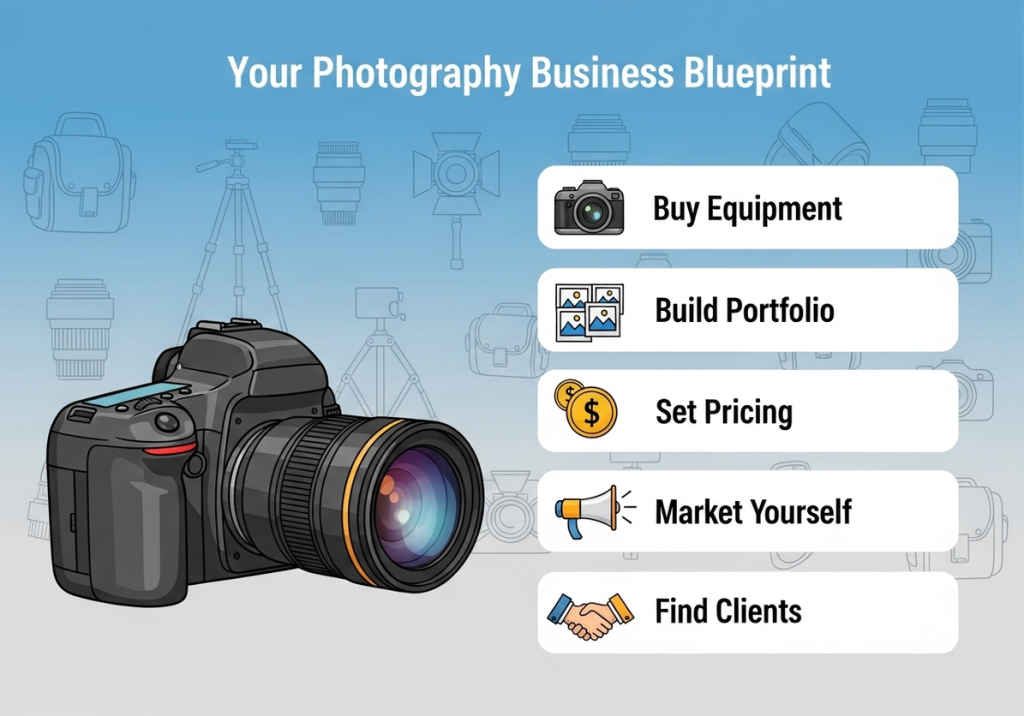
Pick a niche. One niche builds authority. Offering 3–4 services boosts bookings by 28%. Signature style matters. 81% of clients hire for style, not just skill. Fast delivery works superbly. 48–72 hours for photos is standard.
Marketing is digital. Website and Google Business Profile are essential. Post short-form videos 2–3 times a week (11–45 sec).
Conversion example: 500 visits × 3% → 15 leads/month → ~$6,825 potential revenue. Product and real estate photographers use LinkedIn, SEO, YouTube and niche ads for business.
Start solo. Scale when you turn away 2–3 jobs/month. Hire specialists to meet demand. Stay updated with trends. AI editing, drones, storytelling and retro aesthetics keep work relevant. Let’s learn the process:
Define Your Niche and Services
How do you choose between wedding photography, event photography, or product photography?
A . Know the demand
Wedding photography remains strong; 2.4 million weddings in the U.S., with an average spend per wedding photographer at $2,700–$4,500 (Wikipedia, Forbes).
Event photography is expanding through corporate conferences and festivals; hybrid events increased 19% YoY (Forbes).
Product photography is exploding with e-commerce — online retail sales up 22% globally (Statista).
B . Match the work style to your personality
Weddings: high emotional involvement, unpredictable timing.
Events: dynamic, large groups, fast turnarounds.
Product: controlled studio environment, repeat clients.
C . Judge earning possibilities
Product photographers working with major e-commerce sellers often bill $75–$150/hour.
Event photographers average $200–$500 per hour for corporate clients.
Wedding photographers may earn more per gig, but fewer events per year.
Should You Focus on One Niche or Offer Multiple Photography Services?
Let’s observe deeply through the following discussion:
One niche
Builds authority faster. You can become the go-to person for that type of work.
Example: Paul Nicklen, known globally for wildlife photography, commands premium rates because of niche dominance.
Multiple services
Spreads income risk. You can capture seasonal work; weddings in summer, product shoots in winter.
LinkedIn data recently shows that photographers offering 3–4 services get 28% more bookings annually.
Hybrid approach
Start with one primary niche. Add complementary services over time. This builds depth and resilience.
Map Your Startup Investment to Your Expected ROI

Don’t drown in expensive gear. Buy only what directly supports your niche and income goal. Your first goal is simple: earn back your setup cost within 6–12 months.
| Expense Category | Initial Cost (USD) | Purpose/Niche |
| Mirrorless Camera (Entry-Level Pro) | $1,500 | Delivers print-quality files |
| Prime Lens (50mm f/1.4 or 85mm f/1.8) | $600 | Great for portraits and brand work |
| Flash or LED Kit | $300 | Clean, reliable lighting for any scene |
| Adobe CC (6-Month License) | $70 | Industry standard for editing |
| Website + LLC Registration | $330 | Adds trust and legal cover |
| Total Setup | $2,800 | |
| Target Income (6 Months) | $12,000 ($2,000/month) | |
| ROI in 6 Months | 328% | (($12,000 – $2,800) ÷ $2,800) × 100 |
Expert Insight
“The real cost of business isn’t the camera — it’s the protection around it. No corporate client pays a photographer who can’t file a W-9.”
— Andrew Hellmich, Host of PhotoBizX Podcast
Case Study: Crest Media
Website: www.crestmediausa.com
The Problem
Crest Media’s founder shot weddings, food and portraits but couldn’t land long-term clients.
The Move
They picked a single direction — Fitness Brand Photography. They invested $4,500 in:
Continuous lighting setup: $1,800
Test shoot for a local gym (portfolio build): $500
LLC, insurance and CRM system (HoneyBook): $2,200
The Outcome
Their average rate jumped to $1,200 per session. Within two months, they signed two retainers worth $2,400/month. Their $4,500 spend was recovered in under 60 days.
How to Build a Strong Photography Brand
A strong photography brand makes you memorable and trusted. It shows your style and professionalism. Clear visuals, consistent colors and a recognizable logo set you apart. Online presence and client connection turn visibility into bookings. Let’s explain:
A) Naming and branding a photography studio that sticks
Keep it short and clear. Choose 2–3 words. Easy to spell. Easy to say.
Check availability. Search the USPTO TESS for trademarks. Check if the domain is free.
Design for mobile first. Your logo must be readable at 40–60 px. Over 60% of searches are now on mobile.
Claim your Google Business Profile on day one. This puts your studio on Search and Maps. It also gives you reviews and access to Local Services Ads.
Use the same visual style everywhere. Colors, tone and image style should match on your site, social media and marketing materials. Consistency makes people remember you. Marketing bodies call visual content a “dominant force” in engagement.
Stay culturally aware. Mirrorless cameras and retro aesthetics are hot today. Small nods to these trends make your brand feel current.
If your logo/name is seen 1,000 times a week on Reels or Shorts and even 1.5% click through → that’s 15 profile visits/week.
At a 5% inquiry rate, that’s 0.75 inquiries/week ≈ , 39 inquiries/year from brand visibility alone.
B) Portfolio styles for wedding vs. real estate photography
Wedding portfolios tell a story. Clients want emotion. Short reels highlight key moments. Real estate portfolios show space clearly.
Buyers want tours and accurate photos. AI tools speed edits. Mirrorless cameras handle weddings well. Let’s analysis the comparison:
Wedding vs. Real Estate Photography
| Feature | Wedding Photography | Real Estate Photography |
| Focus | Emotion, key moments | Property layout, details |
| Gallery | 6–10 galleries by moments | Browse by room type |
| Captions | Short, emotional | Minimal, factual |
| Video | 15–45 sec reels | Vertical video + virtual tour |
| Technical | Skin tones, low light, fast autofocus | Straight lines, color accuracy, high detail |
| Tools | Mirrorless cameras | Drones, Matterport, Photoup, BoxBrownie |
| Client Goal | Relive moments | See the accurate property |
| Delivery | 48–72 hrs | Professional, VR-ready |
C) Present your photography services professionally from day one
Launch a one-page website. Include About, 12–18 best images, Services, pricing “from” rates and Contact.
Connect your Google Business Profile the same day.
Post three short videos: one introducing yourself, one about your niche and one showing a client result.
Show proof. Add 2–3 measurable outcomes like:
“Delivered a 24-hour event gallery”
“Listing shot Friday, live Saturday, 18 showings in 48 hours”
NAR data proves visuals drive buying decisions.
Promise fast replies. State: “Replies in under 2 hours. Galleries in 48–72 hours.” Use tools like Lightroom AI to keep the promise.
Post short videos regularly. Short-form video outperforms all other formats. Platforms give preference to this format.
Be local-search ready. Add schema markup and match your business name, address and phone with your Google profile. Google’s present docs confirm this helps with Search and Maps presence.
Possibilities:
500 visits/month × 3% conversion = 15 leads/month.
Close 35% = 5.25 jobs/month.
At $1,200/job = $6,300/month.
If 40% of those jobs add a $250 upsell = $525 extra/month.
Total ≈ $6,825/month.
Extra trends:
Keep clips under 30 seconds when possible (Forbes).
Retro camera looks are resurging; small references can make your brand feel timely.
Set Up the Business Structure and Legal Essentials
Choosing the right business structure protects your assets. Proper setup ensures smooth operations and compliance. Let’s observe:
A) What business structure is best for photographers?
LLC gives liability protection. Your personal assets stay safe if the business faces legal claims.
Sole proprietorship is simpler. Lower cost. But you are personally responsible for debts and claims.
Many photographers choose LLC for protection while keeping tax flexibility.
Compare both with a local accountant before registering. Rules and fees differ by state or country.
B) Which licenses or permits do you need for a photography studio?
You may need a general business license.
Some areas require a home occupation permit if you run the studio from your home.
A sales tax permit is needed if you sell prints or albums in taxable states.
Local rules vary. Check with your city or county clerk’s office.
If you photograph in public places, know the local location permit laws. Some cities enforce fines for unpermitted shoots.
C) How should you price wedding and event photography packages?
Research your local market.
Factor in your costs: gear, insurance, software, travel and editing time.
For weddings: set a base package. Include a set number of hours, edited photos and add-ons like albums or second shooters.
For events: charge hourly or offer half/full-day rates. Include delivery timelines.
Competitive pricing is not the lowest price. It’s a balance between market rates, your skill and the value you deliver.
Marketing Strategies for Photography Businesses
Marketing drives clients to your photography business. Social media marketing, short videos and SEO marketing attract attention. Quick responses and clear portfolios convert leads. Let’s see:
A) Social media marketing for photography services for clients
Make a budget for marketing your photography service. Use short-form video on Instagram, TikTok, Reels and Facebook.
Show behind-the-scenes clips. Include quick client reactions.
Post highlight reels of weddings, events, or shoots.
Use geo-tags to reach local clients.
Engage in comments and DMs within hours. Fast replies increase booking chances.
Keep a steady posting schedule. Platforms give higher reach to consistent creators.
B) Which platforms bring the best leads for a professional photographer?
Instagram for weddings and portraits — visual-first and high engagement.
Pinterest for wedding inspiration — couples plan here months in advance.
LinkedIn for corporate headshots, events and B2B work.
Google Business Profile for local search and map visibility.
YouTube for tutorials and behind-the-scenes videos — builds trust over time.
Facebook: Local marketing, groups, event promotion and targeted ads.
Twitter/X: Quick updates, networking and sharing behind-the-scenes content.
C) How to market photography services
1 . For product photography:
Network with e-commerce sellers on LinkedIn.
Offer packages for Amazon, Shopify, or Etsy listings.
2 . For real estate photography:
Keep your Google Business Profile updated with property photos.
Share drone tours on YouTube.
Run niche Facebook ads targeting real estate agents.
How to Scale and Sustain Your Photography Business
Scaling your photography business starts with steady demand. Expand services and hire specialists when needed. Let’s have a look:
A) Expand from solo photographer to full studio
Start when you have a consistent demand that you cannot handle alone.
Move from a home setup to a dedicated studio space.
Invest in extra gear that can be used by multiple photographers.
Offer more services — weddings, events, products, portraits — based on client requests.
Build a clear brand style so every photographer under your studio delivers the same quality.
Use business systems for booking, contracts, invoicing and file delivery to handle larger volumes.
B) When is the right time to hire additional photography specialists?
Hire when you turn away more than 2–3 jobs per month because of your schedule.
Bring in specialists when a niche (like product or real estate) has steady, repeat clients.
Choose people whose style and work ethic match your brand.
Train them in your workflow so edits, delivery times and client experience stay consistent.
Extra photographers allow you to cover multiple jobs on the same day.
C) How to keep your services relevant as photography trends change
Review industry news every quarter.
Update your portfolio with new styles clients are requesting.
Test new tools — like AI editing, drones, or virtual tours — when they fit your niche.
Keep your social media content fresh with new formats and trends.
Ask returning clients what they want to see more of.
Adapt without losing your core brand style so clients still recognize your work.
What’s New in the Photography Industry This Year?
Cameras are lighter, faster and more versatile. AI, VR and new tools speed up work. Candid and textured styles feel more real. Let’s discuss:
Mirrorless cameras dominate
They are lighter and faster than DSLRs.
They are more versatile.
Improved autofocus helps capture sharp images quickly.
Image stabilization works well even in low light. (Wikipedia)
Retro cameras return
Gen Z prefers vintage digital cameras and point-and-shoots.
The “imperfect” look comes from grain, light leaks and unpolished exposures.
This style feels authentic and nostalgic. The Guardian
Candid and imperfect styles grow
Brands and users value photos that feel real.
Imperfect framing, motion blur and natural poses create relatability.
Authenticity now outranks polished perfection.
Textures and depth are trending
Photographers emphasize surfaces, shadows and layers.
Images feel tactile and alive.
Viewers are drawn deeper into the scene.
AI and VR reshape real estate photography
Virtual tours, sky replacements and staged interiors are automated. This speeds up production. Listings look polished and professional.
Matterport (virtual tours), Photoup (sky replacement, staging), BoxBrownie (virtual furniture) and Zillow 3D Home (interactive listings) create polished results in minutes.
Storytelling returns in documentary work
Focus is on human-made narratives.
Emotional context, sequencing and real interactions matter.
Stories stand out in an AI-saturated market.
Gear innovation continues
New drones, mirrorless upgrades and retro-style cameras are emerging. They improve speed, image quality and creative options. (TechRadar)
Which Photography Niches Are Most Profitable?
A profitable photography business focuses on high-demand, high-value work. Weddings stay lucrative for their emotional appeal.
Brands pay top rates for commercial shoots. Real estate grows as buyers shop online. Fashion relies on editorial budgets.
Portraits serve corporate and personal branding. Product photography benefits from booming e-commerce.
Pro insight: Many portrait studio owners earn between $200K and $400K annually before taxes. Let’s observe the table below:
Top Photography Trends and Best-Paying Niches
| Niche | Online Market Demand | Avg. Annual Earnings |
| Wedding Photography | High — 74% of couples hire pro photographers; destination weddings up 18% (Forbes) | $45K–$120K |
| Product Photography | Very High — e-commerce product listings grew 22% YoY (Statista via Forbes | $50K–$150K |
| Real Estate Photography | High — 93% of buyers view homes online first (NAR) | $60K–$130K |
| Sports Photography | Niche but lucrative — Sports media market $44B (Statista) | $40K–$110K |
| Food Photography | High — Food delivery app usage +19% YoY (Forbes) | $45K–$95K |
| Portrait Photography | Consistent — 67% of corporate profiles have updated photos. | $60K–$130K |
Note: Earnings vary by country & workload. US market figures.
Observations & Logic
Shift to Visual-First Marketing
Online buyers trust visuals over descriptions. Forbes notes that listings with high-quality photos convert 43% more than average.
Why These Niches Stay Relevant
A wedding is an emotional investment. Once-in-a-lifetime events keep demand steady even during recessions.
Products get popularity with e-commerce growth (Shopify merchants hit 5M+ sellers worldwide).
Real Estate ties to rising online-first home searches, 9 in 10 buyers start online.
Sports benefit from media licensing. One shot can be sold multiple times.
Food connects with social media’s “eat with your eyes” culture.
Portrait feeds into professional branding in a remote-work economy.
What Makes Professional Photography Services Alluring?
Clients value more than just technical skill. A distinct, consistent style catches attention. Fast delivery meets expectations. Genuine personal connection earns trust. Let’s explain:
Consistent style
Forbes recently notes that 81% of clients choose photographers because of a signature style, not just technical skill.
Fast delivery
Clients now expect edited photos within 72 hours for events, 48 hours for products.
Personal connection
A warm, trustworthy approach converts leads — like Annie Leibovitz, whose portraits feel personal because she spends hours in conversation before the shoot (Wikipedia).
Visible presence
A professional website, Google Business profile and active social channels are non-negotiable.
Conclusion
Summing up, how to start a photography business today means picking a niche, mastering tech and style, staying visible, delivering fast and adapting to trends.
FAQ
How can NFTs or digital collectibles affect photography income?
Selling photos as limited-edition NFTs or digital collectibles opens an additional revenue stream. It can attract tech-savvy clients and collectors, especially for artistic or branded content.
Are micro-influencers good clients for photographers in 2026?
Yes. Micro-influencers need consistent, professional visuals but have smaller budgets than large brands. They provide frequent gigs and social proof for your services, helping you build a portfolio.
Can photographers earn from AI-generated image platforms?
Yes, by offering curated input, refinements, or commercial-ready edits. Photographers can combine AI tools with human creativity to deliver unique images faster and serve clients who need high-volume content.
Is integrating e-commerce photography with Shopify or Etsy important?
Absolutely. Product photographers who know Shopify, Etsy, or WooCommerce guidelines can create images that convert better. This niche grows steadily as online shopping expands.
How can remote collaboration tools affect photography business growth?
Tools like cloud galleries, client proofing apps and video calls make remote projects easier. You can serve international clients, offer faster revisions and reduce the need for physical meetings, expanding your market.
How do I price myself as a beginner photographer?
Charge $50–$150 per hour or $500–$1 500 for a full-day shoot.
Set rates based on your costs, your time and what the market accepts.
Beginner hourly: $50–$150
Wedding day rate: $500–$1 500
Keep it fair. Add 30–40% extra above your costs for profit. That’s cost-plus pricing.
Use a simple rule: cost × 2.85 = your price. That covers your business and gives profit.
Always check what others near you charge. Beginners often underprice by 2–3×.
How much does a 30 minute photo session cost?
A 30-minute beginner photo session today costs $75–$300. Lean packages ~$75, common deals $100–$150, more polished sessions $200–$300.
How to get photography clients quickly?
Ask past clients for referrals (can bring 50% of new work).
Run targeted Meta ads with AI (3–5% lead rate).
Offer free mini-shoots at local spots (often 20+ prospects in a day).
What is the app that finds photography clients?
Try Zazzi. It connects photographers and clients fast.
Zazzi works like Airbnb for creatives. Clients search by location. They view your portfolio, rates and can contact you directly.
As a photographer, you get more exposure, lead flow and booking chances. Clients book you straight through the app.