


Ethics in marketing means you cause zero harm. You always tell the truth about your product.
You protect consumer data fiercely. You treat every person with absolute respect. You never manipulate human emotions to force a quick sale.
A recent Thales report proves this massive problem. Over 84% of shoppers fear data misuse. They hate hidden tracking.
They hate fake AI reviews. They hate false green claims. They leave brands instantly over these lies.
You lose money when buyers leave. So, you will learn how to apply honest data practices.
Still, if you trick your audience, the algorithm catches you. It penalizes your site heavily.
I tell my clients the truth. Strict honesty remains the most profitable SEO strategy you can ever use.
The Benefits of Ethics in Marketing
The best companies survive severe algorithm updates easily. They survive market crashes easily. They all share one trait.
They have deep consumer trust. A brand that acts honestly builds a massive wall around its business.
Competitors cannot steal your customers. Your buyers trust you completely. I watch honest brands grow steadily while sneaky brands crash and burn.
1. Faster Sales Cycles
Trust removes buying friction. Shoppers skip the long research phase. They do not hunt for hidden flaws online.
They see your product and buy it the same day. Complete honesty makes the buying decision instant.
2. Lower Advertising Costs
Ad networks reward good behavior in 2026. Google and Meta track user reports closely. Users flag misleading ads quickly.
This makes your ad costs go up. Honest ads get zero reports. This keeps your cost per click very low.
3. Better Brand Partnerships
Good companies protect their reputation. They refuse to work with shady businesses.
When you practice strict ethics, top brands want to collaborate with you. You gain access to their loyal audiences safely and easily.
4. Massive Email Engagement
You only send emails to people who specifically asked for them. This makes your open rates jump.
Your messages reach the primary inbox. Users click your links because they actually want your content.
5. A Shield Against Public Backlash
Internet users investigate brands constantly today. They look for dark secrets to expose. You run a clean operation.
They find nothing to attack. This absolute transparency makes your business immune to viral social media takedowns.
Yet, cheap tricks create heavy friction. Honesty removes it completely. When you run clean ads, Google rewards you with lower costs.
Your emails avoid the spam folder. Other honest business owners notice your clean record and offer you highly profitable partnerships.
Doing the right thing makes your entire marketing system run faster and cheaper.
Traditional vs. Ethical Marketing
| Business Practice | Outdated Traditional Method | Ethical Standard |
| Finding Customers | Buying hidden data lists secretly. | Using quizzes to ask for data directly. |
| Selling Products | Using fake countdown timers. | Offering real sales with honest deadlines. |
| Environmental Claims | Stating “Natural” with no proof. | Providing official green certificates. |
| Using AI Tools | Passing AI text off as human work. | Labeling AI chatbots very clearly. |
| Email Marketing | Hiding the unsubscribe button. | Putting a large “Unsubscribe” link at the top. |
Fundamentals of Ethics in Marketing
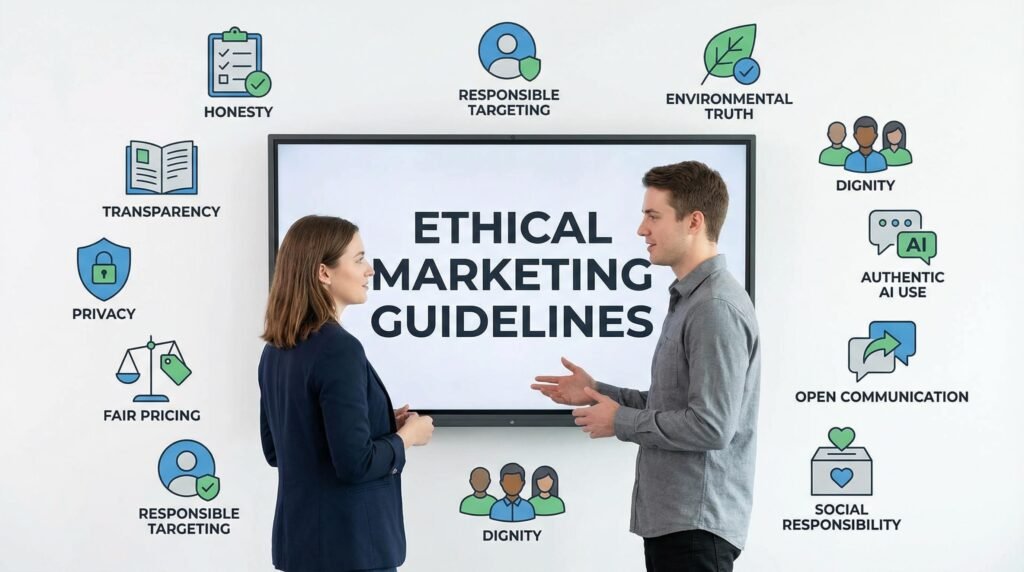
Marketing ethics go far beyond simple law. You must act right even when no one watches. You must apply total honesty to every ad.
You must apply total fairness to every campaign. You must align your business practices with human values. To do this, you must follow these strict rules.
1. Absolute Honesty
You tell the exact truth about your product. You never hide flaws. You never exaggerate features.
Example: A software company finds a bug in their new app. They do not hide it. They send an email to all users immediately.
They explain the problem. They offer a timeline for the fix. Users respect this honesty.
2. Total Transparency
You hide nothing from the consumer. You show them exactly how your business works. You explain your pricing clearly.
Example: A clothing brand shows the exact cost to make a shirt. They list the cost of fabric.
They list the cost of labor. They list their exact profit margin. Customers gladly pay the price because they see the truth.
3. Strict Privacy Protection
You protect user data fiercely. You never sell email addresses. You only collect data when the user says yes.
Example: A health blog asks readers to join a newsletter. They put a clear checkbox on the form.
The checkbox says, “We will never share your email with anyone.” They keep this promise forever.
4. Fair Pricing Practices
You do not use hidden fees. You do not change prices based on a user’s browser history. You offer the same fair deal to everyone.
Example: A US airline shows the final ticket price on the first page. They include all taxes and baggage fees upfront. The customer pays exactly what they saw first.
5. Responsible Targeting
You never target vulnerable people. You do not show addictive products to minors. You do not show bad loans to poor communities.
Example: A video game company sells a game with in-app purchases. They block all ads for this game on children’s websites. They only show ads to verified adults.
6. Environmental Truth
You prove your green claims with hard science. You never exaggerate how eco-friendly your product is.
Example: A coffee brand says their cups are compostable. They put an official, third-party certification stamp right on the cup. They link to the scientific proof on their website.
7. Human Respect and Dignity
You avoid harmful stereotypes entirely. You show real diversity in your ads. You treat every demographic fairly.
Example: A makeup brand stops editing the photos of their models. They show real skin textures. They show real blemishes. They celebrate natural human beauty.
8. Authentic AI Use
You label AI-generated content clearly. You tell users when a chatbot speaks to them. You never pretend a machine is a real human.
Example: You run a customer support chat. The first message says, “Hello, I am an AI assistant. I will help you find your order.” The user knows the truth immediately.
9. Open Communication
You answer complaints publicly and politely. You do not delete negative comments. You offer real solutions to angry buyers.
Example: A restaurant gets a bad review on Google. The owner replies the same day. The owner apologizes publicly. The owner offers a free meal to fix the mistake.
10. Social Responsibility
You give back to the community. You care about more than just profit. You help society grow.
Example: A US shoe company donates one pair of shoes to a local shelter for every ten pairs they sell. They publish a yearly report showing exactly where the shoes went.
The Main Types of Marketing Ethics You Must Know
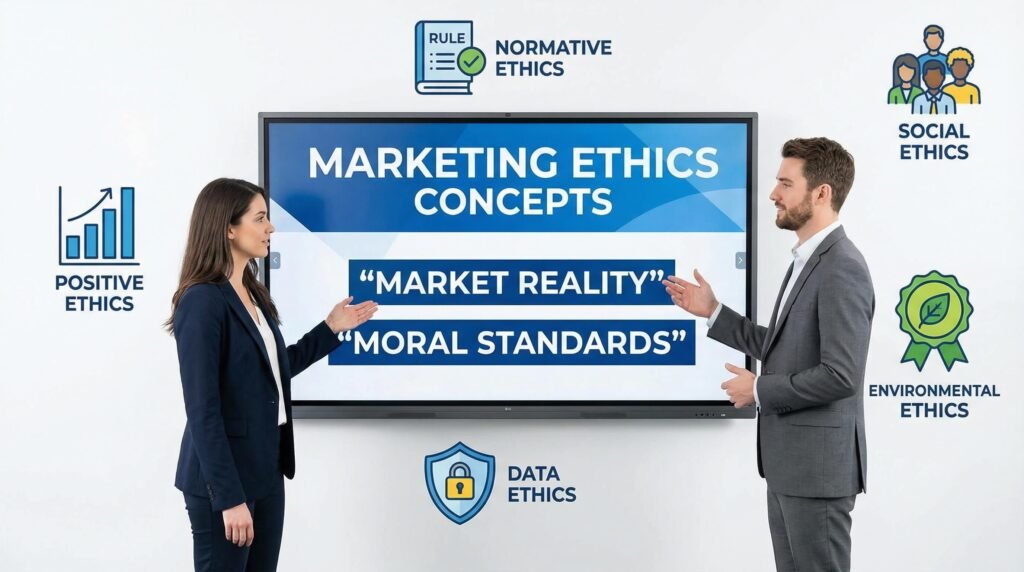
You must understand how experts study ethics. Academics and professionals divide marketing ethics into two distinct categories. You need to know both to run a successful business.
Positive Marketing Ethics
This type describes “what is” actually happening. It looks at hard facts. It studies how marketers behave in the real world right now. It does not judge the behavior. It just records the data. It helps you understand the current market reality.
Example of Positive Ethics: A researcher studies 500 top US retail websites. The researcher counts how many sites use hidden tracking cookies.
The researcher finds that 300 sites still use them. The report just states this fact. It does not say if this is good or bad. It only shows the reality of the market.
Normative Marketing Ethics
This type describes “what should be” happening. It looks at moral rules. It tells marketers the right way to act.
It sets a high standard for human behavior. It tells you how to build a good, honest company.
Example of Normative Ethics: A US brand creates a strict company policy. The policy states, “We must never use hidden tracking cookies on our users.”
The brand sets a moral rule. They decide the right way to act. They ignore what other companies do. They follow their own high standard.
Other Types
Data Ethics
You collect information safely. You only take data when the user says yes. You never buy secret email lists from data brokers.
Environmental Ethics
You prove your green claims. You use hard science. You never exaggerate how eco-friendly your product is.
Social Ethics
You avoid harmful stereotypes. You show real diversity in your ads. You ensure your AI tools do not discriminate against anyone.
I analyze search trends every single day. I see many brands focus only on positive ethics. They just look at what competitors do.
They say, “everyone else uses fake countdown timers, so we will too.” This causes massive problems.
My best clients focus heavily on normative ethics. They set strict moral rules for their teams.
They refuse to copy the bad habits of competitors. They stand out because they act better than the rest.
How Do You Market Ethically and Avoid Common Barriers?
The technology world changed drastically. You must adapt your daily activities. You must respect user privacy.
Bosses push marketing teams hard. They demand instant sales. This heavy pressure causes big problems.
Marketers take unethical shortcuts. You must know these traps to avoid them.
Collect Zero-Party Data
This means information users willingly give you. You ask customers to share their preferences intentionally.
You create fun quizzes. You create simple surveys. You ask people exactly what they want.
Example of Zero-Party Data: A coffee company stops tracking users across the web.
They put a short quiz on their homepage. The quiz asks, “Do you prefer dark roast or light roast?”
The user clicks an answer. The company saves this data legally. They only send emails about the user’s favorite coffee.
Avoid the Greenwashing Trap
Greenwashing means lying about the environment. You misled consumers about the green benefits of a product.
The Federal Trade Commission punishes false claims heavily now. You must avoid this completely.
Example of Greenwashing: A plastic bottle company prints green leaves on its label.
They write “100% Earth Friendly” in big letters. They have no proof. They do not use recycled materials. Customers find out. They boycott the brand instantly.
Stop Manipulative Advertising
You must never use dark patterns. You must never force people to buy quickly out of fear. You must stop creating artificial scarcity.
Example of Manipulative Ads: A hotel website shows a message saying, “15 people are looking at this room right now!”
The number is fake. A script generates a random number. This tricks the user into booking fast. This destroys trust when the user realizes the trick.
I track Google algorithm penalties very closely. I recently watched a major retailer lose millions of dollars.
They lost all their organic traffic. They used fake countdown timers on their sales pages.
They created false urgency. Search engines caught the lie. Consumers caught the lie.
The brand lost its credibility entirely. I tell every business owner the same thing. Never trick your customer. The temporary cash grab will destroy your entire business.
Does Ethics in Marketing Increase Business Revenue

Many business owners think honesty costs too much money. They are wrong.
Deep honesty drives massive revenue growth. People buy faster when they feel safe. Strong trust elements on a website increase conversion rates heavily.
Higher Customer Spending
Consumers spend much more money with retailers they trust. They gladly pay a higher price for guaranteed honesty.
They ignore cheaper competitors because cheap often means risky.
Example of High Spending: An outdoor gear company repairs old jackets for free. They publish their factory conditions openly.
Customers love this radical honesty. They buy all their winter gear from this one brand. They never shop anywhere else.
Protection From Lawsuits and Fines
Honesty keeps you safe from lawsuits. You avoid heavy regulatory fines. You follow privacy laws perfectly.
You avoid massive PR disasters. You never worry about the media exposing your hidden trackers. You sleep well at night.
Attracting Top Marketing Talent
Smart marketing professionals want to work for good companies. They refuse to work for scammers.
They check a company’s ethics before they accept a job. Honest brands attract the best workers in the US market. Good people want to do good work.
Practical Suggestions for Applying Ethics Today
You need to take immediate action. You must protect your US brand right now. Follow these exact steps to fix your marketing strategy.
1 . Audit your website today. Read every page carefully. Find fake reviews. Delete them immediately. Find exaggerated claims. Remove them right now.
2 . Rewrite your privacy policy completely. Delete the confusing legal terms. Use simple words. Tell your users exactly what you do with their data.
3 . Stop tracking users in the background. Put a survey on your site instead. Ask them what content they want to see.
4 . Look at your chatbots and AI images. Add a visible tag that says “Generated by AI” to every single one.
5 . Fix your email templates. Make the unsubscribe button huge. Make it easy to find. Let people leave if they want to.
Conclusion
You must choose a better path. You must prioritize absolute honesty in every campaign. You must protect user data fiercely. You must prove every single claim you make with hard data.
Start by auditing your data collection methods today. Delete your hidden trackers. Build a clear preference center for your users.
Give them total control. Commit to absolute transparency right now. You will fix the trust gap.
You will earn the long-term loyalty and high revenue that your competitors constantly fail to achieve. Clean up your marketing strategy right now and watch your business grow safely.
FAQ
Can I buy search ads for a rival’s brand name?
Yes, but you must be clear. Do not pretend to be your rival. Use your own brand name in the ad text. Never trick people into clicking your link.
Can I use customer photos from social media?
You must ask first. Never take pictures without permission. Send the user a direct message. Ask for legal rights to use their photo. Pay them if you can.
Is it okay to send business gifts to clients?
Keep your gifts small. Do not use gifts as secret bribes. Follow strict company rules. A gift should never force a client to sign a deal.
Should I tell buyers how long a product will last?
Yes. Do not hide a short product lifespan. Sell replacement parts openly. Support the right to repair. Tell the exact truth about product life.
How should I advertise during a national crisis?
Do not profit from public panic. Stop sending sales emails during bad events. Offer real help to the community instead. Never use a tragedy to sell things.
Can a bankrupt company sell my data?
No. Selling user data to pay debts is wrong. State your rules clearly in your privacy policy. Let users delete their data before you close or sell the business.
Is it wrong to buy fake likes and comments?
Yes. Faking popularity lies to the public. Grow your audience naturally. Never pay secret groups to like your posts.