

A year ago, I was stuck. I sold digital products like online courses and design templates. But everything happened badly. Indeed, I had no idea how digital product businesses with AI could help me. Due to my shortage of AI perception, I couldn’t keep up with customer questions.
One night, I realized I couldn’t do it alone. Then, I started researching AI tools. At first, I thought AI was only for big businesses. But I was wrong. I tried it with my full effort and confidence and it changed everything.
Digital Product Businesses with AI
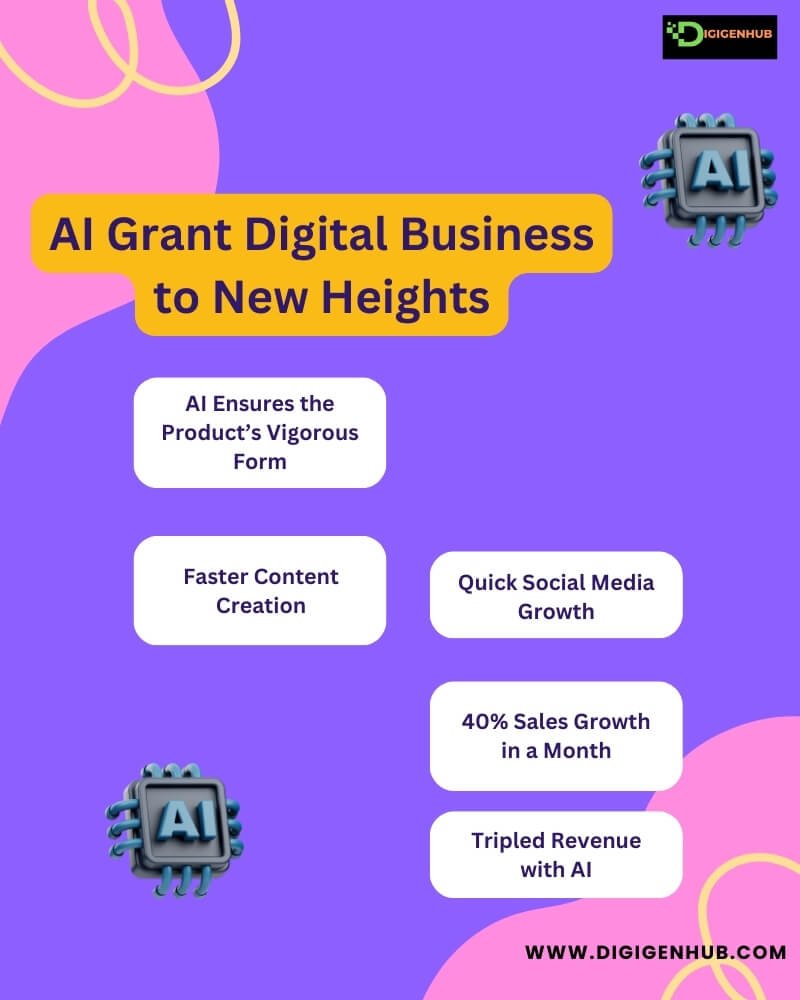
I added an AI chatbot (like Tidio or Intercom) to my website. It answered questions 24/7, reducing complaints and making customers happier.
Next, I used AI sales tools (like Paddle or Shopify Analytics). They showed me top-selling products and suggested bundles. I launched a “Content Creator’s Toolkit” ( templates and calendars) and monthly sales grew by 40%.
I applied AI tools like Jasper, Canva AI and Descript to create content. They helped me to create captions, posts and videos quickly. What once took hours now took minutes and my social media grew.
Six months later, my business tripled in revenue, got better reviews and I had more time for what I love—creating new products.
AI-Generated Products That Are Winning the Online Market World
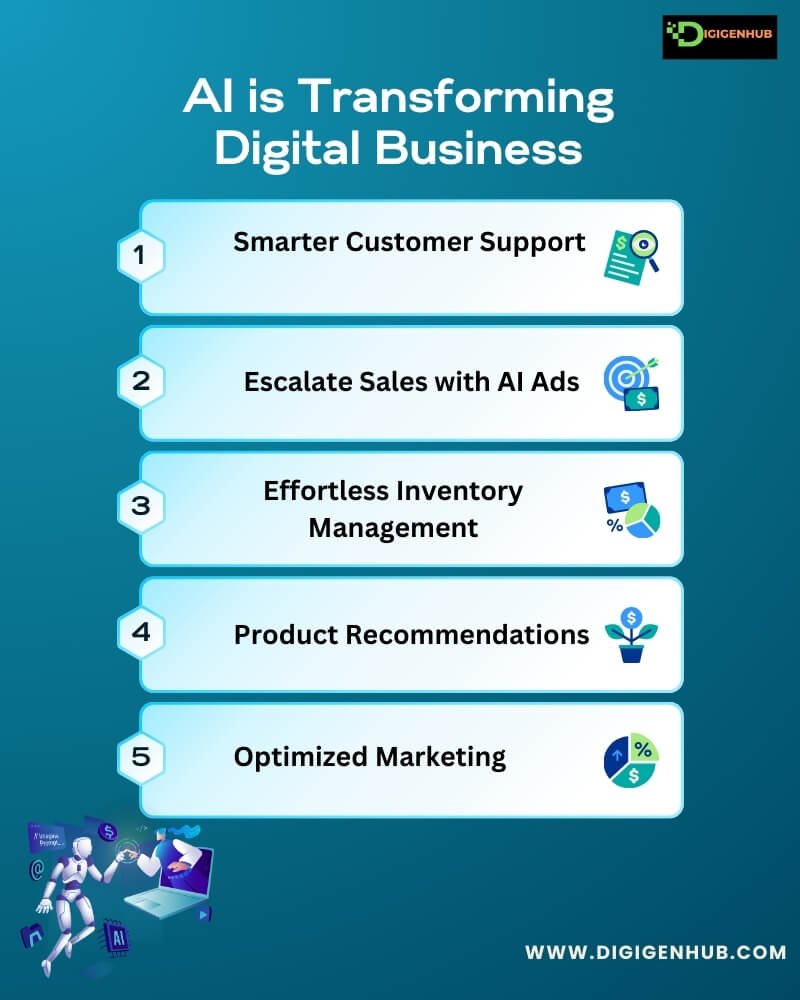
AI products are changing many industries in today’s digital business world. Businesses use AI to improve customer service, automate tasks and make data-driven decisions. Here are some AI products making an impact:
1 . AI for Business Operations & Productivity
AI-powered CRM Systems
AI helps businesses personalize customer interactions, automate responses and predict needs.
Example: Salesforce Einstein automates sales tasks and forecasts trends.
AI Virtual Assistants
Virtual assistants automate tasks like scheduling and reminders.
Example: Zapier integrates with 2,000+ apps to automate workflows like email responses.
AI Email Marketing Tools
AI optimizes email campaigns, personalizes messages and boosts engagement.
Example: Mailchimp uses AI to segment audiences and improve campaigns.
AI-based Lead Generation and Sales Optimization Platforms
These platforms use AI to find and qualify leads, increasing sales efficiency by predicting which prospects are needed to convert.
Example: HubSpot employs AI to help businesses track leads, automate follow-ups and optimize sales strategies.
AI for Document Automation & Workflow Management
AI automates document handling, from scanning and extracting data to creating reports, making processes more efficient.
Example: DocuSign uses AI to manage contracts automatically, reducing paperwork and processing times.
AI-powered Business Intelligence & Data Analytics Tools
AI-driven BI tools analyze large data sets, helping businesses uncover trends, forecast outcomes and make data-driven decisions.
Example: Power BI by Microsoft uses AI to visualize data and generate actionable presentations.
AI-driven Project Management Tools
These tools use AI to predict project timelines, allocate resources efficiently and monitor team performance.
Example: Monday.com uses AI to automate tasks, track project progress and ensure deadlines are met.
AI for Supply Chain Optimization & Demand Forecasting
AI helps businesses predict demand, manage inventory and optimize shipping routes, reducing costs and delays.
Example: Llamasoft (now part of Coupa) uses AI for supply chain analysis and forecasting, enhancing operational efficiency.
AI-based Fraud Detection and Prevention Systems
AI systems detect unusual patterns, flagging potential fraud in real-time and preventing financial losses.
Example: Kount uses AI to detect and prevent fraudulent transactions by analyzing purchase patterns and behavior.
AI-powered Financial Planning & Risk Management Tools
AI tools help businesses assess financial risks, predict market trends and create strategic plans.
Example: Kavout uses AI to analyze financial data, forecast market movements and assist in investment decisions.
2. AI in Content Creation & Marketing
AI-driven Copywriting and Content Generation Tools
AI helps create blog posts and marketing copy quickly.
Example: Jasper creates blogs, ads and content for social media with AI.
AI-powered Video Editing and Production Software
AI can automatically edit videos and add effects.
Example: Magisto edits videos for you with AI, making them look professional.
AI-based SEO Tools and Content Optimization Platforms
AI helps improve website content for better search engine rankings.
Example: Surfer suggests changes to boost your SEO and rank higher.
AI for Social Media Content Creation and Scheduling
AI helps make social media posts and schedule them.
Example: Lately turns long content into social posts and schedules them for you.
AI-based Graphic Design Tools (e.g., logo generation, art creation)
AI makes logos, art and designs with just a few inputs.
Example: Looka creates logos and branding with AI based on your style.
AI-powered Music Composition and Sound Design Software
AI can create custom music and sound effects.
Example: Amper Music makes music for videos and games using AI.
AI-driven Podcast Creation and Transcription Services
AI helps with podcast editing and transcriptions.
Example: Descript transcribes podcasts and edits them easily using AI.
AI for Personalized Ad Campaigns (targeting and optimization)
AI targets ads to the right people, saving money and time.
Example: Google Ads uses AI to improve your ad targeting and results.
AI for Email Copy and Personalization
AI writes personalized email copy to boost open rates.
Example: Persado creates email content that gets more clicks and responses.
3. AI for E-commerce & Retail
AI-powered Personalized Shopping Experience and Product Recommendations
AI suggests products based on what customers like and buy.
Example: Amazon uses AI to recommend items that customers may want based on their browsing history and purchases.
AI-driven Inventory Management and Demand Forecasting
AI helps stores predict what products will be in demand and manage stock.
Example: Shopify uses AI to track inventory and predict which items need restocking based on customer demand.
AI-based Virtual Shopping Assistants
AI assistants help customers find products and answer questions.
Example: H&M has a virtual assistant powered by AI to help customers find clothes and guide them through shopping.
AI-powered Image Recognition for Product Search & Shopping
AI helps customers search for products by uploading pictures.
Example: ASOS uses AI to let customers search for items by taking photos of products they like.
AI for Customer Sentiment Analysis and Feedback Management
AI analyzes customer reviews and feedback to understand their feelings.
Example: Zendesk uses AI to analyze customer feedback considering their sentiment.
AI-driven Pricing Optimization Tools for Retailers
AI sets the best product prices by analyzing market trends and competition.
Example: Dynamic Yield uses AI to adjust prices based on demand, competitor pricing and other factors.
AI-based Augmented Reality (AR) Shopping Experiences
AI-powered AR lets customers try products virtually before buying.
Example: IKEA uses AR to let customers see how furniture will look in their homes before purchasing.
AI for Customer Support (Chatbots and Virtual Assistants)
AI chatbots answer customer questions and resolve issues quickly.
Example: Sephora uses AI chatbots to help customers with product recommendations and order issues.
4. AI in Healthcare & Wellness
AI-powered Diagnostic Tools (e.g., for medical imaging)
AI helps doctors analyze medical images like X-rays or MRIs to find problems quickly.
Example: Zebra Medical Vision uses AI to detect health issues in medical images, helping doctors diagnose faster.
AI-driven Personalized Treatment Plans and Health Monitoring
AI tailors treatment plans for each person by analyzing their health data.
Example: Tempus uses AI to analyze patient data and create personalized cancer treatment plans.
AI-based Fitness and Nutrition Apps
AI helps create workout plans and meal suggestions based on your goals and health data.
Example: MyFitnessPal uses AI to track your meals and exercise and suggest improvements.
AI for Drug Discovery and Pharmaceutical Research
AI speeds up the finding process of new medicines by analyzing vast amounts of data.
Example: Insilico Medicine uses AI to find new drug candidates and speed up the research.
AI-powered Virtual Health Assistants
AI health assistants help answer health questions and provide guidance 24/7.
Example: Babylon Health offers a virtual health assistant that gives medical advice and book appointments.
AI-driven Mental Health Apps and Therapy Bots
AI apps help people manage stress, anxiety and mental health by offering therapy or guidance.
Example: Wysa is an AI-powered mental health chatbot that helps people with therapy exercises and support.
AI for Telemedicine and Remote Health Monitoring
AI helps doctors monitor patients remotely and offer virtual consultations.
Example: Teladoc provides telemedicine services powered by AI to offer virtual doctor visits and health monitoring.
AI-based Wearable Health Devices (e.g., smartwatches, ECG monitoring)
AI-powered devices track health metrics like heart rate, sleep and stress.
Example: Apple Watch uses AI to monitor your health, like checking heart rhythm and tracking activity.
5. AI for Education & Learning
AI-powered Learning Management Systems (LMS)
AI helps organize and manage online courses. It tracks student progress and customizes learning.
Example: Moodle uses AI to create learning paths and track students study performance.
AI-driven Personalized Education and Tutoring Platforms
AI adjusts lessons to fit each student’s needs. It offers extra help where needed.
Example: Khan Academy uses AI to suggest lessons based on student needs to learn.
AI for Language Learning and Translation Apps
AI helps you learn new languages and translates text or speech.
Example: Duolingo uses AI to create lessons and track your language progress.
AI-based Text-to-Speech and Speech Recognition Tools
AI turns text into speech and understands what you say.
Example: Google Speech-to-Text turns spoken words into written text.
AI-powered Adaptive Learning Technologies
AI changes lessons based on how well you are learning.
Example: Smart Sparrow adjusts lessons to help students who need more practice or new challenges.
AI-driven Research Tools for Academics and Scientists
AI helps researchers find papers and analyze data.
Example: Semantic Scholar helps researchers find the right studies and key information.
AI for Exam Grading and Educational Analytics
AI grades exams and tracks student performance.
Example: Gradescope uses AI to grade exams faster and more accurately.
6. AI in Finance & Investment
AI-driven Investment Platforms and Robo-Advisors
AI helps people invest by giving advice. It picks investments based on your goals.
Example: Betterment uses AI to manage your investments automatically.
AI for Credit Scoring and Risk Assessment
AI helps banks decide if you can get a loan by providing financial data.
Example: Zest AI uses AI to assess credit risk and improve loan decisions.
AI-based Fraud Detection in Financial Transactions
AI spots unusual activity to stop fraud and protect your money.
Example: Kount uses AI to catch fraudulent transactions right away.
AI-powered Personal Finance Management Apps
AI helps you track spending and save money.
Example: Mint tracks your finances and gives tips to save more.
AI for Market Trend Prediction and Analysis
AI looks at market data to predict trends and guide investment choices.
Example: Alpaca uses AI to predict stock trends for smart trading.
AI-based Algorithmic Trading Platforms
AI trades stocks and assets for you, based on data.
Example: QuantConnect uses AI to trade automatically.
AI-powered Tax and Accounting Automation Tools
AI helps you file taxes and manage finances without errors.
Example: Intuit TurboTax helps you file taxes easily with AI.
7. AI for Cybersecurity & Privacy
AI-driven Threat Detection and Prevention Systems
AI spots threats early and stops attacks before they happen.
Example: Darktrace uses AI to detect and stop cyber threats in real-time.
AI for Intrusion Detection and Security Monitoring
AI watches for signs of hacking and keeps your system safe.
Example: CrowdStrike uses AI to monitor for intrusions and protect your data.
AI-based Fraud Detection in Online Transactions
AI detects and blocks fraudulent online payments and activities.
Example: Stripe Radar uses AI to prevent fraud in online payments.
AI-powered Malware and Phishing Detection
AI finds and stops harmful software and phishing attacks.
Example: Barracuda uses AI to detect phishing emails and malware.
AI-driven Data Encryption and Privacy Solutions
AI helps protect data and keeps it secure by encrypting it.
Example: Vormetric uses AI to encrypt sensitive data and protect privacy.
AI for Automated Vulnerability Assessment
AI scans systems for weaknesses and suggests fixes.
Example: Tenable uses AI to find security gaps in your system automatically.
AI-based Identity Verification and Authentication Systems
AI verifies who you are to keep your accounts safe from hackers.
Example: Okta uses AI for identity verification to ensure secure logins.
8. AI for Creative & Design Industries
AI-generated Art and Design Tools (e.g., visual arts, digital painting)
AI helps create art and designs, like paintings and graphics following the inputs.
Example: DeepArt uses AI to turn photos into beautiful artwork, like digital paintings.
AI-based Video Generation and Deepfake Technology
AI creates videos and deepfakes by changing faces or adding effects.
Example: Synthesia uses AI to create realistic videos with virtual people, even without filming.
AI-driven Fashion Design Tools (e.g., custom clothing, accessories)
AI helps design clothes and accessories, predicting trends and styles.
Example: The Fabricant uses AI to create digital fashion and clothing designs.
AI-powered 3D Modeling and Animation Software
AI helps create 3D models and animations faster and easier.
Example: Runway uses AI to generate 3D models and animations for movies and games.
AI for Architecture Design and Urban Planning
AI helps design buildings and plan cities, making them more efficient and sustainable.
Example: Spacemaker uses AI to design smart building layouts and optimize urban spaces.
AI-generated Music Composition and Sound Design
AI creates music or sound effects, helping with composition and production.
Example: Aiva uses AI to compose original music for movies, games and other media.
AI-driven Interactive Storytelling and Game Development Tools
AI creates interactive stories and helps design games, making them more engaging.
Example: Latitude uses AI to build text-based games that adapt to player choices and actions.
9. AI in Communication & Media
AI-powered Real-time Translation and Localization Services
AI translates text or speech instantly into different languages.
Example: Google Translate uses AI to translate text and conversations in real-time.
AI for Sentiment Analysis and Social Media Monitoring
AI helps analyze social media to understand how people feel about topics.
Example: Hootsuite uses AI to track social media trends and analyze user sentiment.
AI-driven News Aggregation and Personalization Platforms
AI collects news and personalizes it based on what you like.
Example: Flipboard uses AI to show news articles that match your interests.
AI-powered Podcast Transcription and Editing
AI turns spoken podcast content into written text and edits it automatically.
Example: Descript uses AI to transcribe and edit podcasts easily.
AI for Content Moderation and User-Generated Content Screening
AI scans content to make sure it’s safe and follows the rules.
Example: Microsoft Content Moderator uses AI to filter harmful content online.
AI-based Voice Synthesis and Voice Cloning
AI creates realistic voices and mimics someone’s voice.
Example: Descript Overdub uses AI to clone voices for podcasts and audio content.
AI for Real-time Video Editing and Content Creation
AI helps edit videos and create content automatically, saving time.
Example: Magisto uses AI to edit videos and add effects in real-time.
10. AI in Smart Homes & IoT
AI-powered Smart Home Automation Systems
AI controls lights, temperature and devices in your home.
Example: SmartThings helps automate your home with AI.
AI-driven Voice Assistants for Smart Devices (e.g., Alexa, Google Assistant)
AI listens to your voice and helps with tasks.
Example: Amazon Alexa answers questions and controls devices.
AI-based Energy Management and Smart Grid Solutions
AI helps save energy by controlling home systems.
Example: Nest Thermostat learns your schedule to save energy.
AI for Home Security and Surveillance Systems
AI watches your home and sends alerts if something’s wrong.
Example: Ring helps keep your home safe with AI.
11. AI for Environment & Sustainability
AI-driven Climate Change Modeling and Risk Prediction
AI helps predict climate change and its effects.
Example: IBM Climate uses AI to model climate risks and predict future changes.
AI for Energy Consumption Optimization
AI helps reduce energy use by making systems more efficient.
Example: Google’s DeepMind uses AI to lower energy use in data centers.
AI-based Environmental Monitoring and Pollution Control
AI tracks pollution and helps control harmful emissions.
Example: Airthings uses AI to monitor air quality and reduce pollution.
AI-powered Waste Management and Recycling Solutions
AI helps sort and manage waste for better recycling.
Example: AMP Robotics uses AI to sort recyclable materials more efficiently.
AI for Sustainable Agriculture and Crop Management
AI helps farmers sustainably grow crops by analyzing soil and weather data.
Example: CropX uses AI to monitor soil health and optimize water use for crops.
AI-based Water Management Systems
AI helps manage water use to save resources and prevent waste.
Example: Aquacycl uses AI to treat and manage water sustainably.
AI-driven Carbon Footprint Calculators
AI tracks your carbon emissions and helps reduce them.
Example: Carbonfootprint.com uses AI to calculate and reduce your carbon footprint.
12. AI for Human Resources & Workforce Management
AI-powered Recruiting and Candidate Screening Tools
AI helps find the best candidates and check resumes fast.
Example: HireVue uses AI to interview and rank candidates.
AI-driven Employee Engagement and Well-being Solutions
AI checks how happy and healthy employees are at work.
Example: Officevibe uses AI to track employee happiness.
AI for Performance Management and Talent Development
AI tracks how well employees work and helps them grow.
Example: Lattice uses AI to give feedback and guide growth.
AI-based Employee Training and Skill Development Platforms
AI personalizes training for each employee.
Example: Docebo uses AI to make learning fit for each person.
AI-driven HR Analytics and Workforce Planning
AI looks at HR data to help plan staff needs and improve work.
Example: Workday uses AI to plan staffing and manage employees.
AI for Payroll Automation and Compliance
AI automates payroll and ensures everything is legal.
Example: Gusto uses AI to handle payroll and taxes.
These AI tools make HR work faster and easier!
13. AI in Automotive & Transportation
AI for Traffic Management and Smart Cities
AI helps control traffic and improve city life.
Example: Waycare uses AI to make traffic safer and faster.
AI-powered Predictive Maintenance for Vehicles
AI predicts when cars need repairs before they break.
Example: Uptake helps trucks get fixed before they fail.
AI for Fleet Management and Route Optimization
AI helps manage cars and find the best routes.
Example: Samsara uses AI to track cars and save time on routes.
AI-based In-Car Virtual Assistants
AI helps with tasks like navigation and music in cars.
Example: Mercedes-Benz MBUX listens to your voice and helps in the car.
AI-driven Driver Assistance and Safety Systems
AI helps drivers stay safe with things like automatic braking.
Example: Volvo Pilot Assist uses AI to assist while driving.
14. AI in Legal & Compliance
AI-powered Legal Research and Document Review Tools
AI helps lawyers find information and review documents faster.
Example: ROSS Intelligence uses AI to search legal documents and find key information.
AI for Contract Automation and Risk Assessment
AI creates contracts and checks for risks or issues.
Example: Kira Systems uses AI to read and analyze contracts for risks.
AI-based Intellectual Property (IP) Protection
AI helps protect patents, trademarks and copyrights.
Example: TrademarkNow uses AI to check trademarks and protect intellectual property.
AI-driven Legal Chatbots for Client Assistance
AI chatbots help answer legal questions and assist clients.
Example: DoNotPay uses AI to give legal advice and help with small claims.
AI for Compliance Monitoring and Regulatory Reporting
AI helps companies follow the law and report regulations.
Example: Ascent RegTech uses AI to track regulations and ensure compliance.
Eminent Strategies for Building Grant-Worthy AI Products
Creating a grant-worthy AI product requires technical and non-technical skills. Let’s learn about this part:
1. Core Qualifications
a) Technical Skills
A . AI and Machine Learning: Knowledge of AI, ML, deep learning (DL) and NLP, plus experience with libraries like TensorFlow and PyTorch.
B . Data Science: Skills in data processing, cleaning and analysis, especially with large datasets.
C . Cloud Computing: Familiarity with AWS, Google Cloud and Azure for hosting and scaling AI models.
D . Ethics and AI Governance: Understanding AI ethics, privacy laws (e.g., GDPR) and explainable AI.
E . Software Engineering: Ability to build scalable, efficient software integrating AI.
F . Cybersecurity: Knowledge of safeguarding sensitive data and preventing AI vulnerabilities.
b) Non-Technical Skills
A . Entrepreneurial Mindset: Understanding market needs and business operations to turn AI solutions into profitable products.
B . Project Management: Ability to plan and manage complex AI product development.
C . Business Strategy & Fundraising: Skills in pitching products to investors and securing grants.
D . Networking: Building connections with mentors, tech organizations and grant providers.
2 . Strategies for Building Grantable AI Products
a) Identify Market Needs
Solve Real Problems: Focus on AI solutions that tackle urgent issues like healthcare, fraud detection, or business automation.
Niche Markets: Target underserved industries like AI in education, agriculture, or environmental solutions to stand out.
b) Build an Innovative AI Solution
Technological Innovation: Create unique AI algorithms or systems using advanced tech like reinforcement learning or quantum computing.
Scalability: Ensure your product can scale efficiently, with the potential to grow internationally or across industries.
c) Data Strategy
Data Quality & Privacy: Comply with privacy laws (GDPR, CCPA) and use ethical data practices.
Use Open Data: If possible, use open datasets to make your product more attractive to government grants.
Data-Driven Insights: Build AI that generates valuable insights for business growth.
d) Coincide Social and Economic Goals
Social Impact: Focus on AI that benefits society, like improving health, sustainability, or education.
Economic Benefits: Show how your product can drive growth and create job opportunities.
e) Clear Monetization Path
Business Model: Have a clear, sustainable business model (e.g., subscription, SaaS, or licensing).
Proof of Concept: Present a working prototype or MVP to prove your product’s viability for further development.
Conclusion
Thus, with AI and smart strategies, you can build a product that solves real problems and attracts attention. Your right skills and AI solutions can grow, scale and secure funding. AI helps you turn your ideas into a business that makes a real impact.
FAQ
How is AI used in digital business?
AI is used to automate customer interactions with chatbots. It helps businesses create personalized ads and content. AI analyzes data to predict trends and improve sales. It also streamlines operations, saving time and boosting efficiency.