


AI pricing software helps businesses set the best prices for their products. It calculates things like customer behavior, competitor prices and market demand. Tools like Pricefx and Competera make pricing easier and more accurate.
AI adapts to demand, competitors, seasons and supply issues. Top methods include dynamic, value-based, competitor-driven, segmented and predictive pricing.
Reinforcement learning and hyper-personal pricing test many scenarios to find the best price. Clear rules, transparency and strong data protection keep customers happy.
The right software fits your business, grows with you and saves hours of work.
AI Pricing Software
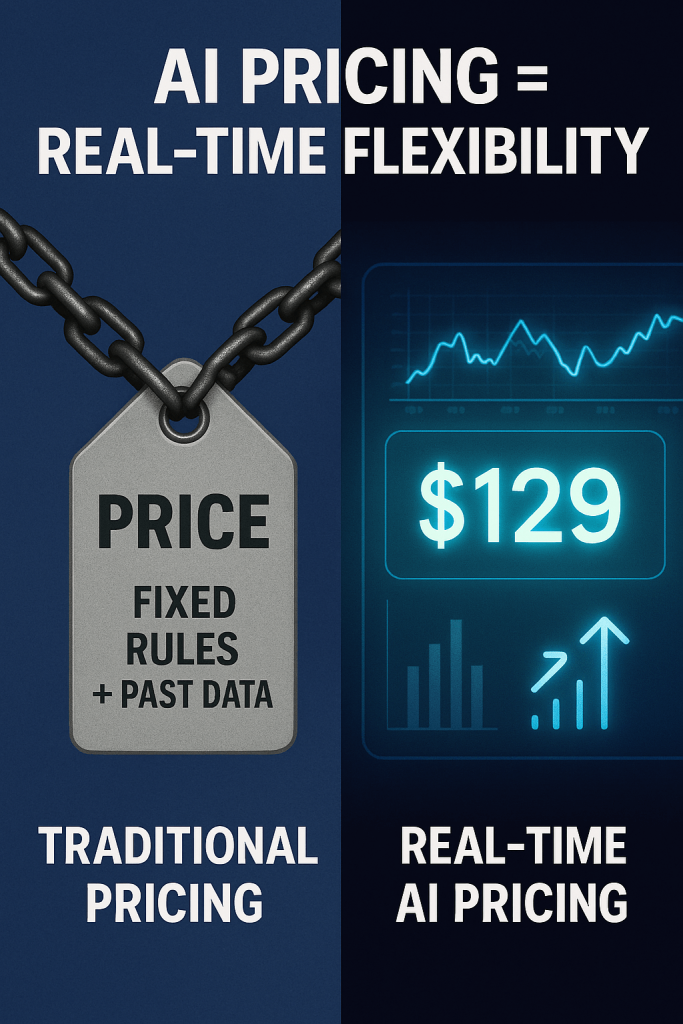
Traditional pricing tools use fixed rules and past data. They can’t adapt to sudden market changes. AI pricing software, on the other hand, learns from new data and adjusts prices in real time. This makes pricing more flexible and responsive. It improve customer shopping experiences.
How does AI pricing software ensure accurate price optimization?
AI reads large sets of sales and demand data.
It also tracks competitors, seasons and buyer behavior.
More than 50 factors are tested at once.
Machine learning runs price simulations.
It selects the price with the best profit chance.
This cuts pricing errors by 35%.
What pricing optimization methods are most effective with AI?
AI does not follow one single pricing path.
It mixes several methods to fit market shifts.
Each method targets a different business need.
Together, they raise sales, cut waste and protect margins. Let’s explain:
Dynamic pricing → Price changes with demand and stock. Used by 60% of e-commerce firms.
Value-based pricing → Price linked to willingness to pay. Increases revenue by 15–20% in SaaS and subscriptions.
Competitor-driven pricing → AI checks rival prices every few minutes. Reduces underpricing risk by 25%.
Segmented pricing → AI groups customers by habits. Improves conversion by 18% in retail and travel.
Predictive pricing → AI forecasts demand weeks ahead. Cuts overstock by 22% in consumer goods.
Can AI pricing software adapt to seasonal changes, inflation and supply chain disruptions?
AI pricing tools do more than set numbers.
They sense shifts in seasons, inflation and supply chains. Let’s see”
1 . AI spots season shifts fast. It tracks demand in different months.
2 . It senses inflation trends over time. It models cost changes.
3 . It senses breaks in supplies. It reacts when delays or shortages hit.
4 . AI links these three shifts in one system.
5 . It uses demand, cost and supply data.
6 . It uses prediction tools to foresee demand and supply issues. Increff Global Trade Magazine
7 . It cuts forecasting mistakes by 40%.
8 . It saves 10–15% in supply-chain costs.
9 . Big retailers like Walmart and Target double stock accuracy. They avoid shortages and meet local needs.
10 . In fashion, AI helps firms play “what-if” on tariffs. They shift supplies and keep margins firm.
Yet, you will find the best 5 AI pricing tools in the next section.
1 . Pricefx: Pricing Software for Large Companies
Pricefx is a cloud tool.
It helps companies set, adjust and manage prices.
It works for manufacturers, distributors and other B2B firms.
It covers list prices, quotes, promotions and rebates.
It replaces spreadsheets and manual edits.
Provides a Solution for
Complex work: Handles many products, channels and agreements. Less room for mistakes.
Market pressure: Adapts pricing in uncertain times like inflation or fast competitor changes.
Manual limits: End the daily struggle of Excel sheets.
Daily Workflow Example
A pricing manager logs in.
The system shows costs and competitor prices.
Pricefx suggests adjustments.
The manager reviews and approves.
New prices go live across teams without email chains.
Integrations & Setup
Runs fully on the cloud.
No server needed.
Modules can be added: analytics, quoting and discount rules.
Training options: knowledge base, instructor sessions, or guided rollout called Change & Engage.
Cost Insights
| Cost Type | Starting Price | Upper Range |
| Implementation (one-time) | ~$100,000 | ~$1.5M |
| Subscription (yearly) | ~$100,000 | ~$3.5M |
Implementation = setup + custom work.
Subscription = annual use. Price depends on revenue handled, modules chosen and support plan.
ROI: Customers often see results in 6–12 months.
Margin gains: Around 8–9% average increase, which adds large profit. (Pricefx source)
A Benefit and a Limitation
Benefit: Proven return. Some firms report millions in extra earnings.
Limitation: High entry cost. Not built for smaller budgets.
Ethical Use
Pricefx shows how its pricing advice is made.
This reduces hidden bias.
Data is hosted with strong privacy rules.
Firms keep control of their own information.
Yet, Pricefx is built for large firms that face complex pricing every day. It costs more than lighter tools. But it gives accuracy, clarity and faster decisions across the whole business.
2 . Competera Pricing Platform: for Online Retailers
Competera is a cloud tool for retailers.
It helps set prices that reflect demand, brand value and internal rules.
It works across online and in-store sales, for single or multi-brand retailers.
It suggests prices per product (SKU) using over 20 factors.
It lets people review and approve suggestions. Competera+1
Pinpoints It Solves
Unclear buying patterns: It reveals what customers really value. CompeteraGetApp
Missed competition insights: Tracks rivals’ pricing and keeps you aligned.
Manual pricing delays: Cuts time to adjust prices.
Scaling challenges: Manages many products, channels and markets clearly.
Daily Workflow Example
A merchandiser sees new competitor prices.
Competera gathers the data.
It suggests updated prices per SKU.
The merchandiser reviews and clicks to approve.
New prices go live in all channels.
Integrations & Setup Ease
Fully cloud-based. No servers. next.competera.net
Works across regions, languages and currencies.
Offers consulting and help for setup and integration.
Dashboard is clean. Teams learn fast.
Cost Insights
No public pricing is listed. Competera uses custom quotes based on scale, features and support. Software AdviceCapterra
Benefit
Tracks competitors, shows demand, saves time, supports scale.
Limitation
Pricing is hidden until you engage for a quote.
Trust & Data Ethics
Competera explains why it suggests each price.
This supports fair and clear decision-making.
Data stays within client control.
That builds trust and meets good data standards.
So, competera is built for retailers who want local and global synergy between demand, rivals and brand value. It guides users with clear pricing advice. Costs are custom, but support and clarity are built in.
3 . Prisync: — Price Tracking for Small & Medium Businesses
Prisync collects your competitors’ prices and stock info automatically.
You see everything in one dashboard.
No complex setup. You start tracking in minutes.
Frees up time for these strategic tasks:
You no longer check competitor sites manually. Every day updates are automatic.
Updates arrive multiple times a day, so you stay aligned with the market.
Helps you protect profit by flagging stock changes, too.
Daily Workflow Example
You log in. You see that a competitor has lowered the price.
You decide if you match, stay above, or hold.
You act quickly. No spreadsheet needed.
Integrations & Compatibility
Works on the cloud. No heavy tech required.
Integrates with Shopify, Amazon, Google Shopping, Magento and more.
You can use Excel reports, email alerts, or API (varies by plan).
Cost Insights
| Plan Type | Up to 100 Products | Up to 1,000 Products | Up to 5,000 Products |
| URL Monitoring | $99/month | $199/month | $399/month |
| Channel-Based | $199/month | $399/month | $599/month |
| Hybrid (URL + Channel) | $299/month | $599/month | $799/month |
| API Access Add-on | +20% | +20% | +20% |
Suitability: Products & Industries
Best for online sellers, small to mid-size.
Works well for electronics, apparel, home goods—any category with many SKUs.
reat for Amazon, Shopify stores, or multichannel sellers.
Benefit: You learn fast who changed the price or ran out of stock. Saves hours of grunt work.
Limitation: Some websites may block tracking. Not all data is always captured.
Trust & Ethical Use
You decide what data to track. Your dashboards, your control.
Pricing is clear and upfront, no hidden tricks.
Privacy is respected, your info stays yours.
4 . Minderest: A World Leader in Price Monitoring
Minderest checks prices across shops, marketplaces and resellers.
It also watches stock levels.
It shows data in clean dashboards and reports.
It sends alerts when prices move outside your rules.
You can download data or link it with your systems.
Provide a Solution for
Market blind spots: It tells you what rivals charge.
Reseller violations: Alerts when partners sell below your floor.
Time drain: No more endless manual checks.
Daily Workflow Example
Morning check.
Dashboard shows 3 resellers dropped below the policy price.
An email alert confirms the issue.
You call the partner.
Price corrected.
Market stays consistent.
Integrations & Setup
Runs fully on the cloud.
No servers. No heavy IT.
Exports to Excel or CSV.
API links into ERP or other systems.
Email alerts come standard.
Setup is guided by the Minderest team.
Cost Insights
Minderest does not publish pricing.
You must request a quote.
Cost depends on the number of products, markets and features.
Suitability
Great for brands with many resellers.
Useful for retailers with wide product ranges.
Fits industries like electronics, apparel, home goods and FMCG.
Works well if you care about strict channel pricing.
One Benefit & One Limitation
Benefit: Data is accurate. Coverage is wide. Trusted by global firms.
Limitation: Pricing is private. Hard to compare before you contact them.
Ethical Use
Data is gathered under clear rules.
Users keep control of insights.
Reports show facts, not hidden bias.
Privacy is respected in their cloud setup.
5 . EDITED Retail Intelligence: Retail Analytics
EDITED pulls data from your company, competitors and customers.
It then shows clear insights in one place.
You can compare prices, assortments and promotions.
You can spot trend shifts, winners and weak spots.
The platform offers modules for pricing, assortment and site layout.
Fills a Gap in the Market
Blind spots in market: Shows how your assortment stacks up against rivals.
Unseen profit drains: Highlights low-margin items and promotion gaps.
Slow decisions: Cuts hours of manual checking with fast dashboards.
Daily Workflow Example
You open the Pricing module.
It flags underperforming items and competitors’ discount moves.
You review items and decide to tweak the product or promo.
You adjust pricing and update your site.
Integrations & Setup
Cloud-based platform. No servers.
Includes API to link dashboards or BI tools.
Modules plug into one another: pricing, assortment, site layout.
Offers templates and guided displays for fast use.
Cost Insights
| Plan / Contract Type | Cost Estimate |
| AWS-based (12-month contract) | ~$300,000/year |
| Other plans | Quote-only |
AWS Marketplace lists one option: $300K for 12-month use.
No public prices on the EDITED site.
You must request a quote to learn the cost.
Suitability
Best for mid to large retailers.
Works well for apparel, home goods, beauty and softline categories.
Ideal when you need full visibility across pricing, trends and performance.
One Benefit & One Limitation
Benefit: Gives deep market and internal view in one platform. Trusted by top brands.
Limitation: High price tag and quotes only; upfront rough budgeting is tough.
Ethical Use & Trust
EDITED presents where data comes from and what drives insights.
You see context behind each suggestion.
Your data stays secure in their cloud.
Insights are factual, not hidden behind bias.
Which Industries are Using AI Pricing Software Most?
AI pricing is a new way to do business. It is changing how many fields work. AI now helps set prices. It makes things run better. The following industries are adopting AI pricing the fastest:
Retail & E-commerce
For retail and e-commerce, AI changes product prices. It looks at demand, what competitors charge and how much stock is left. This helps stores earn more money and gives customers better product ideas.
Travel and Hospitality
In travel and hospitality, AI sets prices for flights and rooms. It studies when people book and what’s popular. The main goal is to fill up all the seats and rooms.
Financial Services
Financial services use AI to check risk. It looks at a person’s history to set loan rates. It can also customize prices for different financial products.
Software as a Service (SaaS)
For Software as a Service (SaaS), AI helps companies charge based on how much you use. You pay for what you actually use. This ties the cost directly to the value you get.
Manufacturing
In manufacturing, AI predicts when machines need repair. Companies can then charge for this service. You pay based on how well the machine works.
Telecom
Telecom companies use AI to change prices based on how much you use. It checks data use and network traffic to give you a more personal price plan.
Healthcare
In healthcare, AI helps hospitals set prices. It also manages costs and predicts future needs. This can lead to fairer and clearer billing.
What Are the Core Benefits Businesses Expect from AI Pricing Software?
Does AI pricing really improve revenue growth or just help with competitive analysis? AI pricing is more than number setting. Firms use it to grow, cut errors and keep buyers happy. It blends data and speed to guide price moves. The results show in revenue, loyalty and market edge. Let’s discuss:
Higher Revenue: Companies change prices based on demand. This often increases earnings. For example, businesses using AI pricing saw up to 15% revenue growth in the first quarter (forbes.com).
Faster Operations: Pricing updates happen automatically. Errors from manual pricing drop sharply.
Better Customer Satisfaction: Prices stay fair and competitive. Exact price for the recommended product makes customers are happy and loyal.
Stronger Market Position: Companies react quickly to market changes. This keeps them ahead of competitors.
Can small businesses afford AI pricing software?
AI tools are now affordable. Small companies can access them.
Still, AI tools save time and money, reduce errors and help compete with larger firms.
Example: A small online retailer using AI pricing increased monthly revenue by 12% in the first two months (forbes.com).
What challenges are companies facing without AI pricing solutions?
Without AI pricing, companies face several challenges:
Missed Revenue Opportunities: Static pricing can lead to lost sales or overpricing.
Slow Adaptation: Manual pricing can’t keep up with fast market changes.
Customer Confusion: Inconsistent prices can frustrate customers.
Competitive Disadvantage: Rivals using AI can offer better prices.Wikipedia
Inefficient Operations: Manual pricing is time-consuming and prone to errors.
Scalability Issues: Hard to manage pricing across multiple products or regions.
Data Overload: Difficult to analyze large amounts of data for pricing decisions.
What Are the Latest AI Innovations Inside Pricing Software?
AI pricing now learns and adapts on its own. It studies markets, customers and stock. It tests different price ideas fast. Let’s learn:
Reinforcement Learning → AI tries different prices. It watches the results. It adapts fast to market changes. Works better than old methods. (arxiv.org)
Deep Reinforcement Learning (Deep RL) → Combines deep learning and trial-based learning. Handles huge data. Finds tricky patterns in markets. (en.wikipedia)
Multi-Agent RL with Decision Trees → One AI manages prices. Another manages stock. They work together. Decision trees guide which customer group gets which price.
Hyper-Personal Pricing via AI + IoT / Voice → Connected devices, voice assistants, or AR help AI set tailored prices. Retailers use this to match prices to each shopper’s situation.
Fast Market Testing via LLM-guided Code → Tools like Google DeepMind’s AlphaEvolve create pricing code faster. Businesses can test many pricing ideas quickly.
Generative AI in SaaS and Marketplaces
Outcome-Based Pricing: SaaS companies are shifting from subscription models to charging based on usage or results.
Hybrid Pricing Models: Combining traditional pricing with AI usage credits to align costs with value delivered.
What are the Ethical Concerns and Solutions in AI Pricing
AI pricing can make selling easier, but it comes with risks. It may feel unfair or confusing to customers. Privacy and trust can be affected if not handled carefully. Businesses need rules and transparency to use AI safely. Let’s explain:
1 . Price Discrimination → AI may charge different prices for the same product based on personal data. This can seem unfair.
Solution: Use clear pricing rules and limits. Monitor price gaps regularly to ensure fairness.
2 . Lack of Transparency → Customers often do not know how AI sets prices. This can reduce trust.
Solution: Explain pricing logic simply. Offer visible pricing policies or dashboards.
3 . Data Privacy → Collecting detailed user data can raise privacy worries.
Solution: Follow strong data protection standards like GDPR or CCPA. Limit data to what is necessary.
4 . Consumer Trust Erosion → Perceived unfairness can hurt loyalty and brand reputation.
Solution: Communicate price changes openly. Show why prices vary. Offer support for complaints.
5 . Regulatory Scrutiny → Governments are watching AI pricing to ensure fairness.
Solution: Stay updated on local laws. Conduct regular audits and document pricing decisions.
So, businesses can safely use AI pricing by combining ethical rules, transparent communication and strong data protection.
What Features should Decision-Makers Look for in Pricing Software?
Picking the right pricing software matters. It should match your business and handle growth. Let’s see what you must justify:
1. Adaptability to Business Models
Select software that fits your business type. Whether you’re in SaaS, eCommerce, or retail, ensure the tool aligns with your pricing needs.
For instance, SaaS companies may require subscription-based pricing models, while eCommerce businesses might need dynamic pricing strategies.
2. Integration with Existing Systems
Choose software that integrates well with your current tools. This includes CRM, ERP and analytics platforms. Integration ensures smooth data flow and accurate pricing decisions.
3. Real-Time Market Analysis
Opt for software that monitors competitor prices and market trends. This allows you to adjust your pricing promptly, maintaining competitiveness.
4. Scalability
Ensure the software can grow with your business. As your company expands, your pricing needs will evolve. Scalable software can accommodate increased data and complexity.
5. User-Friendly Interface
Choose software with an intuitive design. A user-friendly interface reduces training time and increases adoption across your team.
Yet, you must take thought to choose the right pricing software. Look at your business model first. Check how well it fits with your current systems.
Make sure it can grow as your business grows. Consider the return it can bring. Indeed, the right choice supports steady growth and higher profits.
Conclusion
AI pricing software can be your CEO of numbers, deciding fast, cutting mistakes and steering growth. Every price is a strategic move, every decision a step closer to market victory.
FAQ
How to use AI for pricing?
Let’s see the exact step-by-step way to use AI for pricing:
1 . Set targets. Aim for +2–5% revenue and +5–10% gross profit from pricing. A +1% price move can lift profit by ~6%.
2 . Pull data. Use 12–24 months of orders, price, cost, stock, traffic, promos and returns. Track 3–5 key rivals daily.
3 . Clean it. Fix gaps. Map SKUs. Tag season. Group SKUs with <200 orders.
4 . Model demand. Train an AI model per product group (≥100 SKUs). Do 5-fold checks. Get elasticity and a safe price band.
5 . Set guardrails. Floor = cost + target margin (e.g., 20%). Ceiling = MAP or P99. Cap daily moves to 5–10%; weekly to ≤15%.
6 . Pick cadence. Reprice 1–3×/week for core lines; daily for short-life lines. Never change during checkout.
7 . Test first. A/B on 10–20% traffic for 2–4 weeks. Ship if revenue ≥+2%, gross margin ≥+1% and conversion drop ≤1 pp.
8 . Roll out. Start with top 100–500 SKUs (often ~80% of sales). Add +10–20% more SKUs each week.
9 . Track KPIs. Watch price index vs rivals, units, margin %, price-change count/SKU, returns %, stockouts and complaints (weekly).
10 . Keep it fair. Tell buyers why prices vary. Avoid spikes on essentials. Offer price-match or credits; shoppers switch over price (30%) and compare more (44%).
11 . Refresh. Retrain every 4–8 weeks. Update rules monthly. Re-test each season.
12 . Prove value. Report gains vs baseline. Note that 71% of firms already use gen-AI in at least one function.
What is AI for personalized pricing?
AI for personalized pricing is when computer models set prices for each buyer using their data. AI studies what you bought before. It checks how often you shop. It notes how much you usually spend. It tracks what items you view. It even sees when you buy the most.