

Growth in digital business needs ads that react fast to buyers. AI Facebook ads do this by making content, reading intent and moving budgets to conversions.
I learned this with my own SaaS tool. Ads ate money but gave poor results. I switched to AI Facebook ads, added product details and let the system test creatives. Sign-ups became steady. The campaign cost less.
Still, AdCreative.ai or Trapica are reliable for Facebook ads. AdEspresso is also superb for SMBs. Enterprises rely on Smartly.io. Mid-sized brands get Madgicx.
Still, AI ads platforms like Meta Advantage+ and Google Performance Max help to use these Facebook ads tools.
What Are AI Facebook Ads Today?
The biggest change this year is the rollout of Meta’s Andromeda engine and Advantage+ updates.
This handles audience prediction and creative testing with far less setup. Advertisers now use these tools to create large-scale campaigns that adapt on the fly, from Facebook to Instagram to Threads.
Traditional vs AI-Powered Facebook Ads
| Aspects | AI Ads | Traditional Ads |
| Creative | AI creates text, visuals and short videos from your assets | Human copywriters, designers |
| Targeting | Predictive audience clusters, intent-based groups | Manual audience selection |
| Budgeting | Automatic budget shifts to top segments | Manual bid rules, frequent edits |
| Testing | Continuous auto-testing of variations | Manual A/B setups |
| Workload | Lower — system runs most processes | High — constant monitoring |
The Importance of This Transition
1 . Faster campaign setup – Brands no longer spend weeks building dozens of creatives or testing small segments.
2 . Higher ad relevance – AI pulls from user data and creative feedback to match ads with buyer intent.
3 . Cost efficiency – U.S. case studies show campaigns spend more on buyers who convert, cutting waste.
4 . Access for smaller teams – Mid-sized retailers and service firms can now compete with larger brands.
5 . Meta’s forward push – The company is moving toward ads that run end-to-end on AI by default.
Expert Quote
“We are seeing advertisers in the U.S. get better returns when they hand off campaign mechanics to AI while staying focused on strategy and creative direction,” said Dan Levy, VP of Ads at Meta, during Meta’s 2025 Cannes announcement. (Source: PPC Land)
Case Study
E.l.f. Cosmetics, a California brand, tested Meta’s Advantage+ Shopping campaigns. Their team reported a 32% higher return on ad spend compared to manual targeting.
The AI handled audience discovery and creative matching, while the marketing team focused on product launches. (Company site: e.l.f. Cosmetics)
What Are the Top AI Tools for Facebook Ads?
There are many AI tools for Facebook ads available today. After extensive research, I have identified and compiled a list of the top five best options for you.
Best 5 Facebook AI Advertising Tools
| AI Solutions for Meta Ads | AI Capabilities & Features | Latest Pricing Data |
| AdCreative.ai | AI-generated creatives with performance scoring, auto headlines & visuals | No specific pricing found, widely known for high adoption among SMBs & agencies |
| Smartly.io | AI Studio, DCO (Dynamic Creative Optimization), Predictive Budget Allocation, multi-platform automation & bulk editing | Custom pricing starts around €1,000/month or 2–4% of total ad spend, with minimums of ~€5,000/month for large accounts |
| Trapica | Full campaign automation: real-time targeting, bidding, creative scoring/A/B testing, cross-platform scaling | Basic plan: $7,450/month; Premium suite: $9,200/month |
| Madgicx | AI-driven targeting, creative performance insights, automated budget & campaign optimization | Pricing not found; recognized for high satisfaction among growth marketers |
| AdEspresso | Bulk ad creation, advanced split-testing & segmentation tailored to Facebook Ads | Pricing info not located; but widely praised for SMB usability and campaign control |
Main Points
AdCreative.ai generates high-performing ad creatives. It also provides performance scoring. AdCreative.ai scores creatives with 90%+ accuracy. Pricing for this tool isn’t public.
Smartly.io is designed for enterprise-level advertisers. It provides automation for both creative and media buying. However, it’s an expensive tool.
Madgicx offers a balanced approach. It provides AI-driven targeting, creative insights and automation. Its pricing is not publicly listed.
Trapica offers full campaign automation. It lowers CPA by 26% and lifts ROAS by 41%. The pricing is on the higher side.
AdEspresso is great for small and medium-sized businesses (SMBs). It simplifies bulk editing and testing for Facebook ads. Its pricing details are not easy to find.
How Do AI Facebook Ads Work?
Meta’s AI can build ad visuals, headlines and copy using generative models. You submit base assets (images, logos, product info). The system then spins dozens of versions of ads automatically.
Meta’s Advantage+ Creative now lets brands input a few assets and get many variants.
Generative tools include image-to-video conversion, background augmentation and persona-based copy tweaks.
Meta reported that Advantage+ generative creatives help increase Return on Ad Spend (ROAS) by ~22% over manual creatives.
Because the AI generates many creative variants, it tests which ones perform best and pushes winners to get more budget.
1 . Targeting
AI targeting has shifted away from strict interest layers toward broad “signal-rich” sets and dynamic prediction.
Meta now uses intent-based signals and broader clusters, not just narrow interest buckets.
The algorithm ingests many signals: on-site events, app activity, click behavior and more.
Manual interest targeting is declining. Since mid-2025, Meta has consolidated many interest segments into broader categories.
Lookalike audiences 2.0: AI refines lookalikes continuously, expanding or contracting the reach depending on performance.
Because the system refines who sees your ads dynamically, you don’t need to pick dozens of micro-segments.
2 . Budget & Bidding
AI now manages budgets and bidding to channel spend where you’re most likely to convert.
It reallocates money from weaker ad sets to stronger ones.
AI models forecast which segments will deliver conversions and adjust bids.
Advanced auto-bidding innovations like HALO: Hindsight-Augmented Learning (August 2025) improve bidding under shifting constraints, reducing wasted spend while respecting ROI targets.
Meta’s Opportunity Score suggests campaign tweaks to improve efficiency, such as shifting budgets or adjusting creative inputs.
By letting AI run bidding and budget, you reduce guesswork and free yourself up to think about messaging and big-picture goals.
3 . Optimization
AI never “rests”—it continuously tests, adapts and discards underperformers.
It runs internal A/B (or multivariate) tests across creatives, placements and audiences.
The system automatically stops weak creatives, shifts traffic to better ones and tries new variants from your asset pool.
Over time, it learns which combinations of creative + audience + placement work best.
Because automation handles this, you don’t need to manually pause or duplicate ad sets often.
How does AI know your audience?
It builds audience profiles by combining data sources:
1 . Historical data – User actions, purchase history, engagement signals.
2 . Pixel + Conversions API (CAPI) – Sends event data (purchases, add-to-cart) to Meta. The more accurate your events, the better AI learns.
3 . Broad signals – App usage, click behavior, time on page, in-app engagements.
4 . Lookalikes – Copy patterns from your best customers to find similar users.
5 . Cold expansion – If AI sees strong potential beyond your fixed audience, it experiments outward to find new users.
Thus, the AI doesn’t “guess” — it calculates probabilities from data patterns to show ads to those most likely to convert.
Why Use AI Facebook Ads?
Let’s see the strongest reasons advertisers are switching.
Efficiency Gains: Free Time for Strategy
Manual ad work sucks up time. AI cuts that out.
1 . AI handles creative permutations, audience testing and bid shifts. You don’t juggle dozens of ad sets.
2 . Teams focus on big decisions: brand story, offer, messaging.
3 . Agencies report 40–60% less time spent on manual optimization when using Meta’s Advantage+ tools. (Industry anecdotal)
4 . Meta’s recent guidance encourages “clean creative inputs + letting Advantage+ run the rest.”
So, let AI do the grunt work so you can think bigger.
Performance: Higher CTR and ROAS Supported by Recent Data
Real numbers back this shift.
1 . Meta internal and partner data show that campaigns using Advantage+ creative tools see ~22% higher ROAS than manual campaigns.
2 . In a large A/B test with a generative model “AdLlama,” click-through rate improved by 6.7% over conventional models.
3 . Across industries, AI-powered Meta campaigns report $4.52 revenue per dollar spent.
4 . StrategyEye found that brands using AI-driven ads generate ~22% more revenue per dollar vs legacy ads.
These numbers show AI ad tools aren’t wishful thinking—they deliver measurable gains.
Cost Control: Smarter Spend to High-Return Segments
“Do AI ads really cut costs?” — Yes, when done well.
1 . The AI automatically pulls money away from underperforming creatives and audiences.
2 . You don’t chase losers; you amplify winners.
3 . Meta’s early tests showed Advantage+ Shopping campaigns reduce cost per action and improve efficiency vs manual setups.
4 . In performance audits, marketers saw up to 9% lower cost per impression once AI pruned low-score placements and reallocated spend.
5 . But caution: rapid shifts in bid aggressiveness or campaign fatigue can spike costs. Monitor consistently.
So yes, AI ads can cut costs, but only if you feed it clean data and supervise.
Personalization: Ultra-Relevant Ads that Fit Intent & Behavior
General ads don’t cut it . People expect relevance.
1 . AI maps your content to signals like past behavior, nearby interests and micro-conversions.
2 . It combines your base assets with predicted audience intent to tailor headlines, images,and calls to action.
3 . Advantage+ Audience and creative tools adapt content per viewer.
4 . That means someone who browses “running shoes size 10” sees ads formatted with that size, while someone else sees a different variant.
Personalization helps you avoid generic, low-engagement ads.
Expert Quote
“The next wave in ads isn’t more rules—it’s handing over less but with better input. Creative clarity and clean data let algorithms do the heavy lifting.”
— Corien de Jong, President of IMM IMM
How to Set Up AI-powered Facebook Ads Accurately
Start with a lean build
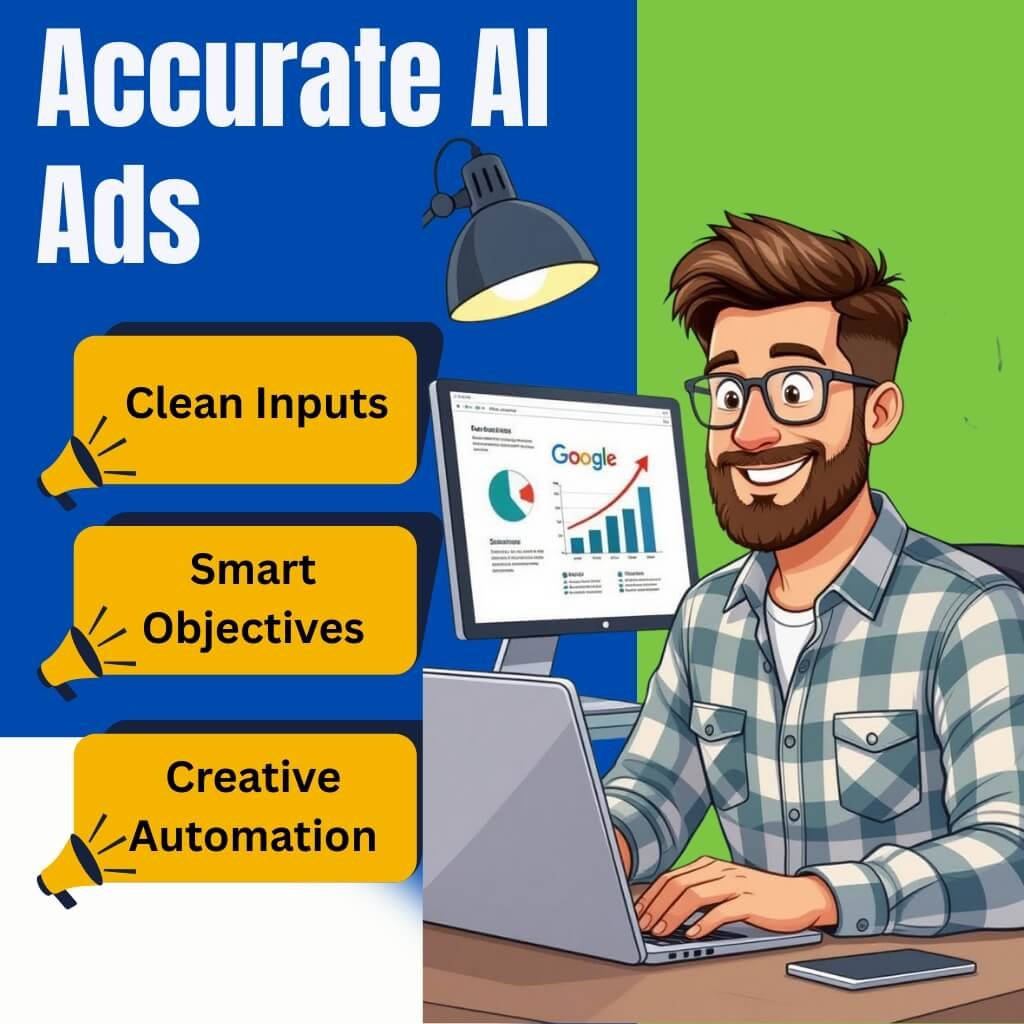
Pick one goal: Sales (ASC), Leads, or App. Use the matching Advantage+ objective.
Load clean inputs: product feed, five to ten crisp images, two short videos and at least six headlines.
Turn on Advantage+ Creative for automatic image-to-video and text variants. Keep brand rules tight: logos, fonts, colors.
Feed the system better data
Implement the Pixel + Conversions API together. Map purchase value, content_ids and email/phone (hashed). This raises match rates and improves delivery.
Use one primary event for optimization (usually Purchase) and one secondary (AddToCart) for learning depth.
Structure for today’s delivery
Use a broad Advantage+ Audience and let the model find intent. Avoid heavy interest stacks.
One campaign → one ad set → many creatives. This suits Andromeda-era retrieval and reduces throttling.
Publish 20–50 creative variants. Swap the bottom 20% weekly. Keep winners alive.
Expand placements where it now matters
Keep Feed, Reels, Stories and In-Stream on. Add Threads once available in your account. It rolled out ads/tests.
Common Mistakes Marketers Still Make (and How to Fix Them)
Over-automation
People set and forget. Fix it: Set a weekly 30-minute review to rotate weak creatives and refresh copy.
Ignoring data hygiene
Broken events, missing values, or messy catalogs hurt delivery. Fix it: audit Pixel/CAPI and feed fields monthly.
Crowded targeting
Heavy interest layering restricts reach under Andromeda. Fix it: go broad; let predictive clusters work.
Too few assets
The model needs variety to test. Fix it: ship a bank of shortcuts, UGC, product demos and offer frames each week.
No holdout testing
You can’t tell if AI helps without a control. Fix it: run split tests on Advantage+ vs. your manual setup for two learning cycles, then decide.
Ethical Considerations: Privacy, Data Usage, Algorithmic Bias
Privacy signals are changing
Meta plans to use AI chat interactions as an input for ad personalization starting December 16, 2025. Advertisers should disclose how they use data and offer clear opt-outs on their sites.
Teens and safety
Instagram added PG-13-style filters and tighter teen settings in October 2025. Brands should exclude under-18 audiences for mature products and review creative suitability.
Fairness and bias
Follow FTC guidance on transparency, claims and testing when you use AI for targeting or creative. Document what data you use and why. Keep records of lift studies.
Practical checklist for ethics:
A . Publish a clear privacy notice.
B . Honor user choices (email opt-outs, Do Not Sell/Share where required).
C . Avoid sensitive targeting.
D . Review ads against brand-safety and youth-safety rules monthly. Reuters
Upcoming trends to prepare for:
AI + AR ads across Facebook/Instagram
Meta showcased virtual try-on and creative sticker CTAs this summer. Expect more AR placements and product try-ons inside Reels and Shops. Prepare 3D/try-on-ready assets now.
Predictive creative generation
Meta introduced video generation upgrades and “Vibes” tools that spin new ad videos from a few assets. Add “evergreen b-roll” to your library so the system can cut new edits fast.
Toward fully autonomous campaign management
Meta’s target: near-total automation by 2026, per WSJ reporting confirmed by Reuters. Plan now: consolidate campaigns, clean signals and build creative depth. Reuters
Hardware-assisted capture → ad creative
Ray-Ban Meta launched display glasses and new AI features in September 2025. Expect creator workflows that post hands-free clips into ad libraries. Brands should draft usage policies and asset rights now.
Expert quote
“Automation pays off when brands give it good ingredients: clear goals, accurate events and a steady stream of fresh creative.” — John Hegeman, Meta’s head of monetization, discussing AI tools for advertisers. Inc.com
Case study
Company site: oatsovernight.com
Oats Overnight (Arizona-based) tested Reels-native creative alongside standard ads. The brand saw a 47% higher conversion rate when it ran both creative types together versus either alone and kept Reels-native assets in ongoing sets. Learnings: diversify creative, let Advantage+ test distribution and keep a weekly creative swap routine.
Conclusion
AI Facebook Ads are your factory managers. They turn clicks into customers. Budgets run like smooth machines. Campaigns grow like fast-moving startups. AI guides your brand. Sales rise. Growth lasts.
FAQ
Can AI Facebook ads run without a product catalog?
Yes. A catalog helps with dynamic ads, but AI can still run campaigns with static creatives. You just upload images, text and videos. The system will create variations and test them. Catalogs simply give more depth for e-commerce.
Do AI Facebook ads work for small budgets?
Yes. Even with smaller spends, AI can test variations and push traffic to the better ones. The main difference is speed—larger budgets reach results faster, while smaller budgets may need more days for the system to learn.
How long should I let AI ads run before judging results?
At least one learning phase, which is usually 5–7 days, depending on budget and conversions. Stopping too early can block the system from finding the right audience patterns.
Do AI Facebook ads replace manual campaigns fully?
Not always. Many advertisers still run a mix. AI handles broad targeting and testing, while manual ads are useful for brand campaigns, seasonal promos, or very specific audiences.
Can AI ads handle seasonal demand changes?
Yes. AI detects shifts in buyer interest when activity spikes around events like Black Friday or holidays. But you should still update the creative and offers before those periods. So the system has fresh inputs to use.
Do AI Facebook ads work for B2B companies?
Yes. They can reach decision-makers by analyzing job titles, behaviors and lookalike data from your CRM. The process is slower than B2C, but AI still improves targeting and message testing for lead generation.
How do AI ads choose placements like Reels or Stories?
AI tests your creatives across placements. If short videos perform better in Reels, it will push more budget there. If images perform better in Feed, spend shifts there. You don’t pick manually; the system adapts.
Can AI Facebook ads use existing customer lists?
Yes. You can upload a customer list or CRM data. The AI uses it to create predictive audiences, then expands beyond those users to find new buyers with similar traits.
Do AI ads need constant new creatives?
Yes. The system tests continuously. If you don’t refresh, performance may drop once audiences tire of the same content. A common practice is to upload 5–10 new creatives every two weeks.
Can I track which part of AI ads drives results?
Yes, through breakdown reports. You can still see which creative, audience cluster, or placement drove sales. AI hides some micro-targeting details, but it shows performance insights you can use to plan next inputs.