


The biggest issue for founders is that seed capital has become a professional-grade milestone.
You now need to prove your business works before you get the money to build it.
Most founders fail because they ask for millions of dollars without any data to back up their claims. They waste months chasing investors instead of building their product.
So, what is seed capital? Seed capital is the first professional fuel for your startup.
This is the initial investment a company raises to prove its product works in the market.
This money helps you move from a basic prototype to a scalable business. It is called a seed because it is the small investment planted at the beginning. It helps grow a massive company later
While earlier money comes from your own pocket, seed capital usually comes from outside experts. It pays for your first key employees, legal setup, and early marketing.
What is seed capital?
Seed capital is no longer just a small check to get started. It has become a massive funding stage.
The median seed round in the US has reached $3.1 million. If you are building an AI company, that number jumps to $4.6 million.
Investors now expect you to have at least $300,000 to $500,000 in yearly revenue before they consider you for a seed round.
They are looking for businesses that can use AI to keep costs low and profits high.
I have worked with many founders who thought a “cool idea” was enough for a seed round. In my experience, that era is dead.
Today, the founders in my network who get funded are those who can show a spreadsheet of real user growth.
Do not pitch a vision; pitch a working machine that needs fuel to go faster.
A few months ago, I worked with a remote client in Austin, Texas. He had a brilliant idea for an AI-driven logistics platform.
He was talented and driven. He spent his own savings building a beautiful prototype. But he hit a wall.
He needed to hire two senior engineers. He also had to pay for massive server costs to launch his business.
He was exhausted from chasing big Venture Capital firms. They would not return his emails.
He felt like his dream was dying. He did not have the fuel to start the engine. That fuel is exactly what we call seed capital.
The Problem: The Pitching to Silence Cycle
My client was stuck in the Validation Trap. He was asking for $2 million while his user dashboard was empty.
In the current market, investors are terrified of ideas without data. He was spending 80% of his time writing pitch decks.
He spent 0% of his time getting customers. Because he had no traction, the investors saw him as a high-risk gamble. They did not see him as a smart investment.
Solution: How I Fixed His Funding Strategy
I stepped in and shifted his entire focus. I told him to stop emailing VCs for two weeks.
Instead, we used low-cost AI automation to find 50 Beta Users. These users were willing to pay a small monthly fee to test the prototype.
Within 14 days, we had a spreadsheet showing three things:
1 . Real Revenue: $1,200 in pre-launch sales.
2 . User Data: Evidence that users stayed on the platform for over 30 minutes a day.
3 . Low Cost: Proof that we could acquire a customer for $5 through targeted LinkedIn automation.
We updated his pitch deck with these three points. Two weeks later, he secured $1.5 million in seed capital from a Micro-VC.
The lesson was clear. Now, seed capital follows the data, not the dream. By building a moving train first, we made it easy for investors to jump on board.
Where Does the Seed Capital Come from: Major Sources

The funding scene has changed. You can now find money from many different places, depending on your business type.
1 . Angel Syndicates
Groups of rich individuals pool their money to invest. They often help with advice and connections.
2 . Micro-VC Firms
These are small investment companies that only focus on the seed stage. They move much faster than big banks.
3 . Equity Crowdfunding
Platforms like Wefunder are huge right now. They allow your actual customers to invest and own a piece of your company.
4 . AI Accelerators
Programs like Y Combinator now give you $500,000 and special access to computer power to build AI tools.
Startup Funding Comparison
| Funding Source | Average Check | Key Advantage | Best For |
| Angel Syndicates | $50k – $250k | Personal Mentorship | Early prototypes |
| Micro-VCs | $1M – $3M | Industry Expertise | Scaling an MVP |
| Crowdfunding | Up to $5M | Huge Brand Loyalty | Consumer products |
| Accelerators | $500,000 | Massive Network | Tech/AI startups |
I have seen a huge shift toward “Coordinated Capital” this year. Founders raise half their money from a professional VC and the other half from their customers through crowdfunding.
This is the smartest move because it gives you professional guidance and a loyal fan base.
Effective Spending: How to Use Seed Capital?
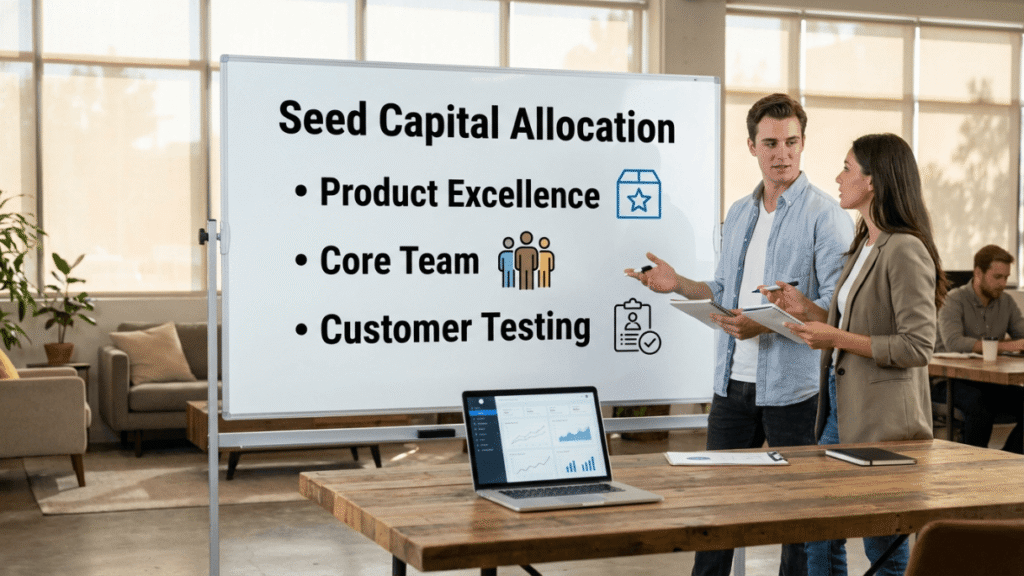
If you spend your seed capital on a fancy office or a huge sales team too early, you will go broke. The most successful startups stay “lean.”
Product Excellence (40%): Spend most of your money making your product better than everyone else’s.
Core Team (30%): Hire two or three “experts” instead of ten average workers.
Legal and Security (10%): Data privacy laws are very strict now. You must pay for good legal help to avoid fines.
Customer Testing (20%): Run small experiments to find the cheapest way to get new users.
I always tell my team to hire for “pain.” Do not hire someone because you think you are supposed to.
Only hire someone when you have so much work that your current team cannot handle it.
This keeps your “burn rate” low and makes your seed capital last much longer.
General Guidelines to Get Seed Capital
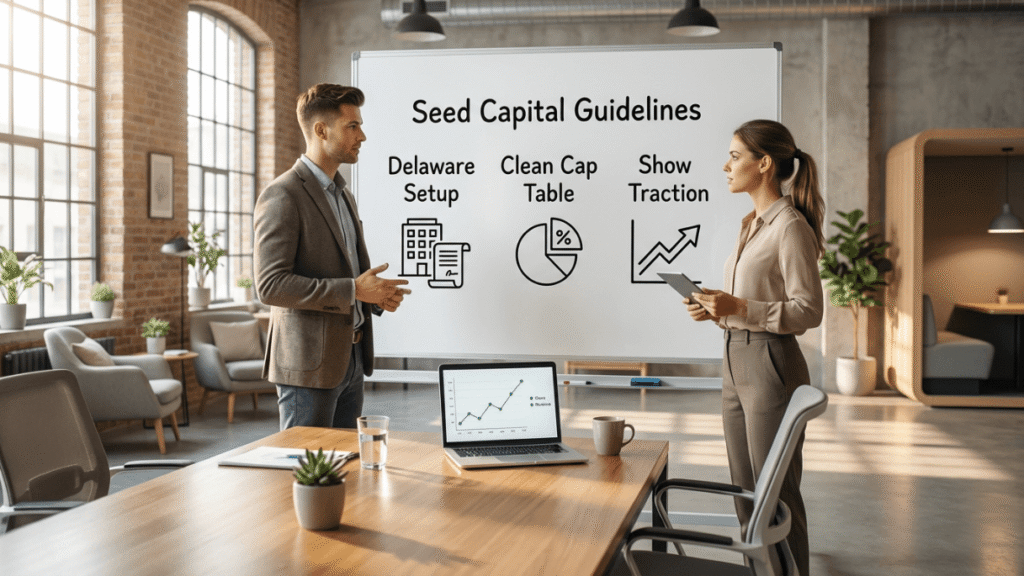
Getting seed capital requires a mix of hard data and smart legal choices. Investors no longer fund ideas; they fund systems that work.
You need to show that your business is safe, scalable, and legal before a VC will open their checkbook.
Let’s discuss how to build a professional foundation that makes you look like a winner from the very first meeting.
Incorporate in Delaware
Almost all investors only invest in Delaware C-Corps. This state has the best business laws. If you are not in Delaware, investors might ask you to move before they sign.
Example: A tech founder in Florida had to spend $5,000 to “flip” his company to Delaware because a top VC refused to invest in a Florida LLC.
Use a SAFE Agreement
This is the fastest and cheapest way to sign a deal. It stands for Simple Agreement for Future Equity.
It avoids complex legal battles over how much your company is worth today.
Example: Use the standard Y-Combinator SAFE to close a $500,000 investment in days instead of months.
Clean Your Cap Table
Do not give away large chunks of your company to people who do not help every day. Investors hate seeing a “passive” founder with 20% of the equity.
Example: Avoid giving your cousin 10% just for designing your first logo. Pay them cash instead.
Focus on the Problem
Spend most of your pitch explaining why the current solution is broken. If the problem is big enough, the solution is valuable.
Example: Instead of talking about your AI features, show how companies lose $1 million a year because of the problem you solve.
Show Traction
Prove that people use your product and come back to it. Traction is the only thing that cures investor doubt.
Example: Show a chart showing your user base grew by 10% every week for the last two months.
Have a Moat
Explain why your technology or brand is hard to copy. A moat protects your profits from competitors like Amazon or Google.
Example: Your “moat” could be a unique dataset that no one else has access to.
Know Your Numbers
You must know your Customer Acquisition Cost (CAC) by heart. If you do not know your numbers, investors think you are an amateur.
Example: If an investor asks your CAC, answer immediately: “It costs us $12.50 to get one paying user.”
Get a Warm Intro
Ask a friend or another founder to introduce you to an investor. Cold emails rarely work because VCs get thousands of them.
Example: Find a founder who previously raised money from that VC and ask them for a quick email introduction.
Record a Demo
Show a video of your product actually working in the real world. A video is better than twenty slides of text.
Example: Record a 60-second screen share showing a user solving a problem with your app.
Plan for 24 Months
Show how this money will keep you alive for two full years. Investors want to know you will not run out of cash in six months.
Example: Create a budget that shows your “runway” lasts until 2028.
Be Honest
If your business has a weakness, tell the investor before they find it. Honesty builds trust.
Example: Say, “Our current cost is high, but we have a plan to lower it by 30% next year.”
Focus on Retention
Investors love companies where customers never want to leave. High retention proves your product is “sticky.”
Example: Show that 80% of the people who signed up in January are still using the app in March.
Send Monthly Updates
Keep potential investors excited by showing your progress every month. It shows you are consistent and fast.
Example: Send a short email once a month with three bullet points: “What we did,” “What we learned,” and “Our new numbers.”
Use AI Wisely
Use AI to handle boring tasks so your team can focus on big ideas. This shows you are a modern, efficient founder.
Example: Use AI to handle your basic customer support so you do not have to hire five extra people.
Hire a Professional Lawyer
Never sign an investment deal without an expert checking it first. A bad contract can ruin your life.
Example: Use a law firm that specializes in startups to review your “Term Sheet” before you sign it.
If you cannot find a VC check immediately, look for Grants. Many organizations give “non-dilutive” money. This means they give you cash but do not take any of your company’s.
Example
A founder I know used a $100,000 government grant to build her first AI model.
Because she did not give away equity early, she owned 100% of her company when she finally talked to big investors. This made her much wealthier in the long run.
Conclusion
High-growth ideas only win when they show real user traction. Build your prototype first and secure a few paying customers on your own. This proof makes you irresistible to professional angel investors and seed funds.
Keep your legal structure clean with a Delaware C-Corp and use SAFE agreements to move fast.
Focus every dollar of your seed capital on product excellence and efficient customer growth.
A business that shows profit potential will always find the right partners. Start validating your data today to secure your company’s future success.
FAQ
Does my startup need an AI Ethics Policy to get seed capital?
Yes. Investors perform Algorithmic Due Diligence. They check how you handle data bias and user privacy. A written ethics policy shows you are ready for future US regulations.
Can I use seed capital to pay for GPU cloud credits?
Yes. Many seed rounds are raised specifically for computing power. Investors often approve using 20% to 30% of the funds for specialized AI cloud services to train your models.
What is a Lead Investor and why do I need one?
A Lead Investor is the person who sets the price and terms of your seed round.
Most other investors will only give you a check after a Lead signs. Finding this person is the hardest part of your fundraiser.
Do I have to be a US citizen to raise seed capital in America?
No. You can raise money from US firms as a foreign founder. However, you must have a US-based entity, usually a Delaware C-Corp. Some investors may also require you to have a US-based business address.
Is Equity Crowdfunding a bad signal to big VCs?
No. In the past, VCs disliked crowdfunding. Now, they love it. A successful crowdfunding campaign proves that thousands of regular people want your product before the VC even writes a check.
Can I raise seed capital for a consulting agency?
Usually, no. Seed capital is for scalable tech businesses. If your revenue depends on your own manual hours, investors will not fund you. They want to see a product that makes money while you sleep.
What is a 409A valuation and why does it matter?
A 409A valuation is a formal report that sets the price of your company’s common stock. You need this before you can legally give stock options to your employees. It protects you and your team from IRS tax penalties.