
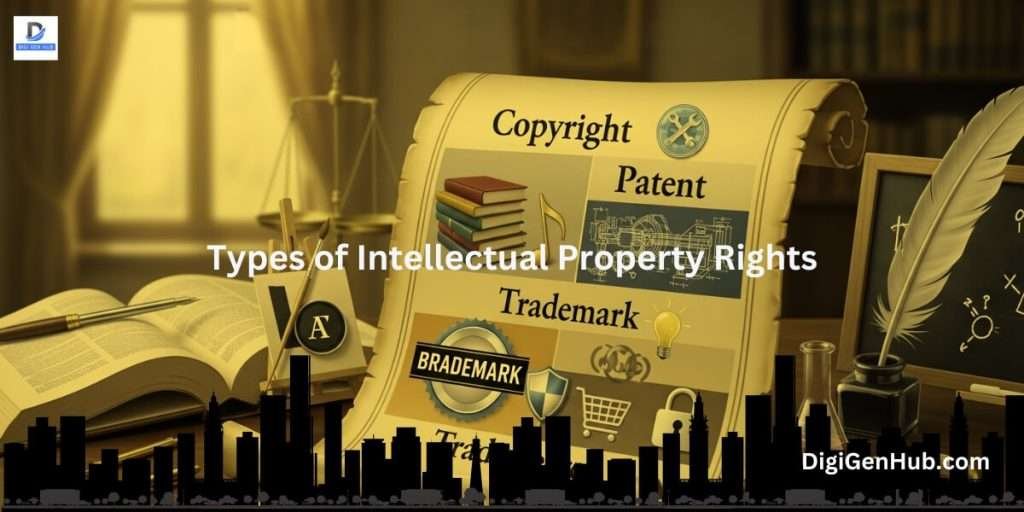

The audiences demand trust and authority. This is why intellectual property rights are crucial for a reputable brand.
My aunt built an online education platform. Her lessons were copied and sold on fake sites.
She fought back by securing copyrights, protecting her brand and filing takedowns. The originals regained value and learners returned.
This is the reality today. Patents cover new tech. Trademarks defend brands online. Copyrights protect creative work in the AI era.
Trade secrets guard data. Designs, Geographical Indications and plant rights secure looks, origin and food innovation.
Protection is only the first step. Monitoring, fast enforcement and new tools like AI tracking and blockchain proof are now essential.
Ignore this and you risk stolen ideas and lost trust. Act on it and you turn your work into durable assets that secure lasting business growth.
The Types of Intellectual Property Rights and Their Modern-Day Relevance

Intellectual property is the operating system for value creation. Let’s explain its type and its activities.
1) Patents — Protect Breakthroughs that investors can price
You can patent new tech in AI, biotech and climate solutions if a human made a meaningful contribution. The USPTO says humans must be the inventors, even when AI helps. Document that human role.
Hot debate
Courts and agencies hold the line: AI is not an inventor. That keeps inventorship human if you add real input.
Why investors prefer patents.
Patents publish claims. Investors can model the moat and licensing value. Global applications hit 3.5M+ in 2023, showing strong filing appetite into 2024–2025. WIPO
Protect your idea
1 . File a provisional first to lock the date.
2 . Keep the inventor’s log that shows the human’s specific ideas vs. AI output.
3 . Use PCT if you plan multi-country filings.
4 . For GenAI inventions, capture prompts, edits and design choices in your lab book.
2) Trademarks — The currency of digital branding
Names, logos, app icons, jingles, even colors. Files often include virtual goods and NFTs. US appeals around MetaBirkins show how courts weigh branding in digital art and tokens. Reuters
Counterfeit trade sits near $467B by OECD/EUIPO estimates. Fake listings bleed trust and sales. Strong marks help take down engines and customs actions. OECD
You can do this
1 . File core marks in the US, UK and EU. Add virtual goods classes.
2 . Enroll in Amazon Brand Registry. Use Catalog Lock and upgraded tools for faster removals.
3 . Record marks with customs where you sell most.
3) Copyright — Guard the digital creative economy
Books, film and music still count. The new fight is AI art, AI music and code. The Copyright Office’s 2025 report repeats the human authorship rule.
Training-data lawsuits moved fast
In September 2025, a federal judge preliminarily approved a $1.5B class settlement between authors and Anthropic over pirated book corpora. It shows courts will scrutinize unlicensed datasets.
Do this now.
1 . Keep edit logs to show human selection and control.
2 . Register high-value works early.
3 . Add dataset warranties to vendor deals.
4 . For music/images, request clear training disclosures.
4) Trade Secrets — The invisible assets that never expire
Algorithms, formulas, pricing logic, customer data, process docs. You keep them secret on purpose.
Why do many firms pick secrets?
No filing. No expiry. But you must control access. 2025 Verizon DBIR shows rising third-party and credential-abuse breaches, which hit secrets first.
Do this now.
1 . Lock secrets with least-privilege, NDAs, logging and off-boarding checklists.
2 . Track shadow SaaS use and uploads to GenAI tools. SpyCloud
3 . Mark documents CONFIDENTIAL and trains staff on what stays inside.
5) Industrial Designs — Where looks drive clicks
Product shape, UI/UX screens, icons, packaging. The EU design reform (phase-in May 1, 2025; second phase July 1, 2026) widens protection and modernizes enforcement.
Still, most shoppers decide in seconds. Design clarity lifts conversion. Historic smartphone design battles proved that design rights can carry large awards.
Do this now
1 . File registered designs for your packaging and core screens before launch.
2 . Keep dated screenshots and variant files.
3 . Align trademarks and designs so takedowns hit both fronts.
6) Geographical Indications (GI) — Origin as a trust signal
Foods, wines and crafts are tied to a region. Shoppers care about authenticity and source.
GI programs help communities fight fakes at the border and marketplace levels. OECD/EUIPO warns of large-scale counterfeits that target GI goods too.
Own your ideas
1 . If your product qualifies, seek GI protection in your main markets.
2 . Add traceability and QR codes that link to verified origin pages.
3 . Coordinate with distributors on GI use in ads and labels.
7) Plant Variety Rights — Seeds for a hotter world
New plant breeds. Traits for drought, pests and yield. Food systems face heat and water stress. IP for resilient seeds draws investment into agri-tech. Policy debates continue, but filings and titles keep growing.
Do this now.
1 . File PVP where you sell seed or harvest.
2 . Run side-by-side trials and lock evidence on performance.
3 . Use stewardship contracts with growers to protect know-how.
Expert Voice:
“Despite headwinds, innovation remains resilient. Every minute, more than 40 IP applications are filed somewhere in the world.” — Daren Tang, Director General, WIPO, July 2025. WIPO
What Do Intellectual Property Rights Mean in Today’s Market
Intellectual property rights are the way businesses claim ownership of ideas, designs, names and inventions.
They act as an accurate part of a company’s value. Investors ask for IP portfolios during funding rounds. Buyers check for registered rights before signing deals.
Courts are also drawing new lines. In March 2025, a US appeals court ruled that AI cannot be the author of a work; a human must add creative input. (Lexology) Swiss courts in June 2025 confirmed the same for patents: only people can be inventors, not AI systems like DABUS. (Wikipedia)
Practical moves for businesses:
1 . Keep detailed drafts, edit logs and design files to prove authorship.
2 . Show your IP in business pitches as proof of durability.
3 . Treat registration and renewals as an investment, not a side cost.
Its importance from heavy industry to digital-first value
Now, software, algorithms, digital brands and data shape markets. Sectors heavy in IP contribute larger shares of GDP and higher wages in both the US and the EU. (EUIPO Report)
The EU AI Act, which started rolling out in February 2025, shows how closely law and IP now connect.
Companies using AI at scale must log training data, assess risk and explain their models. That directly touches copyrights, trade secrets and patents.
Practical moves for businesses:
1 . Make a list of every digital asset you own: code, models, branding and content.
2 . Decide what to patent, what to trademark and what to keep confidential.
3 . Protect design elements like packaging or app interfaces that influence buyers.
4 . Plan filings where your main customers or investors are, not just at home.
Why markets now treat IPR as assets
Because they generate cash. Patents earn royalties, trademarks protect pricing power and copyrights open licensing streams.
Examples:
Qualcomm earns billions yearly from licensing mobile patents. (Qualcomm)
Arm Holdings licenses processor designs and collects royalties on every chip made using its architecture. (Arm)
So, build financial forecasts that include licensing income. Package IP into alliances or M&A talks. Use IP to secure better terms with partners and distributors.
Expert insight
“We must reward human creativity in AI-assisted inventions while not shackling future innovation.” — Kathi Vidal, USPTO Director (Allen Dyer)
Case study: Nike vs. StockX
Background. Nike sued StockX in 2022 over NFTs tied to sneakers and allegations of counterfeit shoes.
Ruling. In March 2025, a court found that 37 counterfeit pairs were sold. (Global Law Today)
Settlement. In August 2025, both parties settled and ended the case. (Reuters)
Lesson for businesses:
1 . Register trademarks across both physical and digital classes.
2 . Track resale markets closely.
3 . Collect proof before acting in court or negotiations.
The action plan you must apply
1 . Audit all IP: patents, designs, content and trademarks.
2 . File protections where sales or investors are strongest.
3 . Keep clear records of human input in AI-assisted work.
4 . Watch marketplaces, NFT platforms and global import channels.
5 . Draft licensing terms early: regions, usage, minimums, audits.
6 . Prepare budgets for disputes and oppositions.
How to Protect and Use IP Rights Effectively
Ideas make money only when you lock them, watch them and act fast. Let’s know a tight plan you can follow today.
A) Step-by-step: register → monitor → enforce
1) Register the right stuff, in the right places.
Trademarks: file in the US, UK and EU first. Add classes for digital goods and virtual items if you sell online. (EU design reform also streamlines visuals; see below.)
Patents: Use a provisional to lock your date. Move to PCT if you expect global sales.
Designs: register your packaging and UI screens before public launch in the EU/UK/US. Recent EU changes started on May 1, 2025. More updates land in 2026. EUIPO
Copyright: Register high-value content. Keep edit logs to prove human control. (Courts and the U.S. Copyright Office still require human authorship.) Reuters
Trade secrets: use NDAs, role-based access, device controls and off-boarding checks. Courts now award large damages for secrets taken abroad. Dentons
2) Monitor the markets where abuse happens.
Watch marketplaces, app stores, NFT sites and social video. Use alerts for name look-alikes and counterfeit listings.
Track small-parcel routes; they carry most seized fakes, per the OECD–EUIPO 2025 report.
3) Enforce with a fast ladder.
Start with platform takedowns and brand registry tools.
Send cease-and-desist with evidence packs (test buys, chain-of-custody, screenshots).
Escalate to customs recordations and civil suits if the seller returns.
In trade secret cases, ask for forensic collection and injunctions early. Courts have backed big awards.
B) Globalization: why one country is not enough
You sell across borders. Infringers do too.
File first in your money markets. That often means US + UK + EU for high CPC buyers.
Add a PCT patent path if you need Asia later.
Watch trans-shipment and “local assembly” tricks. The OECD–EUIPO 2025 study shows counterfeiters ship parts, then assemble near end markets. Small parcels dominate seizures.
Use parallel filings for designs and marks when you launch a product page in a new region. Time them with ad spend.
Trade secrets travel, too.
The Seventh Circuit confirmed that DTSA can reach worldwide sales tied to stolen US secrets. That changes the risk math for offshore misuse.
C) Tools: AI IP stacks, blockchain proofs, smart contract workflows
AI for patent and docket work.
Patent teams now draft, search and route claims with AI. The IPO 2025 meeting recap lists USPTO’s own tools (SCOUT, SimSearch, CPC Autoclassification). Expect tighter, faster prosecution.
For analytics and alerts, 2025 roundups track mature tools for drafting, drawings and prior-art scans. Use them to cut misses and watch rivals.
Blockchain for proof and registries.
Firms timestamp designs and datasets to prove first use and chain of custody.
Projects like IPwe explored patent registries on distributed ledgers; the core idea remains useful for audit trails and deals. Google Patents
Smart-contract licensing.
You can automate royalty splits for digital goods and API usage.
Add audit clauses and usage caps in code and in the paper contract.
D) Cost control for 0small teams (without cutting corners)
Stage filings. Provisional → PCT only if traction appears.
File where you sell. Skip vanity countries.
Bundle tasks. Register design + mark for the same product drop to share evidence and dates.
Use platform tools first. Brand Registry and app-store takedowns cost less than court.
Ensure the big launch. Media, fashion and gadget drops can get IP insurance quotes to cap legal shock.
Track ROI. Map each right to a SKU, feature, or license. If a right does not pay, drop it at renewal.
Risks if you wait
Stolen tech. Competitors ship your feature first. (US courts may still help, but you lose time.) Dentons
Brand drift. Look-alikes confuse buyers and kill conversion. The fake-goods trade sat near $467B per the 2025 OECD–EUIPO report. OECD
Investor doubt. Missing filings read as a weak moat.
Costly clean-ups. You pay more later for backlog filings, disputes and rebrands.
Expert voice
“Illicit trade threatens public safety, undermines intellectual property rights and hampers economic growth… counterfeiters leverage new technologies and techniques to avoid detection.” — Mathias Cormann, OECD Secretary-General, May 7, 2025.
Case study
Motorola said Hytera took radio communications secrets and used them abroad.
In 2024, the Seventh Circuit upheld a judgment exceeding $400M. In 2025, analysis confirmed the court’s view: DTSA can reach overseas conduct and worldwide sales.
Why is this essential to you?
You can cite US law to hit foreign misuse if facts fit the DTSA tests.
You need forensic-grade logs and tight access control to win.
You should plan injunctions early, not after a product cycle. Your product must meet the customer’s needs.
Copy the playbook.
Run access audits on engineers and vendors quarterly.
Require device imaging on exit for high-risk roles.
Keep a clean-room protocol when former staff join from rivals.
Map damages by global shipments to match DTSA logic.
I) Your simple 90-day plan (print this)
Days 1–30
1 . File name + logo in US/UK/EU.
2 . List every patentable feature; file one provisional.
3 . Register 2–3 core designs (packaging or UI).
4 . Lock NDAs + access rules for code, data and labs.
Days 31–60
1 . Turn on the marketplace and app-store brand tools.
2 . Add dataset warranties to vendor and model-hosting deals.
3 . Launch counterfeit watch for small parcels and cross-border sellers.
Days 61–90
1 . Prepare PCT if demand proves out.
2 . Record your marks with customs in your top regions.
3 . Build an evidence kit: test buys, screenshots, version logs.
4 . Price one license you can sell in Q4 (region, scope, minimums).
Conclusion
So, intellectual property rights are the contract between invention and growth. Without them, a business is a deal unsigned. With them, every idea becomes a stock and pay returns long after launch.
FAQ
Can intellectual property be used as collateral for a business loan?
Yes. Many banks and investors now accept patents, trademarks and copyrights as collateral, especially in tech and media deals.
How does intellectual property affect cross-border e-commerce?
Sellers must respect IP laws in every target country. A product legal in one region may infringe in another if rights are already registered there.
Are open-source projects protected by intellectual property rights?
Yes. Most open-source licenses are built on copyright law. The creator grants permission under specific terms, but ownership still exists.
Can artificial intelligence help in detecting IP infringements?
Yes. AI tools scan marketplaces, images and code repositories to flag possible misuse, helping companies act faster.
Do intellectual property rights apply to digital influencers or content creators?
Yes. Influencers can trademark their names, protect original videos with copyright and even license content to brands.
How does intellectual property work in franchising?
Franchisors license trademarks, trade dress and sometimes proprietary methods. IP rights are the foundation of franchise value.
What role does intellectual property play in mergers and acquisitions?
IP portfolios are audited to assess the company’s worth. Strong IP often raises the purchase price or makes a deal more attractive.
Can intellectual property be donated or gifted?
Yes. Owners can transfer rights to individuals, nonprofits, or institutions. This can also bring tax benefits in some jurisdictions.
Is intellectual property relevant for non-profit organizations?
Absolutely. Nonprofits often rely on trademarks for identity, copyrights for materials and patents for research developed in labs.
What is the future of intellectual property in virtual reality and metaverse platforms?
Brands are registering rights for virtual goods, avatars and digital services, ensuring ownership extends to immersive online worlds.