


Great websites don’t grow because they post more. They grow because every page connects with purpose.
If your content spreads in random directions, search engines stop trusting it and users stop clicking. The solution begins with optimizing how your topic clusters function.
Last summer, my friend Lopa’s elder brother called for help. He runs a digital product business that builds software and mobile apps.
His site had hundreds of posts about app design, user experience and updates. Yet its traffic continued to decline.
Lopa told me he’d lost faith in blogging altogether. Upon checking, I discovered the actual issue. Every article stood alone. No pillar, no linking, no clear intent.
I built one strong pillar around “building digital products” and grouped the rest into focused clusters. These are app strategy, design trends and performance updates.
Then I linked every cluster back to the pillar. Within two months, his organic visits jumped and his demo requests tripled. His content finally worked as a system instead of scattered notes.
What Most People Get Wrong About Topic Clusters
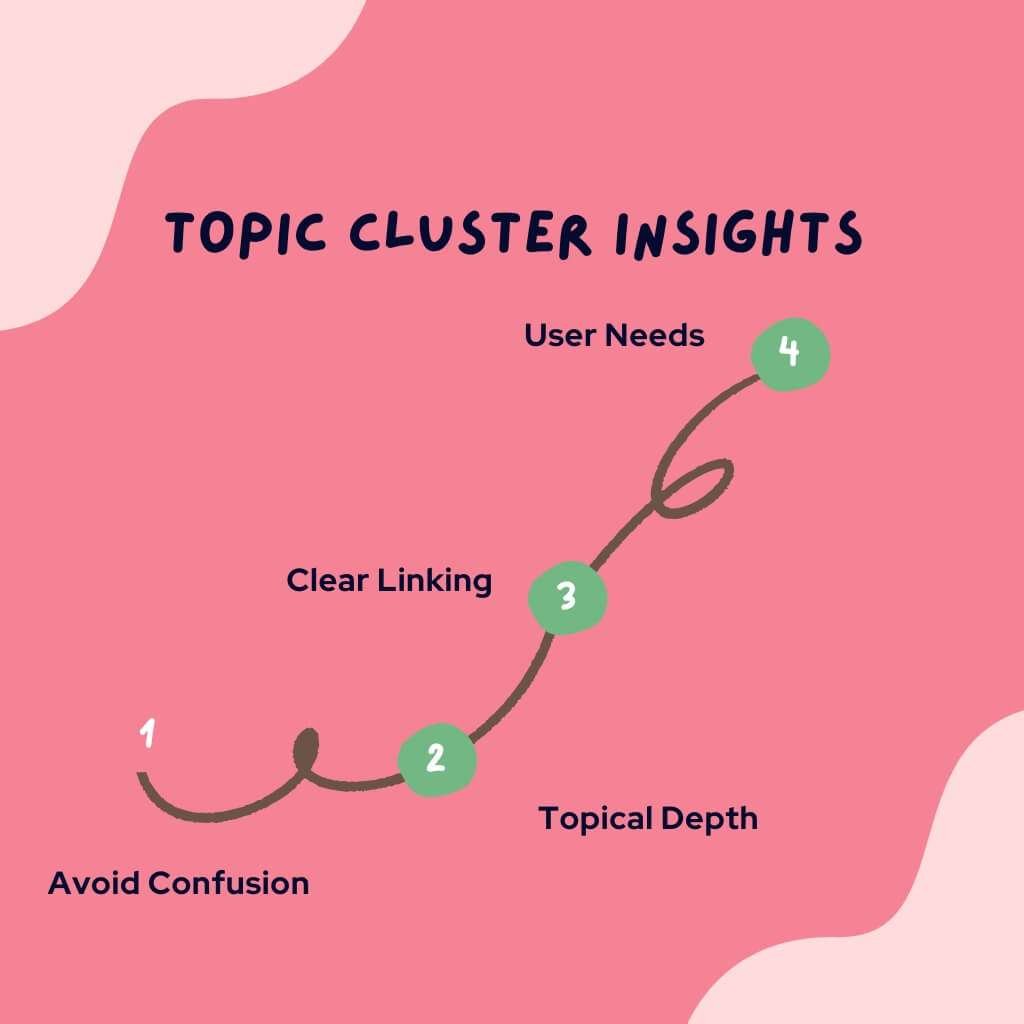
Topic clusters must group pages around real user needs. They must link clearly. They must show topical depth.
When people treat clusters like a keyword checklist or a filing system, they hurt rankings and confuse users.
What a topic cluster should be
One pillar page. It provides a comprehensive overview of the main topic.
Several cluster pages. Each page answers a focused question or intent.
Internal links. The pillar links to clusters. Clusters link back and among themselves where logical.
This setup helps search engines and people find related information fast. It also prevents pages from fighting each other for the same query.
Are you building your cluster around keywords instead of user intent?
If you build clusters from keyword lists alone, you fail.
Why this is wrong (exact reasons)
Keywords hide intent. Two similar keywords can ask different things.
Engines now group queries by intent and entities. Pages that match intent win.
Multiple pages that target the same intent cause cannibalization. They split authority. They confuse indexing.
How people typically make this mistake
They map many keywords to a pillar page.
They write thin pages to hit every keyword variant.
They allow internal links to point randomly to any URL that appears related.
Exact signals that show you built around keywords, not intent
Several pages rank for the same short query.
Low click-through from impressions. (Impressions rise; clicks do not.)
Short dwell time on cluster pages.
Search Console shows many similar queries for different URLs.
Fix — step-by-step (do these now)
Map intent first. List user questions, not keywords.
Group queries that share intent into one page. Use one URL per distinct intent.
Make the pillar a guided entry. Let clusters answer specific intents.
Merge or 301 pages that truly duplicate intent. If both add value, consider rewriting to separate intents.
Use Search Console and a keyword tool to find overlapping queries. Track them monthly.
Are you neglecting internal linking structure?
Bad linking harms both users and crawl signals.
Common linking mistakes
Sparse links. Cluster pages don’t link back to the pillar.
Flat links. All links point only to the pillar and never between clusters.
Irrelevant links. Links point to pages outside the topic.
Overlinking. Authors stuff links for SEO rather than user help.
Why do these mistakes cut your value?
Google and other engines use link paths to learn page relationships. Bad links hide the structure.
Users lose the natural flow from overview to detail. They bounce. That lowers engagement metrics.
Link equity spreads to the wrong pages. The pillar loses strength.
Clear rules to fix internal links (apply immediately)
Make the pillar the hub. Link from pillar → each cluster.
Link cluster → pillar on a logical anchor phrase (use short natural anchors).
Link cluster → cluster only when the second page answers a follow-up question.
Use a small sitemap or content map to track links. Update it quarterly.
Check for orphaned cluster pages and link them in. Orphans never pass signals.
Tools and quick checks
Use Search Console to find top queries by URL. Watch overlapping queries.
Use a site crawler (such as Screaming Frog or Sitebulb) to identify internal linking patterns.
Run a content map in a sheet. Include URL, intent, links in and links out.
Fix 10 worst orphan or mislinked pages per quarter.
The role of topical authority now
Engines value content that thoroughly covers a subject. They reward coherent coverage.
Google avoids magical badges called “topical authority. Still, sites that answer many related questions tend to rank better. So topical depth is purposeful in practice.
Why mis-applied topic clusters undermine authority
When clusters overlap, they dilute signals. Search engines can’t tell your best page.
When links point everywhere, the topical signal blurs. The site looks unfocused.
When clusters stay shallow or copy basic content, they add no new value. Engines see redundancy.
Exact steps to rebuild true topical strength
Audit cluster coverage. Rate each cluster page by unique intent coverage (1–5).
Merge or refocus pages with the same rating. Keep the best content as canonical.
Add missing cluster pages that users have clearly requested. Use Search Console and People Also Ask (PAA) data.
Show author expertise and sources on the pillar and clusters. Add short author bios and citations. This supports E-E-A-T signals.
Quick audit checklist (do these in this order)
a) Run Search Console: export queries by URL. Spot overlap.
b) Crawl the site to identify orphan pages and link depth issues.
c) Tag intent per URL: informational/transactional/navigational/local.
d) Merge pages with identical intent or rewrite to separate intent.
e) Rebuild internal links using the pillar → cluster → related pattern.
f) Add author details and up-to-date citations on the pillar and clusters.
g) Measure: track clicks, impressions and positions weekly for 12 weeks. Use rolling tests.
Expert Views
“Don’t worry about topical authority as a buzzword. Focus on useful content.” — John Mueller, Google Search Advocate (paraphrase based on guidance).
“Internal linking shapes how search engines understand your site. Build it by topic.” — Search Engine Land reporting on internal linking best practices.
How to Diagnose If Your Topic Cluster Strategy Is Failing
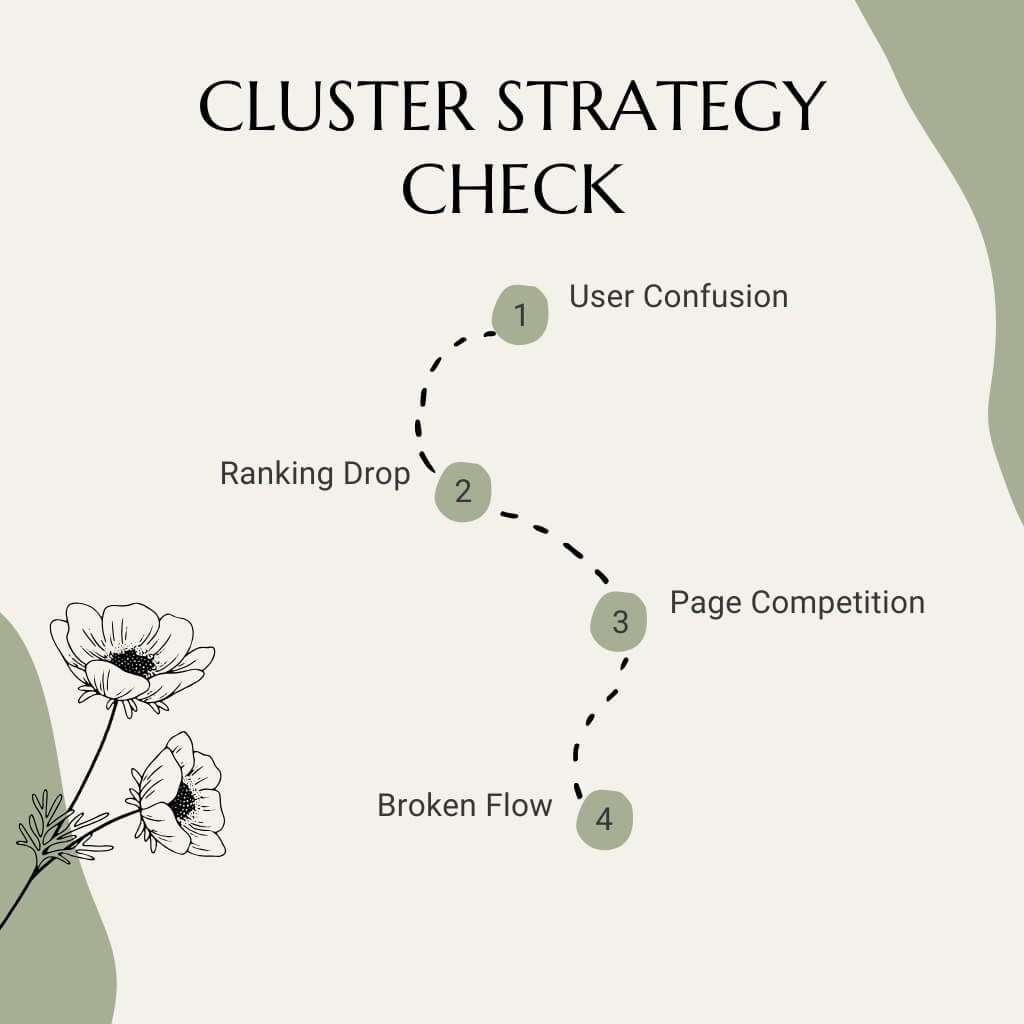
Your topic clusters fail when users get lost, rankings slip, or pages compete for the same search results. A strong cluster leads readers with purpose.
When that flow breaks, your SEO structure starts to crumble.
A) Pressing signals to watch (what to monitor first)
Traffic flattens or falls
What to look for: organic clicks drop by 10%+ over 8–12 weeks while impressions hold or rise.
Why it is significant: impressions up + clicks down often mean SERP features or AI summaries now take clicks. (See Ahrefs and Semrush analyses.
Low or falling click-through rate (CTR)
What to look for: CTR drops but average position stays similar.
Why is it a basis: result snippets, AI Overviews, or poor meta titles can steal clicks.
Short dwell time / poor session duration
What to look for: average time on page below your industry median. Use GA4 or BigQuery. Median session durations in 2025 vary.
Many sites see a time on page of ~50–60 seconds and a session duration of around 2–3 minutes. If you sit well below that, dig deeper.
High bounce on cluster pages but not pillar
What to look for: Cluster pages show much higher bounce than pillar or other informational pages. That hints pages fail to satisfy intent.
Keyword cannibalization
What to look for: the same or very similar queries send impressions to multiple URLs from your site.
Or rankings for a topic bounce between pages. Tools like Ahrefs, Semrush and Google Search Console help detect this.
Low internal link equity to the pillar
What to look for: the pillar page has a few internal links from topical cluster pages. Crawlers (such as Screaming Frog and Sitebulb) display link depth and orphan pages.
B) Is your pillar page too shallow or too broad?
A pillar must hit the right depth and scope. Too shallow confuses searchers. Too broad dilutes signals.
How to test your pillar now
Compare intent match. Use Search Console and a query export. If many cluster questions appear in pillar queries, the pillar covers too much specific intent.
Check content depth. Count the clear subtopics the pillar should answer. If the pillar lacks 8–12 logical sub-sections (each answerable in a dedicated cluster page), it is too shallow. Backlinko and Siteimprove recommend robust subtopic coverage on pillars.
Measure content signals. Compare the average time spent on pillar vs. cluster pages. If pillar time is low, users don’t find the overview useful. Use GA4 or server logs.
Run a SERP intent audit. Search the main query. Check top results. If competitors’ pillar pages answer multiple sub-questions clearly and yours do not, consider rewriting or expanding your content.
Set a practical content length target. Use intent as the guide. For complex topics, aim for 2,500–5,000 words, with clear, modular sections and quick-answer boxes. Don’t pad for word count. (Many recent pillar guides use this range as a practical target.)
Quick fixes if the pillar is wrong
If too shallow → add concise sections that preview each cluster question and link to cluster pages.
If too broad → split off distinct intents into separate pillars.
If it overlaps clusters → merge overlapping clusters or reassign intent so each URL has one clear purpose.
C) Are cluster pages overlapping or stepping on each other’s toes?
Overlap creates confusion for users and engines. Fix it.
What overlap looks like
Two or more pages rank in positions 5–30 for the same short query.
Search Console shows the same queries giving impressions to multiple URLs.
Authors treat pages as variants of the same answer instead of distinct follow-ups.
Exact tests to run now (step-by-step)
Export queries by URL from Search Console. Filter for your topic term. Look for query duplication across URLs.
Run a site: search for the phrase. See how many pages Google returns from your domain for that phrase.
Use a rank tracker cannibalization report. Semrush and Ahrefs have cannibalization views. They show when the same keyword triggers multiple pages.
Open both pages. Ask: Does each page answer a unique question? If no, merge or redirect. If yes, clarify the distinct angle in the H1 and meta.
How to fix overlap (rules to follow)
One intent = one page. Consolidate pages that answer the same need.
Rewrite for unique angles. If pages cover similar ground, give each a single specific focus and label it clearly.
Use canonical or 301 when appropriate. If a page adds no extra value, point it to the canonical URL.
Reassign internal links. Make the strongest internal link point to the canonical page for that intent.
Track changes. Recheck rankings and queries weekly for 8–12 weeks.
D) Why evolving search demands more precise clusters
AI summaries (AI Overviews) now appear frequently
Semrush found AI Overviews rose sharply in 2025. These summaries often draw answers from multiple sites. They change where users click. You must offer clear, short answers for them to source.
Voice search uses conversational queries
Users speak short, direct questions. Optimize cluster pages by using concise question sections and providing clear, concise answers. Voice queries favor clear, direct phrasing and structured snippets.
Generative engines cite and blend sources
They favor authoritative, well-structured content that provides clear answers to follow-ups.
This raises the bar for topical clarity and factual sourcing. Add clear facts, dates and concise, numbered answers to help search engines select exact snippets.
Practical steps to adapt clusters now
Add short Q&A blocks. Use plain questions as H2s and give exact single-sentence answers, then expand below. This helps both voice and AI snippets.
Add structured data. Use FAQ, QAPage and Article schema where relevant. They make it easier for AI tools to parse your content.
Use short anchors in internal links. Engines map anchors to concept signals. Keep anchors natural and concise.
Provide clear sourcing. Link to authoritative references on the clusters and pillars. Generative engines prefer content that cites sources.
Monitor AI-driven metrics. Watch CTR even when positions don’t change. If CTR falls but positions hold, an AI summary likely took clicks. Adapt your snippet and add direct answers.
E) Tools and exact checks (run these today)
Google Search Console: Export queries → group by URL → find overlaps.
Ahrefs or Semrush: Use cannibalization or position tracking reports.
Site crawler (Screaming Frog / Sitebulb): Find orphan pages and link depth.
GA4 or server logs: Measure time on page, sessions and engagement. Compare to industry medians.
People Also Ask & Answer research: Use these to map missing cluster questions that users ask.
F) Quick remediation playbook (run this in 6–8 weeks)
Week 1: Export queries by URL. Flag overlaps.
Week 2: Decide merge vs. rewrite for each overlap.
Week 3–4: Implement merges, redirects, or rewrites. Update pillar links.
Week 5–6: Add Q&A blocks and schema to pillar and top cluster pages.
Week 7–8: Monitor GSC, GA4, rankings weekly. Adjust anchors and meta titles if CTR remains low.
Expert Insight
Danny Sullivan, Google Search Liaison: “Content created primarily for search engine rankings… is against our guidance.
If content is helpful & created for people first, that’s not an issue.” This underscores that precise, useful answers are more effective than keyword stuffing.
Case Study
Planable — content restructure + topic focus → big organic gains
What they did: Planable audited their content. They merged overlapping posts. They rewrote pillar pages to answer clear user questions. They added short Q&A blocks and schema.
Result reported: Planable saw large organic traffic gains (reported ~176% increase across a 6-month window after the changes). SurferSEO published the case details and timeline.
How to Build Topic Clusters the Right Way
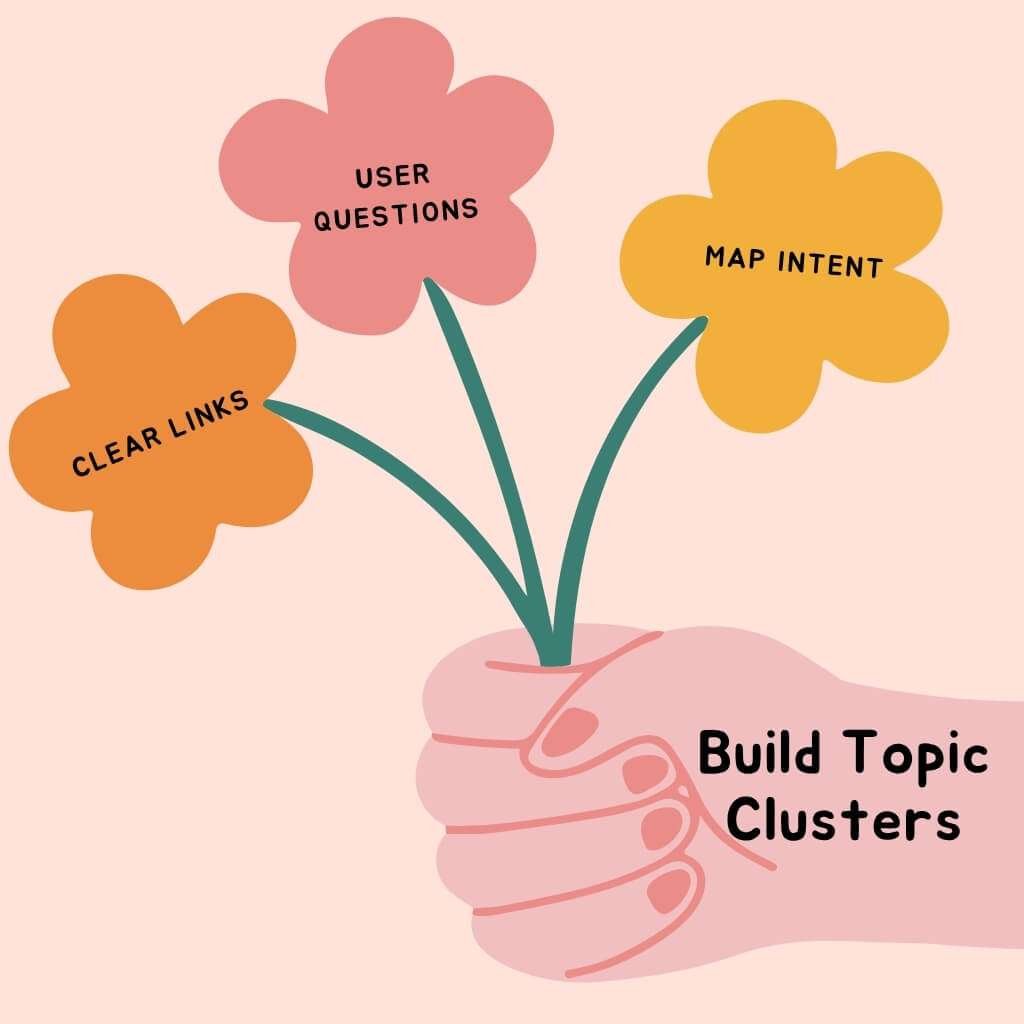
Build clusters around real user questions. Map intent first. Connect pages with clear links and clean anchors. Design for voice, AI summaries and answer engines. Do this and your content can remain useful even as search evolves.
A) Step-by-step cluster build (exact sequence you must follow)
Pick one core topic
Choose a business-relevant topic that users actually ask about.
Use Search Console, People Also Ask and forum queries to confirm demand. Also, be conscious of good business management.
Map subtopics from real questions
List 8–15 distinct user questions. Each question should reflect a single intent. Use short, conversational phrasing.
Example style: “How to X?” not “comprehensive guide about X”. Tools: People Also Ask, AnswerThePublic, Semrush.
Decide page roles
Pillar = overview and hub.
Cluster page = one specific question or intent.
If a subtopic requires depth, create a full cluster page.
Write clear answers first
For each cluster page, add a one-sentence answer under an H2 that matches the question. Then expand. This helps AI summaries and voice assistants pick your snippet.
Interlink with purpose
Pillar → cluster links for navigation. Cluster → pillar links to show relation. Link cluster → cluster only when one page genuinely answers a follow-up question. Use short, natural anchor text.
Add structured signals
Use the FAQ or QAPage schema for clear Q&A blocks. Use Article schema, author markup and Organization schema on pillars. Test with Google’s Rich Results Test.
Publish, measure, iterate
Track impressions, CTR, queries by URL and AI-overview appearances. Update weekly for 8 to 12 weeks. If multiple pages serve the same intent, merge or redirect them.
B) Are you aligning clusters with how people actually ask questions?
If you use long keyword phrases only, you miss voice and AI queries.
What to do now (precise actions)
Use spoken phrasing. Scan your query list for natural language. Convert “benefits-of-x” into “What are the benefits of X?” or “Is X safe?”
Add short Q&A blocks. Put one-line answers under H2s. Then expand. This format helps voice assistants and AI overviews pull clean snippets.
Optimize for follow-ups. Add small “If you want details” links to deeper cluster pages. That supports multi-turn conversational flows.
Test with voice emulation. Use Google Assistant or an emulator to ask your questions. See what answers surface. Adjust tone and brevity to match.
C) Are you integrating E-E-A-T, brand signals and topical authority into your clusters?
Yes. Add visible expertise and verifiable sources across pillar and cluster pages.
Concrete steps (do these on pillar and cluster pages)
Show author credentials. Add short bios for each content author. Include role, years of experience and links to social profiles or LinkedIn.
Cite sources. Link to high-quality references. Use industry reports, research papers, or official docs. Keep citations short and visible.
Add publication dates and updates. Display the date the content was first published and the date of your most recent update. Update at least quarterly for active topics.
Surface brand references. Add press mentions, reviews, awards and partnerships in an “About” or “Authority” panel on the pillar. These act as external trust signals for generative engines.
Use a structured author and organization schema. Mark up the author and organization on pillar pages. This helps machines verify your source.
Collect off-site proof. Encourage citations on industry pages, guest posts, or press sites. Generative engines often pull from multiple sources; being cited helps you appear in blends.
D) Future-proofing: zero-click, snippet optimization, structured data, content libraries vs blogs
Design content for in-SERP value and for deeper journeys. Use both tactics.
1) Design for zero-click value (what to do)
Put a clear one-sentence answer near the top. AI summaries often lift that line.
Add short bulleted facts and a table for quick facts. AI can easily extract structured data from tables.
Brand the answer. If AI shows it, your brand name should appear nearby so users can trust the source. This helps recognition even when clicks fall.
2) Snippet and featured-answer optimization (exact tactics)
Give a 40–60-word direct definition for definition snippets. Place it just under the question H2.
Use numbered steps for “how-to” snippets. Use short sentences and H2/H3 structure.
Keep tables for comparison or quick stats. A schema plus table increases the chance for rich results.
3) Structured data (must-do list)
Use FAQPage for grouped Q&A sections. Use QAPage when you have a genuine question and the community answers feature is available.
Use Article schema on pillar pages. Use sameAs and author fields.
Validate with Rich Results Test after deployment.
Content libraries vs blogs — which to use?
Content library (recommended for pillar-cluster systems):
Use when you need a permanent hub with modular sections.
Good for complex topics that require many updates. Organize by intent, not by date.
Blog structure (use when):
You need frequent, timely posts. Use for news, trends and rapid experiments.
Hybrid approach (best in 2026):
Pillar is a stable content library.
Cluster pages are published as blog posts but moved into the library when mature.
This gives freshness and authority at once.
Operational rules
Keep pillar pages evergreen and modular.
Move well-performing blog posts into the cluster library and adjust the URL as needed (using a 301 redirect).
Maintain a content map and a release cadence for cluster expansion to ensure consistency and efficiency.
Tools & metrics to run
Google Search Console — queries by URL, impressions, CTR.
Screaming Frog or Sitebulb — internal linking, orphan pages.
Semrush / Ahrefs — content gap and topical map discovery.
Rich Results Test — validate structured data.
Voice test: Ask Google Assistant or Alexa the question. Note the phrasing they expect.
Central metrics: impressions, CTR, queries per URL, AI-overview inclusion, featured snippet wins and branded query growth.
Expert Notes
Rand Fishkin: “Publish with clarity and intent. Search now rewards precise answers over long keyword lists.” (summary of recent posts and LinkedIn commentary).
Aleyda Solis: “Design pages for how people ask. Multi-turn queries will pick pages that include clear Q&A and links to follow-ups.” (talks and conference notes). iPullRank
Case study — Airmason
What they did: Built topic maps. Focused on single-intent pages. Used pillar + cluster approach. They used Surfer tools for topical mapping and internal linking.
Result: Airmason increased organic clicks by ~17 times and raised traffic by about 1,300% in seven months. They scaled with a small team by focusing on tight topical clusters and clear internal links.
Optimization & Maintenance: Keep Your Topic Clusters Healthy

Clusters decay if you ignore them. Audit often. Fix links. Track signals beyond rank.
Why is Maintenance Necessary
Content decays
Pages that once drove traffic lose relevance. Competitors update. Search intent shifts. Keep content fresh or it falls.
Algorithm updates change winners
Google pushes core and topic updates. One update can reorder results overnight. Regular checks catch damage fast.
User intent drifts
People ask questions differently now. Voice and AI change phrasing. Clusters must follow.
How often should you audit and update your clusters?
Audit small slices of data monthly and conduct full audits quarterly. Deep audits once a year.
1 . Practical cadence (do this)
Weekly — quick checks: CTR, impressions and traffic dips in Search Console for top 50 cluster URLs. Flag drops >10% week-over-week.
a) Monthly — tactical audit:
Export queries by URL.
Check overlapping queries.
Note pages with falling CTR but stable position.
Fix meta titles and one-sentence answer blocks if CTR drops.
b) Quarterly — content & link audit:
Crawl site for orphan pages and link depth.
Review pillar relevance against market shifts.
Update facts, stats and citations.
Check schema validity and FAQ blocks.
c) Annually — deep refresh:
Reassess the entire cluster map.
Remove or merge weak pages.
Rebuild pillar if the topic scope changed.
Re-run competitive SERP intent audit.
Quick thresholds to act now
Traffic down 10%+ over 8 weeks → full content review.
CTR drops 20% with stable position → update snippet and first answer line.
3 pages ranking for the same short query → fix cannibalization.
2 . Checklists you can follow (copy & use)
a) Monthly checklist (fast)
Export GSC queries by URL. Find overlaps.
Sort pages by impressions and CTR. Mark bottom 20% CTR.
Review the top 10 pages with falling time-on-page.
Fix meta titles or add 1-line answer under H2.
b) Quarterly checklist (deep)
Run a site crawl (Screaming Frog / Sitebulb). Flag orphans.
Build link map: pillar → clusters → related. Note missing links.
Check the schema on pillars and Q&A blocks. Validate with Rich Results Test.
Update at least 20% of cluster pages (including facts, links and examples).
Reassess E-E-A-T signals: author bios, citations, organization page.
c) Annual checklist (strategic)
Review the topic map for new subtopics. Add 8–12 new cluster questions if needed.
Merge pages that still overlap. Use 301s for consolidated URLs.
Run a competitive intent audit. Match or beat top-10 direct answer formats.
Prepare content library migration for top-performing blog posts.
(Use these checklists as living files. Track changes and results.)
Are your internal links still making sense?
Short answer: Links shift value over time. Prune and reassign monthly.
Measure success — beyond rankings (what to track)
a) User engagement
Click-through rate (CTR).
Time on page/scroll depth.
Return visits for the cluster topic.
b) Authority signals
External citations and mentions.
Referring domains to pillar pages.
Branded query growth. (People search your brand + topic.)
c) SERP features & AI signals
Featured snippets and People Also Ask wins.
AI Overviews or generative answer citations. Track instances where your content appears in AI answers.
d) Conversion metrics
Assisted conversions from cluster pages.
Lead form submissions / sign-ups tied to cluster flows.
e) Content health
Number of orphan pages.
Average internal links into pillar pages.
Freshness: percentage of cluster pages updated in last 12 months.
Record these monthly. Watch trends, not single data points.
Prepare for the next wave — generative search & AEO (practical moves)
a) Immediate actions to feed AEO engines
Add concise answer blocks (40–60 words). Place them under the question H2. AI often lifts these lines.
Use the following schemas: FAQPage, QAPage, Article and Organization. This helps AI parse facts and authorship. Validate after changes.
Cite high-quality sources inline. Generative engines prefer verifiable facts linked to trusted domains.
Publish short data panels and tables. AI extracts tabular facts reliably.
Increase off-site mentions. Guest posts, quotes and industry mentions raise your chance to be cited by answer engines.
b) Long-term structural moves
Build a content library hub (pillar + modular clusters) designed for extraction.
Keep a public update log or revision history on pillar pages. AI systems and users both value transparent updates.
Maintain author pages and organization pages with links to press mentions. These help prove trustworthiness to generator models.
Case study — Content refresh that reclaimed traffic
EarthKind (Goinflow case study) — content refresh + consolidation → strong gains.
Action taken: The team audited old posts, merged duplicate pages, updated facts and rebuilt internal links toward pillar pages. They also added clear Q&A sections.
Result: One top article saw a 268% increase in clicks and a 176% rise in impressions after the refresh. The firm documented the tactics and timeline. Inflow
Conclusion
Your website works like a growing company. Every topic cluster is a department when each one knows its job, progress feels effortless.
Strong connections turn content into profit and confusion into clarity. Keep refining the system and your site will run like a business that never stops winning.
FAQ
How do you scale clusters across many teams?
Use templates and a governance playbook. Create content templates, quality checklists and a shared content map so multiple teams produce consistent pages.
Should clusters be localized for U.S. regions or states?
Only if user needs differ by region. Localize when search intent, laws, pricing, or offers change by state. Use region tags, not duplicate content.
How do clusters handle multimedia (video, audio)?
Treat media as a content asset inside the cluster. Add short transcripts, clear captions and an index on the cluster page so visitors and indexing systems find each media piece.
What CMS features help maintain clusters?
Content relationships, tagging and revision history. Select a CMS that supports content types, taxonomy and seamless content migration (not just posts). Use staging and rollbacks.
How do you test if a new cluster page converts visitors?
Run controlled experiments. A/B test CTAs, headlines and page layout. Track micro-conversions tied to the cluster goal (signup, download, contact).
Can topic clusters be automated with tools?
Partial automation helps, but human review remains essential.
Automate mapping, content briefs and gap reports. Require editor review for final publish.
How do you protect clusters during a site migration?
Map and preserve canonical intent before moving URLs. Inventory cluster URLs, plan 301s, keep slugs similar when possible and validate post-migrate traffic and queries.
How should legal or compliance topics fit into clusters?
Isolate regulatory content into a secure, clearly labeled cluster. Add versioning, legal review sign-offs and a visible last-reviewed date on those pages.
How do clusters support PR and earned media?
Use pillar pages as press resources and fact hubs. Create a media panel on pillar pages with press kits, data points and contact info for journalists.
Should clusters use different templates for long vs short content?
Yes, match template to intent depth. Use a short-answer template for quick Qs and a long-form modular template for deep explainers.
How do I measure business impact from clusters?
Tie cluster visits to business events. Track assisted conversions, lead quality and revenue attributed to cluster flows in your analytics or CRM.
How do you keep clusters accessible to all users?
Build clusters with inclusive HTML and navigation. Use semantic headings, alt text for images, keyboard navigation and readable contrast to meet accessibility standards.