


Small business taxes for beginners involve paying the IRS a percentage of your company’s net profit.
You calculate this amount by taking your total income and subtracting your legal business expenses.
As a new owner, you must pay standard federal income tax and a 15.3% self-employment tax.
You also need to make these tax payments four times a year to avoid expensive IRS penalties.
Small Business Taxes for Beginners
Many new business owners face severe confusion when dealing with the IRS. They lose money to penalties.
They fail to track expenses. They mostly file the wrong forms. They miss quarterly payment deadlines.
Tax laws change every year, leaving beginners exposed to audits and heavy fines.
You can master your small business taxes by taking a few direct steps. You must separate your business and personal money immediately.
You need to choose the right legal business structure. You should use automated accounting software to track every dollar.
You must set aside 30% of your income to pay the IRS four times a year. This direct method removes the fear.
Yet, I manage teams and digital operations daily. Recently, a brand-new client hired me to organize her digital business.
She launched a highly profitable online store. She made great money in her first six months. But she made a massive mistake.
She deposited every single customer payment into her personal checking account right alongside her grocery money.
When tax season approached, she called me in a panic. She did not know her actual profit.
She had zero cash saved to pay the IRS. She faced heavy fines and a potential audit.
I stepped in and applied the exact financial system I use for my own operations.
We immediately opened a dedicated business bank account. We connected it to automated tracking software.
We separated her expenses and calculated her exact tax bill. We saved her business from a massive financial disaster.
I see many creators ignore their bookkeeping until April, just like she did. That delay causes massive panic and expensive mistakes.
I have created this guide to share the exact steps I use to keep my finances organized.
I will show you how to handle your taxes efficiently. So you never experience that stress.
How the IRS Taxes Your Small Business Profit
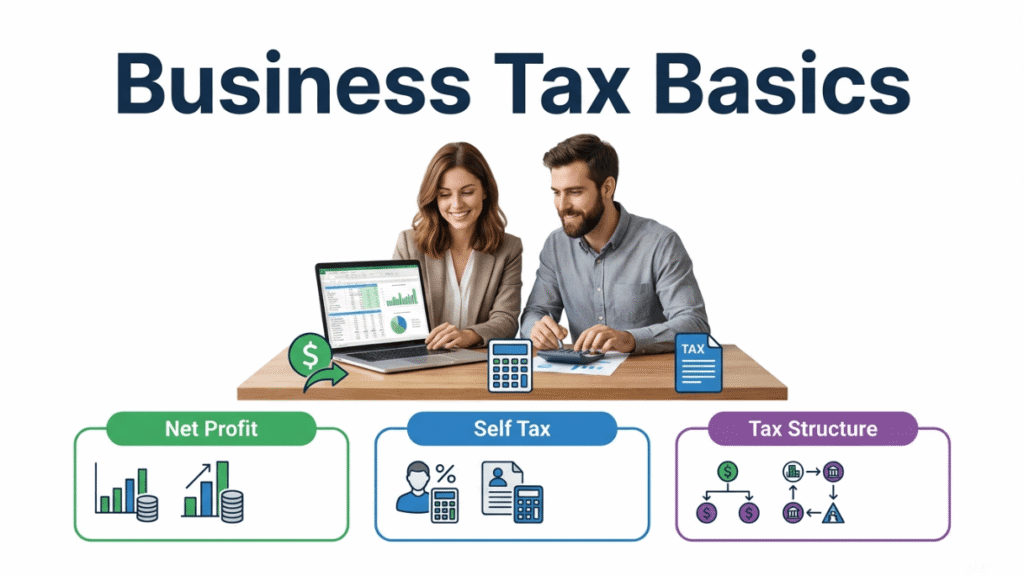
The IRS taxes the money your business keeps, not the total money you collect. You pay taxes on your net profit.
You calculate this profit by taking your total gross income and subtracting your legal business expenses.
Many beginners think they pay taxes on every dollar a customer hands them. That is incorrect.
If you earn $100,000 but spend $30,000 on software, advertising, and supplies, you only pay taxes on $70,000.
You must track every expense. Missing expenses means you report a higher profit. A higher profit means you pay more taxes.
Example: Mark starts a consulting business. He earns $5,000 his first month.
He spends $1,000 on a new laptop and $500 on a website. His net profit is $3,500. He only pays taxes on that $3,500.
The 15.3% Self-Employment Tax Rate
You must pay a 15.3% Self-Employment Tax if your net earnings reach $400 or more in a single year. This tax funds your Medicare and Social Security accounts.
When you work a regular job, your employer pays half of this tax. They take the other half from your paycheck.
When you work for yourself, you play the role of both the employer and the employee.
You must pay the full 15.3% yourself. You pay this tax in addition to your regular federal income tax.
Example: Sarah runs an online store. Her net profit for the year is $10,000. She must pay 15.3% of that amount for self-employment tax. She owes $1,530 just for this specific tax. She will then calculate her standard income tax on top of that.
Business Structures and Your Tax Bill
Your legal business type decides how the IRS processes your money.
Sole Proprietorships and Limited Liability Companies (LLCs) operate as “pass-through” entities.
The business itself does not pay federal income taxes. The profits pass directly to your personal tax return. You report the business income on your personal Form 1040.
C-Corporations operate differently. The corporation pays a flat corporate tax rate on its profits.
The owners then pay personal taxes on the dividends they receive. Accountants call this double taxation.
Most beginners start as Sole Proprietors or single-member LLCs to keep tax filing simple.
Set Up for Accurate Bookkeeping
You cannot guess your business numbers. Guessing leads to audits and lost money.
You must build a reliable digital system to track every single dollar. A proper setup keeps your records clean and protects your hard-earned profits.
How to Get Your Employer Identification Number
An Employer Identification Number (EIN) acts like a Social Security Number for your business.
You need this nine-digit number to open a business bank account. You also need it to hire employees or apply for business licenses.
You can get an EIN for free directly from the IRS website. Do not pay a third-party service to do this for you.
The online application takes five minutes. The IRS generates the number immediately on your screen. You download the PDF confirmation and save it to your computer.
Example: John wants to open a business bank account. The bank teller asks for his EIN. John goes to the IRS website on his phone.
He answers a few questions about his new business. He gets his EIN instantly and opens the account five minutes later.
Open a Dedicated Business Bank Account
You must never mix personal and business money. You need a dedicated business checking account.
Mixing funds destroys the legal protection of an LLC. If you face a lawsuit, a judge can take your personal assets because you treated the business like a personal piggy bank.
The IRS also hates mixed funds. If you face an audit, the IRS agent will scrutinize every single personal transaction. They might reject your valid business deductions.
Example: Lisa buys personal groceries and business office supplies using the same debit card.
At the end of the year, she cannot remember which purchases belong to the business.
She guesses the amounts. The IRS audits her, finds the mixed expenses, and fines her for inaccurate reporting.
How to Set Up a Reliable Bookkeeping System
You need a digital system to track your cash flow. Manual spreadsheets often lead to expensive math errors and missed deductions.
Good automated systems pull transactions directly from your new bank account. They categorize your spending and generate profit reports instantly.
Instead of recommending a specific brand, I recommend looking for a cloud-based accounting platform that includes these core features:
| Core Features of a Reliable Bookkeeping System | Why Your Business Needs It |
| Direct Bank Synchronization | Pulls your daily transactions automatically so you never miss a deductible expense. |
| Digital Receipt Scanning | Stores photo copies of your paper receipts in the cloud to protect you during an IRS audit. |
| Automated Categorization | Learns your regular spending habits and sorts your expenses into the correct tax categories automatically. |
| Instant Financial Reporting | Generates one-click Profit and Loss (P&L) statements so you know exactly how much money you made each month. |
| Mobile App Access | Allows you to track business mileage and log out-of-pocket expenses directly from your phone. |
Saving Money for Tax Time
The government does not withhold taxes from your business income. You must save the money yourself.
I recommend moving 25% to 30% of every payment you receive into a separate savings account. Do this immediately.
If a client pays you $1,000, transfer $300 to your tax savings account that same day. You will build a large cash reserve. You will never panic when a tax deadline arrives.
Quarterly Payments and the Best Tax Deductions
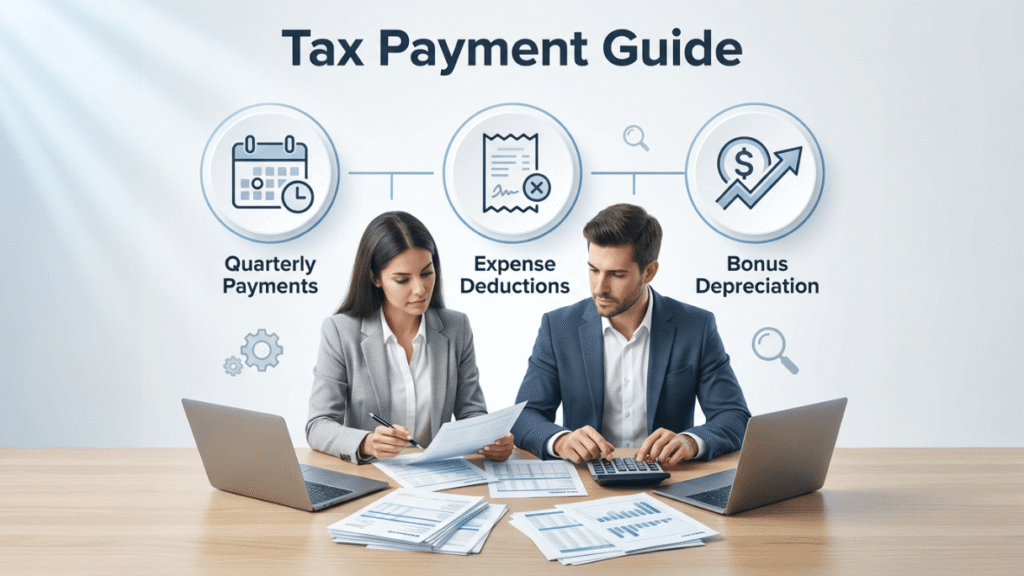
The United States uses a pay-as-you-go tax system. You must pay taxes as you earn the money.
If you expect to owe more than $1,000 in taxes for the year, you must make quarterly estimated payments.
You use IRS Form 1040-ES to do this. The deadlines usually fall on April 15, June 15, September 15, and January 15.
If you skip these payments and wait until the following April, the IRS will charge you underpayment penalties and interest.
Example: David earns a steady profit every month. He ignores his quarterly payments. Next April, he files his taxes and owes $8,000. The IRS adds a $400 penalty because he failed to pay his taxes evenly throughout the year.
Tracking Ordinary and Necessary Business Write-Offs
You lower your tax bill by claiming deductions. The IRS requires a business expense to be “ordinary and necessary” for your specific industry.
Common deductions include website hosting, software subscriptions, office supplies, advertising costs, and business travel.
You can also deduct a portion of your home expenses if you use a specific room exclusively for business. You must keep receipts for all these purchases.
Example: Maria runs a graphic design business. She buys a $50 monthly subscription for design software.
She spends $200 on internet ads. She can deduct these $250 entirely from her income. These are ordinary and necessary expenses for a designer.
Using the 100% Bonus Depreciation and Section 179
The 2026 tax code offers massive benefits for buying equipment. The government passed the One Big Beautiful Bill Act. This law permanently restored 100% bonus depreciation for 2025 and 2026.
If you buy heavy machinery, computers, or expensive software, you can deduct the entire cost in the first year.
You do not have to spread the deduction over five years. The law also raised the Section 179 deduction limit to $2,560,000 forthis year.
This allows small businesses to buy what they need and immediately lower their taxable income.
The Recent Rules for Form 1099-K Reporting
Third-party payment networks and digital wallet apps report your income to the IRS using Form 1099-K.
The IRS has updated these reporting rules recently. For 2026, the mandate is clear.
A digital payment platform will only send you a Form 1099-K if you receive more than $20,000 in gross payments and you complete more than 200 transactions. If you fall below these limits, the platform will not issue the tax form.
However, you must still report all your business income. The IRS requires you to claim every dollar you earn, regardless of whether you receive a formal 1099-K in the mail.
Example: Tom sells custom furniture online. He uses a popular digital checkout platform to collect money from his buyers.
He makes 50 sales totaling $15,000 for the year. He does not meet the $20,000 or the 200-transaction threshold. The checkout platform does not send him a 1099-K.
Tom still actively reports the entire $15,000 on his Schedule C tax form to stay fully compliant.
The $2,000 Rule for Hiring Contractors

You might hire freelance workers. You might hire designers or virtual assistants. In 2026, the IRS changed the reporting rules.
The new limit is $2,000. If you pay a US-based contractor $2,000 or more this year, you must fill out Form 1099-NEC.
The old limit was only $600. This new, higher limit means less paperwork for your business.
You must send one copy of the form to the worker. You must send another copy to the IRS.
You only create this form if you pay with cash, a check, or a direct bank transfer.
Do not send this form if you pay with a credit card or a digital payment app. The payment app company handles the tax forms for those specific transactions.
I hire a freelance writer for my team. I pay her $2,500 over the year using a direct bank transfer.
In January, I prepare a Form 1099-NEC. I sent one copy to her. I sent one copy to the IRS.
This proves to the government that I paid her. It allows me to claim the $2,500 as a legal business deduction.
When to Hire a CPA
A Certified Public Accountant (CPA) does more than enter numbers into tax software. They protect your business.
You should hire a CPA when your business structure becomes complicated.
A CPA finds hidden deductions. They advise you on large equipment purchases.
They represent you if the IRS audits your records. I suggest hiring a tax professional once your business crosses $50,000 in revenue or if you plan to hire W-2 employees.
I handle my own daily bookkeeping. I categorize my expenses every week. But I always hand my final reports to a certified tax professional in February. My CPA knows the exact tax laws.
He finds deductions I miss. His fee easily pays for itself through the tax savings he secures for my business.
15 Tips for Managing Small Business Taxes
Let’s see the 15 exact steps you can take today to protect your business and save money.
1 . Take pictures of your receipts
Ink fades on paper receipts. Use your phone to photograph every business receipt and save it to a cloud folder.
2 . Track your mileage with an app
If you drive for business, use a GPS app to track your miles automatically. The IRS requires exact mileage logs.
3 . Review your profit reports monthly
Print your income and expense report on the first day of every month. Know exactly how much money you made.
4 . Never pay personal bills from the business account
Buy your personal groceries from your personal checking account. Keep the business account clean.
5 . Set calendar alarms for tax deadlines
Put the four quarterly estimated tax dates into your phone calendar so you never pay late fees.
6 . Collect W-9 forms early
Make every new contractor fill out a W-9 form before you pay their very first invoice.
7 . Measure your home office exactly
The IRS only allows a home office deduction for the exact square footage used exclusively for your business.
8 . Deduct your health premiums
If you buy your own health insurance, you can often deduct the premiums to lower your adjusted gross income.
9 . Open a Solo 401(k)
Save for retirement using a Solo 401(k). The money you contribute directly lowers your taxable income for the current year.
10 . Match your bank statements
Reconcile your accounting software with your actual bank statement at the end of every single month to catch errors.
11 . Keep tax records for three years. The IRS generally has three years to audit your tax return. Store your digital records safely for that entire time.
12 . Do not write off daily meals
You cannot deduct the cost of your regular daily lunch. You can only deduct meals if you travel for work or meet a client.
13 . Classify workers correctly
Do not treat a worker like an employee but pay them like a contractor. The IRS issues massive fines for misclassification.
14 . Use a payroll service
If you hire official W-2 employees, pay a software company to handle the complex payroll taxes. Do not attempt payroll math yourself.
15 . Schedule an end-of-year tax meeting
Meet with your accountant in November. You can make final equipment purchases in December to lower your current tax bill.
Still, do not wait until tax season begins. Take action right now. Open your dedicated business bank account today.
Sign up for a free trial of an accounting software program. Connect your new bank account to the software.
Building this system today will save you thousands of dollars and give you total peace of mind.
Conclusion
Handling small business taxes for beginners requires strict organization. You cannot guess your numbers.
The IRS penalizes guessing. You must build a solid financial foundation today.
You now understand how the IRS taxes your profit. You know you need an EIN and a separate business bank account.
You see the value of automated software. You know the exact recent rules for bonus depreciation and 1099 reporting. You know you must save 30% of your income to make quarterly payments.
FAQ
Do I pay taxes on cryptocurrency payments from clients?
Yes, you do. The IRS treats cryptocurrency as property, not as standard currency.
When a client pays you in Bitcoin or Ethereum, you must report the exact US dollar value of that crypto on the day you received it as your gross income.
How does the IRS tell the difference between a hobby and a business?
The IRS looks for a clear profit motive. To classify your activity as a business and claim deductions, you generally need to show a profit in at least three of the last five tax years.
If you lose money every year, the IRS will reclassify your operation as a hobby and block your deductions.
Are crowdfunding campaigns like Kickstarter taxable?
Yes, the money is taxable. The IRS views funds raised through platforms like Kickstarter or Indiegogo as taxable business revenue.
It is not a tax-free gift. You must report the total amount raised, but you can deduct the fees the platform charges you and the costs to produce your product.
Do I owe taxes if I trade services with another business owner?
Yes, you owe taxes on trades. The IRS calls this bartering. If you build a website for a mechanic and he fixes your car in exchange, you both must report the fair market value of those services as taxable business income on your tax returns.
Do I pay self-employment tax if I also have a regular W-2 job?
Yes, you must pay it. You owe the 15.3% self-employment tax on your business profit regardless of your W-2 employment status.
However, if your W-2 salary is very high, you might hit the annual Social Security wage base limit, which will stop the Social Security portion of the tax for your business.
Can I deduct the costs of starting my business before I officially open?
Yes, you can. The IRS allows you to deduct up to $5,000 in startup costs in your first year of business.
This includes money spent on market research, travel to secure suppliers, or legal fees paid before your official launch date.
Can I claim a tax deduction for giving gifts to my clients?
Yes, but the limit is very strict. The IRS only allows you to deduct up to $25 per person per year for business gifts.
If you send a client a $100 gift basket, you can only write off $25 of that purchase on your tax return.
What exact tax steps do I take if my business fails and I close it?
You must mark your final tax return clearly. When you file your Schedule C or corporate return for that final year, you check the box labeled “Final Return.”
You must also close your business bank accounts and send a formal letter to the IRS requesting them to cancel your EIN.