


Buyers want fresh products, quick delivery and clear value. Brands that miss the rhythm lose attention within days. So, planning of production sits at the center of growth, cost control and trust.
My friend’s dad ran a subscription meal service. Costs rose from wasted stock and late deliveries. He asked me to fix this issue. So, we rebuilt their production around demand signals from sign-ups.
We also tied sourcing with weekly delivery cycles. Within months, waste dropped and renewal rates climbed. Now I know poor planning eats both profit and reputation.
You must search for where hidden costs appear when planning is weak. You must know how industries see measurable results with digital-first planning.
Planning of Production: The Secret to Operational Excellence
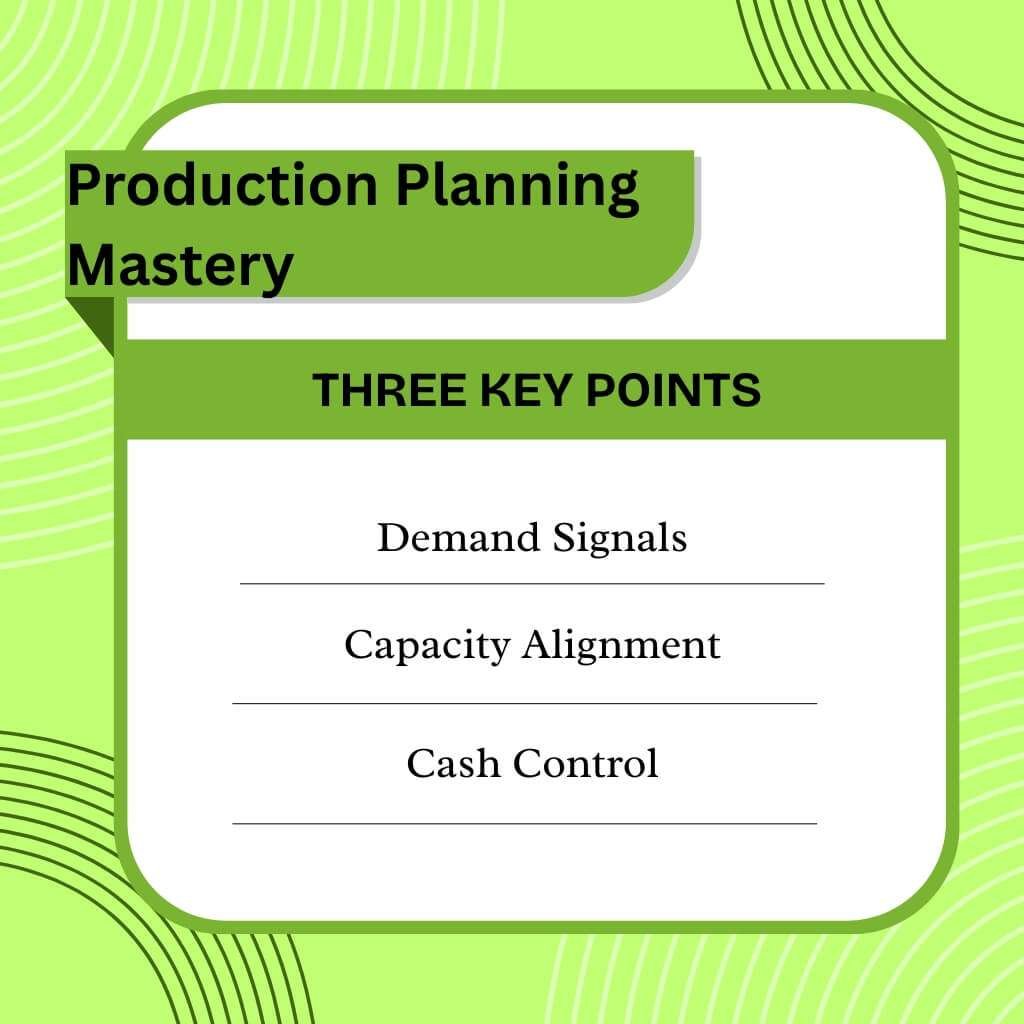
Strong planning lifts scale, launch speed and margin. Data confirms it. Leaders tie planning to demand signals, capacity, cash and launch cadences. Let’s map it out:
How does production planning connect to scalability and expansion?
Plan capacity against demand. Match lines, labor and suppliers to the forecast window. Use rolling S&OP and constraint views.
Standardize the planning rhythm. Replace weekly cycles with daily or shift-level cycles. P&G moved toward daily planning and a single value stream view to react faster and cut buffers. That supports global scale without chaos.
Invest where scale depends on flow. Inditex earmarked €900M per year in 2024–2025 to expand logistics capacity. Planning drives what to expand, when and where, so growth holds.
What to do now
1 . Organize forecast, capacity and inventory on one calendar.
2 . Shorten the plan cadence. Move from weekly to daily where possible.
3 . Tie CapEx to bottlenecks shown in the plan, not gut feel.
4 . Track scale KPIs: plan adherence, capacity utilization, service level, cash-to-cash.
How does planning support faster market launches?
Cut handoffs. Centralize launch gates in the plan: demand signal → materials readiness → line changeover → ship date. Planning shows what blocks “day 1” inventory.
Prioritize materials and lines by launch value. Allocate scarce parts to high-ROI launches first. Lock the freeze windows visibly in the plan.
Use “limited-range” pilots. Launch in a few DCs first. Validate velocity and scale only after the plan shows stable service and yield.
Checklist for faster launches
1 . Reserve capacity windows 6–12 weeks out.
2 . Lock supplier lead-time buffers in the NPI plan.
3 . Stage pre-build only where the forecast risk is low.
4 . Track launch-specific OTIF, first-8-weeks sell-through and changeover time.
How does planning improve demand forecasting and capture new opportunities
Use AI demand sensing for accuracy. AI cuts forecast error 20–50%. Fewer stockouts mean more revenue captured with the same plant.
Link forecast to inventory policy. SMBs still sit on 38% excess stock. Good planning trims excess and frees cash for growth SKUs.
Blend macro and micro signals. Combine promotions, channel POS, weather and price elasticity in the demand plan. Retail leaders already predict granular inventory to reduce shortages.
Turn scenarios into action. FMCG teams use network models and digital twins to test plant adds, lane changes and service targets before spending.
What to implement
1 . Short-term demand sensing (days–weeks).
2 . Mid-term consensus forecast (3–18 months).
3 . Inventory optimization tied to service class.
4 . Scenario planning for promo peaks and new channels.
How does planning drive growth across industries?
Business growth comes from planning that must be different but accurate than competitors. Every sector proves it. Planning sets the pace, controls cost and lifts service.
The details differ, but the message is clear. Let’s see how strong planning avoids mistakes and drives measurable growth everywhere.
Manufacturing
Planning in factories decides how machines, labor and materials move. A clear schedule keeps lines running without long pauses.
It also helps plants react when demand jumps. Without it, growth stalls and delays pile up.
Action: unify scheduling, capacity and labor planning in one system.
FMCG / Consumer Goods
In fast-moving goods, shelves must stay filled. Empty shelves lose sales and loyalty.
Planning ties promotions to supply so products flow at the right pace. It balances freshness with demand and stops stock from sitting too long.
Action: connect forecasts, promotions and co-pack schedules into one cycle.
E-commerce / Retail
Online shops win when products are available. A single “out of stock” can push customers away.
Planning helps place stock in the right warehouse before orders arrive. It keeps product drops smooth and deliveries on time.
Action: link demand sensing with warehouse and store allocations.
Pharmaceuticals / Life Sciences
This sector runs on precision. Medicines must meet strict rules and expiry limits.
Planning keeps materials, batch runs and quality checks in sync. It makes sure products reach markets safely and on schedule.
Action: include capacity, quality checks and expiry rules in planning cycles.
Automotive / Mobility
Cars need thousands of parts. If one is missing, the line stops. Good planning balances workloads, times deliveries and avoids costly pauses. It also helps firms adjust quickly to new designs.
Action: Use advanced scheduling to balance workloads and reduce downtime.
Electronics / Semiconductor
Chips and devices face huge demand swings. Parts are complex and supply is tight.
Planning makes sure designs, suppliers and assembly stay aligned. It helps firms scale faster and avoid rework.
Action: plan for part complexity and sync design with production early.
Custom Manufacturing / Furniture
Custom orders bring variety, not volume. Every piece can differ. Planning helps sequence work, cut setup delays and keep promises. It keeps workshops moving while lead times stay short.
Action: apply flexible scheduling that fits varied orders and setups.
Contract Manufacturing (CMO / CDMO)
Clients want speed and trust. These firms juggle many clients at once. Planning makes sure capacity is shared fairly without cutting corners. It builds confidence and long-term deals.
Action: add compliance rules and multi-site coordination into planning.
Cloud Manufacturing
Capacity comes from many sites, not one. Planning decides where jobs go and when to scale up or down.
It reduces waste and makes use of idle resources. Growth comes from matching demand with flexible supply.
Action: use platforms that shift work across sites as demand changes.
Additive Manufacturing / 3D Printing
3D printing is fast but costly if idle. Planning decides what to print on demand and what to batch.
It keeps printers busy and materials ready. That way, firms deliver prototypes quickly and scale only when demand is proven.
Action: connect planning with digital twins and demand-driven print runs.
Yet, each industry proves the same point: strong planning drives growth and saves costs. The way it works may differ, but the result is always measurable progress.
Cost Control: Where Businesses Save and Where They Lose
You cannot cut costs without a plan. Planning ties demand, capacity, labor and cash. It turns chaos into choices. It also shows leaks before they burn the margin.
Why is cost control impossible without production planning?
Costs spread across the chain. Transport, storage, admin and inventory sit in one bill. U.S. business logistics hit ~$2.6T in 2024. That pressure rolls into 2025. Only a plan can steer spending across those buckets. (Wall Street Journal)
Inventory eats cash. Holding cost often runs 20–30% of stock value each year. Planning sets reorder points, service targets and phase-outs to stop that bleed. Investopedia
Executives now expect procurement and planning to widen margins. 2025 CPO research shows rising pressure to use data and tech for cost wins. Planning provides the levers and cadence.
Do now
Lock one cadence across demand, supply, labor and cash.
Publish plan adherence, service and inventory turns weekly.
Fund only actions tied to plan deltas.
Where poor planning creates hidden costs
Idle labor. Long changeovers and bad sequencing of park crews. Fix with finite scheduling and smaller campaign sizes.
Raw-material gaps. One late component stops a line. Multi-echelon buffers cut that risk. o9 Solutions
Excess inventory. Over-ordering drives carrying cost, obsolescence and write-downs.
Emergency freight. Expedites mask planning misses. The SoL report shows how fast these costs swell when networks wobble.
Bad allocations. Stock sits in the wrong node. ML-driven allocation fixes the mix and cuts write-offs.
Do now
Track “idle hours per changeover” and “expedite spend per SKU.”
Reset safety stocks by service class, not gut feel.
Rebalance inventory weekly by DC and channel.
How advanced planning cuts waste and lifts resource use
AI demand sensing. Pull in POS, weather, promo and macro signals. Firms report sharper forecasts and fewer shortages with AI demand sensing. That shrinks both lost sales and overstock.
Multi-echelon inventory optimization (MEIO). Set targets by node and flow. Drop excess while keeping service. Modern MEIO tools do this at scale.
Finite scheduling + APS. Sequence by constraints, not wish lists. Lenovo shows APS can keep plants running and trim waits.
ERP + IBP upgrades. New IBP releases add ML features and faster scenario runs. That helps planners spot waste sooner and act.
Cost-aware trade-offs. SoL insights remind teams to weigh transport vs. storage vs. service. Planning puts that in one view.
Do now
Add a “waste radar” to your S&OP: stock age, expedite rate, scrap and idle time.
Run two scenarios each cycle: low-demand and supplier delay.
Tie every move to a dollar target: carrying cost, overtime, or freight.
How ERP and AI tools find leaks (and savings)
Spend analytics + contract data. CPOs in 2025 point to GenAI for faster spend insight and contract checks. That flags price drift and maverick buys that swell COGS.
Control towers with alerts. Good tower surface exceptions are worth fixing. Vendors cite time savings and fewer point tools when planners see one truth.
ML-led allocation in retail. Retailers using ML allocation report stockout cuts and lower write-offs while automating replenishment. That is direct cost control.
S&OP optimization at scale. Auto makers show higher margins once S&OP stops living in slides and spreadsheets. Purpose-built optimizers help planners reallocate the mix fast.
Modern Tools, AI and Data-Driven Production Planning
Teams win when data, planning and action sit in one flow. New software makes that happen. You cut delays. You ship on time. You protect margin.
What recent technologies are transforming production planning?
Planning copilots in cloud ERP. Microsoft adds Copilot-first features in Dynamics 365 Supply Chain during the 2025 release wave 1. Planners get faster decisions inside the system they already use.
AI-enabled IBP upgrades. SAP IBP 2502 introduced Joule in IBP. 2508 adds harmonized planning and richer ML-driven insights. Planners run scenarios and align functions faster.
Industrial edge + data clouds. Siemens connects Industrial Edge with Snowflake’s AI Data Cloud. Plants push clean machine data to IT stacks for planning, forecasting and alerts.
Agentic AI enters the shopfloor. SAP’s CEO confirms that supply chain agents talk to sales agents to plan supply and promise delivery. Expect fast moves where data foundations exist.
What does this mean?
Adopt tools that join plan, sense and act. Pick platforms that your teams can use daily, not once a month.
Role of AI forecasting, IoT sensors and cloud-based ERP in decision-making
AI forecasting
Pull sales, POS, promos, price and macro signals into one model. You cut errors and catch demand swings sooner. SAP and Microsoft now ship these features inside planning suites.
IoT sensors
Read machine health and line rates from edge apps. Push signals into planning so schedulers act before lines stall. Siemens shows this flow at CES and Hannover Messe 2025.
Cloud-based ERP / IBP
Keep one truth for orders, materials, capacity and routes. Dynamics 365 and SAP IBP releases in 2025 make this practical for large teams.
Data clouds
Share data with partners without file chaos. Snowflake’s Manufacturing Data Cloud supports supplier and plant collaboration at scale.
Benefits of integrating live data across the supply chain
Fewer stockouts and less dead stock. Shared demand and supply signals reduce misses. You move stock to where it sells.
Faster schedule changes. Edge + cloud pipes tell planners which line lags and why. You resequence before orders slip.
Clear risk calls. AI flags storms, port issues and material gaps. Leaders act days earlier, not hours. GM’s setup prevented ~75 halts this year.
How to wire it
Stream sensor data to an edge layer.
Clean it into your data cloud.
Feed AI forecasts and the planning model.
Push decisions back to ERP, WMS and MES.
How planning methods have changed
Old methods create delays. New methods keep supply and demand in sync. Let’s explain:
Digital-First vs. Traditional Methods
| Approach | Digital-First Methods | Traditional Methods |
| Planning Cycle | Daily or even per-shift cycles inside ERP/IBP | Weekly spreadsheet updates |
| Data Handling | AI-driven demand sensing connected to capacity planning | Manual reconciliations via emailed files |
| Inventory | Flexible inventory targets adjusted through live demand signals | Fixed safety stocks |
| Visibility | Unified data model across suppliers, plants and distribution centers | Blind spots across sites |
Why adopters gain an edge
Speed. AI + copilots reduce decision time in planning tasks. Microsoft documents this wave of notes.
Accuracy. SAP IBP 2508 and 2502 releases add stronger ML and harmonized areas. Planners trust the plan and cut rework.
Visibility. Siemens + Snowflake unlock a common view from line to boardroom. Less guesswork. Better calls.
Resilience. GM’s risk AI proves the value. You avoid shutdowns. You keep shelves and lines moving.
Expert insight
“Agentic AI is the next step. One agent sets the offer. The other checks supply and delivery.” — Christian Klein, CEO, SAP, at Davos 2025. Axios
Case study: General Motors
Problem. Weather hits, supplier shocks and tariff noise threatened output.
Move. GM built an AI stack that maps suppliers, scans news and alerts teams. It also routes comms in one hub.
Result. The system prevented ~75 production halts in 2025. Plants stayed open. Costs stayed in check.
Why does it fit here? Planning gains strength when risk signals flow into the plan, not around it. Source (news report). Business Insider
Build a Resilient and Growth-Oriented Production Plan
Growth needs a plan. Resilience needs a plan. You align goals, cash and capacity. You act early. You avoid waste. Of course, you should keep promises to customers.
Steps to align production planning with business goals
1) Set one scorecard
Tie the plan to four targets: revenue, service, margin and cash. Publish them each cycle. Use the same sheet across sales, ops and finance.
Why now: Shipping routes run longer and costs swing week to week. A shared scorecard keeps choices tight. Reuters
2) Fix the cadence
Run a monthly IBP/S&OP for strategy. Run a weekly operations plan for mix and labor. Run a daily or shift huddle for constraints. Lock the calendar. Teams show up and decide. (No slide decks. Only live numbers.)
3) Fund by bottleneck
Place the capital where the plan shows the pinch. Do not guess. Use queue time, changeover time and lost sales as proof.
4) Make inventory a board metric
Set target turns by channel. Track carrying cost in dollars. Cut dead stock first. Retailers that miss this drown in holding costs.
5) Build supplier depth
Dual-source critical items. Hold options with nearshore vendors. You plan around those gaps.
Flexibility vs. efficiency: how to balance in uncertain markets
Balancing flexibility and efficiency is a daily activity. Sometimes you need slack to face shocks. Other times, you need a tight flow to protect cost. Let’s know how to decide in each area.
Flexibility vs. Efficiency Trade-offs in Production Planning
| Area | Flexibility Focus | Efficiency Focus | Best Use |
| Planning Window | Lock 1–2 weeks. Keep weeks 3–8 open. | Fix monthly cycles. Fewer mid-course edits. | Flexibility works in volatile demand. Efficiency works in a steady flow. |
| Inventory | Hold buffer for high-margin or high-risk SKUs. | Keep lean stock for stable items. | Flexibility saves sales in shocks. Efficiency saves cost in routine runs. |
| Capacity | Pre-approve overtime or backup shifts. | Run stable loads with minimal overtime. | Flexibility fits peaks. Efficiency fits long campaigns. |
| Suppliers | Use dual-source, nearshore, or backups. | Stick with long-term volume deals. | Flexibility cuts disruption risk. Efficiency cuts unit price. |
| Transport | Use rate bands and multiple carriers. | Lock lanes with fixed contracts. | Flexibility absorbs freight swings. Efficiency trims spending in steady lanes. |
| Decision Rhythm | Adjust daily or weekly with guardrails. | Review monthly with fixed targets. | Flexibility suits fast SKUs. Efficiency suits base-load SKUs. |
Risk management: plan for shocks you can see and shocks you cannot
Geopolitical and route risk
Red Sea detours add miles and time. Plan longer transit for Asia–Europe and some Transpacific lanes. Keep alternate ports on file. Update ETAs and safety stock by lane.
Cost inflation
Watch fuel, tariffs and accessorials. Tie each change to landed cost per SKU. Cut low-margin variants first when costs climb. (Do not cut service on your hero SKUs.)
Demand spikes
Wire a “spike mode.” Pre-approve overtime, extra shifts and backup co-packers. Cap spend with a simple rule (e.g., “expedites ≤1.0% of sales”). When demand cools, exit spike mode that week.
Supplier fragility
Score suppliers on lead time drift, on-time % and fill rate. Add a red tag for single-site makers in high-risk zones. Nearshore part of the volume if the score slides. Kearney’s index warns against wishful thinking here.
Data and visibility.
Use a control view for orders, capacity and inventory across the network. You cannot react if you cannot see.
Expert insight
“More than ever, manufacturing executives need to be steeped in fact, not speculation.” — Patrick Van den Bossche, Partner, Kearney.
Case study: PepsiCo
Context. Seasonal swings and promo spikes raise supply risk in beverages and snacks.
Move. PepsiCo signed a multi-year deal with AWS to push AI and data across supply, planning and consumer insight.
They named the supply chain as a focus. They also described ongoing upgrades to plant, warehouse and data foundations in investor remarks. PepsiCo+1
Result theme. Faster sensing. Tighter plans. Fewer misses around peaks. Better mix by channel.
(PepsiCo does not publish exact savings for each node, but the direction and commitments are clear in company materials.)
Why does it fit here? The plan grows stronger when data, partners and plants speak one language. That supports growth and protects margin in a noisy year.
Sources (company site): PepsiCo x AWS press release; CAGNY 2025 transcript (PepsiCo IR). PepsiCo
Fast checklist
1 . Publish one scorecard: service %, inventory turns, landed cost per SKU and plan adherence.
2 . Add a “spike mode” playbook. Name the trigger and the exit.
3 . Set transport bands by lane using Drewry WCI as a guide.
4 . Tag high-risk suppliers. Add a nearshore option for the top three.
Review UN trade alerts monthly. Adjust lead times on lanes that deviate. Reuters
Conclusion
Planning of production is the stage manager who keeps the curtain rising on time. It is the CEO of order, the CFO of cost and the CMO of trust. Planning of production wears every hat and still delivers clarity.
FAQ
What skills are most valuable for a production planner?
Skills in data literacy, scenario thinking and cross-team communication rank highest. Planners also need adaptability as markets change quickly.
How does production planning connect with sustainability goals?
Planning reduces wasted materials and overproduction. It helps companies cut emissions by aligning supply with real demand.
Can production planning help remote or hybrid teams?
Yes. Cloud-based planning platforms let dispersed teams access the same data and update schedules in sync.
What role does cybersecurity play in production planning systems?
As more firms use connected tools, protecting planning data from breaches is critical. Cyber risks can disrupt operations if ignored.
How do cultural differences affect planning decisions in global companies?
Different regions value speed, cost, or flexibility differently. A global plan must adjust to local work styles and regulations.
How is production planning linked to financial reporting?
Accurate plans feed into revenue forecasts, cash flow projections and compliance reports. Finance teams depend on reliable planning data.
Can production planning improve supplier relationships?
Yes. Clear schedules and forecast sharing make collaboration smoother, reduce disputes and help suppliers plan capacity.
How does planning interact with product design?
Design teams use planning input to decide feasible specs, timelines and material choices before launch.
Is employee training part of production planning?
Absolutely. Plans often include labor skills, certification needs and reskilling programs so workers match future demand.
How do government policies influence production planning?
Regulations on trade, labor, or sustainability often dictate how and where production happens. Planners adjust capacity and sourcing to comply.