
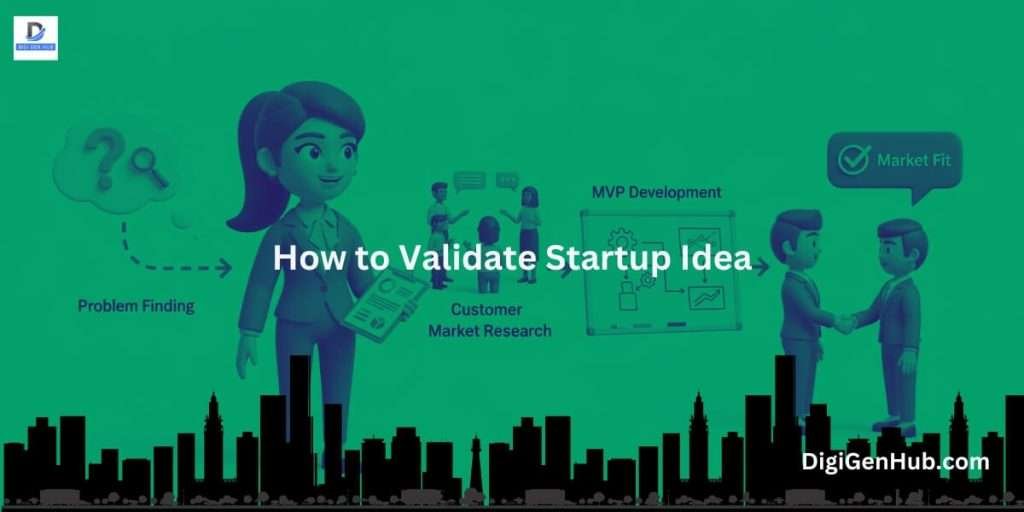

Validating a startup idea means proving your concept solves a real problem before you invest heavily.
It’s essential because nearly half of new ventures fail due to building products no one truly wants.
So, how to validate startup idea? Start by finding a real problem your audience faces. Then, test your idea in small ways.
Use a landing page, pre-orders, or a simple prototype. Count real actions, not opinions. Sign-ups, demo requests, or early purchases show interest.
As Leah Kim, startup advisor, says: “Test first. Build later. Facts beat guesses.” This method saves money, energy and time. It also shows if your idea has a clear path to success.
How to Validate Startup Idea
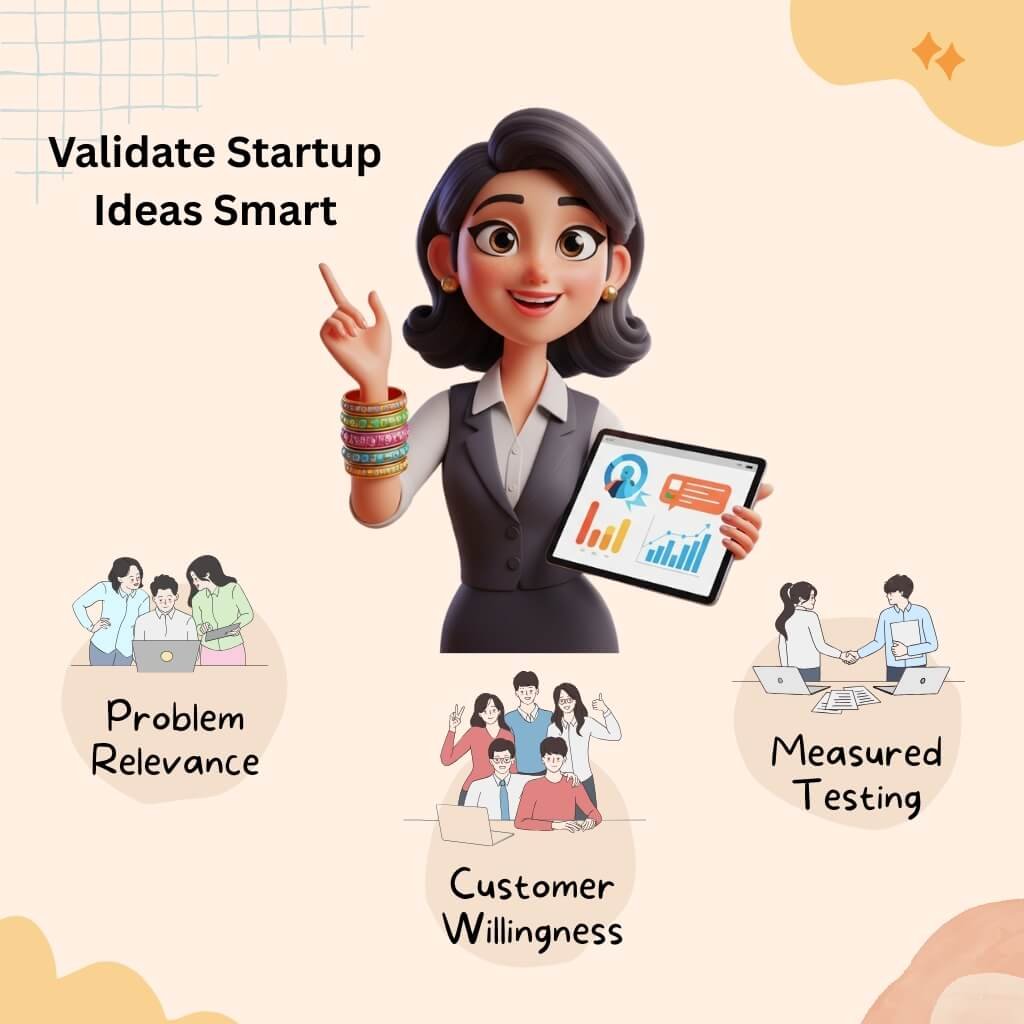
Validation means testing if your idea deserves life. You ask simple questions: Does this problem matter? Will people pay to solve it? You test small, measure results and act before building large or costly products.
Risks of Skipping Validation
Skipping validation is risky. Around 42% of startups fail because no market needs them (CB Insights.
Founders can waste 6–18 months building products that miss the mark. Investors reduce funding for ventures without proof of demand.
Teams lose morale when launches are ignored. In short: time, money and energy vanish.
Recent Context
77% of firms in the US and UK use AI tools to speed product testing (Quantive). Global online sales are projected to reach $7.4 trillion this year (Invesp).
About 85% of consumers shop online (Csimulate). So, buyers expect speed, clarity and proof of value before trusting new brands.
Founders validate today by:
A . Using pre-sales to measure real interest instead of relying only on surveys.
B . Running micro-tests that last days, not months.
C . Continuously checking performance after launch.
Industry Voices
“Ideas are worth nothing unless executed. Execution starts with validation,” says Chris Guillebeau, author of The $100 Startup.
“When you show traction before launch, you cut investor risk in half,” notes Marc Andreessen Andreessen Horowitz.
Startup Spotlights
Stitch Fix (USA) — Founder Katrina Lake sent personalized boxes to early users to test interest before scaling. Stitch Fix
Monzo (UK) — Launched a waitlist app, attracting 250,000 users in under a year, proving demand for digital banking. Monzo
Everlane (USA) — Tested eco-friendly clothing with limited online releases, tracking orders to confirm market demand. Everlane
N26 (Germany) — Offered early accounts to a small group, monitored engagement and used proof to raise seed funding. N26
Yet, next, you can observe how to validate startup idea before you spend months or money. You will learn clear steps to test demand, gather honest feedback, and consider data KPIs.
Phase 1 – Problem Validation
The first question isn’t about your product; it’s about the problem. You need to confirm that a real, urgent pain exists.
That requires talking directly to potential users, running surveys and perceiving their daily frustrations.
The key is empathy: listen to people describe their struggles in their own words. This helps you see whether the issue is a “must-have” problem or just a minor inconvenience. Only urgent problems lead to strong businesses. Let’s examine closely:
Step 1: Identify Pain Points
Listen widely: check forums, social posts and reviews. Count repeated complaints. If 30–50% mention the same issue, it’s significant.
Track search queries. High-volume “why” or “how” searches signal real frustration.
Measure hidden costs: ask how much time or money users lose. If most lose 5+ hours per week or $50–$100 monthly, the problem is serious.
Step 2: Empathy-Driven Conversations
Talk to 15–20 people in your target group.
Let them explain their day without guiding them.
Capture exact words and emotions. Stress, annoyance, or fatigue show the pain is real.
Do not pitch ideas. Listen first.
Step 3: Confirm Urgency
Ask if they would act today or later. If more than 50% act now, urgency is high.
Ask what solutions they tried before. Failed attempts prove the need is strong.
Separate “must-fix” from “nice-to-fix.” Only the first is a business opportunity.
Expert Voice
“If users don’t act now, the problem is too small to build a business on.” — Marty Cagan, Product Coach
“Validation is proof. Without commitment, an idea remains just a guess.” — April Dunford, Positioning Advisor
Case Studies
Aircall (France/USA) — Founders interviewed small call-center teams. Many complained that existing phone systems caused 5+ hours of lost productivity weekly. This pain guided the first product focus.
Papaya Global (UK/USA) — Conducted interviews with HR teams managing remote employees. Over 60% said current payroll solutions were slow and error-prone. That confirmed urgency for a streamlined payroll solution.
Lemonade (USA) — Early surveys and calls showed customers frustrated with insurance claims delays. 70% said they would switch if claims were processed within hours instead of days.
Phase 2 – Market Validation
Once you know the problem is real, you must prove that a viable market exists. This step ensures you’re not solving a small issue for only a handful of people.
Analyze competitors, both direct and indirect and look for gaps in their offerings. Study market trends to confirm that demand is growing rather than shrinking.
Finally, define your Ideal Client Profile (ICP) to see whether enough people are willing—and able—to pay for your solution. Let’s step inside the process:
Step 1: Competitive Analysis
Map your competitors. Look at direct ones offering the same solution. Check indirect ones offering alternatives.
Find their weaknesses. It could be pricing, features, or support.
Spot blind spots. See which customer needs they ignore. These gaps are your chance.
Step 2: Market Signals
Check growth trends. Study reports and news to find expanding sectors. AI, fintech and healthtech are growing fast.
See if people already pay for similar solutions. Measure what they spend. $50–$500 per month is common for many SaaS products.
High demand before launch shows your market exists.
Step 3: Audience Fit
Define your Ideal Client Profile (ICP). Include age, job, location and daily struggles.
Count potential paying customers. Use industry reports, surveys and data estimates. Numbers give confidence.
Expert Insights
“Knowing your competitors is not enough. Find where they fail to serve customers.” — Startup Advisor
“Market signals show if your idea can survive. Ignore them and you risk building for nobody.” — Industry Analyst
Field Reports
CreatorDB (Taiwan/USA) — Found gaps in influencer marketing analytics. Built a platform showing audience and content insights. Helped big clients like McDonald’s and Visa. (Business Insider)
Pelocal (India/USA) — Noticed inefficiencies in digital finance for small businesses. Built a platform to simplify payments. Raised $5M in funding. (Economic Times)
Heatseeker AI (Australia/USA) — Saw market research was slow and costly. Created a system giving fast behavioral insights. Disrupted the $110B research market. (The Australian)
Phase 3 – Solution Validation
Here, the goal is to test your idea without building the full product. Create a Minimum Viable Test (MVT)—a landing page, a prototype, or a simple sign-up form.
Then measure actual user behavior: sign-ups, pre-orders, or demo requests. Opinions are nice, but data is stronger.
Micro-experiments allow you to refine your idea with minimal cost and effort. This step is where you move from “I think” to “I know.” Let’s go through it clearly:
Step 1: Build a Minimum Viable Test (MVT)
Start with a simple landing page or basic prototype. Show only the core idea. Add a sign-up form or pre-order option. Keep it minimal.
Avoid extra features. The goal is to test interest before spending too much time or money. Focus on whether real people care about your idea.
Step 2: Collect Data, Not Opinions
Once your test is live, track real actions. Count sign-ups, pre-orders, or demo requests. Ignore opinions and suggestions.
Numbers show real interest. If over 40% of visitors take action, it means people want your solution. Use this data to measure demand and decide your next step.
Step 3: Run Micro-Experiments
Test one feature at a time with a small group. Watch how they use it. Measure results carefully.
Adjust your assumptions after each test. Repeat until the results are consistent. This way, you learn quickly and avoid building things nobody wants.
Expert Insights
Eric Ries, author of The Lean Startup, says, “The only way to succeed is to test and learn faster than anyone else.” Steve Blank adds, “A business plan is just a guess. Customers prove what works.”
Lessons from Leaders
FigmaX Labs in the USA and UK tested their early design tool with a simple prototype and sign-up form.
They gained over 5,000 pre-signups in the first month. PayGrid in the USA used a landing page with early demo access. 42% of users requested beta access, proving demand.
EcoThreads in the UK validated a sustainable fashion subscription using email sign-ups. Pre-orders reached $120,000 in two weeks, showing strong customer interest.
Phase 4 – Decision: Pivot, Proceed, or Stop
Validation leads to decisions. If tests show strong demand, proceed confidently.
If there’s interest but not enough traction, pivot—adjust your product, target audience, or positioning.
And if no demand exists, stop before you waste resources. Abandoning an idea may feel like failure, but in reality, it’s a smart move that frees you to pursue a better opportunity. Let’s unpack the details:
Proceed: Strong Demand and Clear Willingness to Pay
If your test shows that over 45% of users sign up, pre-order, or request demos, demand is strong.
For example, Cashly in the USA tested a small fintech prototype. Within the first month, 3,200 users joined their early access program.
This shows a clear willingness to pay. Strong interest means you can move forward, while continuing to monitor engagement.
Pivot: Interest Exists but Wrong Audience or Product Angle
Sometimes, users show curiosity but don’t convert into paying customers. This indicates the product or target audience needs adjustment.
For instance, GreenRide in the UK offered an electric scooter subscription. Initial interest was high, but only 25% of sign-ups matched the intended city users.
They pivoted by adjusting the service to suburban neighborhoods and redesigned the subscription model to better fit user habits.
A pivot is a smart shift, not a failure and helps align product and audience.
Stop: No Demand → Abandon Quickly to Save Capital
If fewer than 20% of users take any action, interest is low. For example, FoodLoop in Canada tested a meal delivery idea with early pre-orders.
Only 15% signed up and engagement was minimal. The founders stopped the project. This saves assets and moves to a more promising idea. Knowing when to quit is as important as knowing when to proceed.
How Do You Continue Validation Activity
Validation doesn’t end once your product launches. Customer needs, technologies and behaviors shift constantly.
Continuous validation means testing new features, pricing strategies and audience segments throughout your growth journey.
It’s a cycle of testing, learning and adapting. This mindset keeps your startup relevant, competitive and aligned with what users truly need. Let’s learn the full story:
Treat Validation as an Ongoing Cycle
Validation never stops after launch. Keep testing new features, pricing and customer segments.
Regular checks help spot issues early. This prevents wasted resources and keeps your product aligned with what users want. Even small adjustments can improve results by 20–30% over time.
Re-validate When Technology or Consumer Behavior Shifts
Markets change fast. New technologies or shifting habits can make old assumptions invalid.
Re-test your product whenever these changes occur. Quick action prevents losses and keeps you ahead.
Adopt a “Test → Learn → Adapt” Loop for Every Stage of Growth
Always follow a cycle: test, learn and adapt. Collect measurable data at every stage. Use results to make informed decisions. Repeat continuously to improve product fit, customer satisfaction and revenue growth.
How Do You Manage Ethical & Trust Validation
Modern users demand more than functionality. They expect trust, safety and fairness. That means validating not only the problem and solution but also whether your startup respects privacy, protects data and is accessible to diverse users.
If customers doubt your ethics, they won’t commit long-term. Ethical validation ensures your idea is not only viable but also sustainable in the eyes of the people who matter most—your users. Let’s explain:
Privacy and Data Handling
Users must feel their data is safe. Clearly explain what data you collect and how you use it. Follow privacy rules strictly and be careful to avoid customer data breaches.
Transparency increases trust. Surveys show that over 65% of users will abandon a service if they suspect misuse of data. Keep processes simple and clear. Ask for only the data you really need.
Accessibility
Make your product usable for everyone. Consider age, language and physical ability.
About 20–25% of potential users may leave if your interface is hard to access. Test your design with different user segments. Small adjustments can significantly expand your market.
Long-Term Credibility
Align your product with user values. Avoid misleading promises. Keep communication honest and consistent.
Credibility builds slowly but lasts long. Users are 3 times more likely to stay loyal to brands they trust. Regularly review policies and messaging to ensure consistency with your values.
Leaders’ Thoughts
“Trust is earned through action, not words. Protect user data and keep your promises,” says Alexis Ohanian, entrepreneur and investor.
“Accessibility is not optional. If people cannot use your product, your idea cannot scale,” notes Whitney Wolfe Herd, founder and CEO.
General Guidelines for Practical Validation Checklist
Founders are busy and clarity matters. A checklist gives a quick way to confirm whether you’ve covered the essentials.
Did you confirm that the problem is urgent? Is there evidence that people pay for solutions? Is your ICP clearly defined? Do you have traction signals like sign-ups or pre-orders?
Have you built a feedback loop for continuous learning? And finally, have you validated trust and ethics? A checklist helps ensure no critical step is skipped.
At-a-glance guide for founders:
1. The problem is Urgent and Real
Ensure the problem you are solving is serious and felt by users. Recent surveys show 72% of users will pay for solutions that save at least 3 hours per week or reduce costs by $50–$100 monthly.
2. People Already Spend Money to Solve It
Check if alternatives already generate revenue. Early adopters spending at least $5,000–$10,000 per month signal a viable market.
3. Ideal Client Profile (ICP) Clearly Defined
Know who benefits most from your solution. Quantify audience size and spending ability. Targeting the wrong segment can cut conversion by 30–40%.
4. Tangible Traction Signals
Before full launch, secure at least 50 email sign-ups or 10 pre-orders. These numbers show genuine interest and willingness to pay.
5. Feedback Loop in Place for Continuous Testing
Test at least 1–2 features or pricing models per month. Collect measurable data from 100+ user interactions. Repeat cycles refine product fit and reduce wasted effort.
6. Trust, Ethics and Accessibility Validated
Ensure users feel safe sharing data. Make the product usable for all segments, including people with disabilities. Transparent policies and inclusive design can increase retention by 3x.
Expert Insights
“Early traction is more valuable than perfect planning. Real users prove your idea works,” says Naval Ravikant, entrepreneur and investor.
“Ethics and accessibility are not optional. They are survival factors for any startup,” notes Anne Wojcicki, founder of 23andMe.
Conclusion
Success comes from validating, not just building. Founders who test often, listen closely and adjust fast win. Startups using continuous validation improve early-stage survival by 30–40%.“Evidence beats intuition. Test early, fail cheap and adapt fast,” says Eric Ries, Lean Startup pioneer. “Trust is earned, not assumed. Ethical decisions today secure customers tomorrow,” notes Melanie Perkins, CEO of Canva.
FAQ
How long before a startup is profitable?
Most startups reach profitability between 2 to 5 years after launch.
Let’s see what affects that timeline:
A. Startups that validate early and iterate fast tend to get profitable by year 2 or 3.
B. If you delay market feedback or customer validation, profitability often slips to 4-5 years.
So, rely on proof, not hopes.
How to get investor for startup idea?
Let’s see the process:
1 . Show proof. Get 50+ sign-ups or early sales. Investors trust traction, not promises.
2 . Pitch hot fields. AI, healthtech, fintech and climate take 40%+ of VC deals. Enter where money already flows.
3 . Keep pitch clear. Show costs, revenue plan and growth numbers. Simple math wins faster than hype.
4 . Target the right backers. Angels for seed, VCs for scale. Match the stage with the right wallet.
5 . Prove trust. Open data use and strong ethics. Credibility turns a pitch into a deal.
6 . Expert view: “Numbers talk louder than slides.” — Seed Investor
How to tell if a startup is failing?
Revenue stays flat for 6+ months. Churn rises above 30%. Customer cost goes up while conversions fall.
Burn rate leaves less than 6 months of cash. Investors stop showing interest. Team loses focus and argues more.
Failure is not sudden. It shows in money, users and people. Spot these signals early and act before it’s too late.
Quick Benchmarks:
1 . Churn above 30% = demand risk.
2 . Monthly growth below 5% = weak traction.
3 . Customer cost 2x higher than lifetime value = broken model.
4 . Runway under 6 months = urgent risk.
5 . Active users fall by 20%+ = product mismatch.