


A global marketing approach is more than sending the same message everywhere. It means keeping a strong brand identity while making each message feel local.
So, companies must respect culture, language and social habits. Consumers want proof that brands act responsibly.
They prefer content that speaks to them personally, not generic copy. So, be careful. Ignoring mistakes damages business reputation.
The solution is clear: audit campaigns for local relevance. Grant AI as a helping hand, not a flawless expert.
Yet, I personally gather information to create adaptable content while working with Nathan’s business (one of my clients).
I guide messaging and follow all local laws and customs. Of course, I judge the accuracy of AI’s output and improve myself.
Still, Prof. Erin Meyer from INSEAD highlights that in global business, trust grows when messages match local culture, not when the same words are repeated everywhere.
Why the Global Marketing Approach Is Different Today
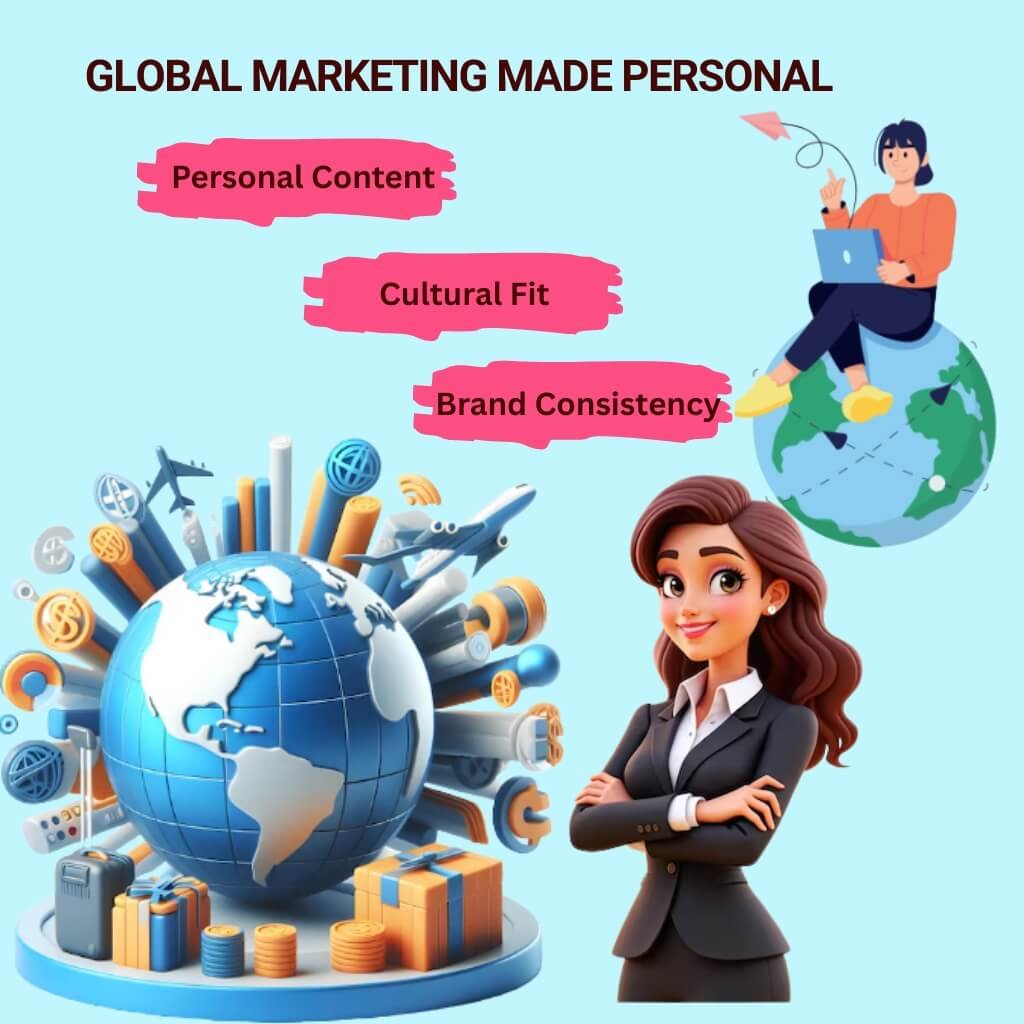
About 71% of customers preferred content made for them rather than generic ads.
Campaigns that ignored local culture saw engagement drop by 67%. Verdence Capital Advisors adapted content for local audiences.
Engagement rose by more than 30% in the U.S. and UK. These examples show that keeping a consistent brand identity while speaking in local accents leads to successful global marketing.
Solutions You Must Use
1 . Use AI tools to send messages that fit each market.
2 . Collect first-party data. Adjust offers for each country.
3 . Train local teams. Let them edit content to match local taste.
4 . Use chatbots or virtual helpers that respond in local style.
“When storefronts blur into agents and virtual shops, customers expect ease and relevance over uniformity.” — Dan Jedda, COO, Roku, remarks on ad-tech trends (TechRadar)
Step-by-Step Implementation of Global Marketing Approach
Audiences expect relevance, cultural sensitivity and authenticity. Old one-size-fits-all strategies no longer work.
Companies must research markets deeply. They need to adapt messaging and operations to local preferences.
Without this, campaigns waste time, money and effort. Let’s learn how to move from problem to solution in practical steps.
Phase 1: Foundational Research – Cultural Misalignment
Brands often miss cultural differences. Ads or campaigns may offend without meaning to. Many rely on surface-level data or automated tools.
They fail to grasp local traditions, values and behaviors. This makes campaigns irrelevant or harmful.
67% of campaigns ignoring cultural context saw engagement drop below expectations.
Solution: Conduct deep market research beyond surface-level data. Involve local experts or cultural consultants to review campaigns.
Test messages with small focus groups before full launch. Collect feedback continuously and adjust campaigns based on real audience responses.
Expert Insight:
“Cultural intelligence is not just about avoiding mistakes; it’s about creating meaningful connections with your audience.” — Dr. A. Noris, 2025 (nature.com)
Phase 2: Strategic Adaptation – Generic Messaging
Many brands use the same message in all markets. Local audiences feel disconnected. What works in one region may fail in another.
Ignoring local tastes, influencers, or social norms reduces engagement. Consumers now expect relevance and authenticity.
Case Study: Sprite launched a summer campaign across ASEAN. The brand included local flavors, spicy food collaborations and regional celebrities.
The campaign resonated with Gen Z in each country. Engagement rose by 50% and brand affinity improved. (ContentGrip)
Solution: Customize messaging for each region. Include local culture, trends and influencers. Translate content carefully.
Adapt imagery, tone and offers to fit local preferences. Monitor engagement and refine campaigns based on local feedback.
Phase 3: Operational Execution – Supply Chain Complexities
Even strong campaigns fail if execution is weak. Companies struggle with taxes, currency changes and cross-border payments.
Logistics delays, compliance issues and poor local presence create problems.
Digital assets may not be adapted for local SEO or language. These gaps hurt sales and brand image.
Solution: Map operational processes for each market ahead of time. Ensure compliance with local laws and regulations.
Adapt digital assets for local SEO, language and payment systems. Build a reliable logistics network or partner with local providers. Monitor execution closely and resolve delays proactively.
Expert Insight:
“Digital transformation is a major undertaking that not all companies are able or willing to embark on.” — Thomson Reuters(tax.thomsonreuters.com)
The Emerging Problems Businesses Face
Businesses must adapt. Or they fall behind. AI powers campaigns, but overuse can strip culture and authenticity.
Consumers demand trust. They want proof of ethics and quality. Laws and rules change by country and region. Data privacy is critical.
1. AI Over-Standardization
Problem: Too much AI content removes cultural touch. Messages feel generic. Audiences ignore them.
Solution: Use AI tools that allow cultural tweaks. Content should reflect local words, tone and customs.
Case Study: A beauty brand adapted AI campaigns to different cultural contexts. Engagement rose 25% in multiple markets. (codedesign.org)
2. Trust & Transparency
Problem: Customers no longer trust claims. They demand proof of ethics.
Solution: Show verifiable sourcing and production details.
Example: Tony’s Chocolonely tracks its cocoa fully. Farmers get fair pay. Child labor is eliminated. U.S. revenue grew 33%. (ft.com)
3. Regulatory Maze
Problem: Data laws differ by country and region. Companies face fines if they ignore rules.
Solution: Follow local regulations strictly.
4. Attention Shifts
Problem: Audiences watch content differently across regions.
Solution: Adapt content format.
Example: Short videos dominate in the U.S. and Asia. Podcasts work better in Europe. (deloitte.com)
Pros and Cons of a Global Approach
Global marketing offers big opportunities and big risks. A unified strategy can save money and build trust.
But ignoring local culture or regulations can backfire. Companies must balance global consistency with local relevance. This section explores the advantages and challenges of going global today.
A . Advantages of a Global Marketing Approach
1. Cost Efficiency
Standardizing campaigns across regions reduces production and operational costs.
Brands like Shein and Temu show how this works. They achieved fast global growth while saving money on marketing and supply chain management.
Using core assets and templates means less spending on creative production and advertising.
2. Enhanced Brand Recognition
A consistent global brand builds trust and familiarity. Customers recognize the brand instantly, which strengthens loyalty.
When the same visual identity and messaging appear across countries, it signals reliability. Strong recognition also makes it easier to enter new markets.
3. Operational Simplicity
Centralized management makes decision-making simpler. Companies can act faster when markets change.
Resources are used efficiently and messaging stays consistent. This reduces duplicated efforts and prevents errors across teams.
4. Data-Driven Insights at Scale
A global approach lets companies collect data from many markets at once. Insights on behavior, engagement and sales guide decisions worldwide.
AI and analytics help spot patterns. Campaigns can be improved globally while allowing small local tweaks.
5. Consistent Customer Experience
Customers expect the same experience everywhere. Online or offline, the brand should feel familiar.
A global strategy keeps values, tone and service standards uniform. This builds trust and satisfaction, especially for digital-first consumers.
6. Easier Use of Technology and AI
Global campaigns allow unified use of marketing tools. AI personalization, automation and CRMs work across markets with less hassle.
This saves time while still giving customers experiences that feel personal.
7. Faster Global Expansion
A tested global framework speeds up market entry. Companies can reuse proven strategies, assets and messaging.
This cuts time and reduces risk when entering new countries. E-commerce and SaaS brands benefit most from this.
8. Stronger Negotiating Power with Partners
A clear global strategy helps when working with international partners. Media agencies, suppliers and distributors understand the brand better. Standardized campaigns make collaboration smoother and goals easier to meet.
9. Sustainability and Ethical Communication
Consumers expect brands to act responsibly. A global approach shares sustainability and ethical practices clearly.
Unified messaging shows accountability. Customers trust companies that communicate consistently across markets.
B . Challenges of a Global Marketing Approach
1. Cultural Insensitivity
Over-standardization can lead to campaigns that overlook local customs and preferences. For instance, a global ad campaign that works well in one country may be perceived as offensive or irrelevant in another due to cultural differences.
2. Regulatory and Legal Complexities
Navigating varying regulations across countries can be challenging.
3. Loss of Local Relevance
Failing to adapt content to local markets can result in decreased engagement.
Brands that do not tailor their messaging may struggle to connect with regional audiences. This leads to reduced effectiveness of marketing efforts.
A Clear Comparison of Global, Multinational and International Marketing Explained
Picking the right marketing strategy matters for businesses that sell across countries. A Global Marketing Approach shows how brands can reach customers worldwide.
“Global,” “multinational” and “international” marketing sound alike. But they work differently. Each approach affects how companies run campaigns, manage teams, and enter new markets.
Learning these differences helps businesses plan clearly and grow in multiple countries.
Global vs. Multinational vs. International Marketing
| Aspect | Global Marketing | Multinational Marketing | International Marketing |
| Focus | One brand identity worldwide | Local relevance in each country | Entering new markets with minimal changes |
| Message | Same across all markets | Adapted to local culture | Mostly uniform, small tweaks |
| Advantage | Cost-effective and recognizable | Strong connection with local audiences | Fast entry into new markets |
| Risk | Cultural mistakes, if ignored | Higher cost and complexity | Low initial brand recognition |
A global marketing approach works when a company keeps a consistent brand identity and respects local culture.
Multinational marketing adds relevance for each country. International marketing allows quick entry into new regions. The best approach blends them.
Future Trends in Global Marketing (Late 2025 & Beyond)
1. AI-Human Hybrid Campaigns
Combine AI efficiency with human creativity. AI handles data and personalization. Humans add emotional depth and cultural relevance.
Real-World Example:
Zalando, a European fashion retailer, uses AI to create digital models and images, reducing production time from weeks to days.
Despite AI’s role, human creatives ensure the content resonates emotionally with audiences. This approach has cut image production costs by 90%. Source: Reuters
2. Decentralized Global Teams
Hiring remote, culturally fluent experts from various regions. Teams operate across time zones, bringing local insights to global strategies.
Expert Insight:
“Remote teams should prioritize real-time collaboration tools and transparent project management platforms.” — Remote Work Trends: Source: Splashtop
3. Ethical and Transparent Branding
Consumers demand brands to be open about sustainability and ethical practices. Companies disclose environmental impacts and supply chain transparency.
Real-World Example:
CDP, formerly known as the Carbon Disclosure Project, remains one of the most widely used frameworks for ESG reporting. They focus on climate, water and forest risk management.
The CDP Disclosure Cycle presents an opportunity for companies to demonstrate environmental leadership by reporting how they are managing environmental governance.
They are identifying and managing environmental risks and continuously improving environmental performance. Source: CDP
Expert Insight:
“Ethical marketing has transitioned from a buzzword to a business imperative.” — Bitquirky
4. Micro-Localization at Scale
Using AI tools to adapt global messages for local audiences. Content is personalized in language, imagery and cultural references.
Conclusion
Global marketing is like a portfolio of markets. Your brand is the core asset. Local culture is the market trend. Respect both. Then ROI grows.
Each message is an investment. Analyze the results. Adjust the strategy. Watch engagement compound over time.
AI acts as your analytics engine. Humans are the executives. Local teams are the regional product managers. Together, they navigate every market.
Balance brand and culture. Your campaigns become sustainable growth.
FAQ
What are the types of global marketing?
Global marketing now uses 7 active types. Each works with online growth and cross-border buyers:
1 . Social-First Marketing
Brands sell and talk directly on TikTok, Instagram and YouTube Shorts. People trust short videos more than ads.
2 . Localized Content Marketing
Brands write and design in local style. They use native words, colors and culture. Buyers connect faster.
3 . Cross-Border E-Commerce Marketing
Shops sell on Amazon Global, Shopify Markets and Temu. Buyers click in one country, but checkout ships worldwide.
4 . Influencer Partnership Marketing
Creators from each region push products. Micro-influencers grow fast in Asia and Africa.
5 . AI-Powered Personal Marketing
Brands send offers based on buyer mood, time and price alerts. AI tools adjust content per region.
6 . Sustainability Marketing
Brands show eco steps. They promote recycled packs, green delivery and fair labor.
7 . Community-Driven Marketing
Brands build global groups in Discord, WhatsApp, or Telegram. Buyers trust groups more than brand ads.
Who is the father of global marketing?
Philip Kotler is the father of global marketing. He leads in teaching and books. This includes Marketing Management and Principles of Marketing. Also, he uses case studies and real business examples.
What skills are needed for marketing management?
Marketing managers need strong data skills to track sales and traffic. They create content for social media, websites and email.
They know digital advertising on social media. They perform customer research to find trends and preferences.
They plan projects and campaigns clearly. They handle SEO and website management. They lead teams and work well with partners globally.
What kind of person should be a marketing manager?
A marketing manager should possess the following qualities:
1 . Adaptable – Adjusts quickly to market or trend changes.
2 . Empathetic – Understands customer needs and team feelings.
3 . Resilient – Handles pressure and recovers from setbacks.
4 . Curious – Learns new tools, platforms and techniques.
5 . Clear Communicator – Validate ideas simply with the team and clients.
6 . Leader – Guides teams, sets goals and motivates others.
7 . Analytical – Reads data and makes smart decisions.
These traits define top marketing managers. (Forbes)
What are hard skills in marketing?
Hard skills in marketing are technical abilities you can learn and measure. You need them to do marketing tasks well.
The most wanted hard skills are:
Data Analysis – Read numbers, sales and clicks. Make clear decisions.
SEO and SEM – Make content easy to find online. Run paid search campaigns.
Content Creation – Write posts, make videos, design visuals. Tell simple stories.
Digital Advertising – Manage ads on Google, TikTok and Meta. Track results carefully.
Marketing Automation – Use tools to handle repetitive marketing tasks.
Project Management – Plan campaigns, assign tasks and keep teams on track.
These skills help marketers work with data, tech and customers more effectively. Professionals who master them get better results and more opportunities.