
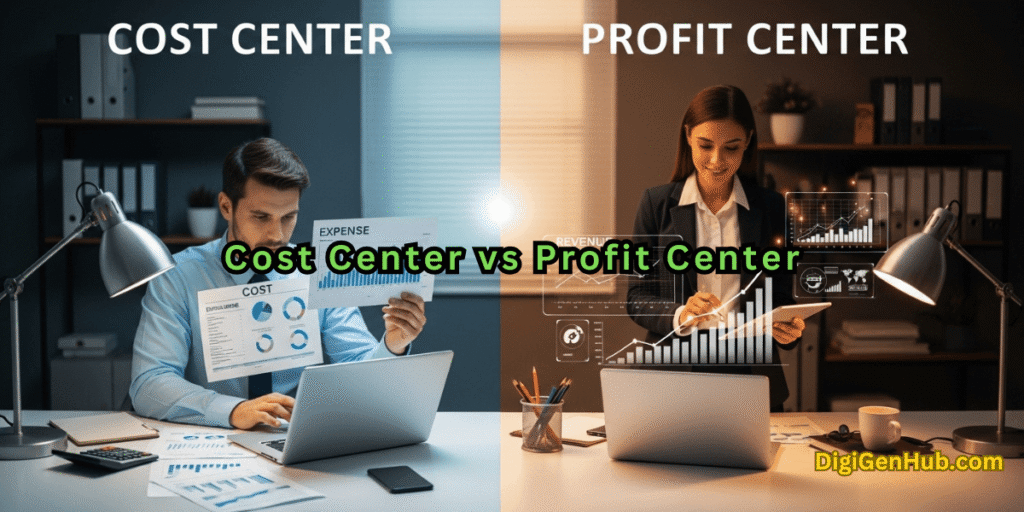

A clear cost center vs profit center split is the only way to manage a healthy business. A cost center like HR or IT only spends money to provide support.
A profit center, like a sales branch, earns revenue and covers its own costs. This clear division helps you find money leaks in your support teams.
You can then move those funds into your high-growth sales units. This strategy keeps your company lean and your bank balance growing.
Business owners somehow see their bank balance drop despite high sales. This happens because they do not track where money is trapped versus where it is multiplied.
Without a clear split between support costs and revenue engines, you cannot make smart hiring or cutting decisions.
Cost Center vs Profit Center
You must categorize every department as either a cost center or a profit center. Use a zero-based budget for cost centers to stop waste.
Use uncapped incentives for profit centers to drive growth. This simple split turns a confusing balance sheet into a roadmap for 10x expansion.
I recently worked with a remote client in Seattle who faced this exact crisis. Their recent Q1 report showed record sales, yet they were nearly out of cash.
By auditing their structure, I found they were over-funding their support units while starving their sales units.
We quickly reclassified their departments into cost centers and profit centers.
The financial management was simple. We cut 15% of the bloat in their cost centers using AI automation.
Then, we moved those funds into their high-performing profit centers. Within 60 days, their net margin jumped by 12%.
This clear split is the only way to survive the high-competition US market today.
Differences between Cost Center vs Profit Center
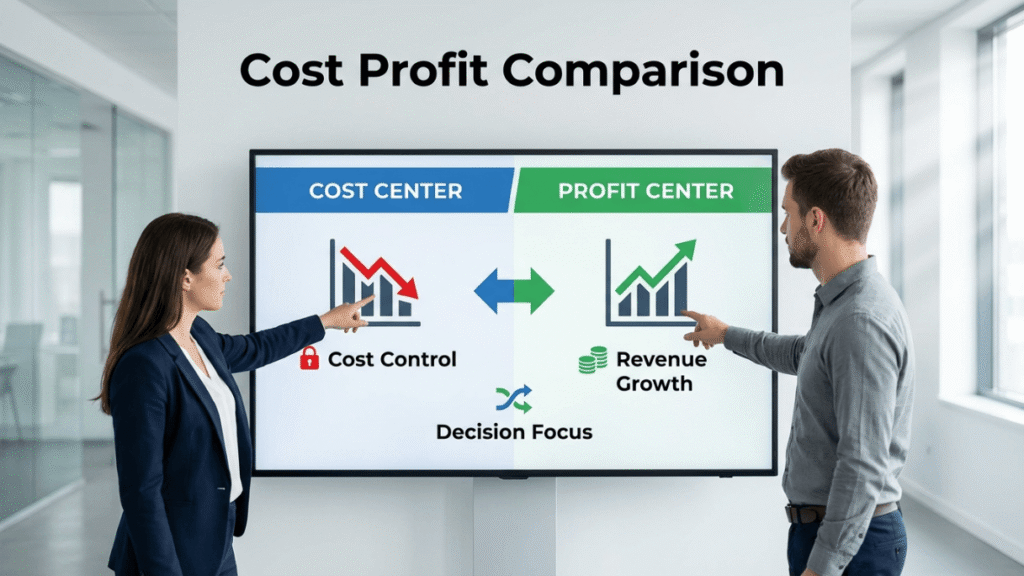
The main difference is Accountability.
A Cost Center Manager is a hero if they spend less than the budget.
A Profit Center Manager is a hero if they make more than the target.
The Decision-Making Split
For Cost Centers: You ask, “Can we do this cheaper with a bot?”
For Profit Centers: You ask: “If I spend $10k more here, will I get $30k back?”
The biggest difference is the impact on your bottom line. A cost center takes money away from the budget to provide a service.
A profit center brings new money into the budget by selling a product. The gap is wider because of digital overhead.
Cost centers now focus on lowering technology costs. Profit centers focus on using that technology to win more customers.
How to Rank Your Departments
| Feature | Cost Center (The Support) | Profit Center (The Engine) |
| Main Goal | Efficiency and Savings | Revenue and ROI |
| Success Tool | AI Automation | Growth Marketing |
| Budget Logic | Spend only what is needed | Spend more to make more |
| Trend | Fully Remote / Lean | High-Conversion / Aggressive |
1. What is a Cost Center?
A cost center is a part of your company that costs money to run but does not sell anything.
It provides the tools and rules that the rest of the company needs to function. In the USA, these are often called back-office roles. The best cost centers use AI to do more work with fewer people.
3 Main Types of Cost Centers
Imposed Centers: These are mandatory, like Legal and Tax Compliance. You cannot skip these.
Discretionary Centers: These are optional but helpful, like a wellness department or a high-end corporate Branding team.
Service Centers: These help other teams, like an Internal IT Helpdesk or a Maintenance crew.
How to sum a cost center: The Accounting Formula
You must include digital overhead.
$$Total\ Cost = (Salaries + Rent) + (AI\ API\ Fees + Cybersecurity\ Insurance)$$
Example: A 5-person HR team in Ohio costs $400k in salary, $50k in software, and $10k in AI tools. The total cost center value is $460k.
Activities of a Cost Center
1 . Hiring and onboarding new staff (HR).
2 . Fixing server errors and blocking hackers (IT).
3 . Filing quarterly taxes with the IRS (Accounting).
Writing contracts to protect the brand (Legal).
I recently advised a Texas-based logistics firm. They treated their safety team as a boring cost center.
We shifted their focus to insurance reduction. By lowering accidents, they saved $1M in premiums. Even a cost center can earn money by saving it.
What is a Profit Center?
A profit center is a business within a business. It has its own income and its own bills.
It is responsible for its own bottom line. In the modern market, companies now treat individual websites or even individual influencers as profit centers.
3 Major Types of Profit Center
Product Centers: A specific product you sell, like a pro version of an app.
Regional Centers: A physical location, like your “California Branch.”
Customer Centers: Groups that handle high-value clients (VIP Sales).
How to Sum a Profit Center: The Profit Formula
You must subtract the support tax to see true profit.
$$Net\ Profit = Revenue – (Direct\ Production\ Costs + Company\ Overhead\ Fee)$$
Example: Your cloud storage product makes $1M. It costs $300k to run. The company charges it $100k for HR/Legal support. The true profit is $600k.
Activities of a Profit Center
1 . Running Google and Meta ads to get leads.
2 . Developing new features that customers will pay for.
3 . Cold calling and closing deals with US retailers.
4 . Analyzing market trends to raise or lower prices.
I see many online founders forget the overhead fee. They think a product is profitable because sales are high.
But if that product requires 10 hours of support calls a day, your cost center (Support) is eating all the profit center (Sales) money.
Efficient financial management requires a clear focus on high-yield activities.
General Tips for Business Success
You must identify where your money generates the most value. Scaling today depends on cutting waste while funding growth. These specific solutions ensure your US business remains lean and highly profitable. The tips below can be helpful for your business:
1 . Automate Support First
Use AI for 80% of cost center tasks. It saves time and reduces human error.
Example: Use an AI chatbot to handle 24/7 customer billing questions.
2 . Bonus for Savings
Reward cost center leads who find cheaper vendors. This motivates them to cut waste.
Example: Give your IT manager a 10% bonus for lowering cloud hosting fees.
3 . Uncap Sales Pay
Never limit the commission for a profit center. High earners drive high growth.
Example: Let your top software salesman earn unlimited bonuses for every new US contract.
4 . Isolate Risks
Don’t let one failing profit center drain your cash. Keep budgets separate.
Example: Close a failing retail branch before it eats the profits of your online store.
5 . Quarterly Audits
Ask: “Is this department still helping us grow?” Stop funding useless units.
Example: Review your marketing team every 90 days to ensure they are bringing in leads.
6 . Remote Optimization
Use remote staff for cost centers. This saves massive amounts on US office rent.
Example: Hire a remote accounting team instead of renting a large office in New York.
7 . SaaS Review
Cancel ghost subscriptions in your IT cost center. Many companies pay for tools they never use.
Example: Audit your team’s software list and delete seats for former employees.
8 . Upsell in Support
Train support staff to offer product upgrades. This turns a cost center into a profit center.
Example: A support agent suggests a pro plan while helping a customer fix a small bug.
9 . Track Time to Hire
Speed is the best KPI for an HR cost center. Slow hiring kills your momentum.
Example: Measure how many days it takes HR to fill a vacant sales role.
10 . Analyze CAC
Know exactly what you spend to get one customer. This is your Customer Acquisition Cost.
Example: If you spend $500 on ads to get one $1,000 client, your CAC is $500.
11 . Use Cloud-Native Tools
They are easier to track across different units. You can see exactly who is spending what.
Example: Use Google Workspace to see which department uses the most data storage.
12 . Set Internal Rates
Charge your profit centers for using internal IT help. This prevents teams from wasting resources.
Example: The Sales team pays the IT team $50 for every technical support ticket.
13 . Focus on Retention
It is 5x cheaper to keep a customer than to find a new one. Loyal customers are pure profit.
Example: Send a discount code to current users to keep them from switching to a competitor.
14 . Legal as Protection
Use your legal team to build moats around your profit. Protect your ideas from rivals.
Example: Have your legal team trademark your brand name to stop copycats.
15 . Transparent Dashboards
Let everyone see the daily profit/loss numbers. Transparency creates a culture of ownership.
Example: Use a live screen in the office showing real-time sales targets for the week.
The most successful companies now are moving toward Value Centers. This means every team—even HR—must show how they help the company grow.
How to do this:
Step 1: List every department.
Step 2: Label them C (Cost) or P (Profit).
Step 3: For the “C” teams, give them a goal to reduce time-waste by 15%.
Step 4: For the “P” teams, give them a goal to increase “Net Margin” by 10%.
If a profit center is not making a 20% margin in an economy, it is actually a cost center in disguise. Close it or fix it immediately.
Conclusion
Success starts with clear financial boundaries. You must know where your money is an expense and where it is an investment.
Separating support teams from sales units stops the constant drain on your cash flow.
This shift gives every dollar a specific job to do. You will see higher margins and much less waste. Your path to scaling becomes simple and your bank account stays healthy.
FAQ
Can a Cost Center be sold to another company?
Yes. You can spin off a high-performing support unit. For example, a US firm can turn its internal logistics team into a separate delivery company for other businesses.
Is environmental compliance now a Cost Center?
Currently, yes. Most companies treat green audits as a necessary expense. However, in 2026, some firms use these audits to win high-value government contracts, making them Profit Enablers.
Should data privacy be its own Cost Center?
Yes. US laws are very strict. You must have a dedicated budget for data protection to avoid massive fines that could wipe out your Profit Centers.
Is customer data a Profit Center asset?
Raw data is a Cost Center because it costs money to store. But, once you use that data to predict US buyer trends, it becomes a high-margin Profit Center.
Does the “Gig Economy” affect these units?
Yes. Many US startups now use 100% freelance staff for Cost Centers. This removes fixed costs like health insurance and office equipment from the support side of the ledger.
Is cybersecurity a Cost Center or an Insurance cost?
It is a Cost Center. But, having top-tier security allows you to charge clients a security premium. This turns a safety cost into a sales advantage.
How do investors view the Ratio?
Venture capitalists now look for lean support. They prefer companies where Cost Centers represent less than 18% of the total operating budget.