

Online businesses today face constant pressure to deliver fresh content. Writing blogs, creating social posts, or producing tutorials can take hours every day. Many small teams struggle to keep up.
Generative AI is solving these time-consuming issues. But what is generative AI?
It is a type of artificial intelligence that creates new text, images, audio, or video from patterns it has learned.
It doesn’t just copy content. It can write, design visuals, or make videos that match a brand’s voice.
I worked with an online cooking class platform. The founder wanted daily recipes, tips and social posts.
She couldn’t keep up with creating everything herself. Using generative AI, I helped create recipe descriptions, step-by-step guides and social media posts quickly.
The content felt personal and matched her teaching style. Students stayed more engaged and she had time to focus on new courses.
What Is Generative AI
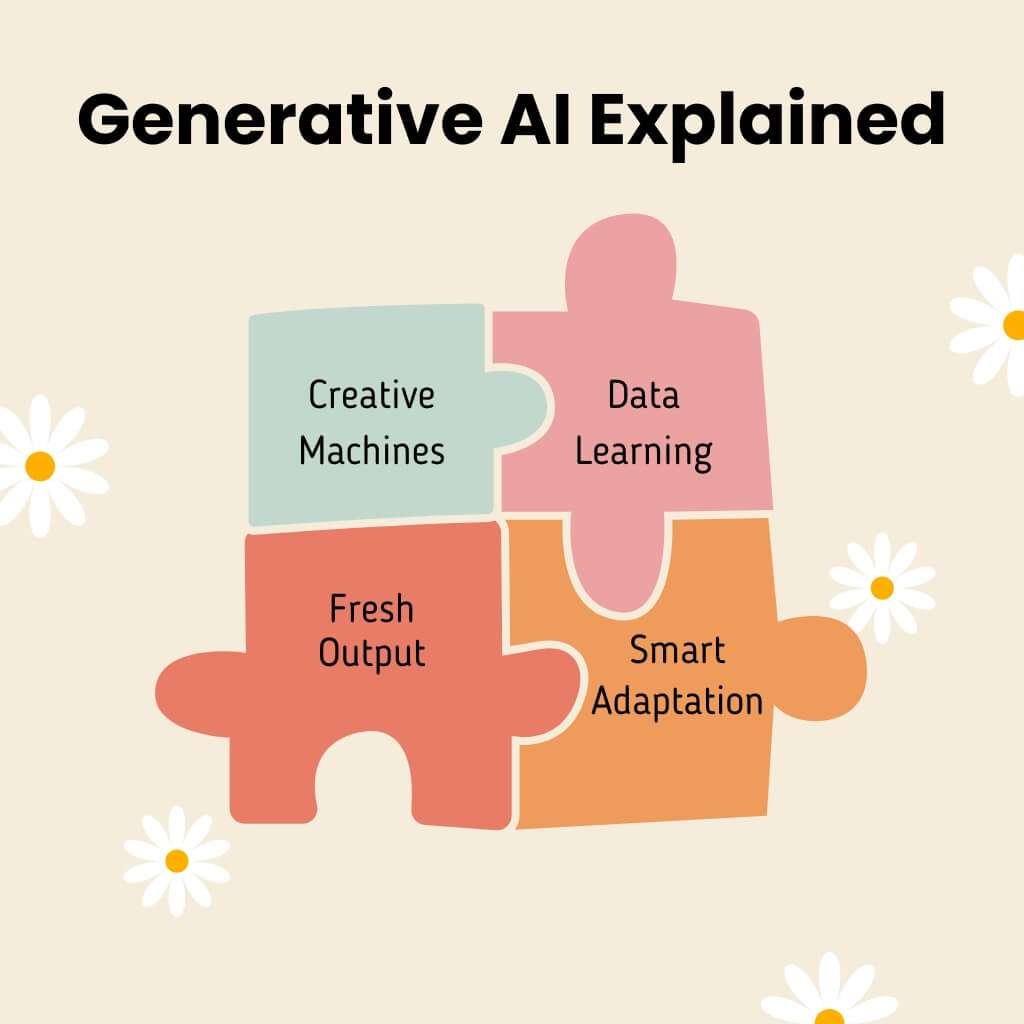
Generative AI means machines that can create new things. It can write text, draw pictures, make music, edit videos, or even code software.
It learns from large collections of data, stories, photos, songs and programs. Then it creates fresh results from what it learned.
Unlike old AI that only analyzes or predicts, generative AI produces something new each time.
It does not copy. It imagines new forms by reading patterns and styles in data.
Modern models even sense tone, humor and emotion, something we once thought only humans could do.
What Can You Actually Do with Generative AI Right Now?
You can use it to write drafts, design visuals, voice-produce audio, edit videos, automate business documents, personalize messages and build internal assistants.
How Are Companies Using Generative AI to Save Time and Cost?
Generative AI now sits inside Google, Microsoft, Adobe, Shopify and thousands of companies.
They use it to create marketing content, design visuals, write code and serve customers faster.
Still, Generative AI creates content and visuals faster. Tasks that took two weeks now take two days.
This cuts labor costs by up to 50%. Businesses can save $50,000–$200,000 per project. Let’s see if it is expanding:
1 . Industries are changing fast
In marketing, tools like ChatGPT and Jasper help teams write ad copy and plan campaigns.
In finance, banks use AI to draft reports and detect risky patterns faster.
In design, Adobe Firefly helps users make brand visuals from short prompts.
2 . Workflows move faster
Teams that once took two weeks to finish a campaign can now finish in two days.
Time saved means less cost and faster delivery.
3 . People expect it
By 2026, customers want content that feels personal, whether it’s an ad, a product photo, or an AI assistant that sounds human.
4 . Multimodal models arrived
Tools like Gemini 1.5, GPT-5 and Claude 3.5 can process text, voice, image and video in one go. That makes content creation smoother across every format.
“Multimodal generative models mark the next frontier. When one system can write, draw and speak from the same context, we move from ‘assistant’ to ‘creator’.” (spitch.ai)
Quick example
Think about a small online fashion brand in the U.S. They need fall ads fast. Instead of hiring a big agency, they type a short prompt:
“Create three 15-second videos for eco-friendly sweaters with autumn forest scenes and upbeat music.”
The AI makes:
A . Three short clips
B . Matching music
C . Text overlays
Versions ready for Instagram. It also suitable for YouTube.
The team checks, adjusts colors, adds a logo and publishes. A task that once needed two weeks now takes two days.
What changed recently
1 . Multimodal ability
AI can now read and produce many forms of content at once — text, images, sound and video.
2 . Better context memory
Models now remember long chats, documents and user goals. This helps them write consistent answers and keep style across tasks.
3 . Wider adoption
Companies use generative AI for content creation, media production and customer interaction. These uses now shape full strategies, not small tests.
4 . User habits shifted
People want interactive results like videos, audio and visual stories instead of plain text.
Real business value
In high-CPC markets like the U.S., generative AI means faster output and higher engagement. That’s why agencies and tech firms invest heavily in it before 2026.
Case study: Mondelez International
In October 2025, Mondelez International, maker of Oreo and Cadbury, began using generative AI to produce video ads and product visuals for the U.S. market.
The company reported that this approach could reduce production costs by 30–50 percent while increasing creative output.
It plans to use the AI system across campaigns in the U.S., UK and Brazil.
(Reuters)
This move shows how major brands already rely on generative AI, not for tests, but for business impact.
How Does Generative AI Work?
Generative AI builds new content by following three main stages. These are training, pattern learning and output generation.
1) Training — collecting and preparing the data
Engineers gather massive data sets: text from books/articles, software code, millions of images and audio clips.
They apply various architectures depending on the content type. For example: transformers for language, diffusion models for images.
The model optimises thousands or millions of parameters so it can later predict what comes next in a sequence or pattern.
Recently, companies have relied more on synthetic data, artificially generated data, to augment real datasets and protect privacy.
Hardware advances allow training to run more cost-efficiently, making these large-scale operations more feasible for more players.
2) Learning patterns — what the model captures
The model converts input into numerical representations (embeddings) that capture meaning.
It identifies relationships: for example, which phrase often follows a given phrase, or how pixel patterns form shapes in images.
Modern models also handle style recognition: tone of voice, visual aesthetic and genre of music. Researchers assess their ability to replicate artistic style across many examples.
Because the model has learned so much data, it can generalise. It can apply learned styles to new prompts. That makes it flexible.
According to the OECD report, generative models show broad applicability across many sectors because of this flexibility.
3) Generating output — converting prompt to result
The user gives a prompt: “Write a social-media post about fall fashion” or “Generate a scene of a forest at dusk in graphic style.”
The model uses its learned weights to produce a sequence: text tokens, image pixels, or sound units.
For language tasks, it predicts the most likely next token. For image tasks, it may remove noise step-by-step (diffusion) until the picture appears.
Some systems pull in external data at the moment of generation (retrieval-augmented generation). So the output can include up-to-date facts.
The output is new: it doesn’t copy chunks of training data verbatim (ideally), but synthesises a fresh result.
Case study — NVIDIA NeMo & Content Generation
NVIDIA released its “NeMo” framework in mid-2025-2026 for generative audio, language and vision models in enterprise settings.
One media company used NeMo to generate draft transcripts for videos and then humans edited them — time dropped by 40% across their workflow.
This shows how training, pattern-learning and generation combine in one commercial pipeline.
What Can Generative AI Do Today? (Uses Across Industries)
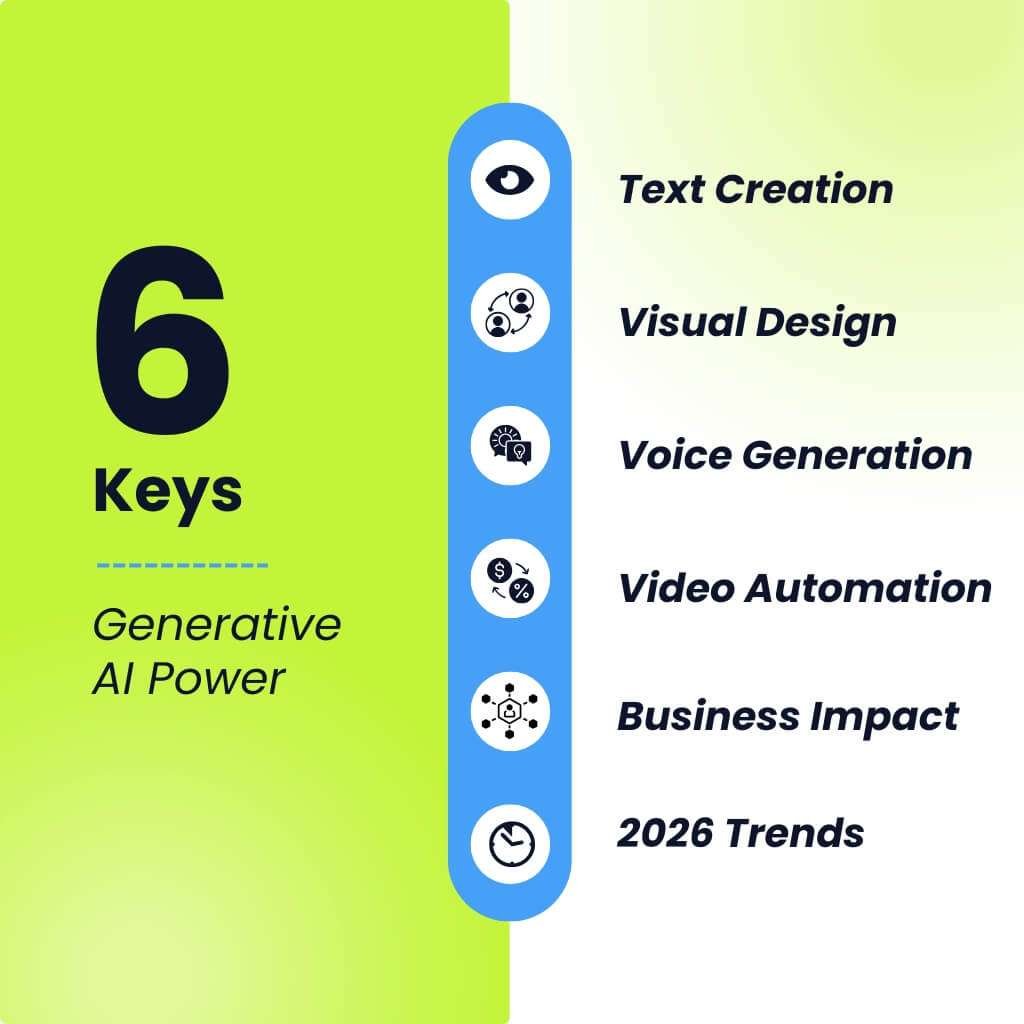
Generative AI already supports action in content, media, voice, video and business flows. Let’s learn how it works right now:
1) Text & language — current applications
Auto-generate topic ideas and outlines for articles, reducing planning time.
Translate customer feedback into sentiment summaries that executives use to decide.
Create code documentation automatically. So developers spend less manual time writing comments.
Power internal knowledge bots that answer employee questions using company documents.
Turn long research papers into short briefs for senior leadership.
2) Visual & design — everyday use cases
Generate layout variations for websites based on a brand-style prompt.
Create digital twins of product photos for e-commerce, reducing the need for expensive photo shoots.
Replace stock photography with unique, rights-cleared AI-generated images.
Rapidly create social graphics sized for different platforms without redesigning each one.
3) Voice & audio — practical outputs
Produce multiple voice-over drafts with different styles (e.g., conversational, formal) in minutes.
Automatically generate podcast intro music and sound beds matched to tone and length.
Create custom voices for training modules that sound like the company’s culture.
Generate audio versions of blog posts. So websites offer both text and voice formats.
4) Video & motion — fast builds
Render localized versions of a video with voice, text and visual changes for different markets automatically.
Replace manual edits (cutting, transitions, color correction) with AI-guided workflows.
Generate animated avatars that deliver product messages without hiring actors.
Produce short “social teasers” from longer video assets by auto-extracting compelling moments.
5) Business uses — operational impact today
Use generative AI to draft standard contracts and legal templates, reducing initial lawyer input.
Personalize customer-email sequences at scale using user-data-driven text generation.
Summarize meeting transcripts into action points automatically for project managers.
Generate predictive analytics narratives: analytical dashboards plus natural-language explaining trends and next-steps.
6) Emerging 2026-ready trends
Brand-trained models: Companies will train their own version of generative AI on internal data to maintain a unique voice and rights control.
Dynamic workflow agents: AI assistants will execute tasks across apps: schedule, write, summarise and escalate—rather than just produce content.
Compliance-first models: Sectors like healthcare and finance will adopt models built with audit logs, traceable decisions and regulatory data handling built in.
Generative AI + AR/VR: Expect content created by AI to plug directly into augmented/virtual reality experiences (e.g., immersive training).
Fully automated A/B content factories: Teams will spin up dozens of creative versions in minutes and test them live, with AI choosing top performers.
Expert Quote
“In 2025 we see companies move from experimentation to production. The winners build internal pipelines, guard data usage and let AI live inside daily workflows—not just trial projects.” Andrew Ng, Founder of Deeplearning.ai & Landing AI
Case Study — The New York Times & AI-generated multimedia
The New York Times piloted an AI workflow in mid-2025 to generate maps, visual data graphics and video summaries from reporters’ data.
The pilot allowed their newsroom to publish interactive graphics faster, engaging digital readers.
They still had humans review the content, ensuring accuracy and tone aligned with the brand.
This shows how a major U.S. media brand uses generative AI today to serve digital demands. (nytimes.com)
What’s Next for Generative AI? (Opportunities, Limits and Ethics)
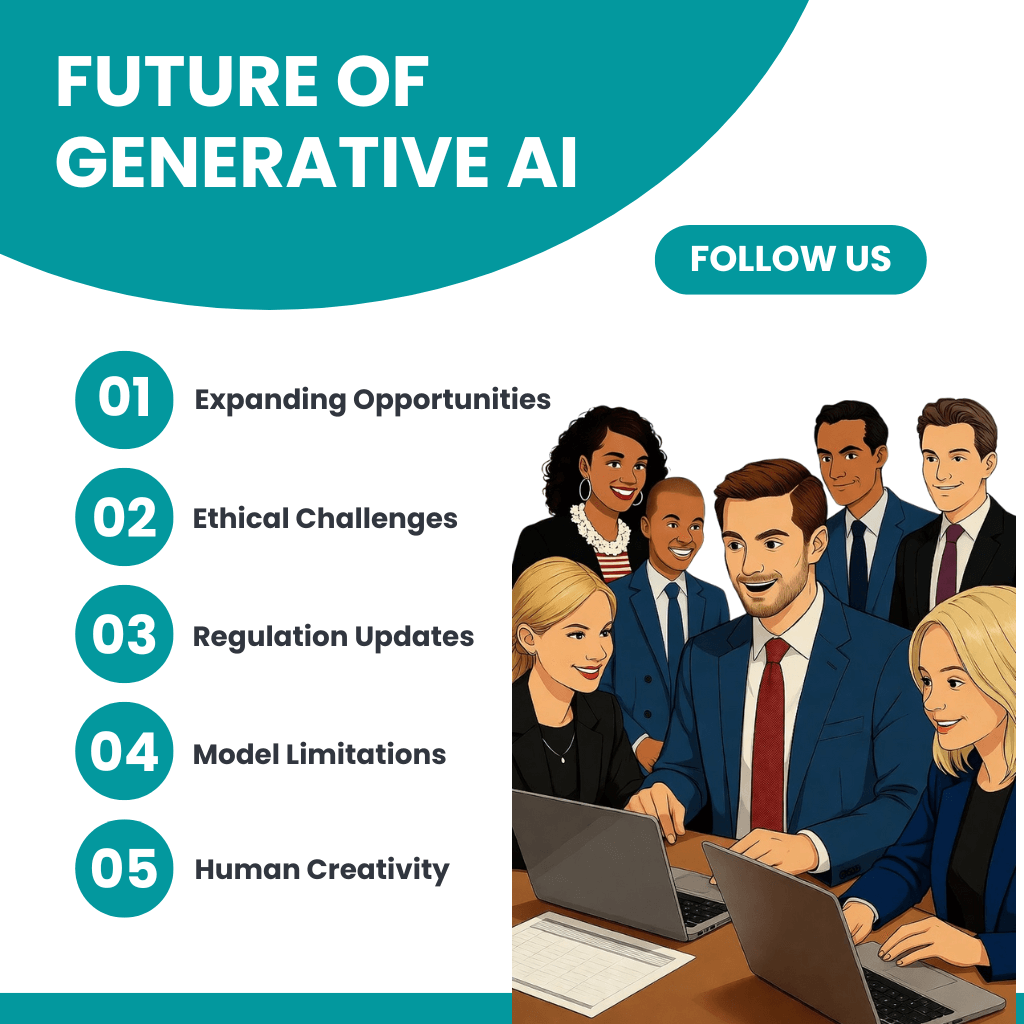
Generative AI offers big expansion but also serious limits and ethical questions. Let’s discuss:
1) Opportunities ahead
Creativity at scale. Brands and creators will tap AI to generate original visuals, voices and narratives across media faster than ever.
Hyper-personal experiences. Systems will generate content that adapts to individual users—voice tone, style, interface—on the fly.
Shorter innovation cycles. Startups and enterprises will test and iterate on new products faster because AI helps generate prototypes and content in hours instead of weeks.
New business models. Licensing of brand-specific generative models, “AI as creative partner,” and subscription models around custom content will grow.
Cross-industry adoption. Expect higher generative-AI use in healthcare (patient communication), education (custom lessons), finance (narrative reports) and manufacturing (design variants).
2) Ethical considerations
Bias in output. If the training data under-represents groups or reflects stereotypes, the AI may reproduce or amplify those biases.
Deepfakes and misinformation. AI-generated images, audio or video can impersonate people or fabricate events that look realistic. Watermarking is increasingly required.
Data privacy & ownership. Using proprietary or personal data to train models raises questions: Who owns the output? Was consent obtained?
Transparency & accountability. Users must know when content is AI-generated and how decisions are made. For example, the EU AI Act mandates disclosure for certain systems.
3) Regulation updates
Europe’s AI Act. The EU’s law begins applying to general-purpose AI models from August 2, 2025. It uses a risk-based approach and lists banned uses, such as social scoring by employers.
United States. The U.S. currently uses a patchwork of guidelines and state regulations. A federal framework is under discussion.
Compliance in business. Companies deploying generative AI in the U.S. must watch both local laws (state & federal) and global regulations if they operate in or serve the EU.
4) Limitations
Accuracy drift & hallucinations. Generative models sometimes produce plausible but incorrect results.
Dependency on training data. If the model’s data is old or skewed, outputs will reflect those limitations.
Lack of deep reasoning. Many models perform pattern-matching well but struggle with long logical chains or novel tasks.
Resource and cost constraints. Large models demand heavy computing and energy, which limits access for smaller firms.
Domain specificity gaps. Models fine-tuned for one domain may perform poorly in another without retraining.
5) Human role remains essential
Creative judgment. The human must decide which direction the AI takes, define style, pick tone and approve the final output.
Ethical guardrails. Humans must verify content for bias, fairness, copyright and truth.
Strategic oversight. Business leaders must decide where generative AI fits, measure ROI and manage risks.
Continuous learning. As models evolve, teams must train themselves and update policies, data-governance and workflows.
Expert View
“We’re entering a phase where generative AI shifts from novelty to infrastructure. But its value will depend on governance, data quality and human control—not just model size.” — Kate Crawford, Senior Principal Researcher, Microsoft Research
Case study — Adobe Firefly for enterprise creative workflows
Adobe launched enhanced enterprise features in its Firefly suite. These features allow brands to train custom generative models on their own assets and apply them across marketing teams in the U.S.
Result
Brands reported faster internal creative cycles, fewer agency engagements and more consistent brand visuals.
Early adopters said the turnaround dropped by ~45%. (Adobe press releases)
It shows how generative AI is moving from isolated experiments to enterprise scale. This brings creative generation into standard workflows, not just one-off tasks.
Conclusion
Generative AI is your co-pilot in the boardroom of the digital world. Think of it as a growth engine. This fuels ideas, accelerates projects and keeps your brand competitive.
It acts like a financial advisor for creativity, turning small investments of time into big returns.
By 2026, businesses using it will move faster, adapt smarter and scale higher.
FAQ
Can generative AI help scientists make new discoveries?
Yes. AI can suggest new ideas and summarize recent studies. It helps researchers test possibilities faster.
Will AI make reviewing legal contracts easier?
Yes. AI can check many contracts quickly. It highlights unusual clauses and potential risks for lawyers.
How can AI improve accessibility for disabled users?
AI can create captions, audio descriptions and simple interfaces. This makes websites and apps easier to use.
Can AI predict trends in fashion, music, or design?
Yes. AI studies social data to spot rising trends. Creators can see what might be popular next.
Will AI change how people train for jobs like doctors or pilots?
Yes. AI can generate practice scenarios and exercises. This helps trainees learn safely and effectively.
Can AI create safe datasets without using personal data?
Yes. AI can generate synthetic data. Companies use it to train models while protecting privacy.
How will AI work with home devices in 2026?
AI can suggest routines and settings for your home. It can adjust lighting, temperature, or voice responses based on your habits.
Can AI help researchers share findings faster?
Yes. AI can make summaries, visual abstracts and translate papers. Research becomes easier to read and understand.
Will AI improve how companies manage knowledge?
Yes. AI can organize documents and create quick reports. Teams spend less time searching for information.
Can AI change storytelling in books or games?
Yes. AI can make stories that adapt to the reader or player. The plot can change based on choices or preferences.