

Trends spread in hours. A design can sell out the same week it appears. This is the heart of what is fast fashion: speed, low price and constant churn.
I see this often in my own work. One client ran a small clothing shop online. She told me her buyers were leaving for cheaper competitors.
We rebuilt her site. Added a resale page. Shared repair guides. Within months, sales returned.
That incident showed me buyers chase new looks besides demanding proof and trust.
Brands slash waste with on-demand tech. Workers face unsafe shifts and low wages.
Rivers fill with polyester fibers. At the same time, resale grows stronger. Rental services expand.
Still, shoppers can buy fewer but stronger items. Brands can design with single fibers, publish supplier lists and repair what they sell. Fashion can stay quick. But it must also be fair, open and built to last.
What Is Fast Fashion and Why Did It Rise So Quickly?
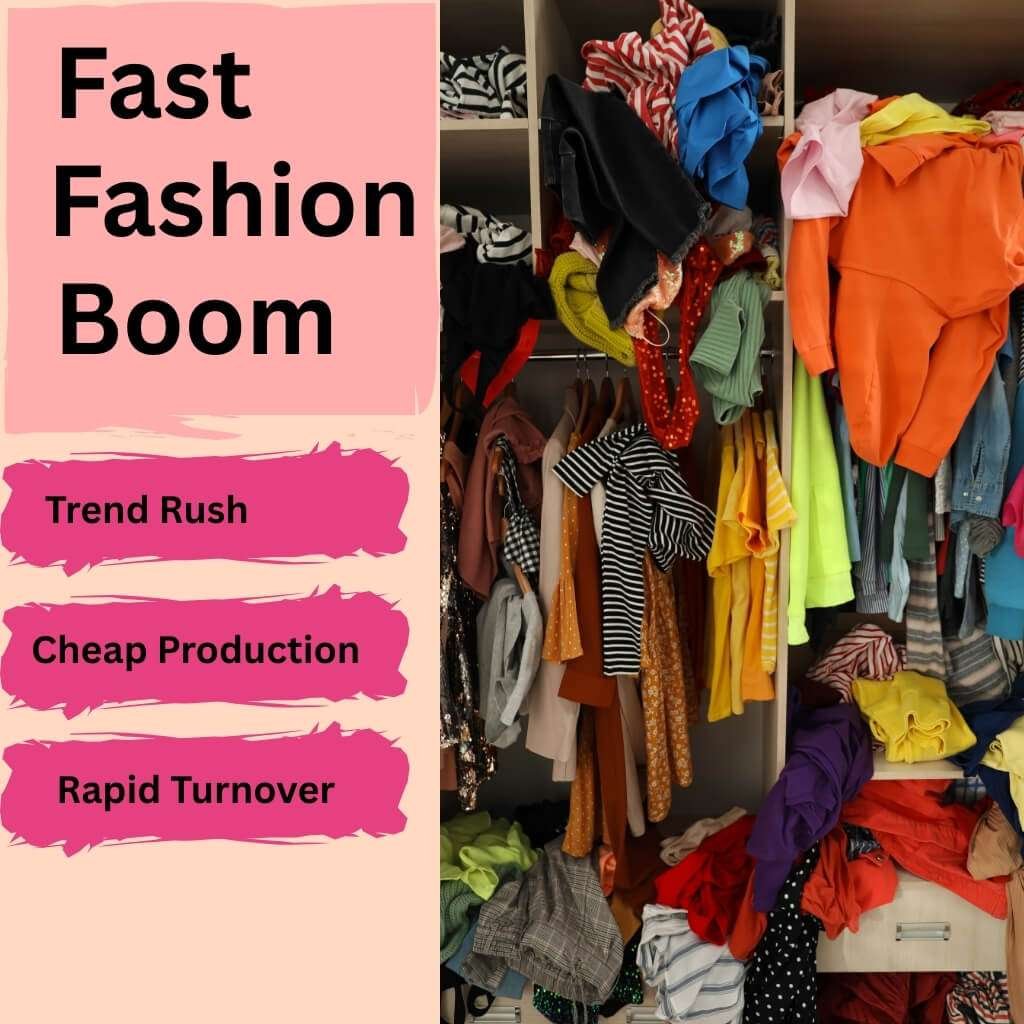
Fast fashion means making cheap clothes fast and selling them while trends are still hot.
A design can go from sketch to store in weeks or even days. It is not about quality. It is about volume, speed and constant turnover.
Origins: From Seasonal Fashion to Weekly Drops
Fashion once worked on four seasons: spring, summer, autumn and winter. Collections were prepared months ahead.
In the late 20th century, brands like Zara and H&M changed this business model. They cut lead times and released new designs much faster.
The term fast fashion was first used in the 1990s to describe Zara’s rapid cycle (coryames.com).
Today, ultra-fast players such as SHEIN launch thousands of styles every single day (en.wikipedia.org).
Why Brands Shifted: Consumer Psychology
Three strong forces shaped this shift.
1 . People want novelty. New designs give quick excitement.
2 . Scarcity drives urgency. “Sold out soon” makes people act.
3 . Low prices reduce hesitation. Cheap pieces feel like low-risk buys.
This mix of novelty, scarcity and low cost turned shopping into a cycle of repeated purchases.
The Digital Acceleration: Tech, Social Media and Online Retail
Technology made the cycle even faster.
1 . Social platforms like TikTok and Instagram spread trends in hours.
2 . E-commerce allowed instant drops without waiting for stores to update.
3 . Brands used data and analytics to predict which prints, cuts, or colors would sell (heuritech.com).
4 . Factories added digital workflows and automated cutting, reducing production time (digital-adoption.com).
5 . AI tools now create campaign visuals in days, not weeks. Zalando cut marketing image lead times from 6–8 weeks to only 3–4 days, saving about 90% in cost (reuters.com).
Case Study 1: Ganni’s Circular Deal with Ambercycle
Danish label Ganni signed a four-year deal with Ambercycle. The goal is to use Cycora®, a polyester fiber made from old textiles (ganni.com, ambercycle.com).
A . Ganni is locked in a steady supply of recycled material for future lines.
B . Ambercycle gained funding, security and scale to grow its tech.
C . Vogue Business noted this as one of the first long-term supply deals of its kind in Europe (voguebusiness.com).
This shows how modern fashion labels mix speed with new material choices to survive.
Case Study 2: Shein Fined for Misleading Green Claims
Italy’s regulator fined SHEIN €1 million for false or vague eco claims (shein.com, agcm.it, The Guardian).
A . Labels like “eco-friendly” or “recycled” lacked proof.
B . Campaigns such as #SHEINTHEKNOW and evoluSHEIN overstated sustainability.
C . The case warns brands: fast growth means nothing if trust breaks.
This highlights a shift. Fashion today is not only about speed and low price. It is also about proof and credibility
How Does Fast Fashion Work Behind the Scenes?
Fast fashion runs on four engines. Speed. Low price. Copy of trends. Mass production.
Brands push styles in days, not months. Some add fresh looks every 24 hours.
Prices stay low by cutting fabric costs and pressing factories for huge runs.
Teams watch social feeds. They copy hot looks fast.
Factories then run big batches. Orders ship daily. Returns flow back. The cycle repeats.
Brands also use AI data and tools to plan stock and cut waste.
From post to product: design-to-doorstep
The cycle runs like this:
Signal: A style spike on TikTok or a celeb post.
Screen: Merch teams check past sell-through.
Spec: Designers draft quick patterns. The materials team picks trims in stock.
Cut & sew: Automated rooms slice fabric. Partner lines sew.
Pack: Quick check. Barcode. Bag.
Drop: Product goes live online. Influencers post try-ons.
Refill or cut: If it sells, scale. If not, delist.
Inditex says near-market factories and central hubs help them ship faster and waste less. They adjust within a season rather than guess months ahead.
The hidden chain: outsourcing and ghost sites
What you see on paper is neat. What you see on the ground is not.
Tier-1 vendors often pass orders down. Tier-2 or Tier-3 takes the work. Some use unlisted units or even home sites. Audits miss them.
Parts of Armani’s supply were put under court control for labor abuse. Dior’s approved contractor was linked to illegal work through a shell firm. Audits failed to catch it.
This shows how short lead times push hidden subcontracting. That hides risk, wages and worker safety.
Why is cheap never cheap
A $15 dress is not cheap when you count the hidden cost. Someone pays.
Labor: Rush orders create unpaid overtime and unsafe setups. Courts in Europe exposed these gaps in 2025 probes.
Environment: Synthetics shed fibers with every wash. A 2025 UT Arlington study found plants remove some, but not all, microplastics. Fibers dominate wastewater streams.
Health: A Duke 2025 study showed polyester fibers move beyond the gut of fish and harm cells.
Fixes that work now: yarns designed to shed less, wash-bag use and lower churn in product runs. Again, AI helps here. Brands use it to cut failed runs before they hit factories.
Case Study: ASOS x TrusTrace
ASOS partnered with TrusTrace to trace materials and suppliers across its full chain (asos.com, trustrace.com).
A . The tool follows fabric from the mill to the store.
B . It blocks hidden subcontracting.
C . It helps ASOS meet new UK, EU and US supply rules.
This case matters. It shows that speed must pair with trace data. Without it, risk spreads unseen.
What Are the Social and Human Costs of Fast Fashion?
Many garment workers still earn far below a living wage. Hours are long. Safety is often ignored.
Researchers showed that non-union workers in Cambodia spent 50% more time in unsafe heat than unionized workers.
Many factories refused to add cooling systems (business-humanrights.org).
Women make up most of the global garment workforce—often more than 70%. Yet pay gaps remain wide. Many cannot cover even basic needs (gitnux.org).
Overcrowded halls, locked exits and weak fire rules show up again and again in audits. Workers face danger every day.
Exploitation: child labor and gender bias
Child labor still hides in supply chains.
Women face bias at nearly every step. They earn less. They get fewer promotions.
Indeed, women work unsafe late shifts. Many endure harassment and abuse. Groups like Labour Behind the Label continue to share worker stories from UK factories and beyond (labourbehindthelabel.org).
Invisible labor: the hidden makers
Shoppers see tags. Shoppers see glossy photos. But they do not see the worker.
Much stitching, trimming and finishing happens in small units or homes. Many of these sites are unregistered. Audits rarely check them.
Even when brands publish tier-1 suppliers, they almost never share tier-2 or tier-3 partners. That keeps invisible labor hidden from public view.
Why do workers stay trapped?
This cycle is hard to escape.
Jobs are scarce in garment hubs. Even poor pay feels better than no pay.
Many workers also carry debt.
Migrant workers in the textiles reported recruitment fees as high as USD 6,000. This debt locks them in (business-humanrights.org).
Fear also keeps workers quiet. Complaints often mean dismissal.
Unions could help, but many factories block them.
In Cambodia, union-busting was linked to unsafe heat exposure, as shown in the 2025 Missing Thread report (business-humanrights.org).
There is no safety net. No insurance. No health cover. Workers cannot afford to lose even one paycheck.
How Does Fast Fashion Harm the Planet?
Polyester rules today’s fashion. It made up 59% of global fiber use in 2024. Synthetics overall hit 69%.
Emissions from fashion rose about 20% in five years. Polyester alone drives 43% of sector emissions.
Every wash sheds fibers. Filters catch some, not all. Microfibers slip into rivers and seas.
Recent reviews show how heavy shedding from blends and treated fabrics makes cleanup harder.
Indeed, use yarns that shed less. Fit washing machine filters and push laundry bags where laws allow. Cut product churn. Fewer throwaway runs mean fewer fibers.
Water and chemical waste
Dyeing relies on toxic and lasting chemicals. They seep into rivers and block light. New studies confirm heavy dye loads that resist breakdown.
Some mills adopt ZDHC wastewater guidelines to limit damage. Big wet plants reported progress with these rules.
Governments step in, too. France passed a law in February 2025 to cut PFAS use. The law forces a phase-out of toxic discharges within five years.
What helps now:
Switch to closed-loop dyeing where possible.
Use electric heat in wet plants where the grid is clean.
Publish mill data, not just policy statements.
Carbon cost of speed and air freight
Reports warn the sector will miss 2030 targets unless it cuts transport and wet-process emissions soon.
What helps now:
Stop routine air freight.
Make trend lines nearer to the shopper. Send base stock by sea.
Track grams of CO₂ per item, not just sales.
Waste mountains and export dumps
Most clothes still end up in landfills or burners. EU data shows 85% of household textiles in 2022 went into mixed trash. The EU will require separate collection from 2025.
Exports worsen the pile. A 2025 probe found UK brand waste dumped in Ghana’s wetlands.
Heaps clog nets and beaches. Traders also reported a falling quality of used clothing bales.
The U.S. GAO flagged fast fashion as a major waste driver and called for national recycling action.
What helps now:
Support extended producer rules (EPR). The EU passed a textile EPR law in September 2025.
Cut weak lines before they flood landfills.
Design with single fibers where possible. Blends jam recycling lines.
Why recycling is no silver bullet
Post-consumer clothes are messy. They arrive dirty, mixed and often blended. Sorting is weak. Blends block fiber-to-fiber loops. Peer-reviewed research in 2025 calls this the main barrier to textile recycling.
Capacity also lags far behind output. Even with new plants, recycling can’t balance the math unless brands make less in total.
What helps now:
Build strong pre-sorting.
Back chemical recycling with multi-year deals.
Drop trims that block recycling and add clear QR care tags.
Expert view
“We’ve had strong engagement, but we’re not seeing enough movement on impact.”
— Claire Bergkamp, CEO, Textile Exchange, 2025. She warns the industry must cut emissions and volume, not just swap fibers.
Case Study: Circ France — recycling poly-cotton at scale
Circ launched a project in Saint-Avold, France. It is the first commercial-scale plant that can recycle poly-cotton into new cellulose pulp and PET monomers. Company hub: circ.earth.
Funding tops $500M. The plant is set for a 2028 start-up. Trade coverage confirms the size and scope.
Why it matters:
Tackles blended waste, the hardest to recycle.
Produces inputs that mills can use directly.
Needs clean feedstock and long contracts to run full.
What brands can do now:
Sign offtake deals to secure supply.
Shift designs toward mono-blends that fit chemical recycling specs.
Fund an EU-style collection so plants get clean bales, not trash.
Is There a Way Out of Fast Fashion?
Fast fashion runs on speed and excess. But it is not the only road. Brands, shoppers and policymakers already hold tools to change the system. The fix is possible, but only if action replaces slogans.
Real alternatives shaping the market
Slow fashion is the base. It means fewer clothes, better fabrics and more repairs. Patagonia Worn Wear proves this works. They run repair hubs, trade-ins and a resale shop on their site. Clothes stay in use instead of being dumped.
Secondhand is no longer a side market. In the U.S., resale hit $56 billion this year. That’s one-third of all clothing purchases. Platforms like Vinted, eBay, ThredUp and The RealReal drive this surge.
Rental is also back on track. Rent the Runway gained more subscribers this year and signed new designers. Rental now works as a stable option for weddings, events and trend-led looks.
Brands testing greener models
Greenwashing is still a trap. The U.S. FTC Green Guides demand proof for all eco-claims. States are moving toward tighter rules, too.
In Europe, the Digital Product Passport is coming in 2026. Every item will carry a scannable code with fiber, origin, care, repair and recycling data. This will separate action from spin.
The consumer’s role
Shoppers shape demand. Buying fewer but stronger garments lowers pressure on factories. Repairing clothes, washing less and using filters or laundry bags extends life and keeps fibers out of rivers.
Trust should go to proof, not slogans. Look for certifications such as GOTS or OEKO-TEX. Choose brands that publish supplier lists and material info. When digital passports roll out, scan them and check the details.
Reuse models give more choice. Secondhand and rental options keep style fresh without pushing new runs. Local swaps do the same at the community level. Each reused garment means less pressure on production.
Shoppers can also push with their voices. Asking tough questions online forces brands to answer. Supporting transparent brands and calling out vague claims both send clear signals.
Can fashion be fast and fair?
Yes, but only under limits. Speed cannot come from unpaid workers, hidden suppliers, or air freight.
Fair cycles use near-market hubs to respond quickly without excess. They cut routine flights.
They build products that last longer and resell more easily. Traceable supply chains and digital passports keep the process open. Repair, resale and rental must sit inside the model, not outside it.
You need to learn the guidelines for a fairer fashion future. Change will take everyone. Brands, shoppers and policymakers each have a part to play. Let’s discuss:
A . Guidelines for Brands
1. Design for long use
Build clothes that last. Use strong fabrics and tight seams. Replace blends with single fibers when possible. Add modular parts, like replaceable buttons or zip-out linings, so items can be fixed instead of dumped.
2. Cut overproduction
Watch sales closely. Stop weak lines before they pile up. Test with small runs first, then scale only if they sell. Place short-cycle orders in near-market hubs to avoid risky stock.
3. Offer repair and reuse services
Make repair part of checkout. Let buyers book a patch or zip online. Host resale inside your site and app. Add buy-back programs for old garments. Sort returns for repair, resale, or recycling.
4. Publish full supply data
Show more than tier-1 suppliers. List mills, dye houses and trim makers. Share audit results and fixes. Add QR codes on tags with fiber source, factory and repair guides.
5. Phase out harmful inputs
Set deadlines to remove PFAS and toxic dyes. Switch to safer chemistry through programs like ZDHC. Track water, chemical and energy use at each plant and publish results.
B . Guidelines for Shoppers
1. Buy less, choose better
Fewer, stronger items cut waste. Ask yourself, “Will I wear this 30 times?” If not, skip it.
2. Extend garment life
Fix small tears quickly. Wash less and at cooler temps. Use filters or wash bags to stop microfibers from escaping.
3. Check for proof, not slogans
Do not trust vague eco labels. Look for certifications, supplier lists, or digital passports. Proof matters more than claims.
4. Adopt reuse models
Buy secondhand. Rent clothes for events. Swap items in your community. Reuse breaks the fast-fashion cycle.
5. Hold brands accountable
Ask direct questions on social media. Call out weak claims. Support brands that show real data and offer real services.
C . Guidelines for Policymakers
1. Regulate green claims
Demand proof for eco-marketing. Italy’s fine against Shein in 2025 showed what’s possible. Expand these rules globally.
2. Set strong waste rules
Ban the landfilling of unsold clothes. Fund textile collection and sorting. Use Extended Producer Responsibility (EPR) laws like the EU’s 2025 framework to make brands pay for waste.
3. Support recycling infrastructure
Recycling plants need funding. Provide grants, tax relief and contracts so facilities for blended fabrics can run at scale.
4. Protect workers
Require brands to publish supplier lists. Tie trade access to labor rights. Fine or ban companies linked to abuse or wage theft.
5. Push digital product passports
Adopt QR or NFC tags for every garment. These tags should carry data on fiber, origin, repair and recycling. The EU’s 2026 rollout is a model worth copying.
Expert voice
“Circular business models must scale and they must work commercially.”
— Ellen MacArthur Foundation, The Fashion ReModel, 2025.
Still, the way out of fast fashion does not mean dull wardrobes. It means style created with care. Closets will hold fewer but better garments.
Brands will earn money by keeping clothes in use, not by flooding landfills. Workers will earn fair pay in safe spaces. Recycling plants will have clean input instead of trash piles.
Fashion can still be quick. But it must also be fair. The tools exist. The moment to act is now.
Conclusion
So, fast fashion looks like a quick win. But it hides big debts. Cheap speed feels fine today. Tomorrow it leaves waste, loss and broken trust.
There is another path. Clothes can act like assets, not throwaway costs. Strong fabric is capital. Repair pays back like a dividend. Resale works like compound growth.
Change is not hard. Brands can design with care. Buyers can choose with thought. Rules can hold all sides honest.
When this happens, fashion no longer feels like a gamble. It becomes a steady trade. Fair. Resilient. Worth keeping.
FAQ
How has fast fashion shaped shopping habits across generations?
Younger buyers often see clothes as temporary, while older buyers recall saving for lasting pieces. This gap shows how the culture of fashion shifted in only two decades.
Does fast fashion affect cultural traditions in clothing?
Yes. Many regions lose local crafts because machine-made garments replace handwork. Traditional textiles become souvenirs instead of everyday wear.
How do influencers and celebrities impact fast fashion cycles?
A single post can drive a global style rush. This instant demand pushes brands to launch lookalike versions within days.
Can small designers survive in a world dominated by fast fashion?
Independent labels often thrive by going opposite—limited runs, handmade pieces, or direct storytelling. They attract buyers tired of mass copies.
What role do fashion schools play in shaping the next generation of designers?
Some schools still focus on seasonal collections, but new programs teach circular design, fabric science and repair culture as part of core training.
How do resale platforms manage trust and authenticity?
Most use digital IDs, professional authentication, or blockchain stamps to confirm items. This helps buyers trust secondhand luxury or limited releases.
How does fast fashion interact with festivals, concerts, or sports events?
Special drops often target these events—cheap jerseys, glitter tops, or themed outfits—designed to be worn once and discarded.
What role does packaging play in the fast fashion footprint?
Single-use plastic bags and oversized parcels add to waste. Some brands now trial compostable mailers or reusable shipping boxes.
How are documentaries and films influencing public awareness of fast fashion?
Streaming platforms spread behind-the-scenes stories to millions. Films spark debates and encourage viewers to rethink quick purchases.
Could digital fashion replace part of fast fashion?
Yes. Some buyers now wear digital-only outfits on social media. Virtual fashion removes physical waste but raises new debates about energy use in tech.