

Small businesses today face many challenges. They need to stay competitive but often have limited resources. Hence, they need better ways to train their employees.
The learning management system for small business is a handy and excellent option now. It makes training easier, faster, and more effective.
Yet many industries are using LMS platforms in today’s small business world. Indeed, they apply iSpring Learn, TalentLMS, EdApp, Docebo, Absorb LMS, and other popular options.
Still, small businesses have adopted LMSs by 15% since 2023. Indeed, the LMS market will be worth over $20 billion in 2024. Let’s discuss several objects of employee training software for small business.
Learning Management System for Small Business (Zestful Software)
If you count, retail businesses use LMS for employee training. They earn $250,000 to $500,000. Construction companies use it for safety training. They earn $3 million to $5 million
IT firms and consultancies that earn $2 million to $10 million use LMS to upskill their teams. Healthcare clinics and small hospitals earning $1 million to $10 million also rely on these systems. Even small hotels use LMS for customer service and safety training.
Incorporating LMS into small business operations offers numerous benefits. The active LMS software turns employees into assets by making them experts. Their vision saves money and improves business performance. Let’s take a view of some LMS software:
Comparison of LMS Software for Small Businesses
| LMS Software | Monthly Price (Approx.) | User Rating | Suitable Fields |
| iSpring Learn | $2.99/user | 4.5/5 | in corporate and product training. |
| TalentLMS | $59 (up to 40 users) | 4.5/5 | Retail, customer service, e-commerce, or any small business |
| EdApp | Free (with premium features) | 4.6/5 | mobile-first training, fitness, hospitality, or quick e-learning. |
| Docebo | $330 (per 50 users) | 4.3/5 | Small businesses, especially in tech, consulting, and professional services, are growing and want AI-powered learning. |
| Absorb LMS | $800 (up to 100 users) | 4.4/5 | technical, compliance, or professional training. |
| SAP Litmos | $6/user (min. 25 users) | 4.2/5 | Small and medium-sized businesses in manufacturing, retail, or compliance-driven industries. |
| LearnUpon | $599 (up to 50 users) | 4.5/5 | Training for software, healthcare, and e-commerce businesses that need scalable, branded learning. |
| Moodle | Free (self-hosted) | 4.2/5 | Nonprofits, education-focused businesses, or businesses with an in-house technical team that can host and customize LMS. |
| LearnWorlds | $29 (Starter Plan) | 4.7/5 | Best for e-learning businesses, coaching, and consulting that want to create online courses. |
| Blackboard Learn | $2,000 (contact for quote) | 4.3/5 | Education and nonprofit sectors, especially for institutions or training-focused businesses |
| Easy LMS | $50 (up to 50 users) | 4.5/5 | Simple LMS for small teams or businesses needing quick course deployment, perfect for SMBs. |
| SkyPrep | $149 (up to 25 users) | 4.7/5 | Retailers, restaurants, and small businesses focused on product/service training or compliance. |
| Coassemble | $49/user | 4.4/5 | It is ideal for retail, hospitality, and creative industries. |
| eFront | $99 (up to 25 users) | 4.3/5 | training needs in construction, tech, and healthcare. |
| LearnDash | $159 (one-time) | 4.7/5 | Best for businesses that create or sell online courses (e-commerce, coaching, and training services). |
| Litmos | $6/user | 4.5/5 | tech, healthcare, and large teams in industries. |
| TalentCards | $99/month (up to 50 users) | 4.5/5 | Small businesses focused on mobile-first, microlearning, and quick skill development like retail or hospitality. |
| Canvas LMS | $299 (up to 25 users) | 4.6/5 | Education businesses or non-profits |
| BrainCert | $49/month (up to 50 users) | 4.6/5 | E-learning platforms, coaching businesses, and startups wanting to create and manage online courses. |
Types of Employee Training Software for Small Business
There are many types of LMS, each with different features. Some are cloud-based, while others can be custom-built for specific needs. Some are mobile-friendly, and some come with tools to create your training materials. So, let’s explain the options and find the best fit for your team or business.
1. Cloud-Based LMS (SaaS LMS)
This LMS is hosted on the cloud and accessed online. It is a Software-as-a-Service (SaaS) model. This “SaaS” indicates businesses don’t need to worry about managing infrastructure or software updates.
Benefits:
A . Easy to set up and use.
B . Scalable and flexible for growing businesses.
C . There is no need for in-house IT support.
Example: MoodleCloud, TalentLMS, LearnUpon.
2. Self-Hosted LMS (On-premise LMS)
A self-hosted LMS is installed on the company’s servers. It gives businesses complete control over customization and data security.
Benefits:
A . Full control over data and privacy.
B . Customizable to specific needs.
Example: Moodle (when self-hosted), LearnDash.
3. LMS with Built-In Authoring Tools
Some LMS platforms have built-in authoring tools. They allow businesses to create and customize training content without needing external software.
Benefits:
A . There is no need for third-party content creation tools.
B . Easy to create courses and training materials.
Example: Adobe Captivate (integrated with LMS), Lectora, iSpring Learn.
4. Open-Source LMS
Open-source LMS is free to use and can be customized. Businesses often choose this type if they have the technical ability to manage and modify the system themselves.
Benefits:
A . Free or low-cost option.
B . Highly customizable.
Example: Moodle, Canvas.
5. Mobile LMS
A mobile LMS is designed for learning on mobile devices such as smartphones and tablets. It offers flexibility for employees who work remotely or travel often.
Benefits:
A . Learning on the go.
B . Ideal for mobile and remote teams.
Example: TalentLMS, LearnUpon.
6. Custom-Built LMS
Custom-built LMS is developed from scratch by a business or a third-party provider to meet a company’s specific needs and requirements. This type of LMS offers complete flexibility and personalization.
Benefits:
A . Completely tailored to the business’s needs.
B . Ideal for businesses with particular training goals.
Example: Custom-built solutions by various development firms.
7. Commercial/Proprietary LMS
These are paid LMS solutions provided by third-party vendors. They come with customer support and a broad set of features that are ready to use out of the box.
Benefits:
A . Professional support and maintenance.
B . Ready to use with minimal setup.
Example: Cornerstone OnDemand, SAP Litmos.
8. Extended Enterprise LMS
This LMS manages training for employees and external users such as customers, partners, and vendors.
Benefits:
A . Helps manage external relationships and training needs.
B . Great for businesses that need to train a wide range of people.
Example: Docebo, iSpring Learn.
9. Social Learning LMS
Social learning LMS focuses on collaboration and knowledge sharing among employees. It includes features like discussion boards, social feeds, and peer-to-peer learning.
Benefits:
A . Encourages collaboration and engagement.
B . It helps build a learning community.
Example: Yammer (integrated with Microsoft), EdApp.
Yet, businesses should choose the one that best fits their size, resources, and training objectives. Whether it’s a cloud-based system, a custom-built platform, or a mobile solution, selecting the right LMS can significantly enhance the effectiveness of employee training and development.
How LMS Nourish Small Business Growth (From E-Commerce to Healthcare)
Small businesses use LMS to grow, save time, and improve skills. Let’s look at examples of how LMS helps businesses grow and perform better.
1. Retail (E-commerce & Stores)
LMS Used: TalentLMS, Absorb LMS, LearnUpon
Example: Allbirds – A Sustainable Shoe Brand
Website: www.allbirds.com
How They Used LMS:
Growth: Allbirds used TalentLMS to train employees on sustainable practices, customer service, and product knowledge.
The company expanded its online presence. Indeed they grew by quickly onboarding new staff through the LMS, which led to better customer service and repeat sales.
Their e-commerce platform allowed them to train a remote workforce globally.
Earnings
- 2019: $200M
- 2020: $300M (50% growth)
- 2021: $450M (50% growth)
- 2022: $500M (10% growth)
- 2024: Estimated at $600M
Growth: Allbirds saw growth of 10-20% per year, with 50% growth in 2020 as online shopping surged.
2. Hospitality (Restaurants, Hotels)
LMS Used: iSpring Learn, SkyPrep, LearnUpon
Example: The Four Seasons Hotels
Website: www.fourseasons.com
How They Used LMS:
LMS Platform: iSpring Learn was used to train hotel employees on safety protocols, customer service, and brand standards.
This contributed to customer satisfaction and better reviews, helping the hotels recover faster and improve profits.
Earnings
- 2019: $4.3B
- 2020: $2.8B (due to the pandemic)
- 2021: $3.2B (14% growth from 2020)
- 2023: $4.5B (11% growth)
- 2024: Estimated at $5B
Growth: The company rebounded with 5-15% annual growth post-pandemic, focusing on safe and quality experiences for guests.
3. Consulting (Marketing, Legal, IT)
LMS Used: Docebo, TalentLMS, Absorb LMS
Example: Upwork – Freelance Services Platform
Website: www.upwork.com
LMS Role:
Docebo LMS helped train freelancers in client management, directly impacting project success rates.
This led to better client retention, driving revenue growth and allowing Upwork to expand globally.
Earnings
- 2019: $200M
- 2020: $370M (85% growth due to the pandemic shift)
- 2021: $500M (35% growth)
- 2022: $600M (20% growth)
- 2024: Estimated at $800M
Growth: Upwork has seen 10-15% annual growth, with significant spikes during the pandemic as remote work surged.
4. Healthcare (Clinics, Medical Practices)
LMS Used: Absorb LMS, TalentLMS, SkyPrep
Example: Zocdoc – Online Healthcare Appointment Booking
Website: www.zocdoc.com
LMS Role:
Absorb LMS helped scale their training across multiple medical professionals. These programs ensured that all staff followed the correct procedures, reduced errors, and improved patient care.
This allowed them to serve a more significant number of patients, increasing revenue and expanding market share.
Earnings
- 2019: $250M
- 2020: $350M (40% growth during the pandemic as telehealth demand surged)
- 2021: $400M (14% growth)
- 2022: $460M (15% growth)
- 2024: Estimated at $550M
Growth: 5-10% annual growth, driven by the rise of telemedicine and digital healthcare services.
5. Creative Agencies (Design, Marketing, Content)
LMS Used: LearnDash, LearnWorlds, Coassemble
Example: Fiverr – Freelance Marketplace for Creative Services
Website: www.fiverr.com
LMS Role:
LearnDash helped scale freelance training, ensuring consistent service quality across thousands of freelancers and improving project outcomes.
This led to more repeat customers and higher earnings for Fiverr.
Earnings
- 2019: $100M
- 2020: $200M (100% growth during the pandemic)
- 2021: $350M (75% growth)
- 2022: $500M (43% growth)
- 2024: Estimated at $650M
Growth: Fiverr has seen 10-15% growth annually, with an enormous uplift during the pandemic when demand for freelance services surged.
6. Education & Online Courses
LMS Used: Moodle, LearnDash, iSpring Learn
Example: Skillshare – Online Learning Platform
Website: www.skillshare.com
How They Used LMS:
They use Moodle and LearnDash to create, manage, and track courses on various topics, including design, business, and technology.
Skillshare also created a community of learners, allowing users to share feedback, leading to constant content improvements.
Earnings
- 2019: $100M
- 2020: $150M (50% growth due to increased demand for online courses during the pandemic)
- 2021: $200M (33% growth)
- 2022: $250M (25% growth)
- 2024: Estimated at $350M
Growth: Skillshare saw 10-20% annual growth, with a big spike during 2020 as the e-learning market exploded..
Benefits of Learning Management System for Small Business
As you head into 2025 and beyond, the role of LMS in small businesses is becoming even more important. These systems make training easier, save money, and help employees grow. With technology improving, small businesses can now use these advanced tools. Let’s explain why an LMS is valuable for small businesses and how they can benefit from it.
1. Employee Training & Development
In 2024, many small businesses used LMS platforms for employee training. Yet, the use of specialized training grew by 40%. This is common in industries like tech and healthcare. LMS platforms help with personalized, on-demand learning.
Businesses investing in LMS saw a 28% boost in employee engagement yearly. These systems offer scalable and flexible training paths. They focus on skill development. This leads to higher employee retention and job satisfaction.
Benefit: Scalable and personalized training boosts engagement and retention.
Example: IT companies use LMS for ongoing tech training. This helps improve project delivery and performance.
2. Cost Efficiency
LMS platforms are a cost-effective alternative to traditional training methods. Small businesses have saved 25% on training costs by using digital solutions. Savings come from less travel, no venue bookings, and fewer materials. This makes LMS a smart choice for businesses with a tight budget.
In 2024, more businesses switched to cloud-based and open-source LMS options. This cut costs even more. Now, businesses get high-quality training at a lower price.
Benefit: Big savings on training costs.
Example: Retail businesses cut in-person training costs by moving to online learning.
3. Improved Compliance & Risk Management
Compliance training is an important area. LMS platforms can work diligently in this zone. In 2024, 68% of small businesses used LMS to keep their teams up-to-date with new rules. With features like automatic content updates, businesses can stay compliant. This helps avoid fines.
The increased use of LMS for compliance shows how it reduces legal and operational risks.
Benefit: Easy compliance training with automatic updates.
Example: Manufacturers use LMS to train employees on safety rules, avoiding fines.
4. Enhanced Employee Engagement & Retention
LMS platforms help improve employee engagement by offering continuous learning. Small businesses with LMS have seen a 25% higher retention rate. Businesses investing in LMS for career development and skill-building directly improve employee satisfaction. This also helps reduce turnover.
Benefit: Higher employee retention and satisfaction through ongoing learning.
Example: Healthcare clinics keep skilled employees by offering continuous training.
5. Data-Driven Insights
LMS platforms provide strong analytics. This helps businesses track employee progress, measure training results, and find skill gaps. In 2024, 63% of businesses used LMS analytics to improve their training programs. This ensures the learning materials are focused and effective.
Small businesses are spending more on data-driven features. There was a 10% increase in spending on analytics.
Benefit: Data-driven training that helps improve performance.
Example: Consultancies use performance tracking to tailor training, leading to better team results.
6. Improved Communication & Collaboration
LMS platforms are changing how employees work together. Features like social forums and chat groups have led to a 30% increase in collaboration among small business teams. This is especially true for remote or hybrid teams.
By encouraging communication through LMS, businesses are improving team productivity and unity.
Benefit: Better communication and collaboration for remote teams.
Example: Remote teams in small businesses use LMS tools to improve productivity by 18%.
7. Support for Remote and Hybrid Workforces
With more remote and hybrid work, LMS platforms offer flexible training for employees no matter where they are. Small businesses have seen higher productivity because employees can easily access training.
In 2024, investment in remote-friendly LMS solutions grew by 16%. This shows the ongoing shift to digital learning.
Benefit: Flexible, location-independent training for remote and hybrid teams.
Example: Small businesses with remote workers save time and resources by using cloud-based LMS solutions.
8. Fostering a Culture of Continuous Learning
In 2024, 77% of small businesses used LMS platforms for continuous learning. Instead of one-time training, businesses create a culture where employees are always encouraged to learn new skills.
As a result, companies are seeing a 12% improvement in adaptability and a 20% amplify in employee productivity.
Benefit: Building a culture of continuous learning to stay adaptable and productive.
Example: Fast-paced businesses ensure employees stay updated with new skills and trends.
9. Increased Productivity and Performance
Using an LMS (Learning Management System) in training programs helps boost employee productivity. It lets employees learn on their own time, without interrupting their work. In 2024, 65% of small businesses saw higher productivity.
Benefit: More productivity and better performance with on-demand learning.
Example: Small IT companies use LMS for software training, speeding delivery and improving efficiency.
Conclusion
Traditional training methods can be expensive. So, learning management system for small business is necessary. Indeed LMS platforms offer a more cost-effective and efficient solution. They help businesses grow, improve skills, and stay competitive. They also create a culture of ongoing learning, compliance, and teamwork—essential for success in 2025 and beyond.
FAQ
What is the most commonly used LMS?
TalentLMS is the best choice for small businesses because it is easy to use, affordable, and scalable. It has all the features you need for employee training without being too complex. Blackboard is better for large organizations or schools but can be too expensive and complicated for small businesses.
Is there a free LMS system?
Yes, there are free LMS systems available. TalentLMS offers a free plan with basic features for small teams. Other free options include Moodle (open-source) and Google Classroom, which can work for smaller businesses or teams.
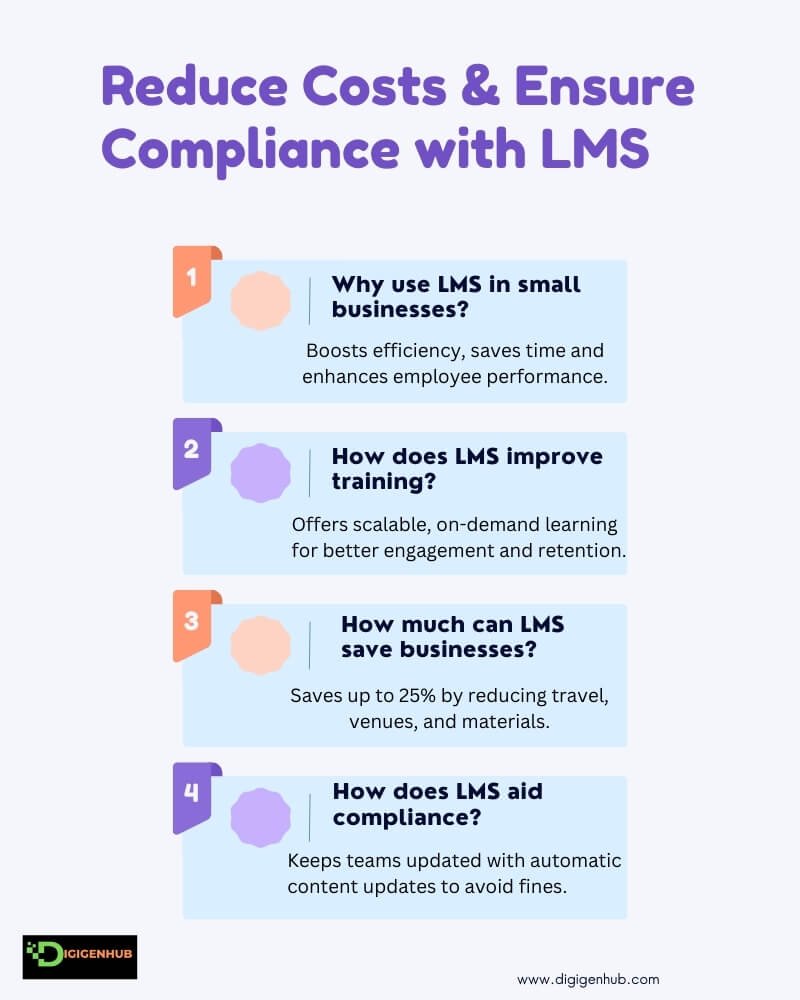
Reduce Costs & Ensure Compliance with LMS
Why use LMS in small businesses?
Boosts efficiency, saves time and enhances employee performance.
How does LMS improve training?
Offers scalable, on-demand learning for better engagement and retention.
How much can LMS save businesses?
Saves up to 25% by reducing travel, venues, and materials.
How does LMS aid compliance?
Keeps teams updated with automatic content updates to avoid fines.
How does LMS improve retention?
Continuous learning increases employee satisfaction and reduces turnover.
What are LMS analytics benefits?
Tracks progress, measures results and identifies skill gaps.
How does LMS boost remote team collaboration?
Enhances communication with forums and chat, increasing collaboration.
Why is LMS great for remote work?
Provides flexible training, boosting productivity for remote teams.
How does LMS foster continuous learning?
Encourages skill development, improving adaptability and productivity.
How does LMS impact productivity?
On-demand learning boosts productivity without disrupting work.