

The debate of humans vs AI is not about replacing people. It’s about combining human observation with AI to help businesses grow online.
At DigiGenHub, I handle almost everything myself. I research trends, track analytics and plan campaigns.
I use AI to draft content ideas and organize data. But I write posts, design visuals and make decisions using my own creativity.
I shape every headline, example and strategy to fit real audience needs. AI speeds up routine tasks, but I control the direction and add a human touch everywhere. Indeed, I think deeply and create the perfect prompt to get an accurate result.
Still, you need to learn how humans think differently from AI. Also, know where humans still lead, what AI can do and how both can work together.
Neuro-symbolic AI links human-like logic with machine learning power. It sees patterns and understands rules. This mix makes AI sharper, clearer and safer.
Humans vs AI: How Do Both Think Differently?
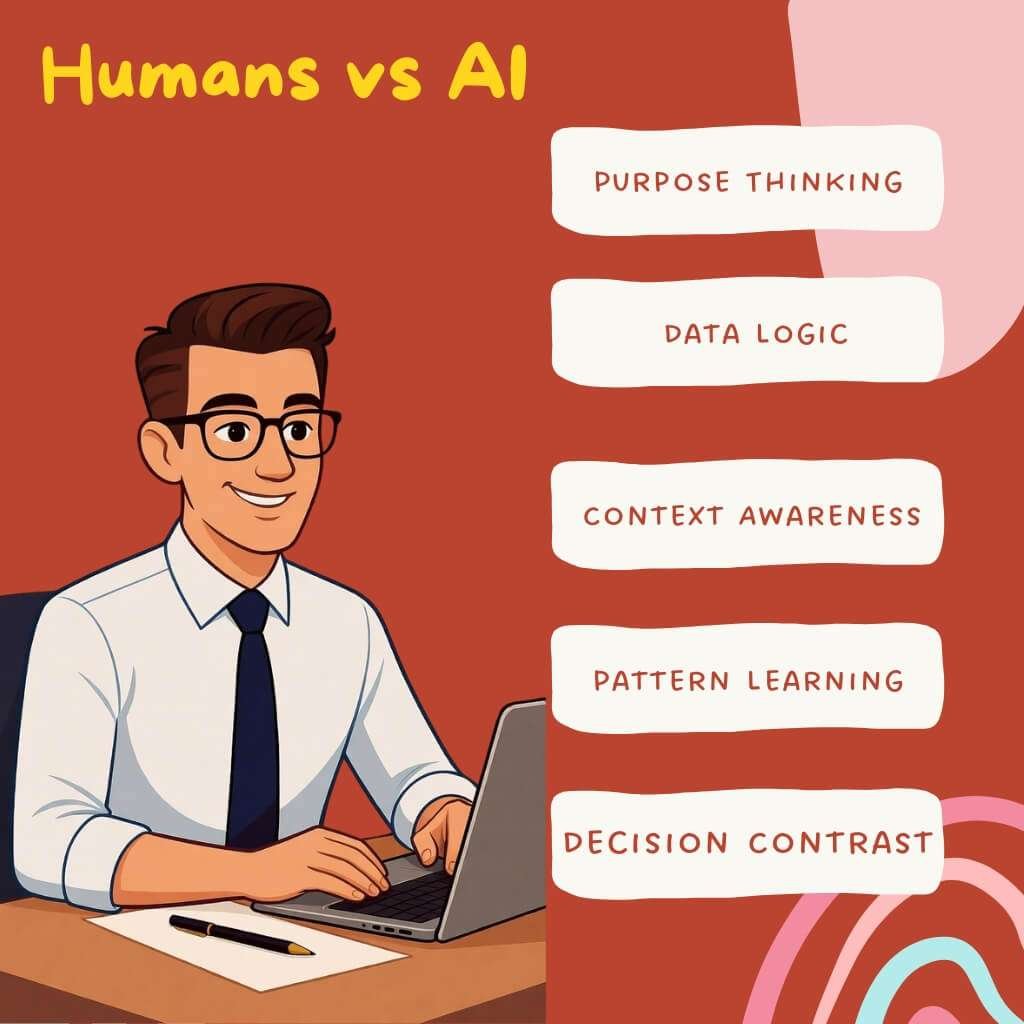
Humans and AI think in different ways. Humans see purpose and context. AI sees data and direction.
Core Comparison: Humans vs AI
| Point | Humans | AI |
| Learning base | Life events, emotion, context | Data, repetition, pattern |
| Adaptability | Handles change and chaos | Works best in fixed rules |
| Decision path | Intuition and judgment | Prediction and metrics |
| Reasoning | Abstract and causal | Pattern-based and statistical |
| Data need | Few examples | Huge training data |
| Sense of the world | Physical, emotional, social | Digital, coded, detached |
| Reflection | Can explain and reason | Often a “black box” |
| Combined power | Creative and moral | Fast and precise |
What “Intelligence” Signifies Today
Intelligence now means more than logic. Humans think, feel and act with context. Machines process, match and calculate 0. Both now cross paths.
Humans use algorithms to extend thinking. Machines learn from feedback to approach reasoning.
Still, human intelligence holds emotion and purpose. Machine intelligence holds data and precision.
How Humans Learn vs How AI Learns
Humans learn through stories, senses and emotions. We think first before using generative AI. We remember where, when and why something happened.
We draw lessons from life and apply them to new challenges. Emotion drives memory. If something moves us, we remember it longer.
Still, AI learns through repetition. It scans data, finds patterns and adjusts weights. No feeling. No sense of place or meaning. It doesn’t know why something matters, only that it repeats.
Example: A human picks up slang from a friend. AI needs thousands of samples to spot it in text.
Reasoning vs Recognition
AI recognizes. Humans reason. Recognition involves matching patterns, such as detecting faces or trends.
Reasoning means asking why and forming new ideas. Humans use limited clues to reach insight. AI predicts from probability. That’s why humans explain cause. AI forecasts effect.
New AI models now attempt to mimic causal steps, but they still rely on stored data. Reasoning remains our domain.
Humans Catch Sarcasm, Humor and Ethics
Humans catch tone and intent. Sarcasm, humor, or moral sense often stems from shared experiences. Say someone says, “Nice job!” after a mistake. Humans hear irony. Most AI systems still rate it as positive.
Ethics and humor depend on empathy and timing.
AI lacks that layer.
It may mimic humor but not feel it.
Humans sense emotion and culture. And machines only count words and symbols.
Why Humans Decide Better with Little Data
Humans can act with fragments. We use memory, instinct and emotion. We trust our past and adjust fast. AI fails when data is missing or messy. It works best in familiar ground. Humans fill the gaps. Machines calculate the known.
New Direction — Neuro-Symbolic AI
This is the new wave. It mixes neural networks with symbolic logic. Neural parts find patterns. Symbolic parts add reasoning. Together, they move closer to human-like judgment.
Researchers expect wide use by 2026 in health, finance and policy.
Neuro-symbolic models utilize less data and provide more accurate explanations of results. They also support safer automation in areas where ethics are a concern.
Case Study — IBM
IBM built a neuro-vector-symbolic model for reasoning tests.
It solved Raven’s Progressive Matrices more quickly and accurately than older systems.
Accuracy reached approximately 88%, and processing time dropped significantly.
IBM says this design enables businesses to integrate recognition and reasoning in AI workflows.
Where Do Humans Still Win?
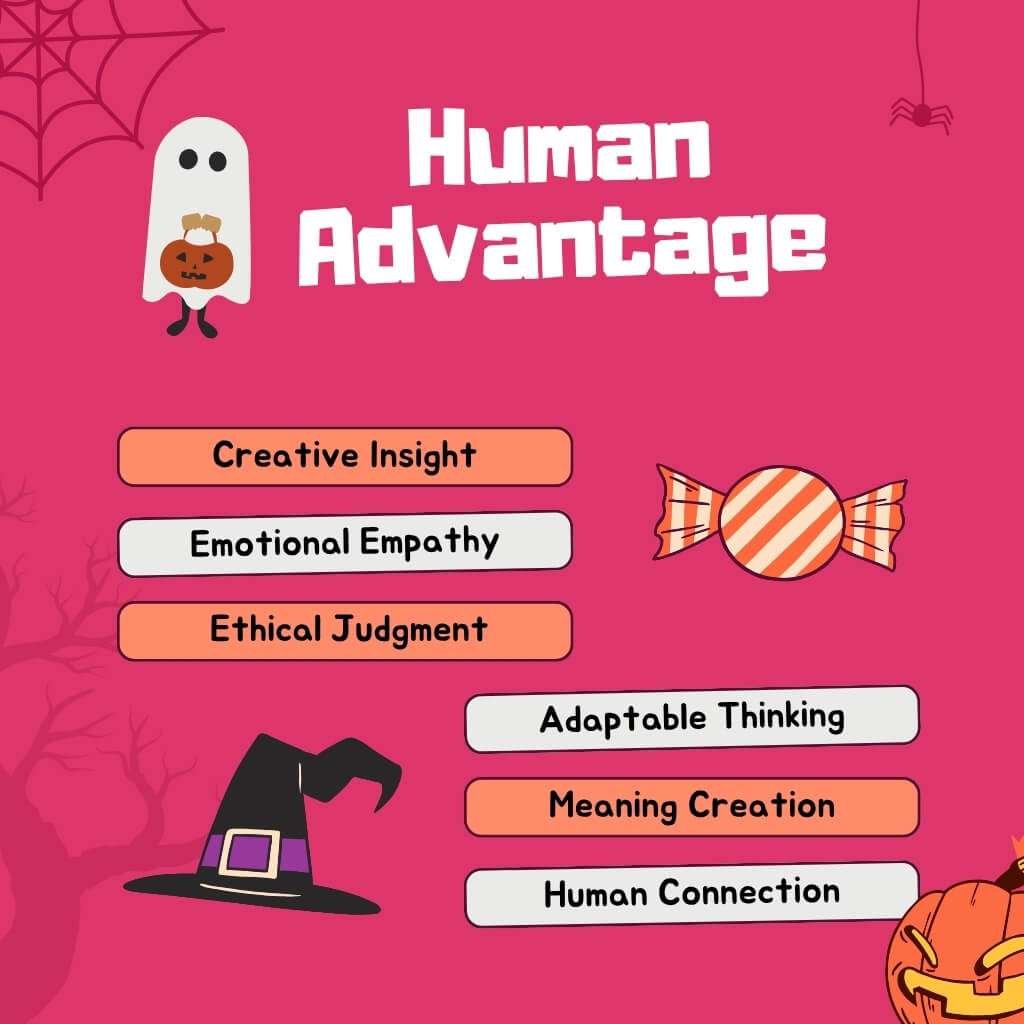
Machines copy patterns. Humans create meaning. Creativity, empathy and flexibility keep people superior and always will. Indeed, companies still rely on human touch even in an automated world.
1) Creativity — humans invent from the unknown
People imagine what data can’t predict. They combine thoughts, memories and emotions to shape new ideas.
A recent study shared by Axios found humans still create wider and bolder ideas than AI systems. Machines repeat patterns. Humans explore from doubt.
The U.S. Copyright Office confirmed this view. It ruled that a work earns protection only when a human adds genuine creative effort. (AP News)
2) Ethical judgement — where conscience still counts
Humans think beyond profit or metrics. They weigh fairness, impact and trust.
Machines don’t have that layer. They follow rules, not morals.
A hiring AI may filter resumes fast, but can’t sense fairness or empathy.
Telegram’s founder, Pavel Durov, said, “Machines may match logic or creativity, but they can’t replace the moral compass.” (Economic Times)
Companies plan to give more weight to ethical decision-making roles — places where human judgment ensures AI remains fair.
3) Adaptability — humans bend, AI repeats
People adjust when things shift suddenly. They react to emotion, trend and tone.
Machines depend on steady data. When markets change fast, humans read signals and act early.
AI product teams now prefer hybrid work: people who manage, tweak and question AI output. That mix keeps systems useful when conditions flip.
By 2026, “adaptive workers” will be among the top hiring priorities for AI-driven companies.
4) Context mastery — people sense what data can’t
Humans catch hints that aren’t written. Tone, facial cues and silence all speak.
That’s what builds trust in leadership, marketing, or service roles. AI may read language but not intention. It can’t tell if humor hides stress or irony hides truth.
Firms are adding “culture reviewers” to check if AI-generated ads or messages align with the tone and region. These roles protect reputation more than any software tweak.
Expert thought
“Human morality and nuance still outpace algorithmic precision. We need people where values and judgement decide outcomes.”
— Dr. Satyadhar Joshi, AI & Emotional Intelligence researcher (Preprints.org)
Case study — Deloitte’s “human-in-the-loop” hiring
Deloitte built a system that mixes AI skill-matching with human coaching. The AI scans profiles, but human mentors confirm cultural fit and ambition.
This mix cut hiring mismatches by 35 percent in its U.S. test.
Read more: Deloitte Human in the Loop
What Makes AI Powerful and Limited?
AI brings strong speed and scale. It pulls ahead in tasks defined by rules. Yet it reaches its limits when the job requires human judgment or moral decision-making.
1) Speed and Scale — where machines excel
AI handles huge volumes of data in seconds.
According to the Stanford Institute for Human‑Centered Artificial Intelligence (HAI) 2025 report, the benchmark performance of AI continues to improve sharply.
For example, a model’s task-length capability doubles about every 7 months.
In the USA enterprises, this means faster decisions, automated workflows and coverage of larger markets.
2) Accuracy and Consistency — why machines win in defined tasks
In medicine or logistics, machines reduce human error and stay fresh 24/7.
AI models now exceed many human benchmarks in narrow domains.
Because machines don’t fatigue, they repeat tasks with the same rules and metrics.
Firms report that consistent automation helps in finance, audit and supply-chain.
Data-driven sectors in the US anticipate increased automation by 2026, as repeatable tasks are expected to dominate.
3) Limits — what AI still cannot do well
AI lacks self-awareness. It doesn’t have its own motivations or goals.
It cannot form moral values on its own or judge right from wrong outside supplied data.
Machines often miss context, tone or purpose in unexpected situations.
A recent report found that advanced reasoning models collapsed on complex tasks beyond benchmark domains.
So, when situations deviate from training data, AI fails. Humans still handle change and novelty better.
Why do AI models still need human oversight?
Because AI can’t manage every risk alone.
Humans check for bias, unfair outcomes and shifts in the environment.
Humans interpret values, ethics and trade-offs.
Regulatory frameworks require human review for high-impact AI. For example, the Organisation for Economic Co-operation and Development (OECD) AI Principles emphasise the importance of human supervision.
Without oversight, companies face trust issues, legal risk and reputation damage.
Ethical touchpoint — bias, deepfakes and over-reliance
AI systems inherit bias from training data.
AI can generate misleading content (deepfakes), which harms trust and brand.
A joint statement highlights global risks: suppression, manipulation and discrimination via AI.
Firms must treat AI as a tool, not a decision-maker with no human input.
Business ethics of AI deployment are now a priority heading into 2026.
Expert thought
“Machines deliver scale, but humans must validate value. Transparency and oversight make AI responsible.”
— Dr. Marissa Lee, AI governance researcher, quoted in “Trust in AI: Progress, Challenges, Future Directions”.
Case study — Company: Google DeepMind (Medical diagnostics)
Google DeepMind has deployed an AI tool for eye disease detection. The system read thousands of retinal scans and flagged potential issues faster than prior methods.
However, the company kept human ophthalmologists informed for the final diagnosis and patient context. Website: https://deepmind.com/health
The Future: How Humans and AI Will Work Together
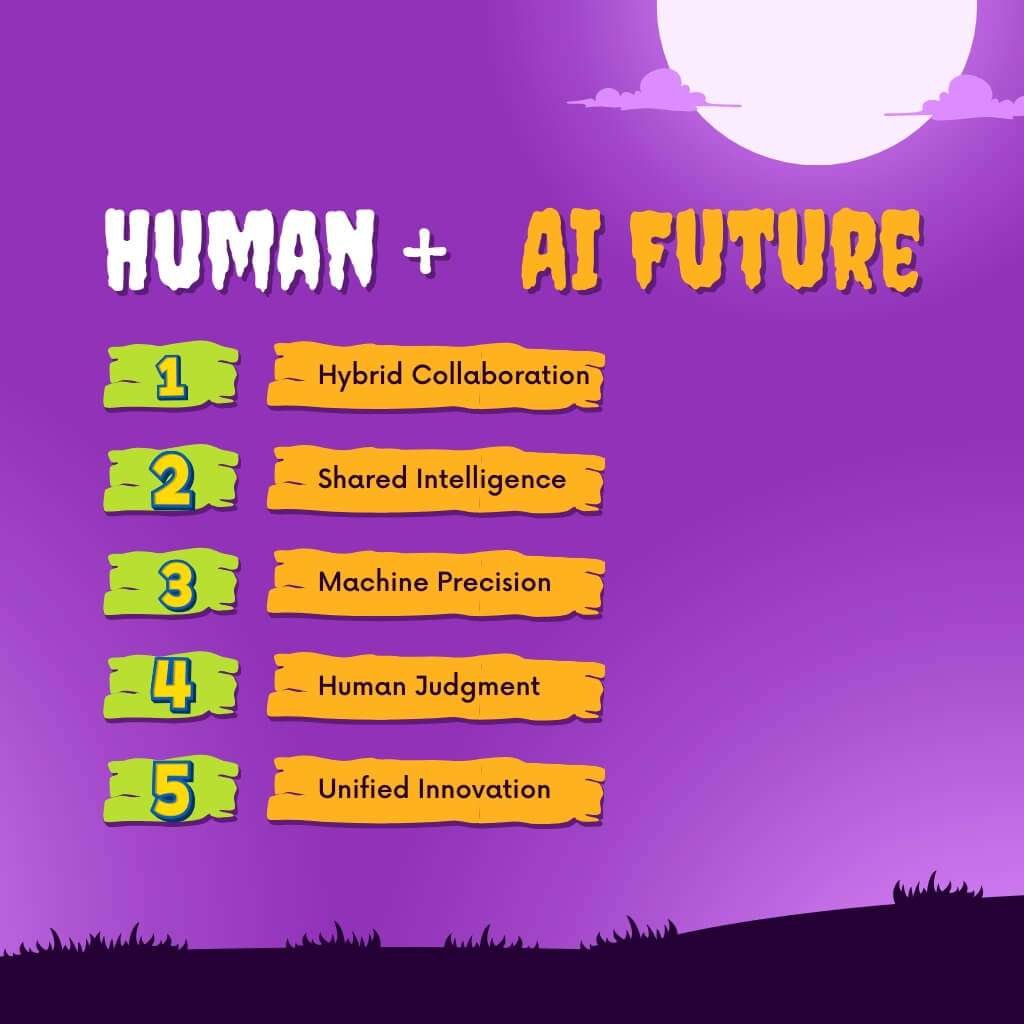
The best future is hybrid. Human insight paired with machine precision wins.
In 2026, the winner won’t be “man or machine” — it will be “man and machine”.
We move from a mindset of “Humans vs AI” to “Humans + AI”. The strongest teams will pair human judgment with machine power.
AI takes on routine — humans do the rest
AI will handle heavy lifting and repetitive tasks. Humans will steer strategy, build connections and spark new ideas. In 2026, U.S. companies will shift roles: AI will handle data work, while people focus on meaning and direction.
2) Examples
a. Marketing teams: An ad agency uses AI to test 100 image/text combos.
Humans pick the ones that feel right for culture, brand tone and emotion.
b. Healthcare: A doctor uses an AI diagnostic tool.
Then the doctor explains the results, answers questions and recommends next steps.
c. Entrepreneurship: A startup uses AI analytics to spot market gaps. The founder uses gut feel, network and vision to pick a path and build culture.
How can you stay relevant in the AI-driven job era?
Let’s see a clear list:
Learn how AI works — not deep tech, but what it can and can’t.
Build skills machines can’t copy: empathy, storytelling, leadership.
Ask better questions than AI: what, why and for whom.
Work with AI tools, not against them.
Update your role each year: by 2030, 39% of workers’ core skills will have changed.
Skills that are urgently needed
Here are the most demanded human skills:
1 . Critical thinking & problem framing.
2 . Emotional literacy: reading feelings, guiding teams, cultural fluency.
3 . Ethical AI literacy: knowing how to work with AI responsibly.
4 . Collaboration: humans + machines + humans.
5 . Lifelong learning: adapting as tools change faster.
Expert quote
“Teams of the future will not separate humans and AI — they will combine them in new workflows where each does what they do best.”
— Bryan Ackermann, Korn Ferry (“TA Trends 2026: Human-AI Power Couple”)
Case study — Company: Seagate Technology
Seagate Technology prepared its workforce for human-AI collaboration ahead of 2026.
The company introduced training programs that utilized AI agents for data processing.
Then, human teams focused on design decisions, customer value and innovation.
The hybrid model helped Seagate launch new products more quickly and enhanced employee engagement.
Website: https://www.seagate.com
Conclusion
Humans are the CEOs, AI is the analytics dashboard. Strategy flows from insight, while AI handles the spreadsheets. Creativity is the currency humans invest in to earn trust and growth. Machines run the operations; humans close the deals. Together, they turn every market challenge into profit.
FAQ
What new job titles will emerge as humans + AI teams grow in 2026?
Expect roles like “AI‑Ethics Facilitator”, “Human‑AI Workflow Designer” and “Contextual Insight Partner” to become common in U.S. workplaces.
Will everyday people use AI assistants at home by 2026?
Yes. More households will have AI tools for chores, personal planning and learning, with human oversight still required.
How will learning and training adapt for human‑AI collaboration in 2026?
Training programs will blend soft skills (empathy, judgment) with AI oversight skills (interpreting machine output, adjusting workflows).
What kind of businesses will lead in human + AI integration by 2026?
Companies that embed both human judgement and AI tools into core workflows — e.g., service firms, health, legal and creative agencies.
Will small businesses be able to afford human‑AI partnerships by 2026?
Many will. Affordable AI tools, combined with human oversight, are becoming more accessible, enabling small firms to adopt scaled-down human-AI models.
How will human identity at work change when AI is more present in 2026?
People will shift from process‑execution roles to “interpretation, meaning‑making and value creation” roles. Work will centre more on human insight.
What risks will arise for workers when human + AI teams become standard in 2026?
Risk: Workers without oversight, human judgment, or decision-making skills may be sidelined. Workers must develop complementary abilities.
How will organizations measure success for human + AI teams in 2026?
Success metrics will include human‑machine workflow fluency, human judgment impacts, transparency of AI actions and not just speed or cost.
Will regulation increase for human-AI systems by 2026?
Yes. U.S. regulators and global bodies will push for mandatory human‑in‑loop controls, audit trails for AI decisions and clarity on who is responsible.
How can someone prepare their career for the 2026 human-AI era?
Start by mastering how to partner with AI: ask the right questions, interpret AI output and make decisions where machines stop. Build ethical judgement and collaboration skills.