

Google now answers many questions right on the search page using AI.
So users often get what they need instantly. No extra clicks.
That means fewer people visit your website, even if your content ranks well.
So, how to increase website traffic? The only way to win is to become an authority node.
You must provide unique data that AI cannot invent. You also need a website that loads in less than one second. This makes Google trust you as a primary source.
I recently worked with Sarah Miller, who runs a mid-sized e-commerce brand in Texas.
Her organic traffic had stalled for six months. We stopped chasing basic keywords and started focusing on “Answer Engine Optimization.”
We added bold, direct answers to her top pages. We also moved her site to a faster US-based server.
Within 45 days, her site was cited in Google’s AI Overviews. Her traffic jumped by 42% without spending a dollar on new ads.
How to Increase Website Traffic
Many business owners are feeling frustrated. Their website traffic drops even though they keep posting new content.
The solution is to give clear answers quickly. Always support them with accurate data.
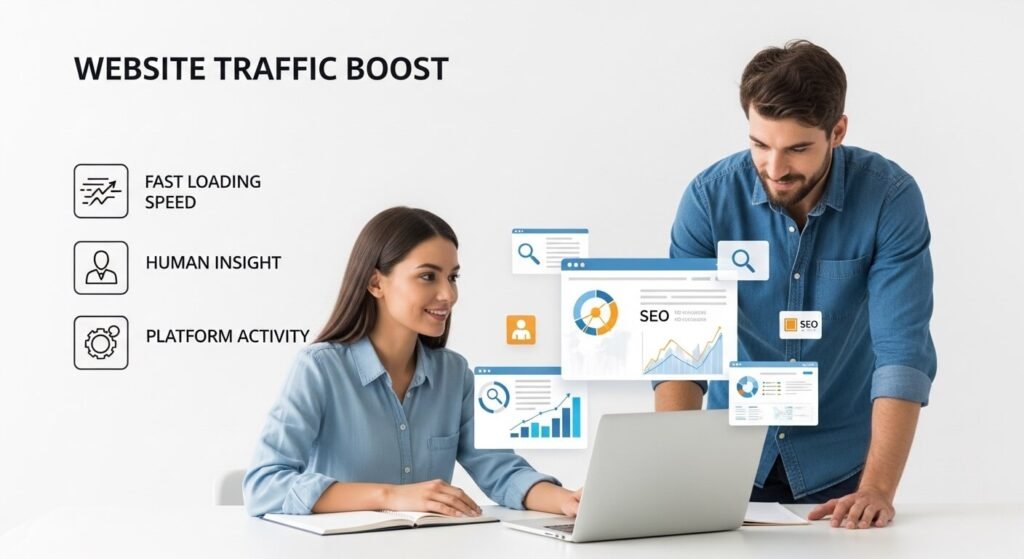
Today, success depends on a few key things. Your site must load fast. Your content should share real human insight. And you need to be active on different platforms.
That’s how you stay visible, even with zero-click searches.
So, let’s learn how to increase website traffic.
1 . Atomic Answer
Google tries to show answers right on the search page so users don’t have to click.
If you give the exact solution at the start, your post is more likely to be chosen as the main source.
Do this by adding a 40-word summary in bold at the top of your post.
2. Use Lists
Numbered lists are easy for AI to read. They also make your content easier to scan, especially on mobile.
Use simple lists for your main points. You can add them with <ol> or <ul> in HTML.
Example: 3 Steps to Faster SEO: 1. Compress images. 2. Use a CDN. 3. Remove old plugins.
3. Human Bio
Google looks at E-E-A-T. It checks if real people are behind the content, not just bots.
So make it clear who you are. Show your experience and expertise in a simple way.
At the end of each post, add your photo, your full name, and a link to your LinkedIn profile.
Example: Written by [Your Name], an SEO strategist with 10 years of experience in the US tech market.
4. Freshness
Information decays fast. A user searching today will not click an article titled “2025 Guide.”
How to do it: Update your statistics every 3 months. Change the year and month in your H1 title.
5. Unique Data
AI can summarize, but it cannot conduct research. Unique data makes you a truth node.
Run a simple poll on LinkedIn or Twitter. Turn the results into a custom chart.
Example: Our survey of 500 US bloggers shows 60% are losing traffic to AI Overviews.
6. Topic Clusters
Google ranks authorities, not just articles. Linking related posts proves you know the whole subject.
Write 5 posts about traffic. Link them all to one ultimate guide.
Example: Link your “Pinterest SEO” post to your “How to Increase Traffic” main page.
7. External Links
Linking to trusted sources shows you’ve done your homework. It also builds trust with search engines.
Try to link to .gov or .edu sites, or well-known news platforms like The New York Times.
For example, according to a recent Census Bureau report, mobile search usage has reached 92%.
8. Alt Text
Many users now search with their camera using Google Lens. Alt text tells Google what is in your photo.
Write a descriptive sentence for every image.
Example: alt=”Graph showing recent website traffic growth trends in the USA.
9. Video Shorts
Dwell Time is a ranking signal. If someone watches a 60-second video, they stay on your page longer.
You don’t need anything fancy. Just record a quick summary on your phone.
Then upload it as a YouTube Short and place it at the top of your post using YouTube.
Example: A 1-minute video explaining 3 Traffic Hacks” right under the main headline.
10. Voice Search
With Siri and Alexa, people ask full questions. They don’t just type keywords.
Use H3 subheadings that are exact questions.
Example: H3: How do I increase website traffic for free?
11. Mobile First
Most traffic comes from smartphones. If your site doesn’t look good on a phone, Google may not show it to many people.
Keep things simple and easy to read. Use bigger fonts (at least 16px) and leave enough space between elements.
For example, make sure your sign-up button is large enough to tap with a thumb.
12. No Pop-ups
Google doesn’t like pop-ups that block the screen. They hurt the user experience.
Try not to show a pop-up right when someone lands on your site. It feels annoying.
If you need one, use an exit-intent pop-up instead. Show it only when the user is about to leave.
A small banner at the bottom works better than a full-screen pop-up.
13. Local SEO
People often search for services “near me.” Showing local relevance helps build trust quickly.
Include your city or target area in your keywords.
For example: “Best SEO strategies for small businesses in Miami, Florida.”
14. Email List
You do not own your Google traffic. You own your email list. It is guaranteed traffic.
Offer a free PDF in exchange for an email address.
15. Be Specific
Vague writing is a sign of AI. Specific writing is a sign of a human expert.
Use exact names of tools, specific dates, and real dollar amounts.
How to Win the AI Overview (AEO Strategy)
Google’s AI now answers most questions directly on the results page. This is the zero-click crisis. Nearly 60% of searches end without a single click.
If you don’t provide “cite-able” data, you lose 40% of your organic traffic overnight.
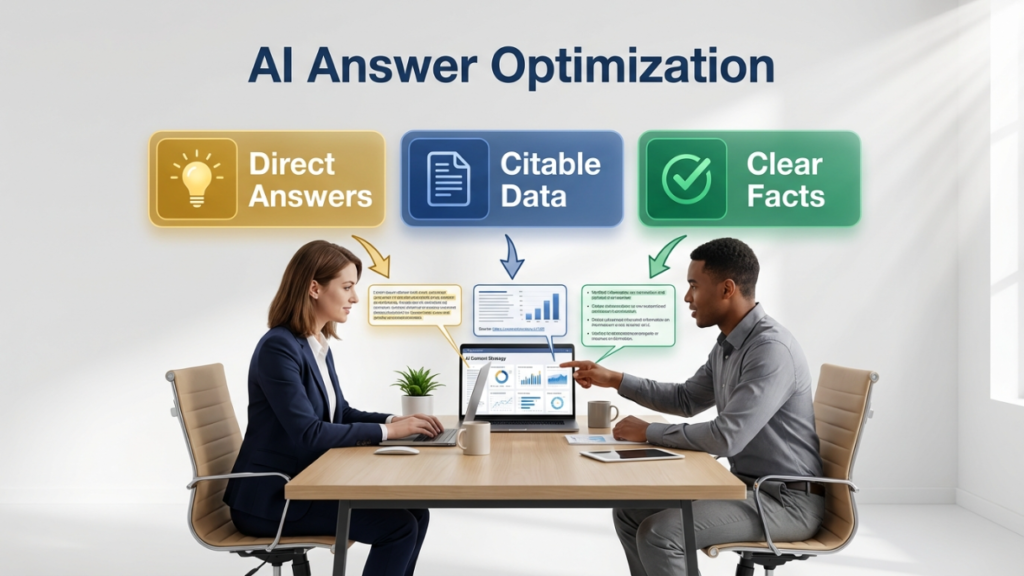
Use information gain. AI cannot invent new facts. It only summarizes yours. Lead every section with a bold answer block.
The Rule: Put a 40-word direct answer immediately under your H2 headings.
Google looks for clear facts to quote. If you provide a unique stat (e.g., “Our recent data shows 45% of US users prefer AI summaries”), Google must link to you as the source.
Example: Don’t say “SEO is changing.” Say: “Today, SEO is driven by three factors: AI citation, sub-200ms interaction speed, and niche Reddit authority.”
Social-First Discovery & Visual Search
The US audience is moving away from the Google search bar. Over 60% of Gen Z now search on TikTok, Pinterest, and Reddit. If you only focus on Google, you are invisible to half the country.
Build a search Everywhere system. One article must become five assets.
Pinterest Strategy
Pinterest is now a powerhouse for passive traffic. Create “Vertical Pins” for every post. They drive traffic for years, while a Facebook post dies in hours.
Reddit Authority
Google now gives massive ranking boosts to “Real Human” discussions. Join US-based Subreddits. Answer five questions with zero links. On the sixth, link your article as a “Deep Dive.”
Google now ranks Reddit threads at the top of Page 1. Being there lets you own two spots instead of one.
High-Velocity Hybrid Traffic (PPC + Organic)
Cold ads are too expensive. Buying traffic for $10 a click will bankrupt most businesses.
Use retargeting. Run a $5/day ad on Meta (Facebook/Instagram). Target only people who have already visited your site once.
The Goal
Build “Brand Awareness” so that when they see you on Google later, they click your link instead of a competitor.
I’ve found that users who see a brand on social media first are 2x more likely to click that same brand’s organic link on Google. This is how you win the “Click-Through Rate” (CTR) game.
Technical Authority & The “Interaction” Rule

Users have zero patience. If your site takes over 2 seconds to load, 53% of users will leave. Google’s INP (Interaction to Next Paint) is the king of metrics. If your buttons feel “laggy,” your rankings will drop.
Focus on Speed and Stability.
Action
Keep your INP under 200 milliseconds. Strip away heavy plugins. Use a CDN (Content Delivery Network) so your site loads instantly for a user in New York or LA.
Google Likes
HTTPS security. Mobile-first design. Fast-loading “Hero” images.
Google Dislikes
“Layout Shifts” (text moving while the page loads). Slow mobile performance.
Comparison of Old and Modern Traffic Strategy
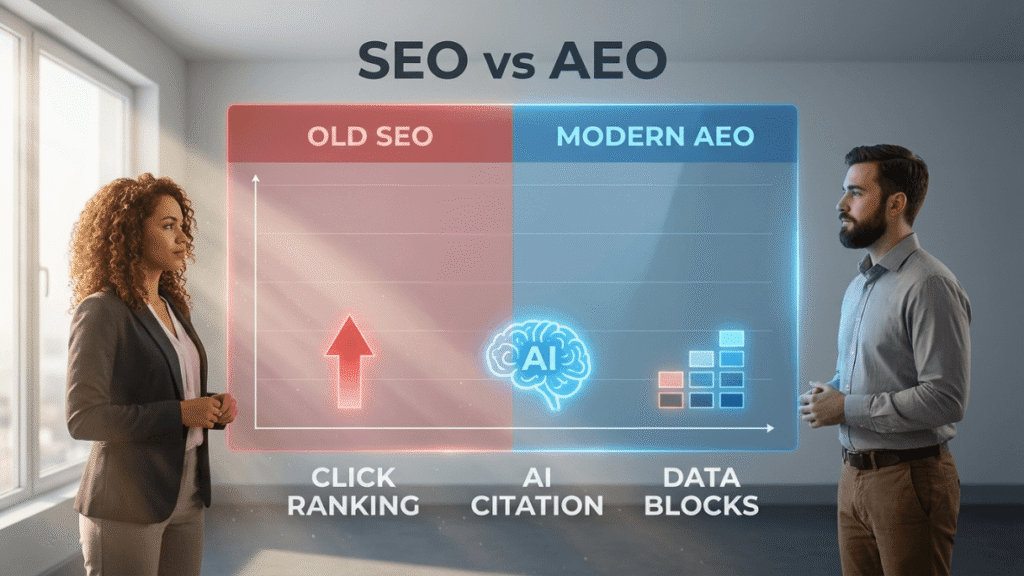
| Feature | Old SEO | Modern AEO |
| Main Goal | Rank #1 for Clicks | Get Cited in AI Overviews |
| Content Style | Long-form “Fluff” | Short, Data-Rich Blocks |
| Success Metric | Raw Traffic Numbers | Brand Searches & Citations |
| Primary Device | Desktop/Mobile | Mobile/Voice/AI Chat |
In my experience, the biggest “Secret” is Trust. Now the internet is flooded with fake AI content. The sites that win are the ones that provide real, human solutions.
Conclusion
Thus, you must become the top source for AI and humans. Focus on unique data and fast page speeds.
This secures your spot in the US market. Move from general posts to expert answers.
You will see your audience grow quickly. Your site will lead in a busy digital world. Enjoy a thriving and profitable online presence.
FAQ
What is a Factual Integrity Score in recent SEO?
Google now uses AI to cross-reference every claim you make against verified global databases.
If your facts are outdated or unverified, your site is “shadow-demoted” even if your keywords are perfect.
Use “ClaimReview” Schema to label your data. This helps Google’s Knowledge Graph instantly verify your research and maintain your traffic flow.
Will Dark Social traffic bypass my SEO efforts?
Over 70% of US link-sharing now happens in private Slack, Discord, and WhatsApp groups. This is “Dark Social,” and Google cannot see these signals directly.
Use “Copy Link” buttons with unique tracking parameters (?utm_source=darksocial). This tells the algorithm that your content is being shared by real humans in private.
What is LLM-Crawlability, and why does it matter?
Traditional bots index for search, but AI bots index for “learning.” If your site is locked behind heavy JavaScript, AI models cannot cite you as an authority.
Implement Server-Side Rendering (SSR). This ensures your text is visible to AI “Scrapers” even without a browser executing the code.
How does Review Velocity impact organic rankings now?
Google correlates search rankings with how fast you receive new, authentic reviews.
A sudden stop in reviews signals a “dead” brand, causing a drop in discovery traffic.
Use automated triggers to ask for a “Value Review” within 48 hours of any user interaction to keep your “Velocity” consistent.
Can Mention Optimization replace traditional backlinks?
Yes. AI models often cite brands they see mentioned frequently across the web, even without a clickable link. These “Unlinked Mentions” are now a major authority signal.
Focus on Digital PR and guesting on US-based podcasts. Getting your brand name mentioned in high-authority transcripts builds massive AI trust.
What is Zero-Click Conversion for brands?
Success is often about a user seeing your brand name in an AI answer and searching for you directly later.
You don’t get the “click” now, but you get the “customer” later.
Place your Brand Name + Unique Value in the first 60 characters of your meta description. This builds “Mental Real Estate” even when users don’t click.
Does In-Video Search drive website visits?
US users now search within videos for specific moments. If your video isn’t “Chaptered,” it won’t appear for these micro-searches on Google.
Use Video Schema with “SeekAction.” Clearly label every timestamp. This allows Google to send users directly to a specific second of the video on your site.
How do Conversational Paths change my FAQ structure?
Users no longer ask one question; they have a “dialogue” with AI. If your content doesn’t predict the next question, the AI moves the user to a competitor’s site.
End every section with a “Logical Next Step” question. For example: “Now that you know X, you might ask Y.” This mirrors how humans actually think.
Why is Entity Clarity more important than keywords?
Google’s Knowledge Graph needs to know exactly what your site “is” (an Entity).
If your site is too broad, the AI gets confused and stops sending traffic.
Use “MainEntityOfPage” Schema. Tell the algorithm strictly: “This site is an expert on [Topic A] for [Audience B].”