


Operating without a contract in today’s freelance world? That’s like jumping from a plane without a parachute. No clarity. No cover. No control.
Clients can change their minds. So, money can vanish. Deadlines stretch forever.
Indeed, a contract isn’t just paper. It’s your armor. Your proof. Your peace.
So, you must know how to create a contract for freelance work. Earn trust on paper. Secure your worth. Protect your time. Lead with terms. Don’t chase respect. Command it with an authoritative agreement.
How to Create a Contract for Freelance Work: Freelance Job Contract
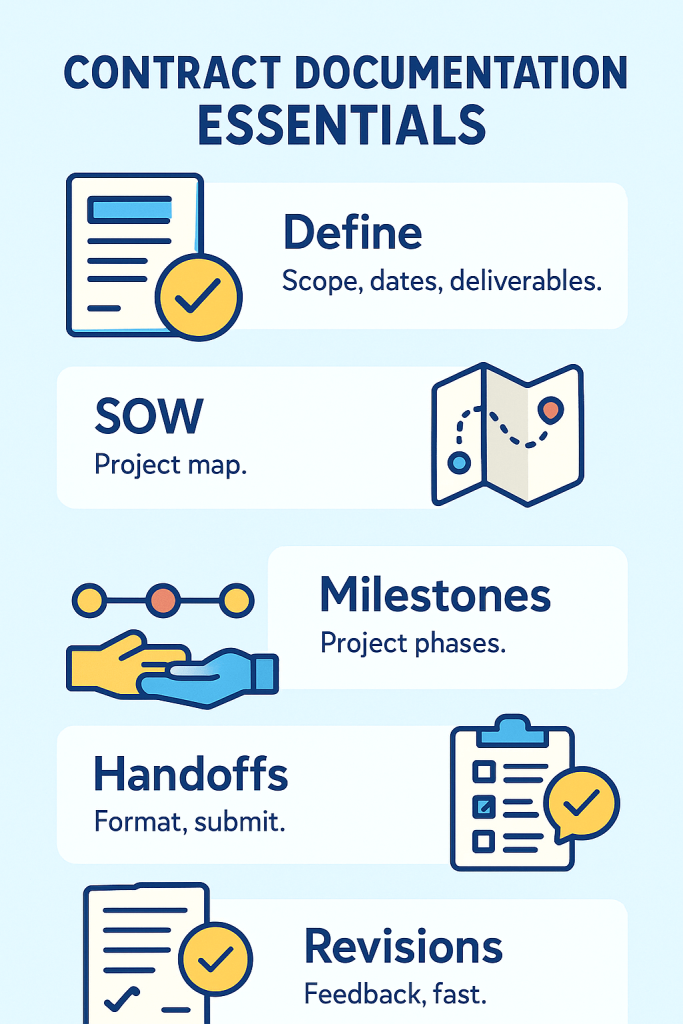
A well-crafted freelance job contract isn’t just a formality; it’s your business’s backbone. I have already explained the core elements of a freelance job contract.
Yet, you may ask, how should project scope, deadlines and deliverables be documented? To effectively document these elements:
Use a Statement of Work (SOW): This document outlines the project’s purpose, services, deliverables, timelines and payment terms in detail.
Define Clear Milestones: Break the project into phases with specific deliverables and deadlines. This approach facilitates progress tracking and timely payments.
Specify Formats and Submission Methods: Clearly state the expected formats (e.g., PDF, Word, JPEG) and how deliverables should be submitted (e.g., email, cloud storage).
Include Review and Approval Processes: Outline how and when feedback will be provided and set timelines for revisions to keep the project on track.
Freelance Terms Explained: Clients and Freelancers Need to Agree On
Crafting a clear freelance contract is a must. It protects both sides. It locks in clarity. It keeps trust sharp and risks low.
Independent Contractor Status: Clarify that the freelancer is not an employee. This affects tax and legal responsibilities.
Written Agreement: Always have a written contract, even if not legally mandated. aaronhall.com
Signatures: Ensure both parties sign the contract. Digital signatures via platforms like DocuSign or PandaDoc are legally recognized.
Compliance with Local Laws: Be aware of regional regulations, like the FWPA in California, to ensure your contract meets all legal requirements.
Ownership Rights: Define who retains rights to the work. This is crucial for intellectual property considerations.
Termination Clause: Outline conditions under which the contract can be ended by either party.
Confidentiality Agreement: Protect sensitive information shared during the project.
Late Payment Penalties: Include fees or interest for overdue payments to encourage promptness. en.wikipedia.org
Dispute Resolution: Establish methods for resolving disagreements, such as mediation or arbitration. ogletree.com
Contract Drafting for Freelancers: Should You Write It Yourself or Use a Template?
You may ask, can freelancers legally draft their own contracts? Of course.
The complexity of the project and the possible legal implications should guide this decision. For straightforward projects, self-drafting using reliable templates may suffice. For more complex engagements, consulting with a legal professional is advisable.
What are the Best free and Paid Tools for Contract Drafting?
For the contract creation, you can use several tools:
Aline: AI-powered and fast. Automates boring bits. Keeps contracts sharp and compliant.
Genie AI: Smart templates. Real-time clause help. Fewer errors. Faster drafts.
PandaDoc: Ready-made templates. Drag-and-drop style. E-sign built in.
DocuSign: Industry giant. E-sign with full legal cover. Trusted by pros.
ContractExpress: Built by Thomson Reuters. Best for complex work. Automates the heavy stuff.
These tools cut time, reduce mistakes and help you look like a pro every time.
Why are More Freelancers Using Written Agreements Now than Ever before?
Most of the dedicated freelancers want proof, not promises. That’s why contracts matter most now. Let’s explain:
Market Growth
The freelance market has crossed $500 billion recently. That shows how big it really is in the world economy.
Technological Advancements
AI and digital tools have made contract work easier. Writing and managing deals is now quick and clear. Freelancers can set terms without the old hassle.
For example, a platform like Bonsai launched faster contract tools. This lets freelancers create, send and track deals in minutes.
Professionalism and Trust
Clients now expect contracts, no questions asked. It shows you’re serious. It builds clarity. It earns real trust in every deal.
Sprintlaw showed how clear client agreements cut risk and boost business. This fortifies why real pros never skip the paperwork. (sprintlaw.com.au)
Are Verbal Agreements Legally Binding?
Verbal agreements can be legally binding if they meet certain criteria. These are offer, acceptance, consideration and mutual intent.
However, they are challenging to enforce due to the lack of tangible evidence. Written contracts provide clarity and are generally preferred, especially for significant engagements. lawdepot.com
Independent Contractor Agreement vs. Freelance Contract: What’s the Difference
To judge this, let’s see the following table:
Independent Contractor Agreement vs. Freelance Contract
| Aspects | Independent Contractor Agreement (ICA) | Freelance Contract |
| Engagement Duration | Typically long-term or project-based, with defined timelines | Often short-term or task-specific |
| Legal Formality | High; includes detailed clauses on scope, payment, IP rights and dispute resolution | Moderate; may be less detailed but should cover essential terms |
| Tax Implications | Contractor responsible for self-employment taxes; client issues 1099 forms in the U.S. | Freelancer handles their own taxes; varies by jurisdiction |
| Use Case | Suitable for specialized roles requiring autonomy and specific deliverables | Ideal for creative or ad-hoc tasks with flexible requirements |
| International Use | Preferred for cross-border engagements to address jurisdictional and compliance issues | Less common; may lack provisions for international legal considerations |
When Should You Use an Independent Contractor Agreement?
An independent contractor agreement is advisable when:
Engaging Specialized Services: Hiring professionals for roles requiring specific expertise, such as software development or consulting.
Long-Term Projects: The work spans an extended period. This necessitates clear terms and conditions.
Autonomy in Work Execution: The contractor operates independently. This controls how the work is performed.
Compliance and Risk Management: To delineate responsibilities, protect intellectual property and mitigate misclassification risks. fingercheck.com
In the U.S., the Freelance Isn’t Free Act mandates written contracts for freelance work exceeding $800. This emphasizing the importance of formal agreements .en.wikipedia.org
Freelance Pricing Contract: How to Structure Payment Terms
Your pricing sets the tone. So, get it right and everything falls into place. Clear terms protect your time and your value. Let’s learn how to set up your freelance contract for success:
Freelance Pricing Contract Structure
| Component | Standard Practice | The Significance |
| Pricing Method | Hourly for flexible workProject-based for clear scopesMilestones for large jobs | A well-mapped payment prevents confusion |
| Scope Creep | Fixed deliverablesPaid change requests | Avoids unpaid extra work |
| Late Payments | 30–50% upfrontNet 7 or Net 14 terms2–5% late fee | Encourages on-time payments |
| Revisions | Max 2 rounds includedExtra billed separately | Keeps workload and time under control |
| Deposits & Milestones | Use milestone billing for projects over $500 | Cash flow protection + transparency |
| Tools Used | Bonsai, Moxie, Payoneer, TransferWise, DocuSign | Smooth handling, tracking and security |
Should you charge per hour, per project, or with milestone payments?
Use per hour when tasks change often. Use per project when the work is fixed. Use milestone payments for jobs above $500 or longer than 2 weeks.
Still, 57% of freelancers on Upwork use milestone-based billing because it builds trust and secures income regularly. Always match the pricing model to the task type, not client preference.
How do you handle scope creep?
Write clear limits in the contract. List what’s included and what’s not. Add a “change fee” clause. 43% of freelancers say scope creep is their top income killer. Stop it early with signed approval for extra work.
How do you handle late payments?
Ask for 30%–50% upfront. Set due dates like net 14 or net 30. Add a 2% weekly late fee in your contract. Yet, 1 in 4 freelancers still report delayed payments, mostly due to vague terms. Use tools like Payoneer, Bonsai, or QuickBooks for auto-reminders and secure payouts.
How do you handle revision limits?
Limit to 2 free rounds. After that, charge per revision or per hour. Write this in your contract. Over 60% of freelance designers use revision caps to protect their time and earnings.
Freelance Project Agreement Essentials: What Do Clients Expect to See?
I have already presented that clients prefer clear freelance agreements with a defined scope of work, timelines and payment terms.
They value revision policies, confidentiality and intellectual property rights. Clear termination clauses and communication protocols ensure smooth collaboration.
Fundamental Abilities for Freelancers
Professionals should cultivate the following skills in the freelance market:
Contract Literacy: Understanding legal terms and the ability to draft clear contracts is crucial. Resources like the Freelance Isn’t Free Act provide guidelines for fair agreements. yunojuno.com
Digital Proficiency: Clients seek freelancers with niche skills in areas like AI, blockchain and digital marketing .linkedin.com
Familiarity with contract management tools and platforms enhances efficiency and compliance.
Negotiation Skills: Effectively communicating terms and setting expectations ensures mutually beneficial agreements.
Attention to Detail: Ensure all contract elements are precise and comprehensive.
Effective Communication: Clear and professional communication is crucial for project success.
Time Management: Meeting deadlines and managing workloads efficiently builds client trust.
Adaptability: Being flexible and responsive to client needs enhances collaboration.
How do you set client expectations with deliverables in the contract?
To meet client expectations with deliverables, list what you’ll do, when you’ll do it and how you’ll deliver it in exact words.
Break it into milestones, attach dates and mention formats (like PDF, PNG, etc.). Use checklists, not vague promises.
71% of freelancers who use itemized deliverables report fewer conflicts and 2x faster approval (Upwork Trends Report 2025). Always add limits like 2 revisions and define what counts as “done.”
Contract Clauses for Freelancers: What to Include for Full Legal Coverage?
A freelance contract must include specific clauses to ensure full legal protection and be ideal for current laws and market expectations. You must know about the freelance terms or essential clauses for freelancers that I have explained.
Yet, how to include clauses on confidentiality, ownership, termination and liability? Let’s learn:
Confidentiality
Say both sides will keep things private. No leaking files, chats, or client info. Keep it in place even after the project ends. Almost 82% of top clients now expect this (Forbes).
Ownership
Write that the client gets full rights only after full payment. Until then, the work is yours. This protects your ideas like a lock on your door.
Termination
Say how to end the deal. Give a short notice—like 7 days. Add that any finished work must be paid for. This keeps exits smooth, not messy.
Liability
Limit blame. Say you’re not liable if tech breaks, emails bounce, or tools fail. Cap any damage at the project fee. No freelancer wants to pay for someone else’s storm.
Why You Must Know How to Create a Contract for Freelance Work
No contract? Get ready for ghost clients, late cash and scope creep. You might work hard and still lose it all. What are the biggest risks of freelancing without a contract? Let’s get clear on the issues:
Legal Vulnerabilities
New regulations, such as California’s Freelance Worker Protection Act, are live from Jan 1, 2025. If the job’s over $250, a written contract is a must. No paper? No protection. Non-compliance can lead to legal disputes and financial penalties. (gunder.com)
Payment Issues
Without a contract, freelancers risk delayed or non-payment. A study highlighted that 62% of freelancers in New York experienced wage theft, with 53% losing up to $10,000 .en.wikipedia.org
Scope Creep
Undefined project boundaries can lead to additional work without extra pay. Contracts set the rules and guarantee you get paid right.
Conclusion
Summing up,you have learned all about how to create a contract for freelance work. The freelance platform market is projected to grow from $8.39 billion in 2025 to $16.89 billion by 2029. This indicates an immense demand for freelance services. 60% of companies prefer hiring freelancers over full-time staff for project-based work. This emphasizes the need for clear agreements. linkedin.com. So, keep yourself updated.
FAQ
What is a freelance project agreement and how is it different from a basic contract?
A freelance project agreement is a detailed contract made for a single project. It includes the task list, deadline, payment terms, revision limit and ownership rights. It’s more focused than a basic contract.
A basic contract may cover general services or long-term work, but a project agreement is sharp, specific and tied to one goal.
68% of freelancers use project-based agreements because clients want clarity and fast delivery (Forbes). Think of it like a Google Maps route, no guesswork, just a straight line to done.