

The fundamentals of digital marketing now mean fast, clear, trusted and visible content. People split attention across apps, search, social and communities.
The main pillars stay the same: audience, value and visibility. Know who clicks, browses and buys. Track behavior and preferences.
Give real help. Solve problems. Show benefits clearly. Make actions easy. Appear where people spend time. Search, social, email and communities matter most.
Still, short videos take nearly half of online attention. So, test micro-influencers, short clips and live events. Add AR/VR for interaction. Measure ROI and spread traffic across channels.
What are the Fundamentals of Digital Marketing
Digital marketing runs on clear rules. Search gives answers, not links. Social video steals time. AI directs spend and trust.
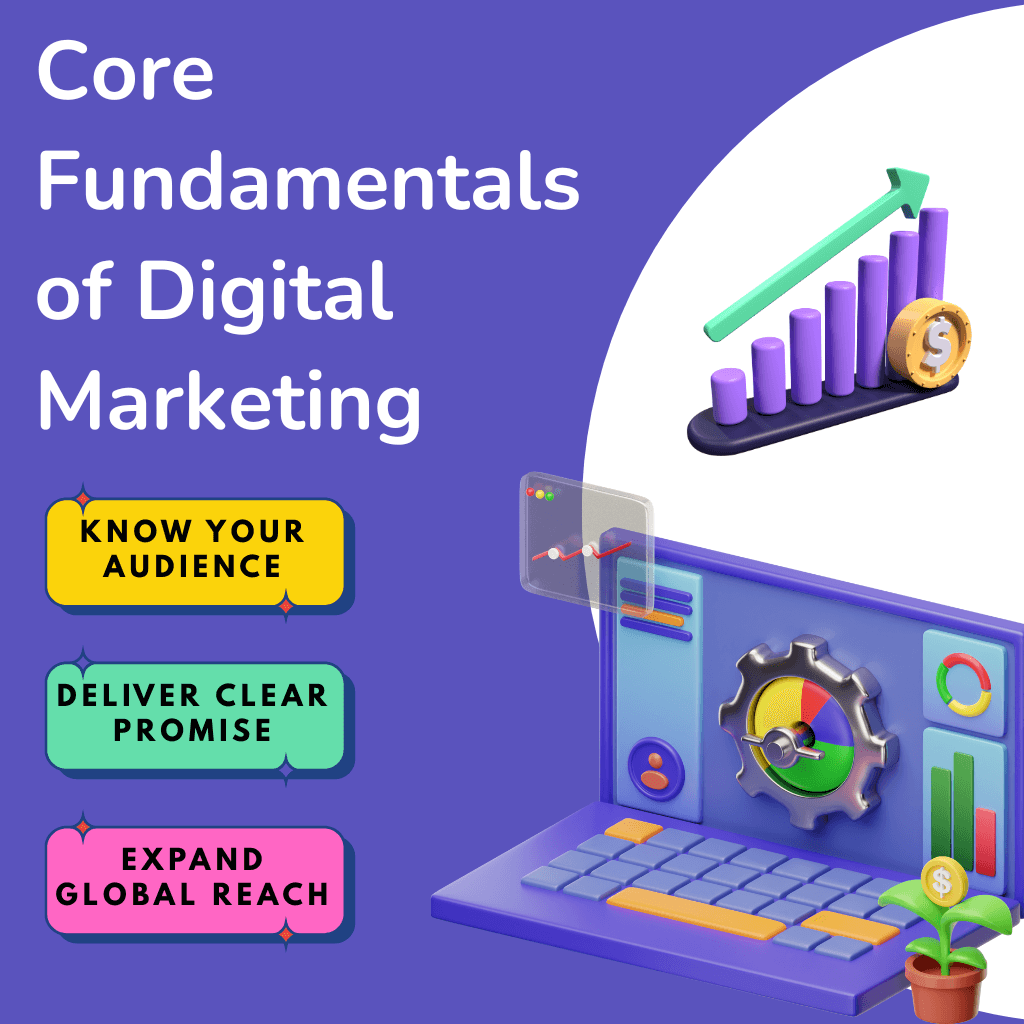
The core stays audience, promise, data and reach. But the steps must be sharper for digital business. Let’s get the map.
1 . Know who you serve
Map real people. Log behavior, buys and questions.
Example: Segment users into “bought in last 30 days”, “browsed pricing”, “abandoned cart”.
2 . Say one clear promise
Write one sentence that says the main benefit. Use that line in ads and page headers.
Example: “Get payroll done in 10 minutes — plans from $6.”
3 . Write for answer engines (AEO)
Give short factual answers first. Add FAQ blocks and schema. Build a short answer (40–60 words) that an AI can quote. Forbes
Example: Put a 50-word Q→A at the top of each guide, then link to depth.
4 . Make people-first content
Write for humans first. Show sources and author info. Keep the first sentence simple. Google for Developers
Example: Start articles with a one-line summary, then list steps.
5 . Own the right channels
Use search, short video, email and your owned hub. Short video wins attention and ad spend now.
Example: Publish one short clip per week. Send an email roundup the next day.
6 . Build first-party data flows
Collect consented signals from signups and purchases. Tag preferences and events. Use those tags to target offers.
Example: Offer a download in exchange for email + a product interest checkbox.
7 . Measure what moves revenue
Run incrementality and holdout tests. Track CPA, LTV and retention. Use server-side events where needed.
Example: Turn off an ad to 10% of users and measure sales lift.
8 . Own distribution, not just reach
Grow a newsletter, SMS and a small community. Push content there first.
Example: Publish a long guide on your site and send it to your list before posting on socials.
9 . Work with creators and micro-creators
Run many small creator tests. Favor honest review clips over slick ads.
Example: Send 8 product samples. Ask each creator for one 30s demo clip.
10 . Fix technical basics and schema
Speed pages, use HTTPS and add structured data (FAQ, article, product).
Example: Add FAQ schema to product pages to improve answer snippets.
11 . Use AI with rules and human checks
Employ AI to draft, summarize and test ideas. Always edit outputs. Log prompts and validation steps.
Example: Let AI draft headlines. Have a human pick, edit and fact-check.
12 . Test creatives fast
Rotate creatives weekly. Keep the best performing variants.
Example: Run 3 video hooks for 7 days. Scale the winner.
13 . Secure trust and privacy
Show clear consent choices. Explain what you collect and why.
Example: Add a simple data control panel for users in their account.
14 . Build authority via originals
Publish original data , case studies and interviews. Pitch journalists and partners.
Example: Run a short survey and publish a one-page report. Send it to industry writers.
Yet, to stay trusted, you must hold your audience in a world of short focus spans. Digital marketing is now about balance. Old rules guide you. New shifts test you.
How do Audience, Value and Visibility remain the Core Pillars?
Audience tells you who to reach. Value makes them stay. Visibility puts you in front of them. All three work together. Let’s discuss:
Audience
People spend time across apps and sites. Track their clicks, searches and preferences. 55 % of users check 3+ platforms before buying. Segment them. Speak to each group.
Value
Give exact help, not empty promises. Solve problems, answer questions, share tips. 62 % of users stop following brands that feel irrelevant. Show benefits clearly. Make content useful and easy to act on.
Visibility
Be seen where people spend time. Use search, social clips, newsletters and communities. Focus on short videos. Paid ads support reach, but must match user needs. Consistent presence wins.
How is AI Search Changing Your Organic Traffic Strategies?
AI search provides direct answers. As a result, users do not always click on websites. This leads to a decline in traditional organic clicks. Some industries have seen traffic drops from 15% to over 60%.
So, how to adapt your strategy and be an AI consultant? Let’s learn:
Optimize for Direct Answers
Focus on being the source for AI answers. This is called Answer Engine Optimization (AEO). Write your content in a Q&A format. Create concise, clear answers that AI can use.
Focus on Brand Authority
Google’s AI prefers trusted brands. You must build a reputation online business. Earn mentions from reputable sources.
Create Human-Centric Content
AI is good at summarizing facts. It cannot replicate human experience. You must create content with real depth and emotion. This type of content is less likely to be fully summarized by AI.
Diversify Your Traffic
Do not rely on one source. You must get traffic from multiple places. Use social media, email marketing and direct community building. This protects you from search changes.
How does Fragmented Attention Redefine the Basics?
Attention breaks fast. So do brands. Your content must be quick, clear and sticky. Make every second count. Let’s see:
1. Scrolling Speed Rules
People now focus online for just 8.25 seconds—down from 9.2 in 2022. Many scroll past in 1.7 seconds. SQ Magazine
That means you must grab them fast.
2. Attention Drives Spending
A 10% rise in focus boosts spending by 17%. People who stay focused spend 2× more than those distracted.
3. Multi-screen, Zero Depth
Users swipe across six platforms daily. Their time splits into short bursts. That kills long reads and deep pages.
What This Means for Your Work
A . Headlines matter. One quick, bold line wins.
B . Show value instantly. Don’t hide facts.
C . Use micro-content: tiny bullet lists, images with short captions, one-liners.
D . Mix formats: text, video snippets, lists, quick stats.
Fresh Rules for the Scroll Era
| Old Rule | New Rule |
| Write long stories | Use tiny bites of clarity and value |
| Trust static pages | Show value in the first 3 seconds or lose them |
| Long videos only | Use clips under 15 seconds or they skip it |
Core Channels & Data Essentials
Only a few channels matter daily. Brands must focus on where people spend time.
Data is now trusted. First-party signals decide reach and relevance. Let’s learn:
Which digital channels remain non-negotiable?
Search gives discovery. Email gives profit. Video grabs eyes. Social drives daily touch. Programmatic ads scale reach.
1. Search (organic + ads)
Search drives 53% of site visits. People still start here.
Example: A SaaS company writes a “How to” blog with a 50-word Q&A on top. Google AI Overviews picks it. Clicks rise by 38% in 3 months.
2. Email marketing
Email brings $36 for every $1 spent.
Example: A fashion shop builds a list with a “10% off” pop-up. They tag users by product type. During a 3-day sale, they send a targeted email to “shoe lovers.” That single email makes £40k in sales.
3. Video (short form)
89% of brands publish video. Short clips hold attention.
Example: A skincare brand records a 12-second TikTok showing before-and-after results. They post daily at 8 pm. One clip hits 2M views. Orders double in one week.
4. Social platforms (Instagram, Facebook, TikTok)
93% of marketers use Facebook.
77% use Instagram, which gives 6× more clicks than Facebook ads.
Example: A home décor brand tests 3 short Instagram Reels with different hooks. They stop the worst two after 5 days. They scale the best one. Cost-per-order drops by 28%.
5. Programmatic display ads
80% of display ads run programmatic this year. It will hit 90% by 2026.
Example: A travel app sets up programmatic retargeting. Users who check flights but leave see banner ads for the same route. Within 2 weeks, 31% of those users finish their booking.
Why is first-party data now the backbone of digital trust?
Third-party tracking fades fast. First-party data arrives with consent. Consumers trust what they agree to share. You get higher conversions. Let’s examine closely:
1. Marketers rely on it
Around 84% of marketers now use first-party data in their work. It tops their list.
2. Regulation forces change
Chrome blocks about 80% of third-party cookies now. Marketers must shift to the data they collect directly.
3. Consumers prefer it when clear
73% of people say they trust brands more when those brands explain how they use their data.
4. It raises conversions and cuts costs
Using intent-driven first-party data delivers 2× more conversions and drops acquisition costs by 30%.
Personalized marketing using first-party signals can lift ROI by 5× to 8×.
5. It fuels AI accuracy
New AI tools need clean, real user data to work well. First-party data delivers that.
How do you measure ROI when data sources are scattered?
1. Use Simple ROI and ROMI Basics
Formula: ROI = (Revenue − Cost) ÷ Cost × 100%
Example: Spend $2,000, earn $10,000 → ROI = 400%
2. Tie Every Channel to Its Dollars
List channels: search, email, social, video, etc.
Track revenue per channel and costs.
Example: $1,500 on Google Ads, $500 on TikTok ads → track sales from each.
3. Use Multi-Touch Attribution
Assign credit to every touchpoint along the user path.
Algorithmic attribution weights each step mathematically.
4. Marketing Mix Modeling (MMM)
Check past sales to see which channels add real value.
Break sales into base (would sell anyway) and incremental (from marketing).
5. AI Tools for ROI Clarity
30% of firms are using AI to track scattered data.
Popular tools: HubSpot Analytics, Google Analytics 4, Adobe Marketo.
These tools tie costs, channels and revenue in one view.
Why is Answer Engine Optimization (AEO) becoming fundamental?
AEO makes your content appear in AI answers. It works for platforms like ChatGPT, Perplexity and Google AI Overview.
Unlike old SEO, it focuses on short, clear answers. It matches what people actually ask and how they speak.
AI Search Is Growing Fast
AI answers now handle millions of questions daily. You must appear there or lose traffic.
Voice Search Explodes
Voice queries grew 58% year-over-year. People speak differently than they type.
AEO Builds Trust
AI often shows your brand first. People see you as credible. Recognition grows naturally.
Content & Engagement Fundamentals
Brands must reach audiences across multiple channels besides aspiring for Google traffic. Let’s talk about it:
How do you reduce risk if Google traffic declines?
AI features like AI Overviews and AI Mode now answer questions directly in search results. This change reduces the need for users to click through to websites.
1. Diversify Traffic Sources
Over 70% of visits from organic search? Use tools like Google Analytics to monitor traffic sources. Aim to grow underperforming channels by 10–20% each quarter.
2. Build Direct Relationships
Focus on engaging your audience directly. Offer newsletters, events and premium content. 87% of publishers are diversifying revenue with these tactics.
3. Create Unique, High-Quality Content
AI can’t replicate human expertise. Publish original, in-depth content. Google rewards content that demonstrates real-world insights.
4. Optimize for AI Search
Ensure your content is visible to AI. Use structured data and clear formatting. Tools like GEOradar can help.
5. Explore Alternative Platforms
Platforms like TikTok, Instagram and YouTube are gaining traction. They offer direct engagement and discovery. 58% of users find answers without visiting external websites.
6. Monitor and Adapt
Regularly check your traffic analytics. Adjust strategies based on performance. Stay informed about changes in AI and search trends.
Why are short-form video, live shopping and community marketing vital?
Short videos grab attention. Live shopping drives action. Communities build trust. Let’s explain:
1. Short-Form Video
People watch short videos first. 96% prefer them over long content.
71% decide if a video is worth watching in the first few seconds.
Shoppers discover products with short clips. 37% say they find new items on TikTok or Reels.
Example: A skincare brand posts 10-second clips daily. Views rise 3×. Sales double in one week.
2. Live Shopping
Global live shopping sales hit $500B this year. Live events create urgency and excitement.
Example: A fashion brand hosts a 1-hour live sale. 25% of viewers make instant purchases.
3. Community Marketing
Communities connect users with shared interests. Micro-influencers drive engagement in tight-knit groups.
Example: A coffee brand runs a small community forum. Product recommendations from members increase orders by 18%.
How do micro-influencers replace old influencer campaigns?
Micro-influencers offer higher engagement, cost-effectiveness and authenticity. Let’s justify its performance:
1. Higher Engagement
Micro-influencers (10K–50K followers) have 1.81% engagement.
Mid-tier influencers (50K–100K) have 1.24%.
Nano-influencers (1K–10K) have 2.71%.
Micro-influencers outperform mid-tier by 46%.
2. Cost-Effective
Micro-influencers charge $100–$500 per Instagram post.
Mid-tier influencers charge $500–$1,250.
3. Authentic Content
Audiences trust micro-influencers more.
Brands like La Roche-Posay partner with creators for authentic content.
4. Long-Term Relationships
47% of brands focus on long-term influencer partnerships.
5. AI Integration
AI tools help brands find the right influencers. AI improves campaign performance and ROI.
6. Platform Dominance
Instagram and TikTok are top platforms for influencer marketing.
How do you build a brand story that cuts through endless content?
Consumers are overwhelmed by content. To set yourself apart, your brand needs a compelling story.
1. Focus on Real People
Share how customers use and love your product. Avoid preaching; let the product experience speak. This approach builds trust and relatability.
2. Be Transparent
Show your brand’s journey, including challenges. Authenticity fosters deeper connections.
3. Use Interactive Formats
Incorporate polls, AR experiences, or co-created content. Engage your audience as co-creators. This participation strengthens loyalty.
4. Keep It Simple
Avoid jargon. Use clear, concise language. A straightforward story is more impactful.
5. Align with Values
Ensure your story reflects your brand’s core values. Consistency builds credibility.
6. Embrace Surprise
Introduce unexpected elements to captivate your audience. Surprise can make your story memorable.
7. Showcase Community
Highlight user-generated content and community involvement. This approach enhances authenticity.
8. Utilize Multiple Channels
Distribute your story across various platforms. Adapt the format to each channel for maximum reach.
9. Measure Impact
Track engagement metrics to assess your story’s effectiveness. Adjust strategies based on feedback.
10. Stay Consistent
Maintain a consistent narrative across all touchpoints. Consistency reinforces your brand identity.
AI in the New Fundamentals
AI now touches every part of marketing. It helps create content, analyze data and interact with customers.
How do you keep brand authenticity while using AI tools?
AI is now common in marketing. Over 90% of businesses use AI tools today for any data. But using AI without care can make your brand feel fake. Let’s get the rules:
1. Treat AI as a Helper
AI can draft content fast. Do not publish it as-is. Add your brand’s voice and values before posting.
2. Set Clear Guidelines
Define tone, style and visuals for AI content. This keeps your messages consistent across platforms.
3. Keep Human Oversight
Review AI outputs before sharing. Humans ensure content aligns with brand values.
4. Personalize AI Interactions
Adjust AI responses to match your tone and language. This keeps customer interactions authentic.
5. Be Transparent
Tell your audience when AI helps create content. Transparency builds trust.
6. Audit Regularly
Check AI content often. Make sure it fits your evolving brand and audience expectations.
7. Combine AI with Human Creativity
Let AI handle repetitive tasks. Humans focus on storytelling and emotional engagement.
How do you grant AI-driven experiences as part of fundamentals?
AI tools now shape daily business activities. Avatars, chatbots and virtual influencers are widely used. They help brands connect, engage and save time.
1. Avatars: Personalized Digital Interactions
Avatars give personalized experiences. They represent brands in virtual spaces.
Example: Meta’s AI creator tools let influencers create digital avatars to chat with followers on Instagram. This keeps interactions consistent and engaging.
2. Chatbots: Efficient Customer Support
AI chatbots handle questions instantly. They improve customer service and satisfaction.
A study of 5,000 consumers shows people are both excited and cautious about AI. Balance automation with human touch.
3. Virtual Influencers: Brand Ambassadors in the Digital Age
Virtual influencers act as brand ambassadors. They can post, reply and engage 24/7. The market may reach $45 billion by 2030. Brands control messaging and maintain a constant presence.
4. How to Use AI Experiences Effectively
Set clear goals for AI tools. Be transparent with audiences about AI use. Keep AI outputs consistent with your brand voice. Monitor results and adjust as needed.
Conclusion
Digital marketing is a market street.
The audience is the crowd. Value is the product. Visibility is the stall sign.
AI is the broker. Data is the ledger. Short videos are the loud call.
When all parts work together, a small stall grows into a busy trade.
FAQ
What are the 5 A’s of digital marketing?
After searching, the most trusted and up-to-date framework remains Philip Kotler’s 5 A’s: Aware → Appeal → Ask → Act → Advocate. (American Marketing Association.) Many sources still use it as the standard model.
Let’s explain:
1 . Aware – People find your brand.
2 . Appeal – They like what they see.
3 . Ask – They ask questions.
4 . Act – They pick and buy.
5 . Advocate – They tell friends.
Each step matters. Each step moves users forward.
Why is this necessary now?
A . No newer model has replaced these trusted sources.
B . It fits digital trends: guiding user paths, keeping focus simple.
C . Deliver clear value to users and search engines.
What are the 7 P’s of digital marketing?
These are:
1. Product
Create a solution for a specific need. Your product solves a problem. This focuses 100% on value.
2. Price
Set a cost for your product. Price should be fair and competitive. This confirms 95% of customer value.
3. Place
Make your product available online. Customers find you on your site, social media, or other channels. This ensures 80% market reach.
4. Promotion
Communicate with your audience. Use different messages to attract people. This generates 70% of new leads.
5. People
Build a team and a community. Your employees and customers are both important. This drives 65% of brand trust.
6. Process
Make buying easy. The steps from interest to purchase are simple. This increases 50% of conversions.
7. Physical Evidence
Show your success online. Reviews, testimonials and case studies build confidence. This secures 45% of new sales.
Still, this model adds People, Process and Physical Evidence to the classic 4 P’s to fit services and online reach.