

Digital business models move fast and change with users, technology and markets. Firms need models that give steady revenue and room to adjust.
Indeed, subscription, marketplace, SaaS, platform, creator and automation models all matter. Many businesses mix them to fit different needs.
Teams work partly remote, partly in-office. Strong digital culture drives faster decisions and higher revenue. Smooth payments and secure systems are vital.
Expanding globally needs planning for local rules, shipping and taxes. By combining the right models, businesses can grow online. Supporting teams makes operations stronger. Adapting to user demand keeps businesses safe and competitive.
Digital Business Models Today: The Core Foundations
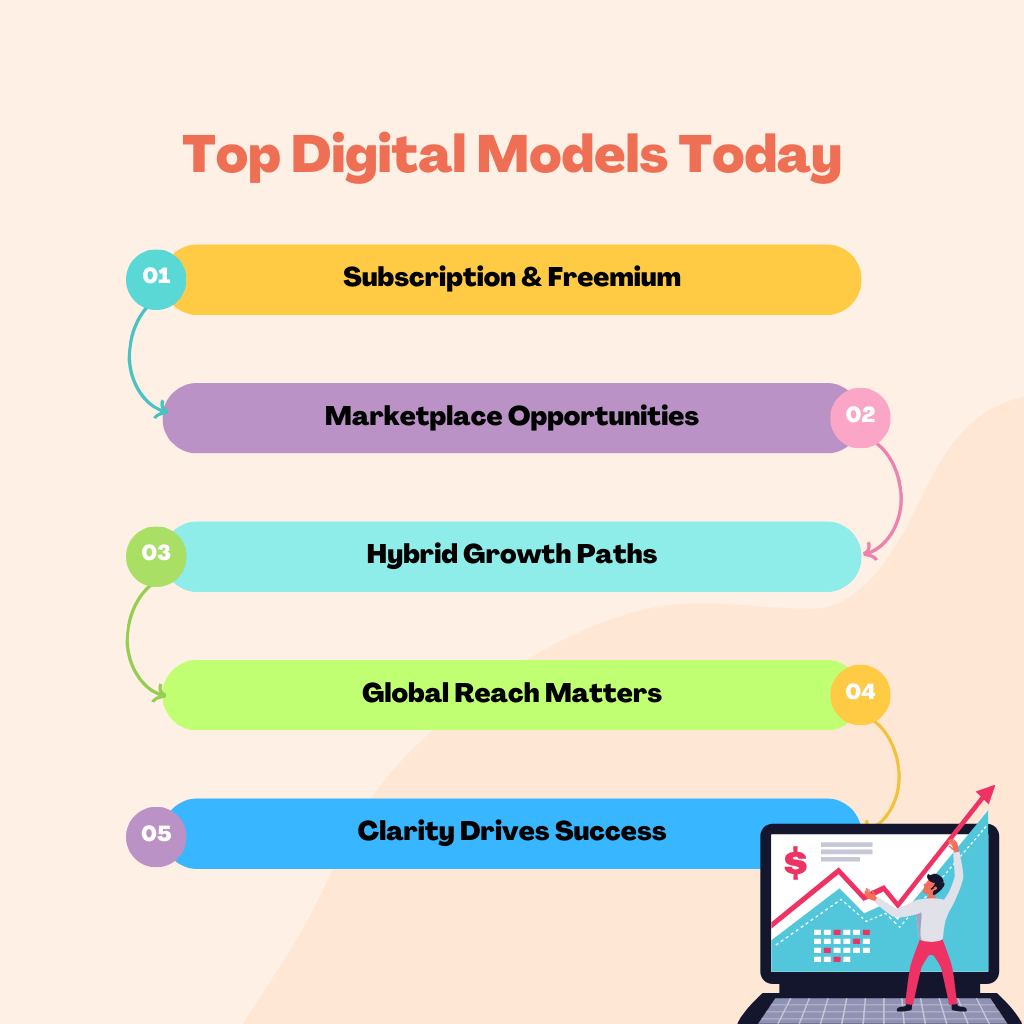
People want models that are flexible and predictable at the same time.
They look for steady income sources but also freedom to adjust offers.
Subscription, marketplace and freemium models are still popular, but they work in new ways now.
Hybrid forms are rising as firms mix old paths with new ones.
Global reach has turned from optional to normal. Even small firms now think beyond borders.
Users search for models that match scale, from tiny startups to large digital empires.
The real need is clarity; what model works, why it fits and how it grows in today’s occupied online space.
What are the Main Types of Digital Business Models
Let’s see the list:
Subscription Model
Recurring income from users who pay monthly or yearly. Works best when services add fresh value often. Now shifting toward flexible tiers to fight subscription fatigue.
Marketplace Model
A platform connects buyers and sellers. Growth comes from cross-border trade, faster logistics and niche-focused markets.
Freemium Model
Free entry with paid upgrades. Still strong in apps and SaaS. Works better now when upgrades feel exclusive, not forced.
Platform Model
Users and creators build value together. Social platforms, creator hubs and community apps expand reach through shared content and transactions.
SaaS Model
Cloud-based apps are sold as services. Firms adopt SaaS not just for tools but for entire workflows, from finance to project control.
Creator Economy Model
Digital creators run their own micro-businesses. Platforms give them revenue paths like direct sales, subscriptions and community payments.
Automation Model
Software or AI handles business tasks once done by people. These are popular in service industries and B2B. It reduces risks, including heavy upfront cost and user pushback.
Hybrid Model
Mix of two or more styles. Subscription + ads, freemium + marketplace, SaaS + creator tools. Helps adapt to different markets.
How do Subscription, Marketplace and Freemium Models Differ Today?
Subscription, marketplace and freemium models lead digital business today. Each works differently. Some earn a steady income. Others grow through connections or free entry. Let’s notice what they do and their main trends:
Comparison of Top Digital Business Models
| Model | What It Does | Trends & Figures |
| Subscription | Users pay regularly for a service or product | A . Total value ~$722BB . Growth last decade: +435 %C . Churn rate: ~5 %D . 89 % of businesses expect more recurring revenue |
| Marketplace | Connects buyers and sellers, earns via fees | Charges fees, expands fast in niche markets and creates new growth opportunities. |
| Freemium | Free basic version; paid extras available | Upgrades must provide value, ~6.8% of free users pay. It is popular in apps and SaaS. |
How do digital business models align with global online operations?
Digital models now drive global reach. Online presence spans 30% of all businesses.
Sales from e-commerce near $4.8 trillion this year.
Digital firms tap cloud tools worth $706 billion now Wikipedia. They use automation and AI in 57% of operations. That makes soaring growth and resilience possible.
Yet, they link revenue streams to global demand. They use the cloud to serve many markets quickly. They apply AI to predict trends and pin costs. They mix platforms, tools and data across borders.
Evolving Models Users Want to Compare
Digital models are not motionless. They change with markets, users and tech waves. Some grow faster, some lose ground and some blend into new shapes.
Firms and users now compare them side by side, not just to pick one, but to see how each works for scale, trust and profit.
How does the subscription business model grow compared to past years?
Companies earn big now and expect nearly double the revenue by 2030. Growth speeds past traditional firms. Users pick short-term deals more. But many still drop out early. Offer fast value and retain early to win. Let’s learn more:
1 . The subscription economy hits US$722 billion this year. It could reach US$1.2 trillion by 2030. That means a +68% jump from 2025 to 2030.
2 . Subscriptions grew faster than the stock market in recent years. They rose by a 16.5% annual rate. That’s much higher than the 4.8% seen in the S&P 500.
3 . In retail apps and digital tools, subscriptions already grow at a 60% combined annual rate. That beats the 10% average across industries.
4 . App users favor short plans. Weekly subscriptions now make up 47% of revenue. Monthly plans lose some share.
5 . Yet, many users leave fast. Weekly plans lose 30–50% of users by the first renewal. Monthly plans lose 15–40%.
Why are marketplace models dominating cross-border commerce?
Ok. Let’s learn the basics:
The global cross-border e-commerce market nearly reach $1.47 trillion this year. It was $477.5 billion in 2024. That is 15.4% annual growth.
72% of global e-commerce transactions now happen through marketplaces. Consumers like fast and simple payments.
53% of transactions worldwide use digital or mobile wallets. Delivery speed matters.
38% of cross-border purchases arrive in 5 days or less.
55% arrive within 7 days. Marketplaces expand by going local. Platforms like Temu let businesses sell directly to local consumers.
Sellers benefit from faster delivery and more local customers. Regulations help growth. Rules encourage more cross-border sales.
What makes platform-based and creator economy models favorable?
Platform models grow fast and add services. Creator models grow via many creators and AI use. Users engage more with small, authentic creators. Let’s find out more:
Platform-Based Models
Digital platforms have almost reached $456.7 billion this year. They grow at 11.2% per year. 78% of platform startups grow faster than traditional firms. Some companies add services and ads. This raises revenue to €3–5 million by 2025.
Creator Economy Models
The creator economy will reach $528 billion by 2030. It grows at 22.5% per year. There are 207 million content creators worldwide. 91% use AI to create more content. Micro-creators get 2.4–6.7× more engagement than big influencers. 60% of users trust creators who feel real.
How are SaaS business apps shaping long-term revenue strategies?
SaaS business apps shape long-term revenue by driving steady growth. U.S. companies spend $225 billion on SaaS.
Most businesses use many apps, but IT manages only a small part of the cost. AI-powered tools are used by 95% of firms.
Vertical SaaS grows fast and helps companies focus on niche needs. Average B2B SaaS churn is low at 3.5%, showing strong customer retention.
Overall, SaaS supports scalable, predictable and technology-driven growth.
What are the strengths and risks of automation platforms in business models?
Automation platforms give cost savings and efficiency. But they carry risks like job loss and security issues. Let’s explain:
Strengths:
1 . Market Growth: The global robotic process automation (RPA) market is $28.31 billion this year. It could reach $211.06 billion by 2034. That is a 25% annual growth rate.
2 . Efficiency Gains: Automation cuts manual work. It speeds up operations.
3 . Cost Savings: Companies save money on labor. Repetitive tasks no longer need humans.
4 . Scalability: Automation handles more work without adding costs.
5 . Accuracy: Automation reduces human errors. Outputs become more reliable.
Risks:
Job Displacement: Some jobs may disappear.
High Initial Investment: Setting up automation costs a lot upfront.
Complex Integration: New tools can be hard to connect with old systems.
Security Concerns: Automated systems can be targets for cyberattacks.
Dependence on Technology: Over-reliance can create problems if systems fail.
Yet, companies need careful planning. They must invest wisely to use automation well.
Challenges in Adopting Digital Business Models
Of course, digital business models drive growth. Still, adoption is not simple. Let’s discuss what hurdles businesses face:
Main Challenges
1. Remote and Hybrid Teams
83% of employees prefer hybrid work. So, teams are split between office and remote. Also, coordination and communication become harder. Engagement and productivity may drop without proper tools.
2. Digital Culture Building
Teams struggle to align with business goals. Innovation and efficiency depend on culture. Poor digital culture slows decisions and reduces revenue.
3. Cybersecurity Requirements
Regulations affect model choices. Sensitive industries need secure operations. Further, data breaches destroy customer trust.
4. Payment Tools and Revenue
Digital payments affect sales and trust. Poor integration reduces conversions. Cross-border sales need local payment support.
5. Scaling Globally
Hidden costs appear when expanding internationally. Localization, shipping, taxes and compliance raise expenses. Businesses often underestimate these costs.
Solutions to Adoption Challenges
1. Remote and Hybrid Teams:
A . Use AI tools like Slack, Asana and Microsoft Teams for communication and task management.
B . Track performance with analytics dashboards.
C . Provide collaboration platforms for projects and messaging.
D . Support employee well-being with mental health programs.
2. Digital Culture Building:
A . Align teams with clear business goals.
B . Encourage knowledge sharing and innovation.
C . Train employees on digital skills.
D . Monitor culture’s impact on revenue regularly.
3. Cybersecurity:
A . Choose models that meet strict security standards.
B . Use encrypted payments and secure cloud tools like AWS or Azure.
C . Regularly test systems for vulnerabilities.
4. Payment Tools:
A . Integrate local and global options like Stripe or PayPal.
B . Ensure fast and secure transactions.
C . Connect payments to user experience and revenue data.
5. Scaling Globally:
A . Plan for shipping, taxes and compliance costs.
B . Use analytics to forecast hidden expenses.
C . Start with pilot markets to reduce risks.
AI in Digital Business Models
AI secures efficiency, predicts trends and guides revenue decisions. Businesses use AI in subscriptions, marketplaces, SaaS and creator platforms.
How AI Changes Business Models
AI analyzes customer behavior to improve products and services. It predicts demand and guides pricing strategies. Companies using AI see up to 20% faster decision-making. AI supports automation, reducing manual work and operational costs.
Models that Work Best with AI Subscriptions
SaaS platforms use AI to offer personalized plans. Marketplace models use AI to match buyers and sellers efficiently. Creator platforms use AI to suggest content and optimize engagement. AI subscriptions grow recurring revenue by offering insights and automation.
AI Tools for Customer Acquisition
AI tools support target, segment and convert users. HubSpot AI automates marketing campaigns and lead scoring. Drift uses AI chatbots for real-time engagement.
Jasper AI generates marketing content and personalized messages. Other top tools include Pardot AI, Zapier AI, Acrolinx, Conversica, Exceed.ai, Salesforce Einstein or Marketo AI.
New Models from AI Agents
AI agents enable self-service platforms and automated marketplaces. They handle tasks like customer support, lead nurturing and recommendations. Some platforms adopt AI-driven microservices for subscription upsells.
AI Redefining Profit and CLV
AI predicts customer lifetime value (CLV) more accurately. It identifies high-value customers early and suggests retention strategies. So, be an AI consultant to adjust pricing and campaigns to intensify profit. AI also detects churn risk and improves customer engagement.
Conclusion
Finally, growth comes from well-planned digital business models. Automation, marketplaces, SaaS and subscriptions boost profit.
How it works: apply the right model to your business perspectives. Optimize every decision and watch revenue multiply.
FAQ
Which digital business model grows fastest today?
Subscription and SaaS models expand the quickest. SaaS grows 13.3% yearly.
Which industry adopts digital business models the fastest?
E-commerce and cloud services lead. Marketplaces drive 72% of global online sales. Cloud spending passes $706B this year. Both depend on the platform and automation models.
Which traditional models risk fading as digital models rise?
Industries tied to one-time sales or offline-only trade lose ground. Pure retail stores shrink while hybrid subscription + marketplace models grow. Legacy B2B contracts also shift into SaaS.
Which roles stay relevant in digital business models with AI?
Jobs in strategy, creative design and relationship-driven sales hold value. AI reshapes repetitive tasks. But roles that guide digital culture, model adoption and customer trust remain secure.