

I had a great experience with a business data communication course. It helped me improve my English and communication skills. The course was practical and focused on real business situations. It nurtured my confidence in email writing, report preparation, presentations and data communication.
The personalized approach from trainers made learning easier. I could go at my own pace. The course helped me grow my small online business.
Yet, these courses are available on Coursera, LinkedIn Learning, edX, Skillshare and Udemy. They improve your English and build confidence in handling business tasks. Let’s learn all aspects of a business administration course.
Business Data Communication Course
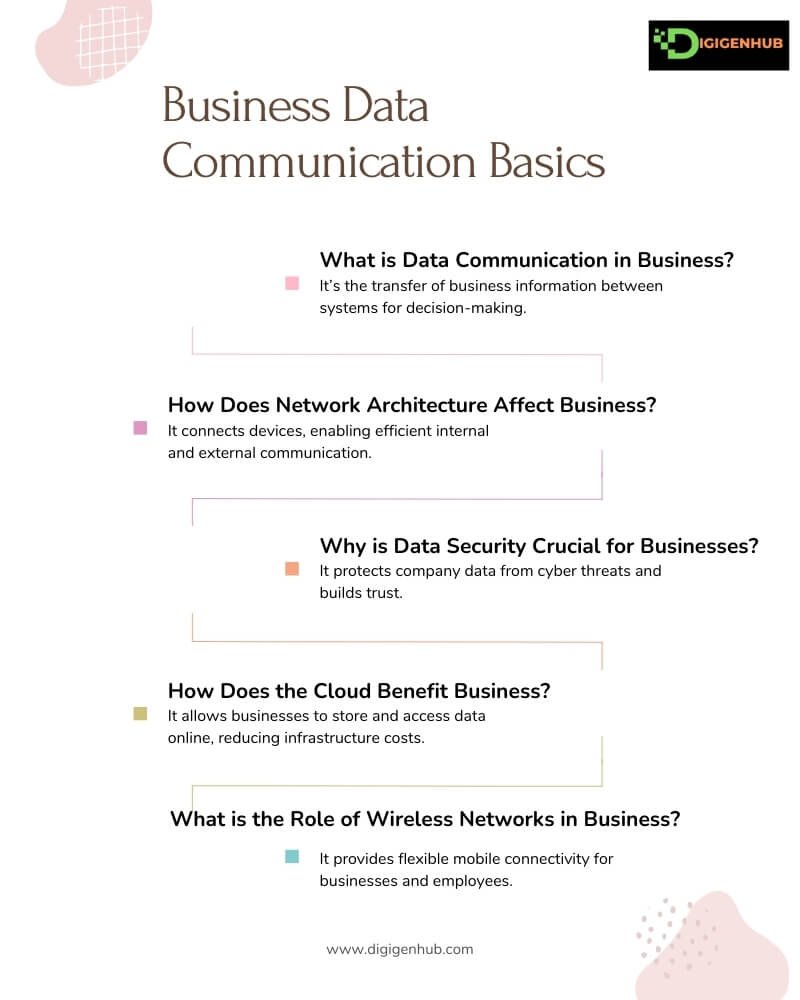
This course teaches how data moves in a business. It covers networks, communication and how to protect information.
Introduction to Data Communication
Data communication is how devices send and receive information. Protocols help devices understand each other. Still, networks connect devices, like the internet, to share data.
Network Architecture
Network architecture is how networks are set up. LAN connects devices in one area, like an office. WAN connects devices over a wide area, like cities. Hybrid networks use both LAN and WAN.
Telecommunications in Business
Telecommunications help businesses communicate. They support calls, meetings and data sharing and connect employees, customers and partners.
Internet and Cloud Computing
The internet and cloud store data online. Cloud storage keeps files on the web. SaaS lets you use software without installing it. Digital tools like email and social media help businesses work better.
Wireless Networks
Wireless networks use radio signals to connect devices. Wi-Fi connects to the internet, cellular networks connect phones, Bluetooth links devices like headphones and IoT connects smart devices to the internet.
Data Security and Privacy
Data security keeps business data safe. Encryption turns data into a code. Firewalls block unwanted access. Cybersecurity rules protect against hacking.
Data Transmission Protocols
Data protocols help devices communicate. TCP/IP connects devices on the internet. HTTP is for web browsing. FTP transfers files between computers.
Business Data Networks
Business data networks connect company systems. VPNs make Internet connections secure. MPLS helps send data quickly.
E-commerce and Digital Transactions
E-commerce lets businesses sell products online. Payment systems let customers pay securely. These tools help businesses manage orders and improve service.
Information Systems for Business
Information systems help businesses make decisions. CRM tracks customer interactions. ERP manages processes like inventory and finance. These systems help businesses run smoothly.
Real-World Examples
Clear communication is essential in business. Many companies struggle with sharing data. The right tools can help fix these problems. Here are some examples:
A . McDonald’s Global BI Strategy:
McDonald’s uses business intelligence tools to gather data from different sources. This helped them make better decisions and run operations smoothly. They faced problems with data quality and system integration.
B . SAP ERP Implementation:
A company used an ERP system to improve efficiency and data accuracy. They achieved this with careful planning and training.
C . Microservice Architecture Communication:
A study examined how data moves smoothly in microservices and focused on the best protocols for good performance.
Benefits of learning business administration course
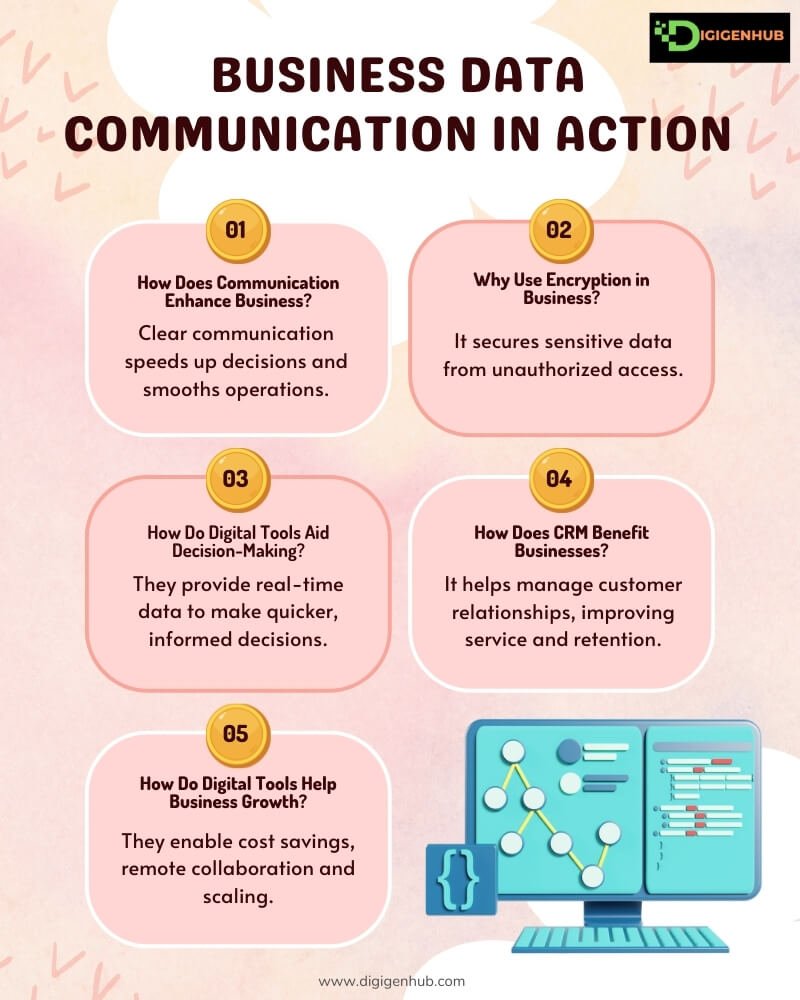
This course teaches you how to use digital tools to improve communication, security, decision-making and customer service. It makes business operations smoother, cheaper and more competitive. Let’s learn this in detail:
1. Better Communication
A course teaches how to use tools like email, chat and video calls to communicate better with customers, employees and suppliers. Effective communication leads to faster decisions and smoother business operations.
For example, Slack or Microsoft Teams can help teams chat and collaborate in real-time.
2. Data Security
It helps you learn how to protect customer information and business data from cyber threats. Protecting data builds customer trust and avoids costly security breaches.
Example: Using encryption tools like ProtonMail for secure emails or Cloudflare for website security.
3. Faster Decisions
You’ll quickly learn to collect and use data to make smart business choices. Access to real-time data allows businesses to make quicker and better decisions. Use Google Analytics to track website traffic and customer behavior to make data-driven decisions.
4. Better Customer Service
Learn to use tools like CRM systems to respond faster and give a better customer experience. Faster responses and personalized support lead to happy customers and repeat business.
For example, Zendesk can be used for customer support, and HubSpot can be used to manage customer relationships.
5. Save Money
Learn how to use digital tools that cut costs, such as VoIP calls and cloud storage. Digital tools can reduce communication, storage and collaboration costs.
For example, Zoom can be used for affordable video calls and Google Drive can be used for cloud storage and document sharing.
6. Reach Global Markets
Understand how to communicate well with customers from different countries and time zones. Expanding your reach internationally is more manageable with digital communication tools.
Example: Use Mailchimp for email marketing campaigns that can target global customers.
7. Support Remote Work
Master tools for remote teams to work together smoothly, no matter where they are. Manage remote teams effectively with digital tools that enable collaboration from anywhere.
Example: Trello helps teams organize tasks, while Asana tracks project progress.
8. Stay Competitive
Knowing the right digital tools helps your business stand out from others. Using the latest tools gives small businesses an edge over competitors.
Example: Canva is used to design professional marketing materials quickly and easily.
9. Manage and Back-Up Data
Learn how to store and back up business data to avoid losing important information. Data management and backups prevent the loss of crucial business information.
For example, Dropbox can store files safely and Backblaze can be used for automatic backups.
10. Follow Laws
Understand laws like GDPR to protect customer data and avoid fines. Understanding data protection laws keeps businesses legal and avoids penalties.
Example: Termly can help you create privacy policies that comply with GDPR and other regulations.
Where to Get Business Data Communication Courses
Websites like Coursera, LinkedIn Learning and edX provide online courses. These courses teach data networks, business communication and digital tools. The platforms are flexible and offer certificates. They work with top universities to help learners improve communication skills in business. Let’s learn their characteristics:
Coursera
Coursera is an online platform for learning from top universities and companies. It offers courses in business data communication, helping you understand data management, network systems and digital communication.
Coursera Course Pricing Plans
1 . Individual Course: $49
Access to specific courses with certificates upon completion.
User Rating: 4.5/5
2 . Specializations: $49/month
Series of related courses; subscription model.
User Rating: 4.5/5
3 . Coursera Plus: $59/month or $399/year
Unlimited access to over 7,000 courses, including certificates.
User Rating: 4.5/5
4 . Coursera for Teams: $399/user/year
For 5-125 users, full catalogue access, customization tools and tracking features are included.
User Rating: 4.5/5
5 . Coursera for Enterprise: Custom Pricing
For 125+ users, it includes AI-assisted course building, dedicated support and integrations.
User Rating: 4.5/5
Note: User ratings are based on available reviews and may vary.
For more details, visit Coursera’s official website: www.coursera.org
Small Niche Businesses that Benefit:
- IT services: Improve network management with data communication knowledge.
- E-commerce: Learn how to protect customer data.
- Marketing agencies: Use data to make better marketing decisions.
Example of Success: Hootsuite, a small social media management company, used online courses to improve its marketing and data communication skills. This grew the company and now helps clients manage social media more effectively.
Website: www.hootsuite.com
LinkedIn Learning
LinkedIn Learning offers online courses on business data communication, including data management and communication tools.
Cost Plan:
1 . Individual Course: $20 – $50
Access to specific courses with certificates upon completion.
User Rating: 4.5/5
2 . Monthly Subscription: $39.99/month
Unlimited access to all courses, including certificates.
User Rating: 4.5/5
3 . Annual Subscription: $239.88/year
Unlimited access to all courses, including certificates.
User Rating: 4.5/5
4 . Team Plan (2-20 users): $379.99/user/year
Unlimited access to all courses, including certificates and administrative tools.
User Rating: 4.5/5
5 . Organization Plan (21+ users): Custom Pricing
Unlimited course access, including certificates, advanced analytics and custom learning paths.
User Rating: 4.5/5
Small Niche Businesses that Benefit:
- Consulting firms: Improve communication strategies.
- Startups: Better team collaboration.
- Marketing agencies: Enhance data analysis skills.
Example of Success: HubSpot used LinkedIn Learning to improve its marketing team’s data communication skills, helping it grow its business.
Website: www.hubspot.com
edX
edX is an online platform offering courses from universities and companies. It covers business data communication, including data management and communication strategies.
Cost Plan
1 . Individual Course: $50 – $300
Access to specific courses with certificates upon completion.
User Rating: 4.5/5
2 . Professional Certificate: $150 – $1,000
Series of related courses; subscription model.
User Rating: 4.5/5
3 . MicroMasters Program: $500 – $1,500
Graduate-level courses can be applied toward a complete Master’s Degree.
User Rating: 4.5/5
4 . Online Master’s Degree: $10,000 – $25,000
Complete Master’s Degree programs entirely online.
User Rating: 4.5/5
5 . edX for Business: Custom Pricing
Tailored learning solutions for organizations; contact sales for pricing.
User Rating: 4.5/5
Note: User ratings are based on available reviews and may vary.
Small Niche Businesses that Benefit:
- Tech startups: Learn about network systems and data security.
- Consulting firms: Improve communication and data management.
- E-commerce businesses: Optimize customer data communication.
Example of Success: MIT used edX to train employees in data science and communication. This improved their decision-making and helped grow their business.
Website: www.mit.ed
Skillshare
Skillshare is an online learning platform. This offers creative and business courses, including topics related to business data communication, such as data management and communication tools.
Cost Plan
1 . Individual Membership: $99/year
Unlimited access to all courses, including certificates.
User Rating: MyeLearningWorld
2 . Team Membership: $159/user/year
Unlimited access to all courses, including certificates and administrative tools.
User Rating: MyeLearningWorld
Small Niche Businesses that Benefit:
- Creative agencies: Learn to manage client communication and data.
- Freelancers: Improve communication with clients and teams.
- Small retailers: Enhance customer data handling and communication.
Example of Success: The Sill, a plant delivery service, used Skillshare courses to improve its marketing and communication strategies. This helped it grow its customer base and increase sales.
Website: www.thesill.com
Udemy
Udemy is an online platform with affordable business data communication courses. This contains data management and communication strategies.
Cost Plan
1 . Data Communication: Analysis → Visualisations → Presentation: $19.99, Focuses on data visualizations and presentations. (4.7/5)
2 . Top Business Communication Courses Online: $149.99, Covers business writing and presentation skills. (4.5/5)
3 . Data-Driven Decision Making in Communication Strategies: $19.99, Teaches data for communication strategies. (4.4/5)
4 . The Ultimate Business Communication Course: $19.99, Covers relationships and professional writing. (4.2/5)
5 . Business Communication Skills in Conversations & Networking: $19.99, Focuses on networking and relationship-building. (4.4/5)
6 . Interactive Data Visualization for Effective Communication: $19.99, Focuses on impactful visualizations. (4.2/5)
7 . Certification in Key Business Analytics and Data Analytics: $19.99, Covers analytics techniques. (4.5/5)
8 . The Data Strategy Course: $19.99, Leverages data for business success. (4.4/5)
9 . BUSINESS COMMUNICATION: $19.99, Covers communication skills. (0.0/5)
10 . Data Literacy and Business Analytics for Business Leaders: $19.99, Enhances data literacy for leaders. (4.5/5)
11 . Business Communication for Working Professionals: $19.99, Practical approach to communication. (0.0/5)
12 . Introduction to Business and Data Analysis: $19.99, Focuses on business analysis. (0.0/5)
Small Niche Businesses that Benefit:
- IT businesses: Improve network systems and data security.
- Marketing firms: Enhance communication and data analysis skills.
- E-commerce: Learn to manage customer data effectively.
Example of Success: Tea Drops, a tea subscription company, used Udemy courses to improve its data communication and marketing strategies. This helped it grow its brand and customer base.
Website: www.myteadrops.com
Conclusion
Thus, you have already learned several aspects of the business data communication course. Indeed, to fix issues like poor communication and cultural differences, businesses can use tools like team chat platforms and provide training. First, assess needs. Then, choose the right tools. Ensure security with encryption. Finally, train staff for practical use.
FAQ
What is a business communication course?
A business communication course teaches how to share information in a work setting. It covers speaking, writing and listening skills. The course helps improve your interactions with colleagues, clients and bosses. It also focuses on precise, professional and effective communication.