

AI takes on complex tasks (data-driven decisions) like an executive in today’s digital business era. It analyzes customer data (70%), finds new leads (60%), predicts sales trends (65%) and helps with marketing strategies (75%).
AI can also automate routine tasks. This capability saves businesses time (50%). So you have no option to ignore AI for business development executives.
If small digital businesses don’t use AI, they risk falling behind. Businesses using AI grow 2-3 times faster than those that don’t. Without AI, small businesses may miss out on new opportunities (80%) and may struggle with efficiency.
So, without AI businesses are at a serious disadvantage today. Indeed, AI is no longer optional—it’s vital for accelerating business growth. So, let’s explain its major aspects.
Why AI for Business Development Executives is in High Demand
75% of businesses rely on AI to automate routine tasks, unify processes and personalize customer experiences.
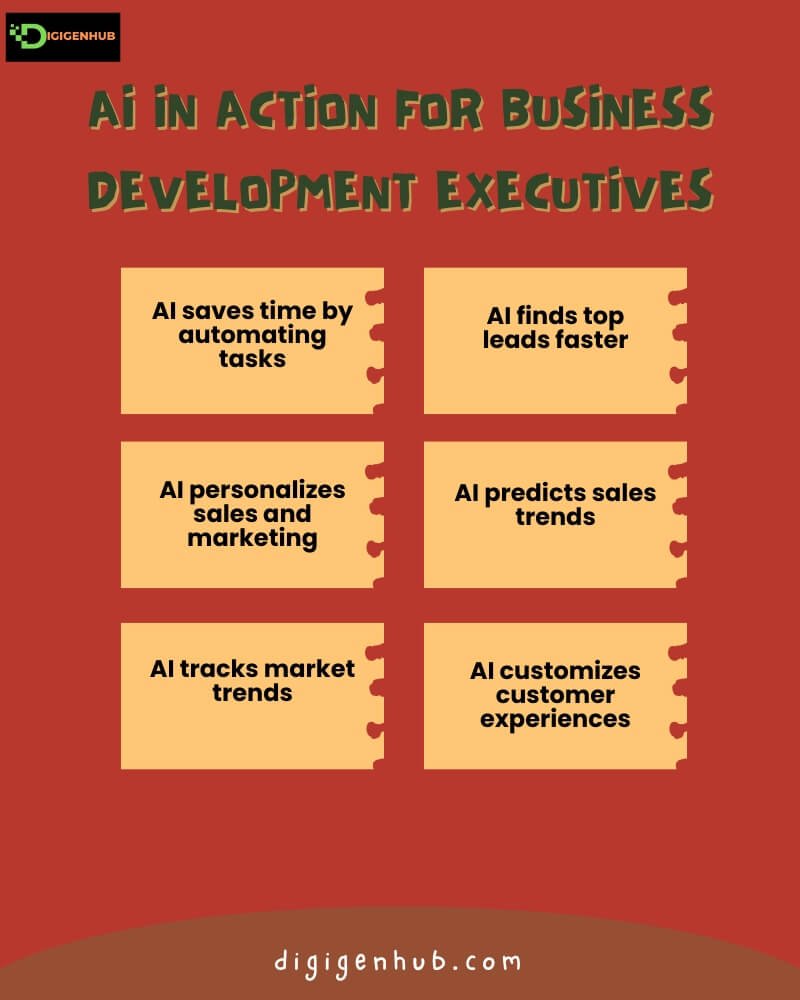
AI makes predicting market trends, finding high-value prospects and optimizing sales pipelines easier. This lets executives focus on strategic growth rather than spending time on manual tasks.
It helps teams find the best leads quickly, so they can focus on the ones most likely to buy. For example, HubSpot uses AI to rank leads.
AI also helps businesses group customers based on what they like and do. This makes marketing more personal, like Netflix’s show recommendations.
AI can predict sales trends too, like Salesforce Einstein does. This helps teams plan better and use their time wisely.
It also performs repetitive tasks. This saves time for more important work like Zoho CRM does. AI tracks what competitors are doing and finds new trends, like Crimson Hexagon’s social media analysis.
It can even make customer experiences more personal, like Spotify’s custom playlists. With all these benefits, AI is a must-have for business development teams.
AI’s Impact on Business Success
Executives can use AI to understand markets faster and more clearly. This helps them make smarter choices and grow their businesses. But how can AI be used? What impact will it have? Let’s explore how AI works for business development and why executives should adopt it.
1. Revenue Increase through AI
Technology Sector: 25-35% increase
Source: McKinsey Global Institute’s report on AI and the future of work.
McKinsey Global Institute – The Future of Work
Finance Sector: 20-30% increase
Source: PwC’s report on AI in business, discussing AI’s revenue impact in various industries.
PwC – AI in Business: Realizing the Potential
Retail Sector: 15-25% increase
Source: Accenture’s report on AI’s impact on the retail industry.
Accenture – How AI is Reshaping the Retail Industry
2. Cost Reduction through AI
Technology Sector: 18-22% cost reduction
Source: McKinsey Global Institute’s “The AI Frontier” report, highlighting AI’s impact on cost-saving through automation.
McKinsey Global Institute – AI Frontier
Finance Sector: 15-18% cost reduction
Source: Deloitte Insights on AI in Financial Services.
Deloitte – Artificial Intelligence in Financial Services
Retail Sector: 12-20% cost reduction
Source: Capgemini’s report on AI in retail and cost-saving potentials.
Capgemini – AI in Retail
3. Operational Efficiency & Automation
Time Saved on Routine Tasks (Across All Sectors): 30-40%
Source: PwC’s 2018 report on AI’s ability to automate processes.
PwC – AI’s Role in Automation
Increase in Operational Agility: 5-10%
Source: McKinsey Global Institute, discussing operational agility in digitally transforming businesses.
McKinsey Global Institute – Agile Transformation
4. Decision-Making & Predictive Insights
Enhanced Decision-Making with AI Tools: 7-12% improvement
Source: Harvard Business Review on AI and decision-making.
Harvard Business Review – AI and Decision-Making
Impact of AI on Sales & Marketing Predictions: 15-20% improvement
Source: Forrester’s analysis on AI and predictive analytics in sales.
Forrester – AI in Sales
5. AI-Driven Sales Forecasting & Lead Generation
Improvement in Lead Qualification: 25-35% increase
Source: Salesforce’s “State of Sales” report, highlighting AI’s role in improving sales forecasts and lead generation.
Salesforce – State of Sales
Increase in Lead Conversion Rates: 20-30% improvement
Source: Gartner’s report on AI and its impact on lead management.
Gartner – AI for Sales Leaders
6. Customer Engagement & Relationship Management
Improvement in Customer Retention: 15-20% improvement
Source: McKinsey & Company’s report on AI in customer service.
McKinsey & Company – AI in Customer Service
Enhancement of Personalized Customer Experience: 10-15% increase
Source: Forrester’s report on the role of AI in customer personalization.
Forrester – AI and Customer Personalization
7. Overall Business Development Productivity
Increase in Productivity Due to AI Assistance: 20-25% improvement
Source: Accenture’s research on AI-driven business transformations.
Accenture – AI for Productivity
Decrease in Sales Cycle Length: 10-15% decrease
Source: InsideSales.com, showing how AI shortens the sales cycle.
InsideSales.com – AI and Sales Cycles
Scholars’ Opinions on AI’s Impact on Business Development
Erik Brynjolfsson, Director of the MIT Initiative on the Digital Economy:
“AI is fundamentally changing the way we do business, from increasing productivity to enhancing customer relationships. Those who fail to adopt AI risk being left behind.”
Source: MIT Initiative on the Digital Economy
Andrew Ng, Co-Founder of Coursera & AI Researcher:
“AI has the potential to automate 40% of all jobs, but for business development executives, AI will amplify their abilities to focus on high-level decision-making and customer relationships.”
Source: Andrew Ng on AI
Satya Nadella, CEO of Microsoft:
“AI is the key to business transformation in the digital age, enabling businesses to innovate faster, make smarter decisions and provide better customer experiences.”
Source: Microsoft AI
Where (Significant Portions) is AI Applied in Business Development?
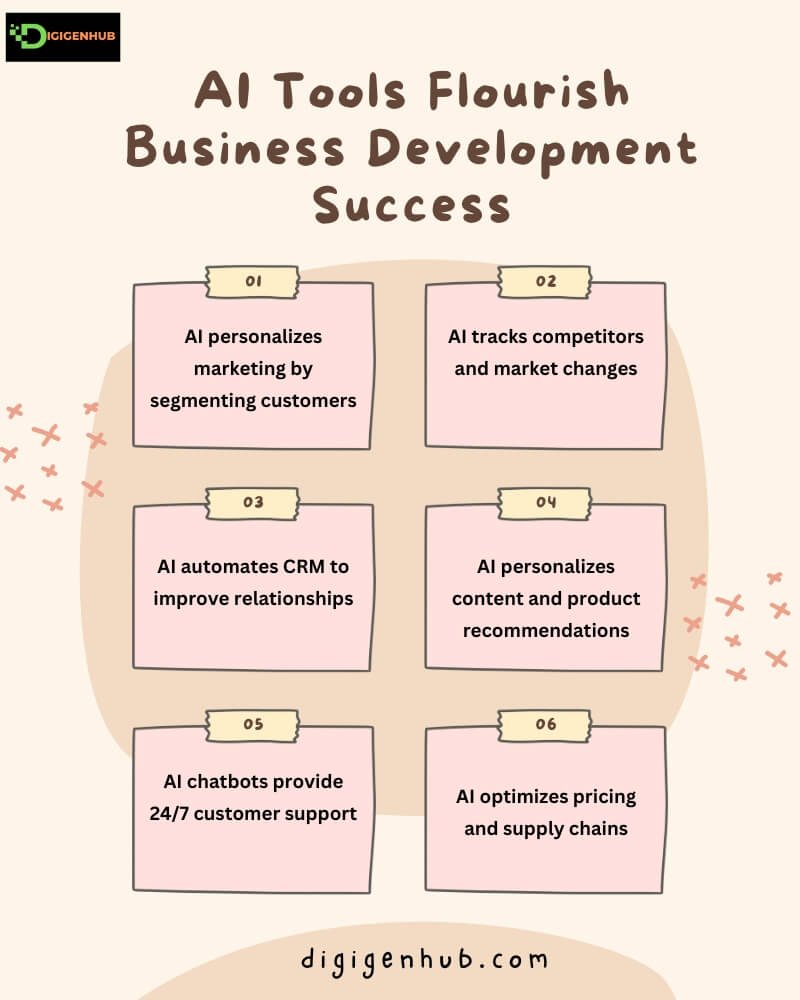
AI is helping businesses grow by improving many parts of the development process. Here are major areas where AI is already making a difference:
1. Lead Generation & Prospecting
AI helps find the best leads. It looks through lots of data to find people or companies who want to buy.
Example: LinkedIn Sales Navigator uses AI to suggest leads based on online behavior. This helps sales teams connect with the right people.
LinkedIn Sales Navigator
2. Customer Segmentation
AI divides customers into groups based on things like behavior and preferences. This helps businesses send the right messages to the right people.
Example: Amazon uses AI to suggest products based on what you’ve bought or viewed.
Amazon Personalization
3. Sales Forecasting
AI looks at past sales to predict future trends. This helps businesses plan better and make smart decisions.
Example: HubSpot uses AI to forecast sales and adjust strategies.
HubSpot Sales Tools
4. Market Research & Competitive Analysis
AI helps businesses track what competitors are doing. It also looks at market trends to help adjust strategies quickly.
Example: Crimson Hexagon tracks social media and customer opinions.
Crimson Hexagon
5. CRM Automation
AI automates customer relationship management (CRM). Tools like chatbots answer customer questions and follow up automatically.
Example: Salesforce Einstein uses AI to prioritize tasks and manage customer relationships.
Salesforce Einstein
6. Content Personalization and Recommendations
AI suggests content based on user behavior. This makes the experience more personal and keeps customers engaged.
Example: Netflix uses AI to recommend movies and shows based on what you’ve watched.
Netflix Recommendations
7. Chatbots and Virtual Assistants
AI chatbots help customers 24/7. They answer questions and guide users through purchases.
Example: Drift offers chatbots that help businesses interact with website visitors in real time.
Drift AI Chatbots
8. Price Optimization
AI adjusts prices based on demand and competition. It helps businesses stay competitive while maximizing profits.
Example: Airbnb uses AI to adjust rental prices based on local demand and events.
Airbnb Pricing Tools
9. Sentiment Analysis and Social Listening
AI tracks customer feelings by analyzing online conversations. This helps businesses understand customer needs and improve products.
Example: Brandwatch uses AI to monitor customer opinions across social media.
Brandwatch
10. Supply Chain & Logistics Optimization
AI predicts demand and optimizes delivery routes. This helps businesses reduce costs and improve delivery times.
Example: Amazon uses AI in its warehouses to predict inventory needs and optimize delivery routes.
Amazon Supply Chain
11. Risk Management & Fraud Detection
AI spots fraud by looking for unusual patterns in data. It can catch issues before they become big problems.
Example: PayPal uses AI to detect fraud by analyzing patterns in real time.
PayPal Fraud Protection
When Should Business Development Executives Implement AI?
AI helps automate tasks, predict trends and make fruitful decisions. But when is the right time to adopt AI?
Executives should start using AI when they face problems like too much data, slow processes, or difficulty scaling.
Let’s break it down by timelines: when to start and how to scale AI.
Short-term (2023-2024): Start with Basic Automation
In this phase, executives can begin using AI tools to automate simple tasks like lead qualification and customer behavior analysis.
Example: Intercom uses AI to automate customer messaging and qualify leads based on online interaction patterns.
Intercom AI
Impact: AI adoption can increase operational efficiency by up to 20%, reducing manual workload and enhancing speed.
Medium-term (2025): Combine AI into Core Strategies
Businesses should integrate AI into their core strategies for improved forecasting, customer personalization and more effective sales funnels.
Example: Clari uses AI to analyze sales data, predict revenue and provide insights on deal health.
Clari AI
Impact: AI-driven sales forecasting can increase accuracy by 20%, improving resource allocation and planning.
Example: Zalando uses AI to personalize product recommendations, improving customer experience and boosting sales conversion.
Zalando AI
Long-term (2026 and Beyond): Full AI Unite
By 2026, businesses should fully integrate AI. This will enable real-time decision-making and autonomous sales processes.
Example: UiPath offers AI-powered robotic process automation (RPA) that can handle repetitive sales tasks, freeing up executives for strategic work.
UiPath AI
Impact: Businesses fully adopting AI could see a 30% boost in revenue due to better decision-making and faster processes.
Example: Tesla uses AI to optimize supply chain management and autonomous driving features. Its AI-powered systems adjust in real-time to market shifts and customer needs.
Tesla AI
So, AI adoption should start with automating basic tasks and progress to integrating AI into core strategies.
How Can AI Be Unified for Business Development?
Now we will explain how to combine AI step by step for business development executives:
1. Data Collection & Cleansing
To make AI work, you need good data. AI uses both structured data (like sales records) and unstructured data (like customer emails). But before using AI, you must clean and organize the data.
AI Tools for Data Collection & Cleansing:
DataRobot: It collects and cleans data automatically, making it easy for executives to use the right data for AI analysis.
DataRobot
Trifacta: It cleans raw data and turns it into usable information for AI models.
Trifacta
Talend: Talend helps merge and clean data from different sources, ensuring it’s ready for AI.
Talend
Clean data makes AI more accurate. It helps AI give better insights, such as predicting sales or customer behavior.
2. Tool Selection & Confirmation
After cleaning the data, pick the right AI tools. These tools should match your goals, like automating lead scoring, predicting sales, or segmenting customers. Choose tools that work well with your existing systems, like CRM.
AI Tools for Selection & Integration:
HubSpot AI: Automates lead scoring and helps personalize marketing. It works well with CRM systems.
HubSpot AI
Salesforce Einstein: Offers sales forecasting, lead management and smart customer service. It works seamlessly with Salesforce CRM.
Salesforce Einstein
Pardot: This tool automates B2B marketing and lead nurturing. It integrates easily with Salesforce.
Pardot
The right AI tools automate routine tasks. They make business development faster and more efficient.
3. Skill Development
AI tools are powerful, but teams need training to use them. Teaching business development teams how to work with AI ensures they can make the best decisions.
AI Tools for Skill Development:
Salesforce Trailhead: Offers free training on using Salesforce AI tools.
Salesforce Trailhead
Udemy for Business: Provides courses on using AI tools for sales forecasting, customer analysis and marketing automation.
Udemy for Business
LinkedIn Learning: Offers training for using AI tools in business development.
LinkedIn Learning
When teams understand AI tools, they can use them to make better, faster decisions. Proper training boosts productivity and confidence.
4. Continuous Optimization
AI models need to be updated regularly. As new data comes in, AI needs to be retrained. This helps the AI stay accurate and relevant.
AI Tools for Continuous Optimization:
Google Analytics 4 (GA4): Uses machine learning to improve marketing and website insights over time.
Google Analytics
Amazon SageMaker: Automatically retrains AI models to stay accurate as new data is added.
Amazon SageMaker
H2O.ai: Keeps AI models updated with fresh data, improving accuracy.
H2O.ai
AI needs regular updates to stay accurate. Ongoing optimization means smarter decisions and better results.
Global Impact of AI on Business Development Executives
In this section, we’ll explore how AI impacts business development globally:
1. Market Efficiency
AI helps executives reduce time spent on routine tasks. The processes like lead generation, data collection and customer follow-ups free up time for strategic work.
Example:
InsideSales.com: This AI-driven sales acceleration platform uses machine learning to help executives predict the best leads, optimize follow-up times and improve sales processes.
InsideSales.com
InsideSales.com analyzes sales data to provide insights into the best times to reach out to leads, ensuring faster and more efficient sales cycles.
2. Increased Revenue
AI allows businesses to focus on the right leads and anticipate customer needs. This increases conversion rates and revenue by delivering the right offers at the right time.
Example:
Conversica: Conversica’s AI-powered sales assistant automatically follows up with leads and nurtures them until they’re ready for a conversation with a sales rep. This helps close more deals without manual intervention.
Conversica
Conversica boosts sales efficiency by automating lead follow-up and converting more leads into actual sales.
3. Job Evolution
AI will automate many operational tasks, allowing executives to focus on strategic aspects such as relationship building and long-term business planning.
LinkedIn Sales Navigator with AI: This tool helps executives by recommending potential clients. So it uses AI to keep sales teams updated on basic changes in client behavior. It lets executives spend less time on relationship building.
LinkedIn Sales Navigator
4. Global Competitiveness
Companies that adopt AI can quickly adjust to market changes and stay ahead of competitors. AI helps businesses provide solutions to customers, which leads to greater customer loyalty and market share.
Example:
Coca-Cola: Coca-Cola uses AI-powered chatbots to interact with customers in real time. These chatbots help customers find product information, making the experience smoother and more personalized.
Coca-Cola AI
Executives’ Opinions on AI’s Global Impact
Satya Nadella, CEO of Microsoft: “AI is not just a tool for the future; it’s the foundation of how we create value today and businesses must adopt it to stay relevant in the digital era.”
Microsoft AI
Jim Farley, CEO of Ford: “AI has revolutionized our ability to innovate quickly and it’s essential for business development to help us scale and maintain competitiveness in a rapidly changing global market.”
Ford AI
What Happens If Business Development Executives Ignore AI?
If executives don’t use AI, they risk falling behind. Without AI, they may face:
Slower Decisions: Without AI, decisions take longer because there’s no quick access to data and insights.
Missed Revenue: AI helps executives spot high-value leads and predict customer needs. Without it, they may lose out on big sales opportunities.
Inefficiency: Without AI, repetitive tasks stay manual, making work slower and more prone to mistakes.
Falling Behind Competitors: Companies that ignore AI will find it hard to keep up with those using it to improve their customer experience and market position.
Conclusion
Thus, business development executives who use AI will work faster, make more money and achieve long-term success. AI will shape the future of business. As it grows, it will create new opportunities. The future is bright for executives who combine AI with their expertise in business development.
FAQ
How do executives use AI?
Machine learning helps executives by finding patterns in data and making predictions. Algorithms automate tasks, saving time and improving efficiency. These tools help make smarter decisions faster. They also give companies a competitive edge by predicting future trends.
What are the 4 stages of an AI workflow?
Data Collection: Gather relevant data.
Data Preparation: Clean and organize the data.
Model Training: Train the AI using the data.Deployment: Implement the model for real-world use