


Last year, I struggled with my print-on-demand T-shirt business. I thought creating cool designs and running ads would increase sales, but I was wrong. I didn’t consider the power of AI and business intelligence (BI) to improve my business.
Still, I was guessing with my marketing. I had no clear idea who my customers were or when they bought. Some ads worked, but most didn’t. It felt like I was wasting time and money.
Then, I have learned about AI and BI and decided to use it. I have realized that tools like Google Analytics, Tableau and HubSpot can present justified data. Then I see who my best customers are. AI also helps me target ads and confirm what designs would sell best.
Indeed, it made over 50% of my marketing decisions. In just a few months, my sales grew by 40%. So, let’s learn specific activities of AI-powered business intelligence.
The Impact of AI and Business Intelligence in Today’s Digital World
AI-powered BI is flourishing across most small industries online. By 2030, it will drive 50-80% of significant decisions in digital businesses. Let me explain its impact on leading small businesses:
1. E-commerce and Online Retail
AI-powered BI helps personalize shopping experiences, set dynamic pricing and predict trends. It helps businesses track inventory and forecast demand. Shopify, for example, uses AI to improve e-commerce (Source: Reuters).
Projected Trends:
2025: AI is influencing 30% of consumer purchasing decisions.
2030: AI will affect 50-60% of decisions in retail. This includes supply chain and marketing.
2. Digital Marketing and Advertising
AI helps marketers target the right audience. It uses customer data for better ads and content. TikTok Shop uses AI to create personalized ads (source: Business Insider).
Projected Trends:
2025: AI is electronic 5% of marketing decisions.
2030: AI will drive 70-80% of all digital marketing strategies.
3. SaaS (Software as a Service) and Cloud-Based Products
SaaS uses AI to understand user behavior. It helps predict when users might leave and offer product suggestions.
Projected Trends:
2025: AI is processing 50% of customer data in SaaS.
2030: By 2030, 80-85% of SaaS services will use AI for better insights and product optimization.
4. Fintech (Financial Technology)
Fraud detection and risk analysis in fintech use AI-powered BI. AI also helps automate investment decisions.
Projected Trends:
2025: AI is handling 40-50% of fraud detection and financial services.
2030: By 2030, AI will control 70% or more of fintech operations.
5. Healthcare and Health Tech
AI helps healthcare by predicting patient needs. It also improves resource use and treatment plans.
Projected Trends:
2025: AI assists 35% of healthcare decisions.
2030: By 2030, AI will be involved in 60-70% of healthcare operations.
6. Gaming and Entertainment
In gaming, AI helps understand player behavior and recommend content. It also helps improve user experience on platforms like Netflix.
Projected Trends:
2025: AI improves 40-45% of gaming content and user engagement.
2030: By 2030, AI will enhance 60-70% of entertainment operations.
7. Retail and Consumer Goods
Retailers use AI to predict customer demand. It helps with inventory, promotions and supply chains.
Projected Trends:
2025: AI influences 50% of retail decisions.
2030: By 2030, AI will control 75% of retail operations.
Benefits of Combining AI and BI for Digital Businesses
AI and Business Intelligence (BI) help companies make better decisions faster. They save time, cut costs and improve services. Let’s look at the major benefits that AI and BI bring to digital businesses:
1. Faster Decision-Making
AI processes data quickly. This lets digital businesses make faster decisions.
Shopify uses AI and BI to analyze real-time sales data, helping e-commerce businesses adjust marketing strategies instantly based on performance.
2. Cost Savings
AI reduces the need for manual work, leading to operational cost reductions.
Square uses AI to automate transaction analysis for online stores, reducing the need for manual accounting and cutting costs.
3. Better Customer Service
AI-powered chatbots enhance customer service by providing instant answers and personalized interactions.
Zendesk uses AI-driven chatbots integrated with BI to handle customer support queries for digital businesses, improving response time and service quality.
4. Improved Productivity
AI automates repetitive tasks, freeing up resources for more strategic activities.
Wix uses AI to create websites for users. This allows digital business owners to launch and manage websites with minimal effort.
5. Enhanced Data Analysis
AI discloses trends and insights in large datasets. Google Analytics helps digital marketers refine their strategies.
6. Predictive Analytics
AI forecasts trends, allowing digital businesses to plan future campaigns or product developments.
Netflix uses AI to predict which movies or shows will become popular, guiding content production and acquisitions.
7. Personalized Marketing
AI segments customer data and creates tailored marketing messages for specific audiences.
Amazon uses AI and BI to analyze customer purchase history. They send tested product recommendations to increase sales and improve the customer experience.
8. Risk Management
AI detects risks and anomalies early, allowing businesses to act proactively.
PayPal uses AI to monitor digital transactions for fraudulent activity. This flags suspicious transactions to reduce financial losses automatically.
9. Scalability
AI and BI can scale as the business grows, handling larger datasets without performance issues.
Cloud services like AWS use AI-powered BI tools to analyze usage patterns, ensuring resources are allocated effectively as customer demand grows.
10. Competitive Advantage
AI helps digital businesses stay ahead of competitors by providing quick insights and enabling agile responses.
Spotify uses AI to analyze user data and create tailored playlists. This gives them an edge over competitors like Apple Music in user engagement.
11. Enhanced Data Visualization
AI generates dynamic and interactive visualizations, making data easier to understand. Tableau allows real-time data analysis and decision-making.
12. Improved Forecasting
AI improves forecasting accuracy by analyzing historical data and trends. HubSpot helps digital marketers optimize campaigns for better results.
13. Better Resource Allocation
AI optimizes the distribution of resources, ensuring efficient use of time and effort.
Uber uses AI to allocate drivers based on real-time demand, ensuring efficient transportation for riders and higher earnings for drivers.
14. Improved Collaboration
AI-driven BI tools help digital businesses share data and insights across departments for better teamwork.
Slack integrates AI with BI to enable cross-department collaboration by automatically providing vital data and reports within channels.
15. Real-Time Analytics
AI processes data in real time, helping businesses adapt quickly to changes.
TikTok uses AI to analyze user behavior instantly. This adjusts video recommendations and keeps users engaged on the platform.
16. Automated Reporting
AI automates the generation of reports, saving time and reducing errors.
Digital marketing platforms like SEMrush use AI to generate performance reports. This helps marketers measure campaign performance without manual work.
17. Enhanced Customer Segmentation
AI analyzes customer behavior in-depth to create more accurate segments for better targeting.
Facebook (Meta) uses AI to segment users based on their engagement and interests. This lets advertisers run highly targeted ad campaigns.
18. Faster Time to Market
AI accelerates product development, allowing digital businesses to respond to market demands quickly.
Adobe uses AI to automate design processes within its Creative Cloud. This speeds up content creation for digital businesses and helps them get products to market faster
19. Increased Profit Margins
AI optimizes pricing, customer engagement and product recommendations, increasing profitability.
Airbnb uses AI to adjust pricing based on demand, competition and availability. This helps hosts optimize their profits.
20. Enhanced Innovation
AI opens up new possibilities for innovation in digital product development.
Apple uses AI to enhance features like facial recognition in the iPhone. This drives innovation in product offerings and improving user experiences.
How AI-Powered BI Tools Set Up Purified Decisions for Small Businesses
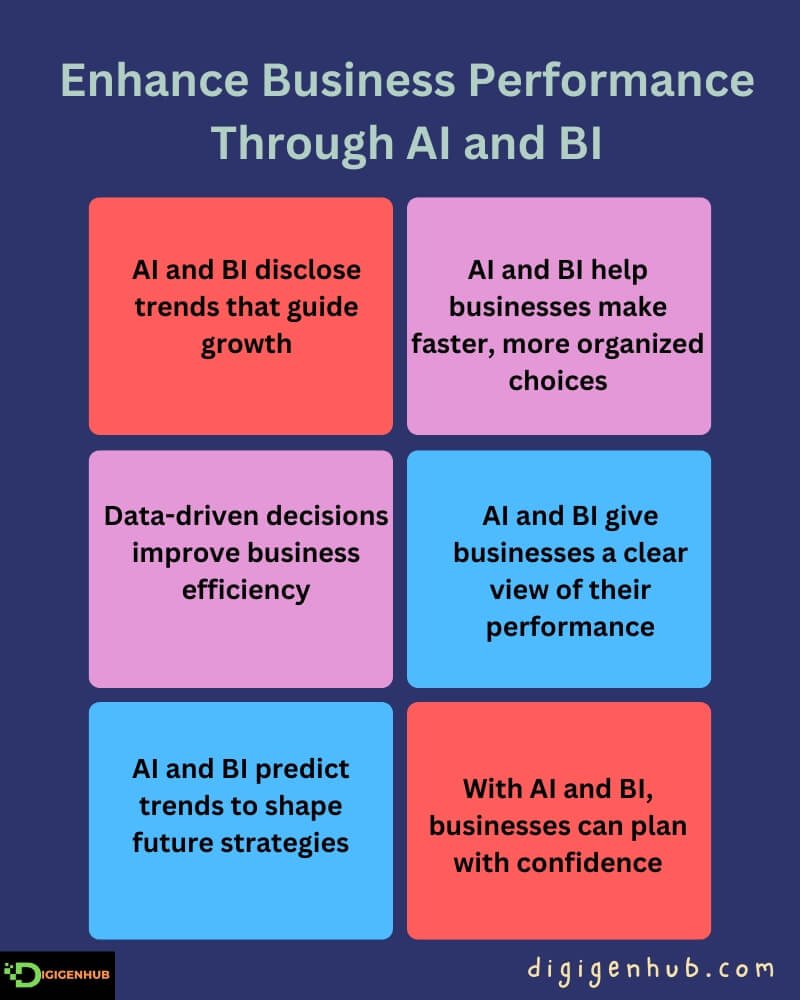
AI-powered BI tools combine advanced algorithms and data analysis to help businesses make wise decisions. These tools use machine learning to analyze data and predict trends, while BI helps visualize and report on this data. Here’s how they work, with some real-life examples:
Tableau
Tableau combines AI with BI to create interactive dashboards that visualize data. It uses AI algorithms to identify trends and patterns in your data. This helps businesses make fruitful decisions. For example, companies like Unilever use Tableau to make data-driven decisions.
Google Analytics
Google Analytics provides insights about your customers, which can help improve marketing strategies. For example, H&M uses Google Analytics to understand customer behavior and optimize campaigns.
Power BI by Microsoft
Power BI by Microsoft combines AI with business intelligence to generate automatic insights and visual reports. It uses machine learning models to predict future trends. Businesses like Heathrow Airport use Power BI to track airport operations and improve efficiency.
Qlik
Qlik uses AI to suggest insights from your data electronically. It connects multiple data sources and applies machine learning to uncover hidden trends. For example, Toyota uses Qlik to analyze data for improved production processes and customer satisfaction.
HubSpot
HubSpot combines AI and BI to improve marketing campaigns and customer relationships. AI helps segment customers and predict their behavior, while BI tracks sales and performance. The Home Depot uses HubSpot to optimize its marketing strategies and improve customer experience.
IBM Watson Analytics
IBM Watson Analytics uses AI to process large amounts of data and provide insights through visualizations and predictive analytics. For example, Woodside Energy uses Watson to analyze data and make smarter business decisions.
SAS Business Intelligence
SAS Business Intelligence combines AI with BI to help businesses make predictions and optimize operations. It uses machine learning algorithms to improve decision-making. Coca-Cola uses SAS BI to analyze sales trends and optimize marketing campaigns.
Domo
Domo uses AI and BI to create interactive dashboards and insights. It applies machine learning to optimize business performance. For example, Xerox uses Domo to improve operational efficiency and track sales performance.
Zoho Analytics
Zoho Analytics uses AI to analyze business data and offer insights that help improve operations. It automatically detects trends and generates reports. Zappos uses Zoho Analytics to track sales and improve customer service.
Looker
Looker uses AI to analyze large datasets and provide businesses with key insights. It helps companies improve customer engagement and optimize marketing. Spotify uses Looker to track user behavior and recommend personalized music.
These tools combine AI and BI to analyze large datasets, find hidden patterns and predict future trends. They help businesses make data-driven decisions quickly and efficiently.
Struggles in Combining Business Intelligence and Artificial Intelligence
Starting with AI-powered BI can be exciting, but it’s not always easy. Many businesses face challenges when trying to use these powerful tools. While AI and BI can help make smarter decisions, there are some struggles along the way. Let’s take a look at some of these challenges and how they can affect your business.
Data Quality Issues
AI needs clean data. If the data is wrong or incomplete, AI gives bad results. For example, if a business uses bad customer data in Google Analytics, the predictions can be off.
Fixing data quality can cost anywhere from $10,000 to $50,000. It depends on the size of the business.
High Costs
AI-powered BI tools are expensive. Tools like IBM Watson Analytics or Tableau need big investments in software and training.
IBM Watson starts at around $80,000 yearly and Tableau can cost around $1,000 to $5,000 per user per year. This can be too expensive for initial small businesses.
Complex Setup
Setting up these tools takes time. You may need experts to help. For example, using Power BI or Qlik can take a lot of time to set up properly.
Setting up these tools can cost $10,000 to $100,000. This depends on business size and complexity.
Resistance to Change
Employees may not like new tools. They may feel unsure about using AI systems. For example, sales teams might not trust SAS Business Intelligence at first.
Training employees can cost $1,000 to $10,000 per employee.
Data Privacy Concerns
AI needs a lot of data. Protecting that data is hard. Businesses need to follow privacy rules like GDPR.
Legal fees and compliance can cost $5,000 to $50,000 per year.
Over-reliance on AI
Relying only on AI is risky. Human judgment is still needed. For example, using Looker without checking the data manually can lead to mistakes.
Errors from over-reliance on AI can cost $10,000 to $100,000 in lost revenue.
These struggles are real. Yet, with organized planning, businesses can overcome them.
Conclusion
AI helps you perceive your customers better. It assists to target your ads and know what works. Your business will run smoother and you’ll focus on what matters most.
So, AI and BI are not just for big companies—they’re for you, too. With the right insights, your business will reach its peak and grow faster.
FAQ
What is artificial intelligence and business?
AI in business means using smart technology to make work easier and faster. It helps companies analyze data and make better decisions. AI is used to improve customer service, marketing and operations. It saves time, cuts costs and helps businesses grow and stay ahead.