
AI effects on society now touch every corner of digital life. People change how they search, shop, learn and judge what feels real.
Businesses adjust their service style. Families rethink habits. Communities try to catch up.
Every part of daily life moves faster because AI is embedded in the phones, sites and tools we use every day.
I noticed this shift in a very personal way. My younger sister asked me why her classmates believed a fake video that spread in their group.
She felt confused and pressured because everyone trusted the clip without checking the source. I sat with her, showed her how to verify content and helped her test a few AI-detection steps.
Then I watched her share the truth with her friends. The group stopped the rumor within minutes. That moment showed me how much people need simple guidance when AI changes what they see and believe.
AI Effects on Society: How does AI Influence What People Choose
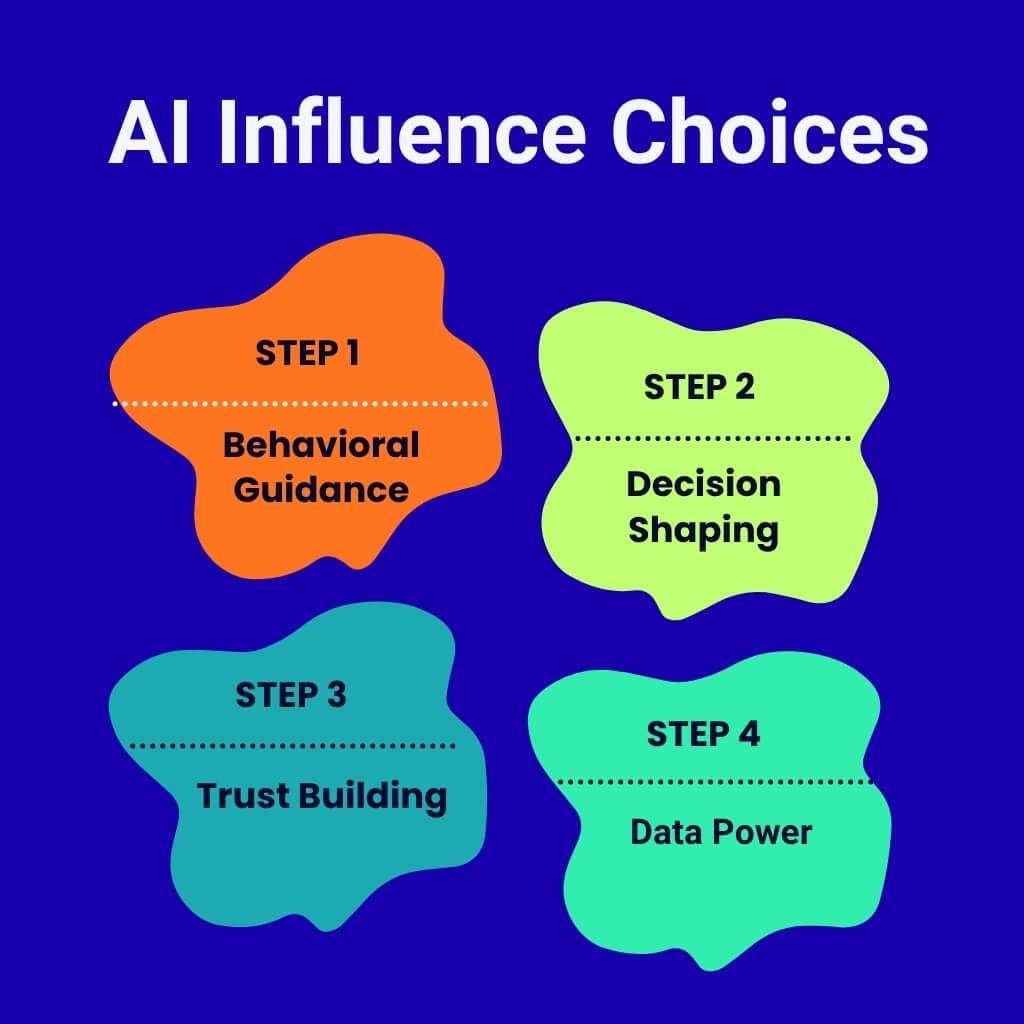
AI now guides actions, not just tasks. People meet it through chat, voice and daily apps.
Trust grows when tools explain choices and offer quick fixes. Firms with strong data and computing rise fastest in this new phase.
The move from “tool-based assistance” to decision-level influence
Companies now embed AI within their decision-making systems. These systems suggest, rank, or decide actions for people.
Examples: office copilots that draft legal clauses, hospital assistants that flag diagnosis concerns and retail systems that set prices by predicted demand. Reuters
Models handle multimodal input (text, audio, images). This allows tools to provide advice based on pictures, voice notes, or documents together. That raises the system’s influence. Wikipedia
Firms now measure AI decisions as business outcomes. They track metrics like reduced time-to-decision, fewer errors and higher throughput. Public filings and product pages show this shift.
Everyday interactions: AI in communication, planning, shopping and personal routines
Most people encounter AI through chatbots, assistants and personalized suggestions.
a) Chat and assistant use grew in 2025. About half of consumers now say they will use a brand’s AI chat or assistant. Younger people use them most. This shows AI has become a normal channel for help. Attest
b) Messaging and phones pick up AI features. Apps suggest replies, summarize long threads and convert voice to text with context. These features cut friction in daily tasks.
c) Shopping: stores use AI to predict what people want, offer short-term deals and show tailored product lists. Retailers utilize AI models to optimize stock management and expedite delivery speed. Amazon and UPS publish product pages that describe these exact tools.
d) Planning and calendar tools now suggest comprehensive plans, including meetings, travel and prep lists tailored to user preferences. People are more likely to accept those plans when the tool explains why it made those choices.
Why does AI feel more human now?
It utilizes voice, images and a broader context. It mimics patterns we expect.
Models listen and speak. They read images and handle long chats. That mix makes their replies feel natural.
Designers tune models with human feedback. That makes the tone more polite and direct. Users feel understood.
What to watch: Tools that act “too human” can mislead. Always check the source and the data behind a strong claim.
Behavioral shifts: reliance on predictions, personalized content and automated choices
People accept predicted outcomes and tailored options more often.
Prediction use
People follow route suggestions, health prompts and job-match recommendations. They trust systems that show data.
Personalization
Sites and apps tailor news, shopping and ads. That raises engagement and narrows the focus of what people see.
Automated choices
Many apps offer “auto-apply” or “one-click accept” on suggestions. That reduces friction but transfers choice from humans to systems.
Show users a short reason and a one-line undo option. That keeps control of people and helps build trust.
How social norms are changing
People expect fast answers and more accuracy from tools.
Speed
Users want answers in seconds. Companies must deliver short, clear results. Delays reduce trust.
Accuracy expectation
People expect fewer mistakes. When tools err, users lose trust quickly. Firms respond by adding checks and human reviewers.
Optimization pressure
People and businesses test small changes often. That makes services change fast. Users learn to expect updates and new features.
Websites should mark machine suggestions. Offer an easy correction flow. That keeps users calm and satisfied.
Public adaptation to AI-driven interactions in daily life
People change habits to match AI behaviors.
a) Many users now prefer voice and chat over long forms. Apps that feature clear chat flows tend to achieve higher engagement.
b) People tailor how they write or speak to get better AI results. Short prompts and exact phrases become common.
c) Public services test assistants for basic tasks like benefits or booking. This lowers waiting time but raises the need for oversight. Governments and large firms publish pilot reports and service pages about the use of assistants. blog.google
Teach people short prompt patterns. That helps them use new tools without frustration.
New societal dependency patterns
Society now depends on computing, data access and model updates.
Infrastructure
Companies require high computing power and access to data to run advanced models. That centralizes power. Large cloud providers and major firms now control a significant portion of the stack.
Data access
Who owns clean, labeled data gains influence. Firms with large datasets can improve their models more quickly. That shapes markets and worker demand.
Rapid updates
Frequent model changes make tools evolve constantly. Users adapt but regulators now track update cycles. Several industry groups call for model-audit standards.
Business impact
Firms must invest in cloud, data governance and audit logs. That protects users and helps meet future regulations.
Expert Opinion
“The future of AI is not about replacing humans. It is about helping them do more meaningful work.” — Sundar Pichai, CEO, Google. TIME
How is AI changing core systems across society?
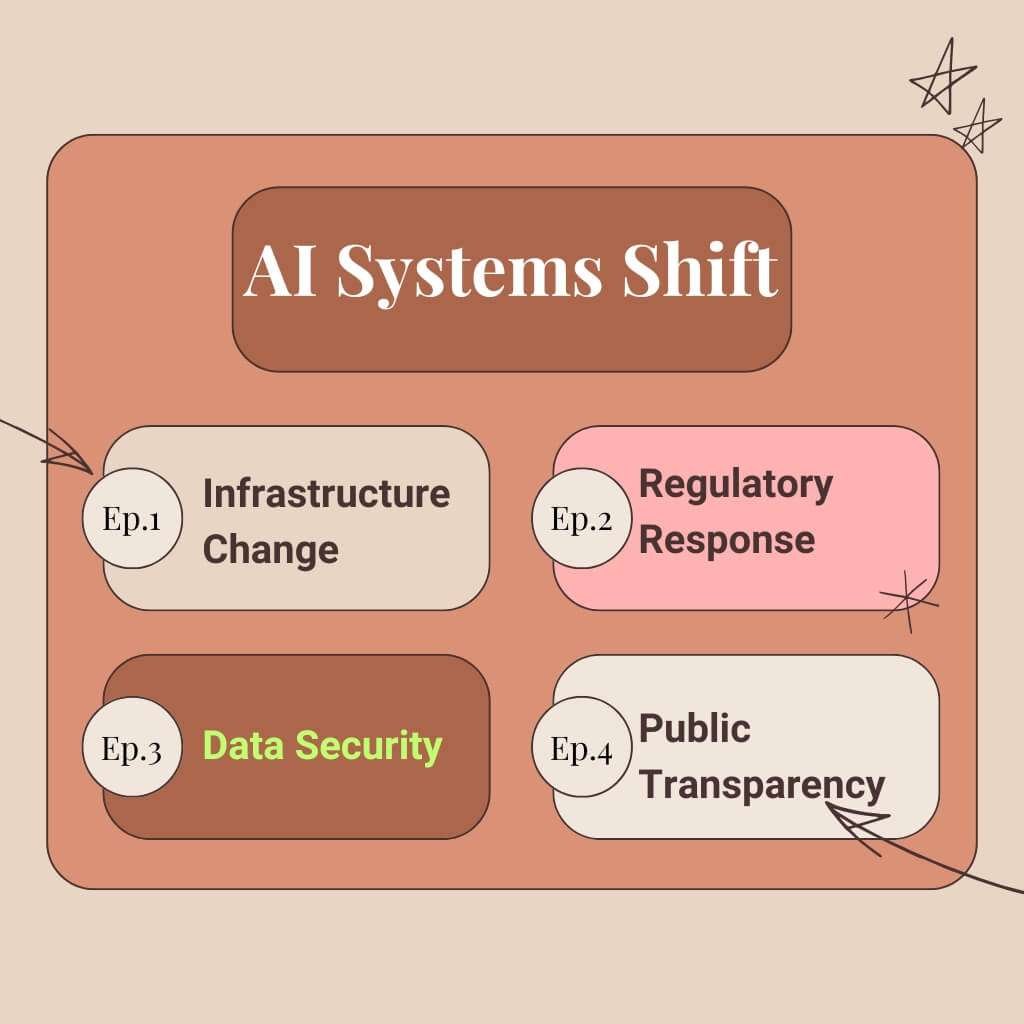
Logistics and city systems move first. Investors follow these signals fast.
Utilities and data centers are now planning for higher AI power usage. Regulators already respond.
Companies must secure data, protect computing resources and maintain clear audit logs.
Public services need transparency. They also need open data and simple review steps.
1) Transition to AI-managed systems in key sectors
Transport, energy, finance and farming now run with AI at their core.
Transportation
Companies deploy autonomous fleets and fleet-management AI for freight and ride services.
These systems plan routes, manage charging and route loads across hubs. Reuters reported that Aurora is integrating autonomous trucking with McLeod’s TMS to enable shippers to manage driverless loads within their existing logistics software.
Cities and operators run low-speed, high-frequency autonomous shuttles for campuses and short routes. May Mobility has expanded its new electric robo-buses for a planned 2026 deployment.
Energy
Utilities use AI to forecast renewable output and balance demand. Operators now run AI for demand-response signals and grid stability.
Recent industry discussions emphasize the use of AI for renewable forecasting and flexible demand.
Data centers and AI workloads change energy patterns. Analysts warn of rising data-center demand and pressure on grid capacity. Utilities update interconnection rules as a result.
Finance
Banks embed AI into lending, fraud detection and trading. Regulators now study systemic effects. The Bank of England published a focused review on the financial stability risks and monitoring plans associated with AI.
Firms adopt continuous model monitoring and governance to meet compliance demands. Recent regulator briefings urge stronger controls.
Agriculture
Farms utilize AI, drones, sensors and satellites to map their fields. They apply treatments by zone and track yield patterns. Precision agriculture cut inputs and raised yields in pilots.
Vendors offer subscription data services. Large farms buy long-term models and satellite feeds.
How coordinated AI changes cities, supply chains and public safety
AI connects systems. This allows operators to manage multiple moving parts simultaneously.
Cities and urban flow
Digital twins let planners test scenarios on city models. Cities use twins to plan transit, energy use and emergency response. UNDP and research reports show that many urban digital twins in use by 2025. UNDP
Traffic managers now run predictive congestion controls and dynamic signals. That reduces delays during events.
Supply chains
AI links suppliers, carriers and warehouses. Systems re-route freight when ports or roads are congested.
Partners like Aurora integrate with TMS products to let shippers handle autonomous legs. That tightens logistics control.
Companies move from monthly plans to continuous optimization cycles. They update inventory and routing daily.
Public safety and response
Emergency services use AI to prioritize dispatch and map hazards. Cities feed sensor data into analytics hubs. Planners run what-if tests on digital twins. UNDP
Police and fire departments utilize analytics to allocate resources effectively. That raises civil rights questions and calls for oversight.
The rise of AI-mediated governance tools
Governments now use AI tools to test policies and plan infrastructure.
What these tools do
They model budgets, traffic, housing and climate impacts. They pull many data layers to show outcomes. Digital twins and policy engines run scenario comparisons. MDPI
Agencies use these tools to spot fragile services and to target investments.
Limits and risks
Tools rely on data quality. Bad inputs give bad outcomes.
Agencies need audit logs and human review. Several research reviews call for interoperability and clear governance. MDPI
Practical note for officials
Start small with pilot areas. Publish model inputs. Let communities review the findings.
Integration of AI into schools, courts, hospitals and national infrastructure
Institutional services now run AI for operations, access and decisions.
Schools
Edtech uses AI for personalized practice and assessment reports. Districts use analytics to spot students who fall behind. Pilots show better attendance and faster support delivery.
Courts
Courts test AI for scheduling, document review and risk flagging. Some jurisdictions use risk tools in bail processes. Experts warn about bias and call for transparency.
Hospitals and health systems
Hospitals adopt clinical decision support, imaging analytics and monitoring platforms. Systems flag high-risk patients and route test results. Many hospitals publish validation studies.
National infrastructure
Airports and ports use AI for passenger flow, security screening and cargo routing. Power grids and telecom operators add AI for stability and load forecasting.
Institutions must add clear oversight. They must document data and maintain human involvement in final review roles.
Where is AI making the biggest shift?
Logistics and city operations are currently undergoing the largest structural changes.
Why logistics?
Because freight depends on routing, scheduling and coordination. AI can replace manual logistics decisions at scale. Integration deals (Aurora + McLeod) show industry adoption. Reuters
Why city ops?
Digital twins enable officials to test and roll out policies more quickly. Many cities now run twin pilots. That changes how cities plan and allocate their budgets. UNDP
Evidence: Coverage of autonomous freight pilots and municipal digital twin reports from 2025 reveals broad deployment and investment trends. Reuters
Social mobility changes driven by digital access and AI literacy
AI widens the opportunity for connected users and limits it for disconnected ones.
Two-tier effect
People with fast internet and digital skills access training, gigs and data services. They move to higher-paying roles.
People without access lose opportunities to train and utilize AI-assisted tools. They fall behind.
Education and retraining
Micro-credentials and employer-led short courses grow. Firms sponsor targeted retraining for new roles. Reports in 2025 show more corporate reskilling programs.
Policy responses
Cities and states fund digital-inclusion programs. They expand public broadband. That narrows the gap, but it still needs funding.
Offer low-cost, local classes that teach practical AI skills. Focus on prompt use, data basics and verification habits.
How AI is redefining economic power: data, compute and IP control
Firms that own clean data, major compute, or key models gain leverage.
Data control
Firms that collect and label large datasets improve model performance faster. That gives them a market edge. Data partnerships and exclusive feeds matter.
Compute access
Access to large cloud capacity and GPUs drives model training and inference speed. Regions with data-center clusters attract more AI investment. Utilities and regulators now plan for this demand.
Intellectual property and productization
Owners wrap models inside platforms and APIs. These tools become product lines. Partnerships (like Aurora + McLeod) show how platform access spreads capability without handing over core models.
Policy angle
Governments discuss data-sharing rules, fair access to computing and export controls. International groups call for monitoring cross-border risks associated with AI.
Expert View
“Meeting customers where they already operate reduces friction and speeds adoption.” — Ossa Fisher, President, Aurora (on integrating autonomous trucking with carrier software). Reuters
“Central banks must watch AI’s systemic effects on lending, markets and stability.” — Bank of England, Financial Policy Committee (Financial Stability in Focus: AI). Bank of England
Case study — Aurora + McLeod Software
Aurora integrated its autonomous trucking platform with McLeod’s Transportation Management System (TMS). Shippers can now handle driverless legs inside the same TMS they already use. Reuters
This move removes an adoption barrier. Carriers don’t need separate software. They can schedule autonomous trucks like any other freight. That speeds commercial uptake. Reuters
Aurora runs beta tests in Texas. McLeod plans broader availability next year. The integration demonstrates how AI systems integrate with existing industry stacks.
What makes AI Hard for Workers, Families and Institutions
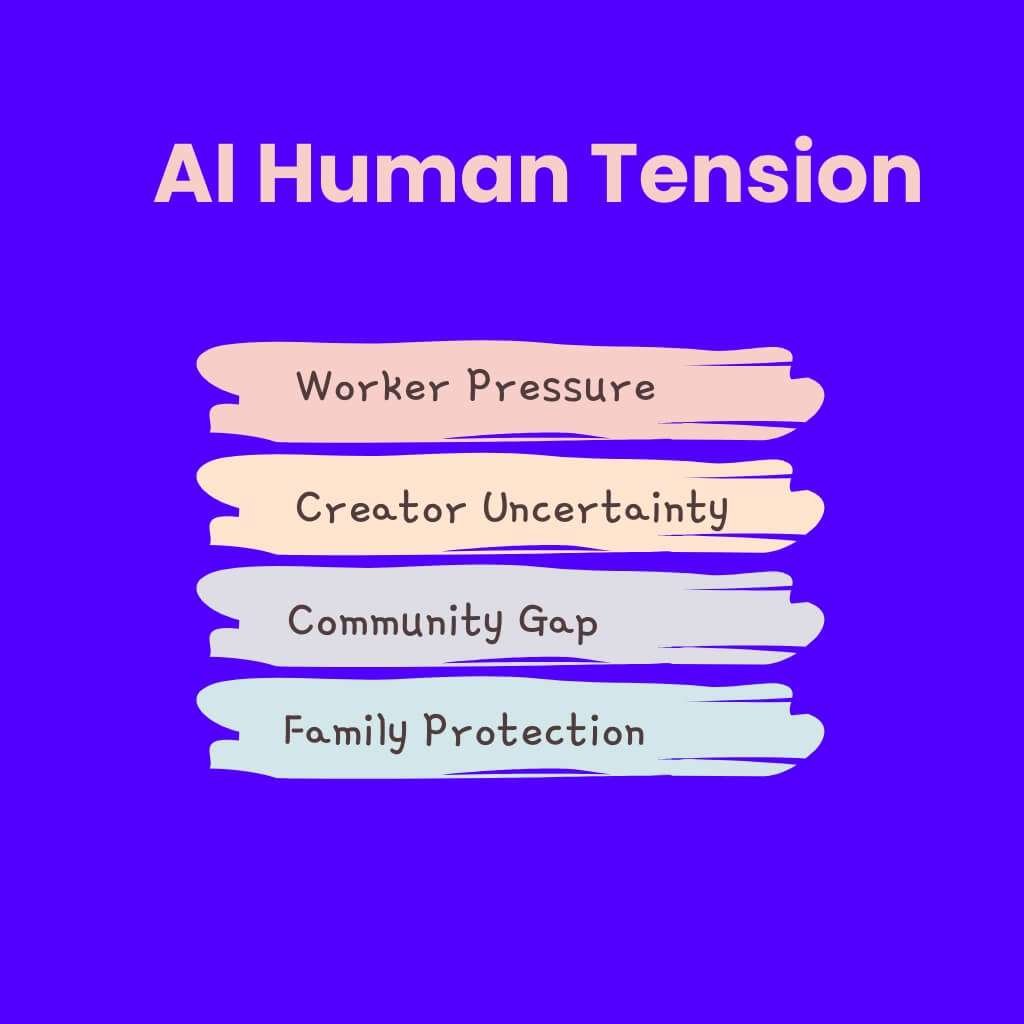
Workers feel the tension between new tools and rising expectations. Creators feel uncertain about their place when machines produce endless content.
Local communities struggle when some individuals have access to AI tools and others do not.
Institutions like schools and hospitals test new systems that change how they serve people.
Families ask how to protect children from manipulated media and emotional pressure.
1) Economic tension: workers vs. automation-driven productivity demands
Employers push for higher output. Workers face faster task cycles and new expectations.
What’s happening now
Companies utilize AI to automate repetitive tasks and enhance productivity. Managers expect faster decisions and higher measurable output. This raises pressure on staff.
Employers measure productivity in finer detail. AI tools track tasks, time and outcomes. This increases performance scrutiny.
Who feels the pressure most?
Routine roles in offices, retail and logistics.
Gig workers who compete on platform metrics.
Immediate effects
Job tasks are split into micro-tasks. Managers shift from broad goals to narrow KPIs.
Workers report stress and shorter attention windows. Surveys indicate a growing concern about job loss and changes in job content.
What to do right now (practical steps)
Offer short skill clinics tied to current tools and technologies.
Publish clear job-role lists showing human vs automated duties.
Provide pause-and-review options when systems give tight deadlines.
Cultural tension: human identity vs. machine-generated creativity
People debate what counts as human work in art, media and craft.
Current pattern
Artists, writers and designers see AI-created work flood platforms.
Audiences struggle to distinguish between human-made and machine-made content. Studies show public concern for authenticity.
Why this essential
Creative work is closely linked to identity and livelihood.
If platforms raise the supply of cheap, similar content, human creators lose distinctiveness.
Practical responses for creators
Make the process visible. Show drafts, references and intent.
Use short “about” blurbs that say which parts a human made.
Offer exclusive, limited editions or behind-the-scenes access.
What platforms should do?
Label machine-assisted content clearly. Let creators verify authorship with simple provenance tags.
Trust tension: which information sources do people now believe
Deepfakes and fast content reduce trust in media. People doubt both real and fake items.
Core objects
AI can make convincing images, videos and audio. That erodes trust. UN and ITU urged stronger detection and watermark standards in 2025.
Pew data show the public doubts AI and regulators. Many want more control. Lack of trust extends to news and elections.
How this plays out
Users call true footage fake. Others accept fake footage as real.
The “liar’s dividend” grows: real facts get dismissed as AI fakes.
Quick verification habits to teach users
Check multiple trusted outlets for the same claim.
Look for provenance markers (watermarks, metadata).
Use platform verification tools and official statements.
For publishers and sites
Add visible provenance for videos and images.
Publish source data and short verification notes.
Interpersonal tension: AI’s influence on relationships and emotional expectations
AI chat tools change how people connect and what they expect from others.
Some people use chat tools for company and emotional support. That fills needs. However, the overuse of links has been linked to social disconnection in early studies.
A 2025 health study found higher social disconnectedness among heavy users of AI chat for companionship.
How habits shift
People expect instant replies and neat phrasing.
They borrow AI tone and patterns in messages. That changes social norms.
Risks for relationships
People may prefer clean, scripted responses. They then avoid messy, real conversation.
Children and teens who rely on AI for interaction may miss out on opportunities for practicing conflict resolution and empathy. Brookings warns about replacing human contact in education and care settings.
Small steps to reduce harm
Limit AI-only conversations for emotional needs.
Teach kids to check feelings with a real person first.
Build “human-check” prompts into companion apps.
Why do people distrust AI content?
Because AI can mimic reality and hide errors or bias.
Core reasons people cite
AI makes realistic but false media.
Many tools do not explain how they arrived at their decisions.
Firms and regulators seem slow to act. Pew shows that the public is concerned about weak oversight.
What users want now
Clear source labels.
Simple provenance checks.
Faster public corrections.
Community-level divides caused by unequal access to AI tools
Access and skill gaps split communities into the “connected” and the “left behind.”
What divides look like now
Urban and wealthier groups access modern tools, cloud services and training.
Rural and low-income groups often lack access to sufficient bandwidth, devices, or internet classes. That limits jobs and services.
Real-world consequences
Job postings increasingly require AI-savvy skills. Workers without training miss those openings.
Local services shift to chat or app-first models. People without access lose easy service routes.
How local leaders can help
Run short, free AI literacy programs in libraries and community colleges.
Offer device loan programs and public Wi-Fi and keep in-person service lines open.
Reward employers that hire and train local residents.
Shifts in authority: when AI judgments conflict with human decisions
AI can clash with human judgment in courts, classrooms and offices. That creates authority conflicts.
Where conflicts appear now
Courts use tools for scheduling and document review. Risk tools sometimes influence bail decisions. Experts urge careful oversight. r
Schools use analytics for testing and discipline. Teachers worry about automated labels that affect students’ careers. citeturn0search11
Workplaces use automated performance flags that managers treat as final. That reduces discussion.
What causes the clash
AI outputs carry a veneer of objectivity. People treat them as facts.
AI lacks context and values. Humans have context and values.
How institutions can keep human control
Make AI outputs advisory by default.
Require a named human reviewer for critical decisions.
Publish appeal pathways and correction logs.
Expert View
“People lose trust fast when a system gives no reason for a decision.” — from Pew Research Center analysis on public concerns about AI oversight. Pew Research Center
How to Build a Stable, Human-Centered AI
Set humans as the lead goals and review their outputs.
Set clear human roles
Assign who sets objectives. Keep humans in charge of aims that affect people. Let AI propose actions. Humans approve direction.
Build mandatory human checkpoints.
For high-impact choices, require an identifiable human reviewer.
Log reviewer name, timestamps and reasons. That creates accountability.
Use layered governance
Put policy rules above model outputs. Let policy blocks prevent harmful actions from reaching users.
Measure outcomes, not only model scores. Track social and legal effects.
Organizations that document their governance processes find fewer surprises and achieve faster compliance.
The IAPP found that firms now treat AI governance as a top strategic priority, with dedicated staff roles managing it.
National priorities for AI readiness
Governments must fund infrastructure, teach people and show evidence.
Digital resilience
Map compute needs for critical services. Plan power and network capacity.
Protect data pipelines with audits and backups. Regulators and utilities have already adjusted their rules to accommodate the rising demand for data centers.
Public training (workforce & citizens)
Fund short, targeted retraining for displaced workers. Use employer partnerships and Pell-like vouchers. The U.S. AI Action Plan recommends rapid retraining and guidance for states to identify dislocated workers.
Offer free community courses on practical AI use. Focus on verification, prompt skills and safety checks.
Community trust-building
Launch public pilot projects. Share results and inputs.
Fund local testbeds that let communities audit models.
Public pilots improve buy-in and reduce fear. The ITU advocates for inclusive, adaptive governance to guide the global impact of AI.
Plan compute, fund retraining, run open pilots and require published audit logs.
The rise of AI oversight professions and human accountability frameworks
New roles must monitor models, audit outputs and explain decisions.
Roles to hire now (and why)
AI governance lead — aligns policy, law and tech.
Model auditor / red team — probes failures and safety holes.
Data steward — owns dataset quality and lineage.
Human review manager — ensures named reviewers check critical cases.
Skills needed
Mix of privacy, legal and technical know-how. 2025 surveys indicate that organizations struggle to find governance talent and are now investing in training or converting privacy staff into governance leads.
Frameworks that stick
Require documentation: risk registers, decision logs and mitigation steps.
Use continuous monitoring tools that record drift and fairness metrics. Tools from vendors now support audits and policy enforcement.
Start small. Move one compliance or product team to own governance. Then scale.
Who protects people from AI mistakes?
A mix of regulators, firms and named humans.
Federal role
Agencies like the FTC enforce unfair or deceptive practices. The White House AI Action Plan outlines federal help for workers and guidance for agencies.
Standards and voluntary frameworks
NIST’s AI Risk Management Framework guides organizations on trustworthy AI. It helps teams set guardrails and measures.
Company duty
Firms must name human reviewers. They must publish redress channels. Companies that track decisions and fixes reduce harm fast.
Real protection requires regulators, standards (such as NIST) and accountable individuals within firms.
Create transparent verification systems for content, identity and data integrity
Use provenance, cryptographic credentials and visible labels.
Provenance standards exist now
C2PA and the Content Authenticity Initiative let creators attach content credentials to videos and images. That proves origin and edits.
What sites should do?
Preserve content credentials across delivery. Do not strip provenance during optimization.
2.2 Show simple user-facing badges or a one-line provenance link next to media. Make verification one click away.
Technical steps
Sign media at creation with public-key credentials.
Store an auditable chain of transformations. Use open tools to verify signatures. Recent work shows watermarking plus signed metadata works best when CDNs preserve credentials.
When platforms preserve provenance, users can check the origin. That helps restore trust in photos and video.
6. Long-term planning: how societies can align AI development with cultural values
AI outcomes are shaped by public values through law, funding and civic input.
Define locally relevant values
Hold public consultations. Let citizens state priorities (privacy, safety, fairness). Translate values into measurable rules and tests.
Fund public-interest AI
Support open datasets, public-model audits and civic labs. These projects protect public needs that the market may ignore.
Law and incentives
Use procurement rules to require transparency for AI used in public services. Offer tax credits for projects that publish model audits and impact reports.
If society sets clear standards and funds public-interest work, AI will reflect local values and keep public trust.
Prepare youth and older generations for an AI-shaped world
Teach practical skills and healthy habits for both young and old.
For youth (K–12 and college)
Add practical courses on data literacy and digital verification. Focus on short modules, not heavy theory.
Encourage project-based learning that shows both the power and limits of AI.
For older adults
Offer short, local workshops on the safe use of AI. Teach verification steps and fraud spotting. Provide device clinics and phone hotlines to help with new services.
Program models that work
Employer partnerships that offer micro-credentials.
Library and community-college classes. The U.S. AI Action Plan calls for rapid retraining and state guidance to identify dislocated workers.
Simple instruction set for trainers: keep lessons short, hands-on and tied to immediate needs (banking, job apps, health portals).
Conclusion
We now enter a time when we must shape AI with intention. We need systems that keep humans in control.
We need national plans for skills, trust and clear rules. We need new jobs that watch, audit and explain AI outputs.
We need tools that verify identity, content origin and data quality. We need learning paths for both young people and older adults so no one falls behind.
FAQ
How will AI change how people store and organize personal information?
AI assistants will sort files, emails, photos and documents by topic, date and priority.
They will automatically create folders and remind users when important items require attention. People will depend less on manual organizing.
Will AI change the way neighborhoods communicate or solve local issues?
Yes. Communities will utilize AI chat hubs to report issues, schedule local meetings and check for updates on repairs or upcoming events.
These hubs will facilitate faster local communication and help residents resolve small issues more quickly.
How will AI affect holiday shopping and seasonal spending?
AI will track deals, compare prices instantly and warn users about fake discounts. It will create spending plans based on income patterns.
Shoppers will avoid overspending because AI alerts will appear before they reach the checkout.
Will AI change how doctors and patients talk to each other?
AI will summarize health notes into clear points before appointments. It will help patients list symptoms and questions.
Doctors will use these summaries to give more direct guidance and avoid missing details.
How will AI influence entertainment habits?
AI will predict what people want to watch or hear based on their mood, the time of day and past viewing preferences.
It will create personalized playlists and short mixes. People will spend less time searching for something to enjoy.
Will AI help people avoid online scams?
Yes. AI filters will read messages, scan links and flag suspicious patterns. They will warn users before they click on fake pages. Banks and email services will rely on these filters to protect customers.
How will AI change the way people compare colleges or training programs?
AI will scan course options, costs, job outcomes and student reviews to provide personalized recommendations.
It will give side-by-side comparisons in simple language. Students will see clearer choices and skip long research sessions.
Will AI affect how people plan retirement?
Yes. AI will track spending, income and savings targets to help individuals achieve their financial goals.
It will run multiple future scenarios and show clear monthly steps to stay on track. Users will receive alerts when they fall behind their goals.
How will AI change online dating and relationship matching?
AI will study conversation patterns, interests and values. It will suggest matches based on deeper traits rather than surface details. People will receive short compatibility summaries before they chat.
Will AI change how people prepare for natural disasters?
AI apps will send early alerts tailored to each household. They will list safe routes, supply checklists and nearby shelters. Families will prepare faster because guidance will come in simple steps.

Aliza Khatun is a Digital Marketing Professional and the founder of DigiGenHub. She has helped various businesses grow their online presence through real-world experience in marketing, branding, traffic growth, and business strategy.
Through DigiGenHub, she shows how to build and grow a business from the ground up using Website Setup, SEO, Branding, Paid Promotion, and smart digital tools.
She also highlights how AI can be used to its full potential to make content creation, automation, marketing, and business growth faster and smarter.
She believes that the right knowledge, modern technology, and the right tools can help any individual or business build a stronger online presence.